Currency Counting Machine Market Size, Share & Demand Report By Product Type (Banknote Counters, Coin Counters, Mixed Denomination Counters, Portable Currency Counters), By End-Use (Banking Institutions, Retail & Commercial Businesses, Casinos & Hospitality, Government Agencies, Transportation & Logistics), By Technology (UV Detection, Magnetic Detection, CIS Detection, AI-Based Detection), By Region & Segment Forecasts, 2026–2034
USD 3950
Market Overview
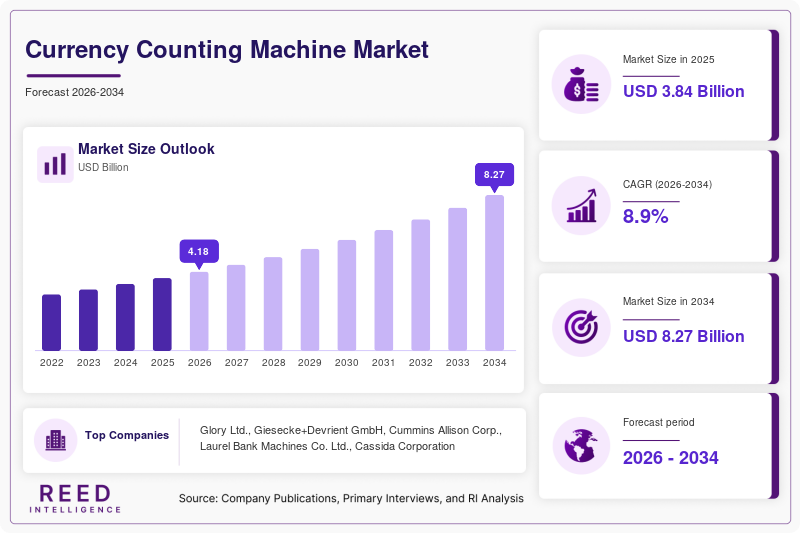
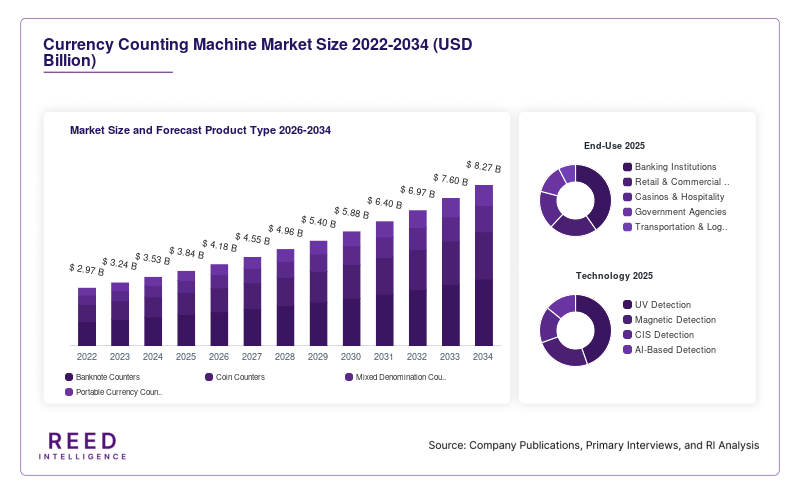
The global Currency Counting Machine Market size was valued at USD 3.84 billion in 2026 and is projected to reach USD 7.62 billion by 2034, expanding at a CAGR of 8.9% during the forecast period from 2026 to 2034. The market continues to gain momentum as financial institutions, retail chains, casinos, and transportation hubs increasingly adopt automated cash management systems to improve counting accuracy, reduce fraud risks, and enhance operational efficiency. Despite the rapid rise of digital payment systems, cash circulation remains significant across emerging and developed economies, particularly in retail, banking, and government sectors, creating sustained demand for advanced currency counting technologies. A major global factor supporting market expansion is the rising emphasis on counterfeit detection and compliance with financial security standards. Governments and central banks are pushing organizations to modernize cash handling infrastructure with UV, MG, IR, and AI-enabled counterfeit verification capabilities, which has accelerated machine replacement cycles and innovation. Increasing labor costs and the need to minimize manual cash processing errors are also encouraging enterprises to deploy high-speed, multifunctional counting systems. Product advancements such as mixed denomination recognition, fitness sorting, serial number tracking, and cloud-connected monitoring are reshaping the competitive environment.
Key Highlights
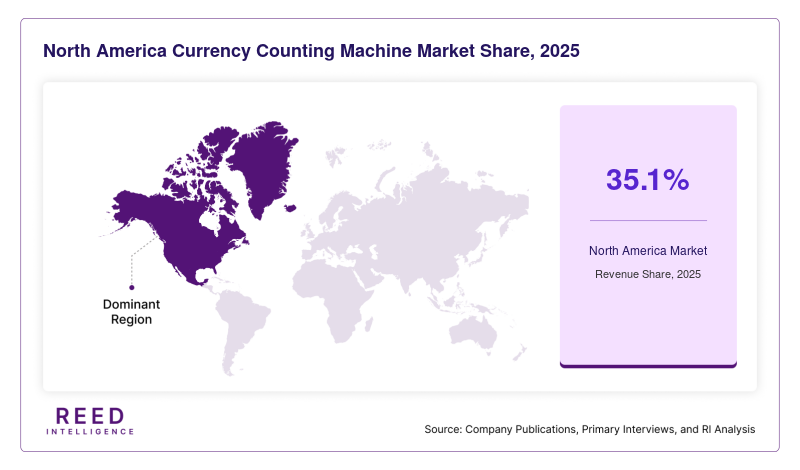
North America dominated the market with a 35.1% share in 2025, while Asia Pacific is expected to grow at the fastest CAGR of 10.8% during 2026–2034.
By product type, banknote counting machines accounted for the largest share of 46.8% in 2024, while mixed denomination counters are projected to grow at a CAGR of 11.6%.
By end-use, banking institutions led with a 39.4% share, whereas retail and commercial businesses are expected to expand at a CAGR of 10.9%.
The United States remained the dominant country, with market values of USD 790 million in 2024 and USD 854 million in 2025.
Market Trends
Integration of AI-Driven Counterfeit Detection and Smart Analytics
Manufacturers are increasingly embedding artificial intelligence, machine learning, and image-processing technologies into currency counting machines to improve counterfeit detection rates and operational intelligence. These advanced systems analyze note texture, dimensions, serial patterns, and security threads with greater precision than conventional UV or magnetic methods. Financial institutions and retail operators are prioritizing machines capable of detecting sophisticated counterfeit attempts while also generating transactional insights. AI-enabled devices are being integrated with enterprise cash management platforms, allowing remote diagnostics, predictive maintenance, and cash flow reporting. This trend is especially prominent in developed markets where compliance and operational transparency are central to banking modernization strategies.
Expansion of Compact and Portable Machines for SMEs
Small and medium-sized enterprises are creating growing demand for portable, cost-efficient currency counting solutions. Compact devices designed for convenience stores, fuel stations, pharmacies, and hospitality businesses are gaining traction because they reduce labor dependency while maintaining reliable counting speed. These machines are increasingly equipped with basic counterfeit verification and user-friendly interfaces, making them practical for non-bank environments. Manufacturers are responding by launching lightweight, lower-cost models that serve decentralized cash points. In emerging economies, where SMEs represent a large share of commercial activity, this segment is contributing significantly to market penetration and supporting broader industry diversification.
Market Drivers
Persistent Cash Usage Across Retail and Informal Economies
Although digital transactions are rising, cash remains a dominant payment method across multiple sectors, especially in developing nations and cash-intensive industries. Retail stores, public transportation systems, gaming establishments, and wholesale markets continue to process high daily cash volumes, requiring accurate and efficient counting systems. Currency counting machines help reduce reconciliation errors, accelerate end-of-day balancing, and improve employee productivity. In countries with substantial informal economies, cash remains the preferred transaction medium, reinforcing long-term equipment demand. This sustained reliance on physical currency supports machine adoption even as payment ecosystems evolve toward hybrid models.
Rising Security Regulations and Counterfeit Prevention Needs
Counterfeit currency circulation remains a major concern for financial institutions and businesses, driving investment in secure counting technologies. Regulatory frameworks in several countries increasingly require businesses handling large cash volumes to implement advanced verification systems. Modern machines equipped with ultraviolet, infrared, magnetic, and CIS scanning technologies help organizations meet compliance standards while minimizing losses from fraudulent notes. Banking modernization initiatives and central bank currency redesign programs are further encouraging upgrades to compatible machines. This security-focused environment is creating a robust replacement market for outdated systems lacking next-generation counterfeit detection capabilities.
Market Restraint
Accelerating Digital Payment Adoption and Reduced Cash Dependency
The growing penetration of digital wallets, real-time payment systems, QR-based transactions, and contactless banking is gradually reducing cash transaction volumes in several urban and developed markets. This structural shift presents a challenge for the Currency Counting Machine Market, particularly in countries where governments actively promote cashless economies through incentives and infrastructure development. Retail chains and financial institutions in highly digitized markets may reduce capital expenditure on large-scale cash handling equipment as transaction patterns evolve. For example, Nordic countries and parts of East Asia are experiencing measurable declines in branch-level cash processing needs. This trend may constrain demand for traditional high-capacity machines, especially in mature economies. Manufacturers must therefore diversify into hybrid cash automation systems or value-added solutions such as note authentication and cash logistics integration to remain competitive amid changing payment preferences.
Market Opportunities
Growth Potential in Emerging Banking Infrastructure
Emerging economies across Asia, Africa, and Latin America present substantial opportunities due to expanding banking networks, ATM deployment, and retail formalization. Governments promoting financial inclusion are increasing the number of banking touchpoints, branch offices, and microfinance institutions, all of which require efficient cash management tools. Currency counting machines can support these institutions by reducing operational inefficiencies and improving trust in cash processing. Rising urbanization and organized retail expansion further broaden demand. As these regions continue modernizing financial ecosystems, manufacturers offering affordable, durable, and region-specific models are positioned to capture significant untapped revenue.
Demand for Integrated Cash Management Ecosystems
Businesses are increasingly seeking end-to-end cash automation solutions rather than standalone counting machines. This creates opportunity for manufacturers to develop integrated systems combining counting, sorting, counterfeit detection, deposit reconciliation, and cloud reporting. Retail chains, banks, and large hospitality operators benefit from centralized oversight and data transparency, which can optimize liquidity planning and reduce shrinkage. Subscription-based software integration and IoT connectivity also create recurring revenue streams beyond hardware sales. As enterprise digitalization expands, vendors capable of transforming counting machines into connected cash intelligence platforms may achieve stronger market differentiation.
Segmental Analysis
By Product Type
Banknote counting machines held the dominant market share of 46.8% in 2024 due to widespread use across banks, casinos, and commercial enterprises. These machines remain foundational because of their speed, reliability, and ability to process large note volumes efficiently. Standard models with UV and MG counterfeit detection remain popular among cost-conscious institutions, while premium variants support batch sorting and denomination recognition. Their broad accessibility across developed and emerging markets has maintained segment leadership. The continued need for high-volume note counting in sectors with heavy cash dependency reinforces this category’s relevance.
Mixed denomination counters are projected to witness the fastest CAGR of 11.6% during 2026–2034. Their growth is fueled by increasing demand for machines capable of automatically identifying and sorting multiple note values simultaneously, significantly reducing labor time. Retail chains, central banks, and large hospitality operators increasingly favor these systems for operational speed and reduced reconciliation complexity. Technological advancements such as CIS scanning and AI verification are further strengthening segment adoption.
By End-Use
Banking institutions accounted for the largest share of 39.4% in 2024, supported by continuous branch operations, vault cash management, and compliance-focused processing requirements. Banks require advanced currency counting systems to manage deposits, withdrawals, ATM replenishment, and counterfeit verification. Centralized cash handling, note fitness sorting, and reporting capabilities are particularly important for financial institutions. Branch modernization programs and replacement cycles continue sustaining this segment.
Retail and commercial businesses are expected to grow at the fastest CAGR of 10.9% through 2034. Supermarkets, fuel stations, malls, and hospitality venues are increasingly adopting currency counting machines to streamline daily cash reconciliation and minimize shrinkage. As labor efficiency becomes a priority, compact and mid-range machines designed for decentralized commercial environments are becoming more attractive.
By Technology
UV and magnetic detection technology dominated the market in 2024 with a 42.7% share due to affordability, broad adoption, and reliable counterfeit screening for conventional applications. These technologies are especially prevalent in SMEs and regional banking institutions where budget sensitivity remains high. Their simplicity and proven utility have sustained widespread market presence.
CIS and AI-based detection systems are forecast to register the fastest CAGR of 12.1% during the study period. These systems offer enhanced counterfeit recognition, serial number scanning, and mixed denomination sorting. As regulatory scrutiny rises and counterfeit threats evolve, organizations increasingly prioritize high-precision systems that improve operational intelligence and compliance readiness.
Regional Analysis
North America
North America accounted for 35.1% of the global Currency Counting Machine Market share in 2025 and is expected to maintain stable expansion at a CAGR of 7.8% through 2034. High banking infrastructure maturity, organized retail concentration, and strong adoption of advanced counterfeit detection technologies continue supporting regional demand. Financial institutions across the U.S. and Canada prioritize machine upgrades for compliance, automation, and labor optimization.
The United States leads the region due to its extensive banking network and large-scale retail cash operations. One unique growth factor is the replacement demand generated by advanced counterfeit prevention regulations and federal currency redesign updates. Casinos, transportation hubs, and hospitality sectors also contribute significantly to domestic equipment purchases.
Europe
Europe represented 24.3% of the global market in 2025 and is projected to grow at a CAGR of 7.4% during the forecast period. While digital payments are strong, cash remains relevant across retail, tourism, and border economies. Demand is largely centered on secure note authentication, euro denomination compatibility, and compliance with strict anti-counterfeit standards.
Germany remains the dominant European market due to its sizable cash-oriented consumer culture and robust banking ecosystem. A unique regional growth factor is widespread SME demand for compact counting devices, particularly among retail and logistics operators seeking efficient back-office cash processing solutions while balancing operational costs.
Asia Pacific
Asia Pacific held 22.8% market share in 2025 and is forecast to register the fastest CAGR of 10.8% from 2026 to 2034. Expanding commercial infrastructure, banking penetration, and high cash circulation in populous economies are key growth contributors. Organized retail and transportation sectors are particularly influential in regional equipment adoption.
China dominates the region due to its large commercial transaction base and widespread financial modernization initiatives. A unique growth factor is the expansion of regional manufacturing capabilities, which lowers production costs and enables domestic availability of competitively priced machines for banks and SMEs.
Middle East & Africa
Middle East & Africa captured 9.6% of the global market in 2025 and is projected to grow at a CAGR of 8.7% through 2034. Cash remains essential in many regional economies, particularly in trade, tourism, and informal sectors. Banking infrastructure expansion and modernization projects are increasing demand for reliable cash handling systems.
The United Arab Emirates leads the region due to high tourism cash flow and sophisticated banking operations. A distinctive growth factor is airport, hospitality, and foreign exchange center demand for multi-currency counting systems that support high-volume international cash transactions.
Latin America
Latin America accounted for 8.2% market share in 2025 and is expected to expand at a CAGR of 8.3% over the forecast period. Regional demand is supported by persistent cash reliance, expanding retail formalization, and banking system upgrades. Security concerns also drive adoption of counterfeit-resistant machines.
Brazil remains the dominant country because of its large population, extensive retail activity, and broad banking presence. A unique growth factor is the increasing use of counting machines by cash logistics providers handling secure transportation and reconciliation services for financial and commercial clients.
Competitive Landscape
The competitive landscape is moderately fragmented, with established global manufacturers and regional suppliers competing through innovation, pricing, and product diversification. Glory Ltd. remains a market leader due to its broad banking relationships, advanced technology portfolio, and international service network. The company recently expanded its AI-integrated mixed denomination product line for financial institutions and commercial enterprises. Giesecke+Devrient, Cummins Allison, Laurel Bank Machines, and Cassida Corporation also hold significant positions through counterfeit detection expertise and specialized regional offerings. Competitive strategies increasingly focus on IoT integration, software connectivity, and emerging market expansion. Partnerships with financial institutions and retail chains remain central to revenue growth.
Key Players
- Glory Ltd.
- Giesecke+Devrient GmbH
- Cummins Allison Corp.
- Laurel Bank Machines Co. Ltd.
- Cassida Corporation
- Royal Sovereign International Inc.
- Hitachi-Omron Terminal Solutions
- Toshiba Infrastructure Systems
- De La Rue plc
- Semacon Business Machines
- Billcon Corporation
- Kisan Electronics Co. Ltd.
- Julong Co. Ltd.
- Bcash Electronics
- Konyee Technology
Recent Developments
- Glory Ltd. launched an AI-enhanced currency sorter with cloud monitoring integration in 2025.
- Giesecke+Devrient expanded its smart cash automation portfolio for retail banking clients in Europe.
- Cassida introduced compact SME-focused portable currency counters targeting emerging Asian markets.
Currency Counting Machine Market Segments
Product Type
- Banknote Counters
- Coin Counters
- Mixed Denomination Counters
- Portable Currency Counters
End-Use
- Banking Institutions
- Retail & Commercial Businesses
- Casinos & Hospitality
- Government Agencies
- Transportation & Logistics
Technology
- UV Detection
- Magnetic Detection
- CIS Detection
- AI-Based Detection
By Region
- North America
- Europe
- APAC
- Middle East and Africa
- LATAM