Customs Audit Market Size, Share & Demand Report By Component (Software Solutions, Services, Cloud-Based Platforms), By Application (Import Audit, Export Audit, Post-Clearance Audit), By End-Use Industry (Manufacturing, Retail & E-commerce, Logistics & Transportation, Healthcare, Others), By Region & Segment Forecasts, 2026–2034
USD 3950
Market Overview
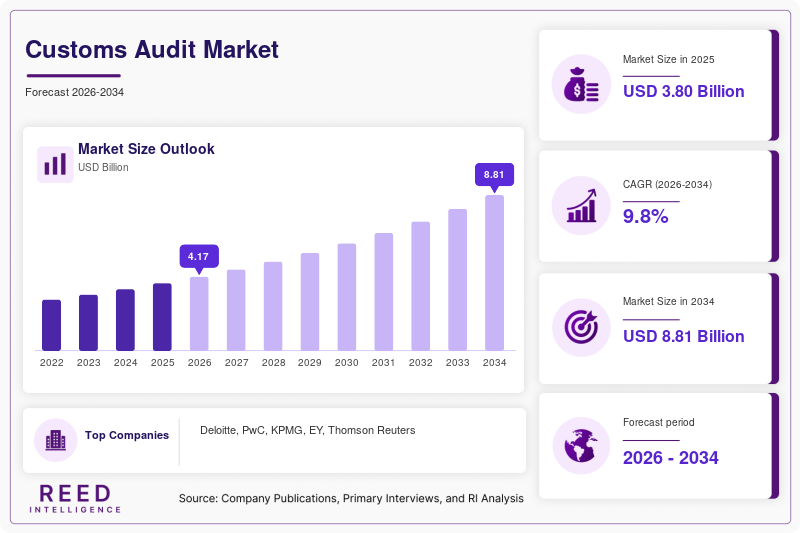
The global Customs Audit Market was valued at approximately USD 3.8 billion in 2026 and is projected to reach USD 8.1 billion by 2034, expanding at a CAGR of 9.8% during the forecast period (2026–2034). The market reflects steady expansion driven by increasing global trade complexity and stricter cross-border compliance requirements. Governments and regulatory bodies are strengthening audit mechanisms to ensure adherence to customs laws, tariff classifications, and trade agreements, which is creating sustained demand for advanced audit solutions.
A key global factor supporting market growth is the rapid digitalization of international trade processes. Automated customs systems, electronic documentation, and real-time trade data exchange have increased transparency but also raised the need for systematic audit frameworks. Organizations are adopting audit software and consulting services to manage risks, reduce penalties, and ensure compliance with evolving trade regulations. Additionally, the rise in free trade agreements and cross-border e-commerce has increased audit frequency and scope.
Key Highlights
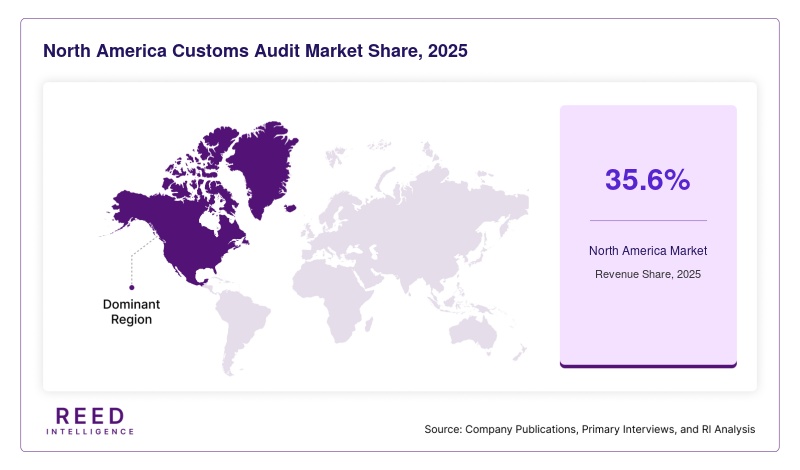
- North America dominated the market with a 35.6% share in 2025.
- Asia Pacific is expected to grow at the fastest CAGR of 11.4% during 2026–2034.
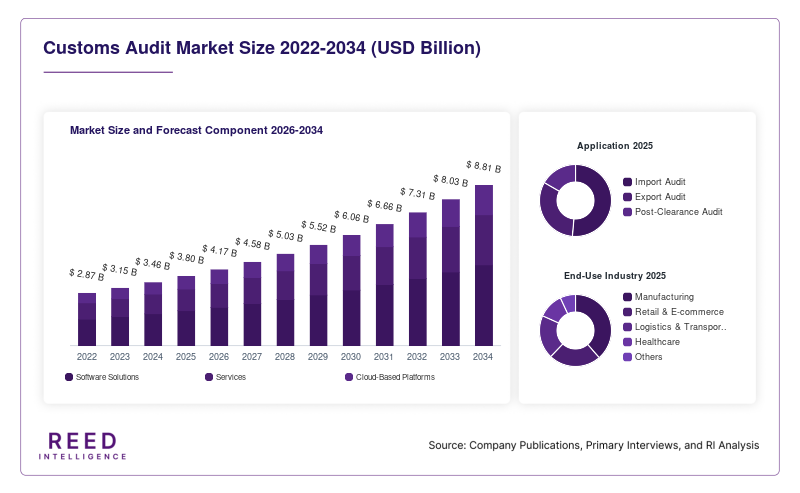
- By component, software solutions accounted for the largest share of 42.8%.
- while cloud-based platforms are projected to grow at a CAGR of 12.6%.
- By application, import audit services led with a 46.3% share, whereas post-clearance audits are expected to expand at a CAGR of 11.9%.
- The United States remained the dominant country, with market values of USD 620 million in 2024 and USD 680 million in 2025.
Market Trends
Integration of AI and Predictive Analytics in Audit Systems
The adoption of artificial intelligence and predictive analytics is transforming the customs audit landscape. Organizations are leveraging machine learning algorithms to detect anomalies in trade data, identify non-compliance risks, and automate audit processes. These technologies enable auditors to analyze large volumes of transactional data in real time, improving accuracy and reducing manual effort. Predictive analytics also helps forecast potential compliance issues before they occur, allowing companies to take preventive measures. As trade volumes continue to rise, AI-powered audit solutions are becoming essential for maintaining efficiency and compliance. This trend is particularly prominent among multinational corporations and logistics providers that handle complex cross-border operations and require scalable, intelligent audit systems.
Shift Toward Cloud-Based Audit Platforms
Cloud-based customs audit platforms are gaining traction due to their flexibility, scalability, and cost efficiency. Organizations are increasingly migrating from traditional on-premise systems to cloud environments to streamline audit processes and enable remote access. Cloud solutions support real-time data sharing, collaboration among stakeholders, and integration with enterprise resource planning systems. This trend is also driven by the need for continuous compliance monitoring rather than periodic audits. Small and medium-sized enterprises are adopting cloud-based audit tools to access advanced capabilities without significant upfront investment. The shift to cloud platforms is expected to accelerate as regulatory requirements become more dynamic and organizations seek agile solutions to manage compliance risks effectively.
Market Drivers
Increasing Complexity of Global Trade Regulations
The growing complexity of international trade regulations is a primary driver of the customs audit market. Governments worldwide are implementing stringent compliance frameworks to monitor imports and exports, enforce tariff classifications, and prevent fraud. Frequent updates to trade policies, sanctions, and free trade agreements require businesses to continuously adapt their compliance strategies. This has increased the demand for specialized audit services and software solutions that can ensure adherence to regulatory requirements. Companies operating across multiple jurisdictions face heightened risks of non-compliance, making customs audits an essential component of their operations. As global trade continues to expand, the need for comprehensive audit mechanisms is expected to rise significantly.
Growth of Cross-Border E-commerce and Trade Volumes
The rapid expansion of cross-border e-commerce has significantly increased trade volumes, driving demand for customs audit services. Online marketplaces and digital trade platforms have enabled businesses to reach global customers, resulting in a higher number of shipments and transactions. This surge in trade activity has heightened the risk of errors in documentation, classification, and valuation, necessitating robust audit processes. Customs authorities are also increasing scrutiny to ensure accurate duty payments and compliance with regulations. As a result, companies are investing in audit solutions to manage risks and maintain operational efficiency. The continued growth of e-commerce is expected to sustain demand for customs audit services over the forecast period.
Market Restraint
High Implementation Costs and Integration Challenges
One of the major restraints in the customs audit market is the high cost associated with implementing advanced audit solutions. Organizations must invest in software, infrastructure, and skilled personnel to effectively deploy and manage audit systems. For small and medium-sized enterprises, these costs can be a significant barrier, limiting adoption. Additionally, integrating audit solutions with existing enterprise systems such as ERP and supply chain management platforms can be complex and time-consuming. Data compatibility issues and the need for system customization further increase implementation challenges. These factors can delay deployment and reduce the overall return on investment. Moreover, organizations may face resistance to change from employees accustomed to traditional audit processes. While technological advancements are improving accessibility, cost and integration challenges continue to hinder market growth, particularly in developing regions where budget constraints are more pronounced.
Market Opportunities
Expansion of Trade Compliance Outsourcing Services
The increasing complexity of customs regulations has created significant opportunities for outsourcing trade compliance and audit services. Many organizations are opting to partner with specialized service providers to manage their audit requirements. Outsourcing allows companies to access expert knowledge, reduce operational costs, and focus on core business activities. Service providers offer end-to-end solutions, including risk assessment, documentation review, and regulatory updates. This trend is particularly beneficial for small and medium-sized enterprises that lack in-house expertise. As global trade continues to evolve, the demand for outsourced audit services is expected to grow, providing new revenue streams for service providers and expanding the overall market.
Adoption of Blockchain for Transparent Audit Trails
Blockchain technology presents a promising opportunity for enhancing transparency and efficiency in customs audits. By creating immutable and tamper-proof records of transactions, blockchain can improve the accuracy and reliability of audit processes. It enables real-time tracking of goods, documentation, and compliance status, reducing the risk of fraud and errors. Governments and industry stakeholders are exploring blockchain-based solutions to streamline customs procedures and enhance trust among participants. The adoption of this technology is expected to accelerate as organizations seek more secure and transparent audit mechanisms. This presents a significant growth opportunity for technology providers and audit solution vendors in the customs audit market.
Segmental Analysis
By Component
Software solutions dominated the segment, accounting for 42.8% of the market share in 2024. These solutions enable organizations to automate audit processes, manage compliance data, and generate detailed reports. The increasing complexity of trade regulations has driven the adoption of software tools that can handle large volumes of data and provide real-time insights. Enterprises prefer software solutions due to their ability to integrate with existing systems and improve operational efficiency. The demand for customizable and scalable solutions is also contributing to segment growth.
Cloud-based platforms are the fastest-growing subsegment, with a CAGR of 12.6% during the forecast period. These platforms offer flexibility, scalability, and cost efficiency, making them attractive to organizations of all sizes. The ability to access audit data remotely and collaborate in real time is a key growth factor. Cloud solutions also support continuous compliance monitoring, reducing the need for periodic audits. As organizations increasingly adopt digital transformation strategies, the demand for cloud-based audit solutions is expected to rise significantly.
By Application
Import audit services held the largest share of 46.3% in 2024, driven by the high volume of import transactions and strict regulatory requirements. Organizations focus on import audits to ensure accurate classification, valuation, and duty payments. The increasing scrutiny by customs authorities has made import audits a critical component of compliance strategies. Businesses are investing in audit solutions to minimize risks and avoid penalties. The growing complexity of global supply chains is further driving demand for import audit services.
Post-clearance audits are the fastest-growing subsegment, with a CAGR of 11.9%. These audits are conducted after goods have cleared customs, allowing authorities to verify compliance and identify discrepancies. The shift toward risk-based auditing is a key growth factor, as it enables more targeted and efficient audits. Organizations are adopting post-clearance audit solutions to ensure ongoing compliance and improve transparency. The increasing use of digital tools and data analytics is enhancing the effectiveness of these audits.
By End-Use Industry
The manufacturing sector dominated the segment, accounting for 38.7% of the market share in 2024. Manufacturers engage in extensive cross-border trade, making compliance with customs regulations essential. The complexity of supply chains and the need for accurate documentation drive the demand for audit solutions. Companies in this sector use audit tools to manage risks, ensure compliance, and optimize operations. The increasing adoption of digital technologies in manufacturing is further supporting segment growth.
The e-commerce sector is the fastest-growing subsegment, with a CAGR of 12.2%. The rapid growth of online trade has increased the volume of cross-border transactions, creating new challenges for compliance. E-commerce companies require efficient audit solutions to manage large volumes of shipments and ensure accurate documentation. The need for real-time monitoring and automated processes is a key growth factor. As e-commerce continues to expand globally, the demand for audit solutions in this sector is expected to rise significantly.
Regional Analysis
North America
North America accounted for a dominant share of 35.6% in 2025 and is expected to maintain steady growth with a CAGR of 8.9% during the forecast period. The region’s leadership is attributed to advanced trade infrastructure, stringent regulatory frameworks, and high adoption of digital audit solutions. Organizations in the region prioritize compliance due to strict enforcement by customs authorities. The presence of established technology providers and strong investment in automation further supports market growth. Increasing trade activities and the need for efficient audit mechanisms continue to drive demand.
The United States remains the dominant country in this region, supported by a highly developed trade ecosystem and advanced regulatory systems. A unique growth factor is the widespread adoption of AI-driven compliance tools among large enterprises. These tools enhance audit accuracy and reduce operational risks. Additionally, government initiatives to modernize customs processes and improve transparency are contributing to market expansion. The focus on digital transformation and data-driven decision-making is expected to sustain growth in the region.
Europe
Europe held a significant market share of 27.4% in 2025 and is projected to grow at a CAGR of 9.2% through 2034. The region’s growth is driven by complex regulatory frameworks and strong emphasis on trade compliance. The European Union’s harmonized customs regulations require businesses to maintain high levels of accuracy in documentation and reporting. This has increased the demand for audit solutions across industries. The adoption of digital tools and cloud-based platforms is further enhancing audit efficiency and compliance.
Germany leads the European market, supported by its strong export-oriented economy and advanced manufacturing sector. A unique growth factor is the integration of audit systems with supply chain management platforms, enabling real-time compliance monitoring. This integration helps organizations streamline operations and reduce errors. The increasing focus on sustainability and ethical sourcing is also influencing audit practices, driving demand for comprehensive compliance solutions across the region.
Asia Pacific
Asia Pacific is the fastest-growing region, with a CAGR of 11.4% during the forecast period, and held a 21.3% share in 2025. Rapid industrialization, expanding trade activities, and increasing regulatory enforcement are key factors driving growth. Countries in the region are modernizing their customs systems and adopting digital technologies to improve efficiency. The rise of cross-border e-commerce has further increased the need for robust audit mechanisms. The region’s diverse regulatory environment creates opportunities for audit solution providers.
China dominates the Asia Pacific market due to its large trade volume and strong manufacturing base. A unique growth factor is the government’s investment in digital customs platforms and smart trade initiatives. These initiatives aim to enhance transparency and streamline processes. The increasing adoption of automated audit systems among enterprises is also contributing to market growth. As trade volumes continue to rise, the demand for efficient audit solutions is expected to increase significantly.
Middle East & Africa
The Middle East & Africa region accounted for 8.1% of the market share in 2025 and is expected to grow at a CAGR of 9.6%. The region’s growth is supported by increasing trade activities and efforts to diversify economies beyond oil dependence. Governments are investing in modernizing customs infrastructure and implementing digital solutions to improve compliance. The adoption of audit systems is gradually increasing as businesses recognize the importance of regulatory adherence.
The United Arab Emirates leads the region, driven by its strategic position as a global trade hub. A unique growth factor is the implementation of advanced customs technologies in free trade zones. These technologies enhance efficiency and reduce processing time. The focus on improving trade facilitation and attracting foreign investment is further driving the adoption of audit solutions. As the region continues to develop its trade infrastructure, market growth is expected to accelerate.
Latin America
Latin America held a market share of 7.6% in 2025 and is projected to grow at a CAGR of 9.1% during the forecast period. The region’s growth is influenced by increasing trade activities and regulatory reforms aimed at improving compliance. Governments are strengthening customs enforcement to reduce fraud and increase revenue. The adoption of digital audit solutions is gradually increasing, supported by technological advancements and growing awareness.
Brazil is the dominant country in this region, supported by its large economy and expanding trade activities. A unique growth factor is the government’s focus on reducing customs clearance times through digital transformation initiatives. These initiatives are encouraging businesses to adopt audit solutions to ensure compliance. The growing presence of international trade agreements is also driving demand for efficient audit mechanisms. As the region continues to modernize its trade infrastructure, market growth is expected to remain steady.
Competitive Landscape
The customs audit market is moderately fragmented, with several global and regional players competing to enhance their market presence. Leading companies focus on technological innovation, strategic partnerships, and service expansion to gain a competitive edge. The market leader is Deloitte, known for its comprehensive audit and compliance solutions and strong global presence. The company continues to invest in digital technologies and AI-driven tools to improve audit efficiency.
Other prominent players include PwC, KPMG, EY, and Thomson Reuters. These companies offer a wide range of audit services and software solutions tailored to various industries. Recent developments include the launch of advanced analytics platforms and cloud-based audit tools to address evolving regulatory requirements. Companies are also expanding their service portfolios to include consulting and outsourcing solutions. The focus on innovation and customer-centric solutions is expected to drive competition in the market.
Key Players List
- Deloitte
- PwC
- KPMG
- EY
- Thomson Reuters
- SAP SE
- Oracle Corporation
- Descartes Systems Group
- Amber Road (E2open)
- Livingston International
- AEB SE
- MIC Customs Solutions
- CargoWise (WiseTech Global)
- Integration Point (Thomson Reuters)
- Expeditors International
Recent Developments
- In 2025, a leading audit firm introduced an AI-powered customs audit platform to enhance risk detection and automate compliance processes.
- In 2024, a global technology provider launched a cloud-based audit solution integrated with supply chain management systems.
- In 2025, a major consulting company expanded its customs audit services to include blockchain-based compliance tracking solutions
Customs Audit Market Segments
Component
- Software Solutions
- Services
- Cloud-Based Platforms
Application
- Import Audit
- Export Audit
- Post-Clearance Audit
End-Use Industry
- Manufacturing
- Retail & E-commerce
- Logistics & Transportation
- Healthcare
- Others
By Region
- North America
- Europe
- APAC
- Middle East and Africa
- LATAM