Cut Resistant Gloves Market Size, Share & Demand Report By Material (HPPE, Kevlar, Stainless Steel Mesh, Others), By Product Type (Knitted Gloves, Cut and Sewn Gloves, Dipped Gloves), By Application (Industrial Manufacturing, Food Processing, Construction, Healthcare), By Distribution Channel (Online Retail, Industrial Distributors, Specialty Stores, Direct Sales) By Region & Segment Forecasts, 2026–2034
USD 3950
Market Overview
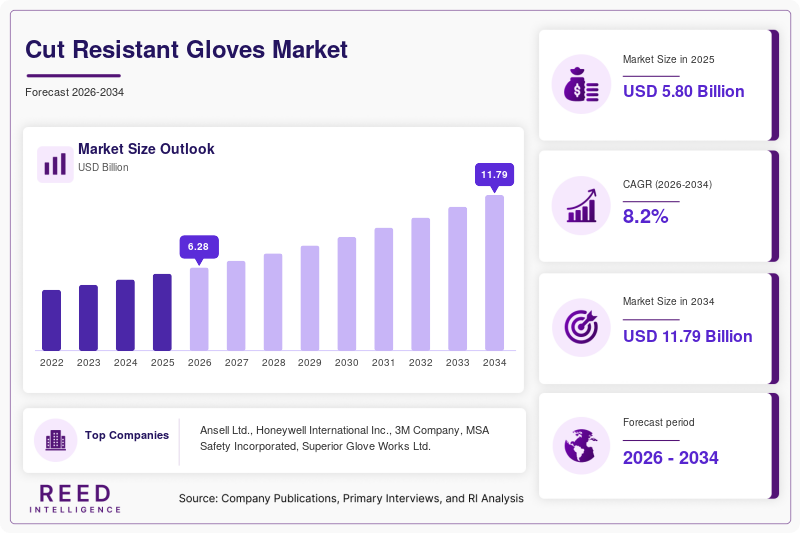
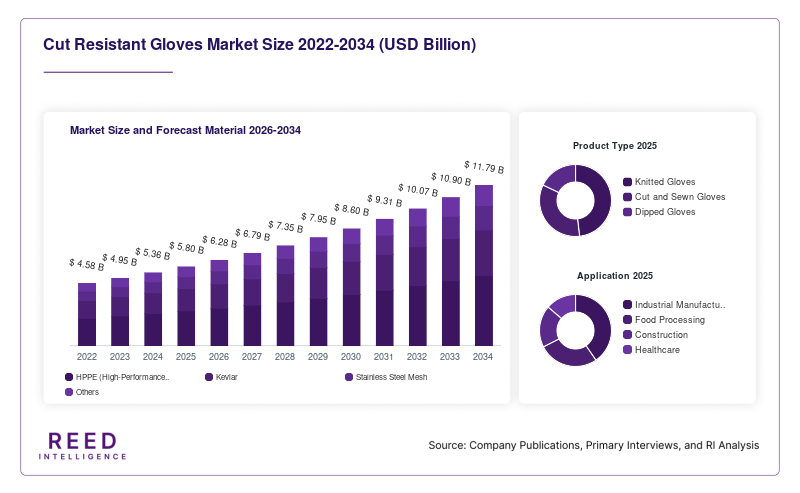
The Cut Resistant Gloves Market was valued at approximately USD 5.8 billion in 2026 and is projected to reach USD 10.9 billion by 2034, expanding at a CAGR of 8.2% during the forecast period (2026–2034). The market has witnessed steady expansion due to the increasing emphasis on workplace safety standards across manufacturing, construction, and logistics sectors worldwide.
A key global factor supporting market growth is the rising enforcement of occupational safety regulations across developed and emerging economies. Governments and regulatory bodies have implemented stricter workplace safety norms, particularly in industries with high injury risks such as metal fabrication and automotive manufacturing. This has significantly increased the adoption of personal protective equipment (PPE), including cut resistant gloves.
Key Highlights
- North America dominated the market with a share of 34.6% in 2025, while Asia Pacific is projected to grow at the fastest CAGR of 9.6%.
- By material, HPPE (High-Performance Polyethylene) held the leading share of 38.2% in 2025, whereas Kevlar-based gloves are expected to grow at a CAGR of 9.1%.
- By application, industrial manufacturing accounted for the largest share of 41.5% in 2025, while food processing is anticipated to expand at a CAGR of 8.9%.
- The United States remained the dominant country, with market values of USD 1.45 billion in 2024 and USD 1.58 billion in 2025.
Market Trends
Integration of Advanced Materials and Coatings
Manufacturers are increasingly incorporating advanced materials such as engineered yarns, glass fiber blends, and high-performance polymers to improve cut resistance while maintaining flexibility and comfort. Coating technologies like nitrile and polyurethane are being enhanced to provide better grip and durability, particularly in oily or wet conditions.
Rising Adoption of Ergonomic and Lightweight Designs
End users are demanding gloves that offer both protection and comfort for prolonged use. This has led to the development of lightweight, breathable gloves with ergonomic fits. These designs reduce hand fatigue and improve worker productivity, especially in sectors requiring precision handling.
Market Drivers
Stringent Workplace Safety Regulations
The implementation of strict occupational health and safety laws has been a primary driver of the Cut Resistant Gloves Market. Regulatory authorities have mandated the use of protective gloves in hazardous environments, compelling industries to adopt high-quality cut resistant solutions.
Expansion of Industrial and Construction Activities
Rapid industrialization and infrastructure development across emerging economies have increased demand for protective gear. Construction, automotive, and metalworking industries require cut resistant gloves to prevent injuries during handling of sharp tools and materials.
Market Restraint
High Cost of Advanced Materials
Premium materials such as Kevlar and engineered fibers increase the overall cost of cut resistant gloves. This can limit adoption among small and medium enterprises, particularly in cost-sensitive regions.
Market Opportunities
Growth in E-commerce and Logistics Sector
The expansion of the global logistics and warehousing sector is creating new opportunities for the Cut Resistant Gloves Market. Workers involved in packaging, sorting, and handling goods require protective gloves to reduce injury risks.
Rising Demand in Food Processing Industry
The food processing sector is increasingly adopting cut resistant gloves to ensure worker safety during slicing and cutting operations. The demand is further supported by hygiene regulations and the need for contamination-free processing.
Segmental Analysis
By Material
The HPPE (High-Performance Polyethylene) segment held the dominant share of 38.2% in 2025, owing to its superior cut resistance, lightweight nature, and durability. These gloves are widely used in industrial environments due to their balance of safety and comfort.
The Kevlar segment is expected to grow at the fastest CAGR of 9.1% during the forecast period. Its high tensile strength and heat resistance make it suitable for applications involving extreme conditions, particularly in automotive and metalworking industries.
By Product Type
Knitted gloves dominated the market with a share of 46.7% in 2025, as they offer flexibility, breathability, and comfort for prolonged usage. These gloves are commonly used in assembly and handling operations.
Cut and sewn gloves are anticipated to grow at a CAGR of 8.7%, driven by their enhanced durability and suitability for heavy-duty applications. Their structured design provides better protection in high-risk environments.
By Application
The industrial manufacturing segment accounted for the largest share of 41.5% in 2025, supported by the widespread use of gloves in metal fabrication, machinery handling, and assembly lines.
The food processing segment is projected to grow at a CAGR of 8.9%, fueled by increasing hygiene standards and the need to prevent injuries during cutting and slicing operations.
By End-Use Industry
The automotive industry held the dominant share of 29.3% in 2025, driven by the need for worker protection during assembly and maintenance processes.
The logistics and warehousing segment is expected to grow at a CAGR of 9.4%, supported by the rapid expansion of e-commerce and supply chain operations.
By Distribution Channel
The offline segment dominated with a share of 63.8% in 2025, as industrial buyers prefer direct procurement from distributors and suppliers for bulk purchases.
The online segment is projected to grow at a CAGR of 10.2%, driven by increasing digitalization and the convenience of e-commerce platforms offering a wide range of products.
Regional Analysis
North America
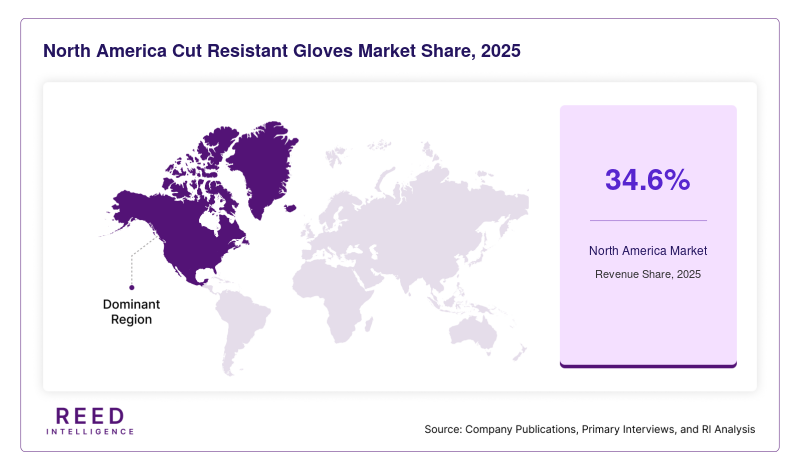
North America accounted for 34.6% of the market share in 2025 and will grow at a CAGR of 7.5% during 2026–2034. The United States dominated the region due to strong enforcement of safety regulations and high awareness among workers. The presence of established industrial sectors and consistent investments in worker safety programs supported market growth.
Europe
Europe held a 27.8% share in 2025 and is expected to grow at a CAGR of 7.9%. Germany emerged as the dominant country, driven by its robust manufacturing base and stringent labor safety standards. The region also benefits from high adoption of advanced PPE technologies.
Asia Pacific
Asia Pacific represented 23.5% of the market share in 2025 and is projected to grow at the fastest CAGR of 9.6%. China led the region due to its expanding industrial sector and increasing focus on workplace safety. Rapid urbanization and infrastructure development are key growth factors.
Middle East & Africa
The Middle East & Africa held a 7.2% share in 2025 and is expected to grow at a CAGR of 6.8%. The United Arab Emirates dominated the region, supported by ongoing construction projects and rising safety awareness in industrial operations.
Latin America
Latin America accounted for 6.9% of the market share in 2025 and will grow at a CAGR of 6.5%. Brazil was the leading country, driven by growth in manufacturing and agricultural sectors where protective gloves are increasingly required.
Competitive Landscape
The Cut Resistant Gloves Market is moderately fragmented, with key players focusing on product innovation, material advancements, and strategic partnerships. Leading companies are investing in research and development to enhance glove durability, flexibility, and safety standards.
Ansell Ltd. is recognized as a market leader, leveraging its strong product portfolio and global distribution network. The company recently introduced a new line of ultra-lightweight cut resistant gloves designed for precision handling applications. Honeywell International Inc. focuses on integrating advanced fiber technologies to improve product performance. 3M Company emphasizes innovation in protective materials and coatings. MSA Safety Incorporated continues to expand its PPE offerings, while Superior Glove Works Ltd. specializes in customized safety solutions.
These companies are strengthening their market presence through mergers, acquisitions, and expansion into emerging markets, contributing to overall market growth.
Key Players List
- Ansell Ltd.
- Honeywell International Inc.
- 3M Company
- MSA Safety Incorporated
- Superior Glove Works Ltd.
- Showa Group
- ATG Intelligent Glove Solutions
- Uvex Group
- Towa Corporation
- HexArmor LLC
- Lakeland Industries, Inc.
- Wells Lamont Industrial
- Ringers Gloves
- PIP Global (Protective Industrial Products)
- Dipped Products PLC
Recent Developments
- In 2025, Ansell Ltd. launched a new series of eco-friendly cut resistant gloves made from recycled fibers.
- Honeywell International Inc. expanded its manufacturing capacity in Asia to meet rising regional demand.
- 3M Company introduced enhanced coating technology for improved grip performance.
- Superior Glove Works Ltd. developed gloves with touchscreen compatibility for industrial use.
- Uvex Group invested in automation to increase production efficiency and product consistency.
Cut Resistant Gloves Market Segments
Material
- HPPE (High-Performance Polyethylene)
- Kevlar
- Stainless Steel Mesh
- Others
Product Type
- Knitted Gloves
- Cut and Sewn Gloves
- Dipped Gloves
Application
- Industrial Manufacturing
- Food Processing
- Construction
- Healthcare
Distribution Channel
- Online Retail
- Industrial Distributors
- Specialty Safety Stores
- Direct Sales/B2B Procurement
By Region
- North America
- Europe
- APAC
- Middle East and Africa
- LATAM