Cutting Boards Market Size, Share & Demand Report By Material (Wooden Cutting Boards, Bamboo Cutting Boards), By Product Type (Standard Cutting Boards, Flexible Cutting Boards), By Application (Residential Kitchens, Commercial Foodservice, Hospitality Industry, Catering Services), By Distribution Channel (Offline Retail, Online Retail, Specialty Kitchen Stores) By Region & Segment Forecasts, 2026–2034
USD 3950
Market Overview
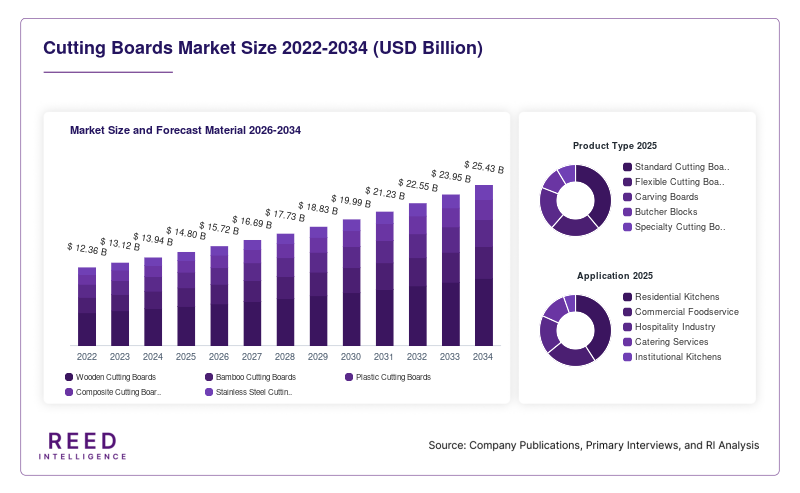
The global Cutting Boards Market was valued at USD 14.8 billion in 2026 and is projected to reach USD 23.9 billion by 2034, expanding at a CAGR of 6.2% during the forecast period from 2026 to 2034. The market growth has been supported by the increasing popularity of home cooking, rising demand for kitchen accessories, and expanding foodservice operations worldwide. Consumers are investing in premium kitchen products that offer durability, hygiene, and aesthetic appeal, which has significantly strengthened demand for cutting boards across residential and commercial applications.
The growing influence of culinary culture through social media platforms, cooking shows, and digital recipe content has encouraged consumers to upgrade kitchen tools and cookware. Cutting boards have evolved from basic kitchen utilities into multifunctional kitchen accessories available in a wide range of materials, styles, and designs. Manufacturers are increasingly introducing antimicrobial surfaces, eco-friendly materials, and customizable designs to meet changing consumer preferences.
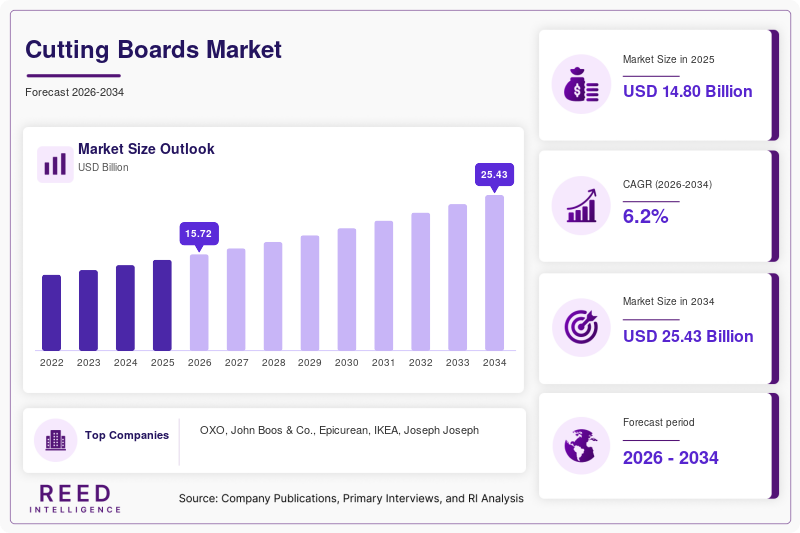
Key Highlights
- North America accounted for 35.1% of the global Cutting Boards Market share in 2025, while Asia Pacific is projected to register the fastest CAGR of 7.4% during the forecast period.
- By material, wooden cutting boards held the leading share of 38.6% in 2025, while bamboo cutting boards are expected to witness the fastest CAGR of 8.1% through 2034.
- By product type, standard cutting boards dominated with 44.7% market share in 2025, whereas flexible cutting boards are anticipated to grow at a CAGR of 7.9%.
- By application, residential applications represented 61.3% of the market in 2025, while commercial foodservice applications are projected to expand at a CAGR of 7.6%.
- By distribution channel, offline retail remained the dominant segment with 58.2% share in 2025, while online retail is expected to grow at a CAGR of 8.4%.
- The United States Cutting Boards Market was valued at USD 3.46 billion in 2024 and reached USD 3.69 billion in 2025 due to increasing consumer spending on premium kitchenware products.
Market Trends
Growing Preference for Sustainable Kitchen Products
The Cutting Boards Market is witnessing increased demand for environmentally friendly kitchen accessories. Consumers are increasingly choosing bamboo, recycled wood, and biodegradable composite cutting boards as part of broader sustainable lifestyle preferences. Manufacturers are introducing eco-conscious product lines featuring renewable materials and reduced chemical processing. Sustainable packaging and responsible sourcing certifications are also becoming important purchasing considerations among environmentally aware consumers.
Rising Adoption of Antimicrobial and Hygienic Surfaces
Hygiene-focused kitchen products are becoming a major trend shaping the Cutting Boards Market. Consumers and commercial kitchens are prioritizing cutting boards with antimicrobial coatings, non-porous surfaces, and dishwasher-safe designs to reduce contamination risks. Color-coded cutting boards designed for separate food categories are also gaining popularity in restaurants and institutional kitchens to improve food safety compliance.
Market Drivers
Expansion of Home Cooking and Culinary Activities
The growing popularity of home cooking is a major driver supporting the Cutting Boards Market. Consumers are increasingly preparing meals at home due to changing lifestyle preferences, interest in healthy eating, and rising digital cooking content consumption. This trend has increased demand for durable and visually appealing kitchen preparation tools.
Kitchen renovation activities and premium cookware purchases have also contributed to increased sales of cutting boards in residential settings. Consumers are investing in specialized cutting boards designed for meat preparation, bread cutting, and vegetable chopping to improve cooking convenience and organization.
Growth of Foodservice and Hospitality Industries
The expansion of restaurants, cloud kitchens, catering services, and hospitality businesses is significantly driving the Cutting Boards Market. Commercial kitchens require heavy-duty cutting boards capable of handling continuous food preparation activities while maintaining hygiene standards.
Foodservice operators are increasingly adopting professional-grade cutting boards with color-coded systems to improve operational efficiency and reduce contamination risks. Rising tourism activities and expanding quick-service restaurant networks are further strengthening commercial demand.
Market Restraint
Durability and Maintenance Challenges in Wooden Boards
Maintenance requirements associated with wooden cutting boards remain a key restraint for the Cutting Boards Market. Wooden boards require regular oiling, careful cleaning, and moisture management to prevent cracking, warping, and bacterial accumulation. Consumers seeking low-maintenance kitchen products may prefer plastic or composite alternatives, which can limit adoption of premium wooden boards in some markets.
Market Opportunities
Increasing Demand for Personalized Kitchen Accessories
The growing trend of customized kitchenware is creating opportunities in the Cutting Boards Market. Consumers are increasingly purchasing engraved and personalized cutting boards for gifting purposes, weddings, and home décor applications. Manufacturers are expanding customization services to cater to premium consumer segments.
Expansion of Smart Kitchen and Modular Kitchen Concepts
The rising adoption of modular kitchens and smart kitchen layouts is expected to create new opportunities for cutting board manufacturers. Integrated cutting board systems designed for kitchen islands, sink covers, and compact storage solutions are gaining popularity among urban households. Manufacturers are introducing multifunctional cutting boards with built-in trays, knife sharpeners, and waste compartments to meet evolving kitchen design preferences.
Segmental Analysis
By Material
Wooden Cutting Boards: Wooden cutting boards accounted for 38.6% of the Cutting Boards Market share in 2025. Their dominance was supported by strong consumer preference for natural aesthetics, knife-friendly surfaces, and long-lasting durability. Premium hardwood cutting boards remained highly popular in residential kitchens and gifting applications.
Bamboo Cutting Boards: Bamboo cutting boards are projected to grow at a CAGR of 8.1% through 2034. Increasing consumer interest in sustainable kitchen products will support segment growth. Bamboo boards are expected to witness rising adoption due to their lightweight structure, moisture resistance, and renewable material properties.
By Product Type
Standard Cutting Boards: Standard cutting boards held the largest share of 44.7% in 2025 due to their widespread household usage and affordability. These boards remained common across residential kitchens, restaurants, and catering businesses.
Flexible Cutting Boards: Flexible cutting boards are expected to register a CAGR of 7.9% during the forecast period. Their lightweight design and easy ingredient transfer functionality will increase adoption among urban households and compact kitchens.
By Application
Residential Applications: Residential applications accounted for 61.3% of the Cutting Boards Market in 2025. Demand remained strong due to increasing home cooking activities and rising consumer spending on kitchen organization products.
Commercial Foodservice Applications: Commercial foodservice applications are projected to grow at a CAGR of 7.6% through 2034. Expanding restaurant chains and food preparation businesses will strengthen demand for heavy-duty hygienic cutting boards designed for high-volume use.
By Distribution Channel
Offline Retail: Offline retail accounted for 58.2% of the Cutting Boards Market share in 2025. Consumers continued to prefer physical retail stores for evaluating product quality, thickness, and material finish before purchasing kitchen accessories.
Online Retail: Online retail is projected to expand at a CAGR of 8.4% through 2034. Increasing digital shopping adoption and wider availability of premium kitchenware products through e-commerce platforms will support segment growth.
Regional Analysis
North America
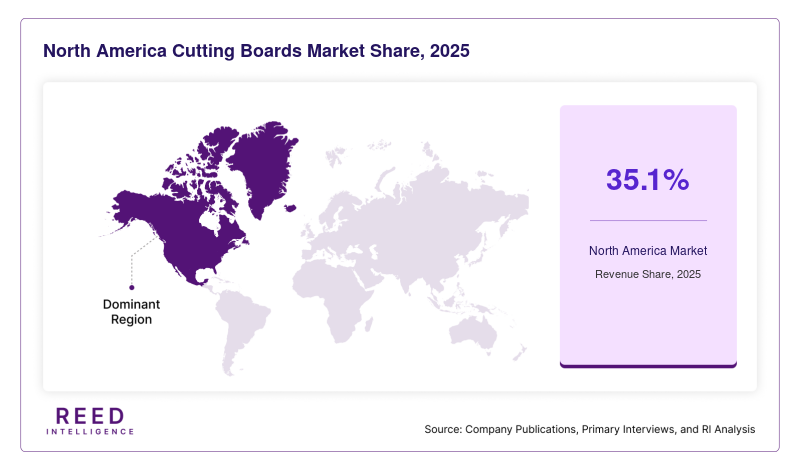
North America accounted for 35.1% of the global Cutting Boards Market share in 2025 and is expected to grow at a CAGR of 5.8% through 2034. The regional market benefited from high consumer spending on premium kitchenware and strong adoption of home cooking trends.
The United States dominated the regional market due to increasing demand for aesthetically designed kitchen accessories and professional-grade cookware products. Consumers in the country increasingly preferred sustainable bamboo boards and antimicrobial plastic cutting boards for residential kitchens.
Europe
Europe represented 27.4% of the Cutting Boards Market in 2025 and is projected to expand at a CAGR of 5.9% during the forecast period. The market was supported by rising interest in sustainable home products and premium culinary tools.
Germany emerged as the leading country in the region owing to strong household spending on kitchen renovation products and growing adoption of eco-friendly kitchen accessories. Commercial foodservice operators in the country also increased procurement of hygienic food preparation tools.
Asia Pacific
Asia Pacific held 23.8% of the Cutting Boards Market share in 2025 and is anticipated to witness the fastest CAGR of 7.4% from 2026 to 2034. Urbanization, rising disposable income, and expanding middle-class populations supported regional market growth.
China dominated the regional market due to increasing kitchenware manufacturing activities and rising household spending on modern kitchen products. The growing popularity of organized retail and online shopping platforms contributed to increased cutting board sales across urban areas.
Middle East & Africa
The Middle East & Africa accounted for 7.6% of the Cutting Boards Market in 2025 and is forecast to grow at a CAGR of 5.7% through 2034. The market benefited from rising hospitality investments and expansion of international restaurant chains.
Saudi Arabia emerged as the dominant country in the region because of increasing residential construction projects and growing consumer demand for premium kitchen accessories. Luxury hospitality projects also supported commercial kitchen equipment demand.
Latin America
Latin America captured 6.1% of the Cutting Boards Market share in 2025 and is expected to grow at a CAGR of 5.5% during the forecast period. Rising urban household spending and growth in foodservice businesses supported regional market expansion.
Brazil led the regional market owing to increasing demand for durable kitchen preparation products and expansion of retail kitchenware distribution networks. Growing consumer interest in home cooking further contributed to market growth.
Competitive Landscape
The Cutting Boards Market remains moderately fragmented with the presence of established kitchenware manufacturers and specialty culinary accessory brands. Companies are focusing on sustainable materials, innovative product designs, and premium craftsmanship to strengthen their market presence.
OXO remained a leading participant in the Cutting Boards Market due to its strong kitchenware portfolio and focus on ergonomic product design. The company recently introduced antimicrobial cutting boards featuring non-slip edges and integrated juice grooves designed for modern residential kitchens.
John Boos & Co. focused on expanding premium hardwood cutting board collections for professional chefs and luxury households. Epicurean emphasized eco-friendly composite cutting boards manufactured using recycled wood fibers. IKEA expanded its affordable bamboo kitchen accessories portfolio across international retail stores. Joseph Joseph introduced multifunctional cutting boards with foldable surfaces and storage-friendly features.
Key Players List
- OXO
- John Boos & Co.
- Epicurean
- IKEA
- Joseph Joseph
- Farberware
- Totally Bamboo
- Core Kitchen
- Gorilla Grip
- Cuisinart
- KitchenAid
- Dexas International Ltd.
- TeakHaus
- Winco
- Architec Housewares
Recent Developments
- In February 2026, OXO launched a new antimicrobial cutting board collection designed for residential kitchens and meal preparation applications.
- In November 2025, Epicurean expanded its eco-friendly composite cutting board manufacturing capacity to address increasing sustainable product demand.
- In September 2025, Joseph Joseph introduced foldable cutting boards featuring integrated waste disposal compartments for compact kitchen spaces.
- In June 2025, IKEA expanded its bamboo cutting board product line across European and North American retail markets.
- In March 2025, John Boos & Co. introduced premium handcrafted hardwood butcher blocks targeting luxury residential kitchen projects.
Cutting Boards Market Segments
Material
- Wooden Cutting Boards
- Bamboo Cutting Boards
- Plastic Cutting Boards
- Composite Cutting Boards
- Stainless Steel Cutting Boards
Product Type
- Standard Cutting Boards
- Flexible Cutting Boards
- Carving Boards
- Butcher Blocks
- Specialty Cutting Boards
Application
- Residential Kitchens
- Commercial Foodservice
- Hospitality Industry
- Catering Services
- Institutional Kitchens
Distribution Channel
- Offline Retail
- Online Retail
- Specialty Kitchen Stores
- Wholesale Distribution
By Region
- North America
- Europe
- APAC
- Middle East and Africa
- LATAM