Cyanate Ester Resin Market Size, Share & Demand Report By Type (Bisphenol-Based, Novolac-Based, Others), By Application (Composites, Electronics, Adhesives, Coatings), By End-Use (Aerospace & Defense, Automotive, Electrical & Electronics, Energy) By Region & Segment Forecasts, 2026–2034
USD 3950
Market Overview
The Cyanate Ester Resin Market size was valued at approximately USD 410 million in 2026 and is projected to reach USD 790 million by 2034, expanding at a CAGR of 8.6% during the forecast period (2026–2034). Cyanate ester resins are high-performance thermosetting polymers widely used in advanced composites, electronics, aerospace, and defense due to their excellent thermal stability, low dielectric constant, and superior moisture resistance. The market continues to evolve with increasing demand from industries requiring lightweight, high-strength, and heat-resistant materials.
A key global factor supporting market growth is the rising adoption of advanced composite materials in aerospace and defense applications. Governments and private sector manufacturers are investing heavily in next-generation aircraft, satellites, and defense systems that rely on lightweight yet durable materials. Cyanate ester resins offer enhanced mechanical properties and reduced outgassing, making them suitable for such high-performance applications. This has driven steady demand across both developed and emerging economies.
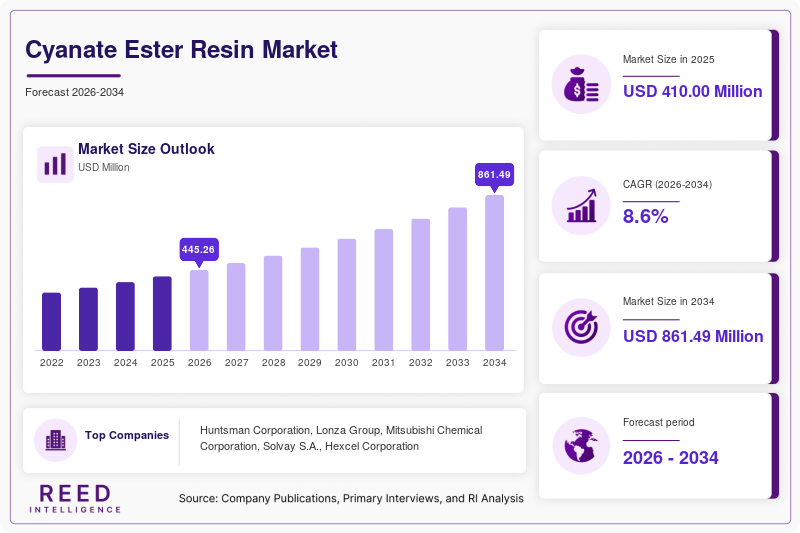
Key Highlights
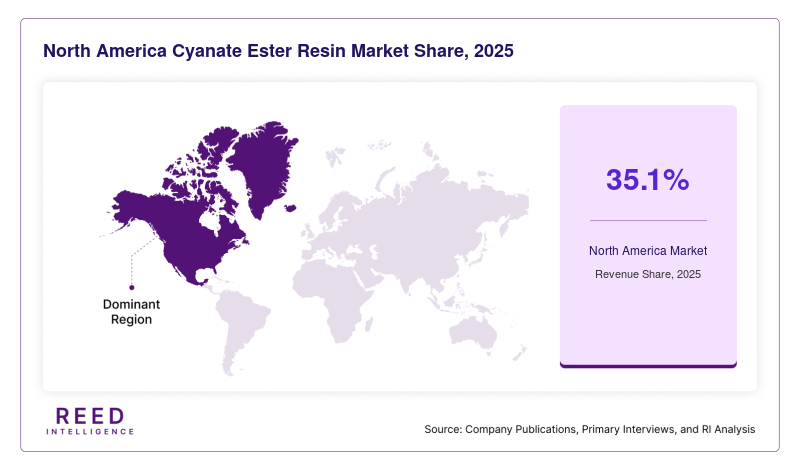
- North America dominated the market with a 35.1% share in 2025.
- Asia Pacific is expected to grow at the fastest CAGR of 9.8% during 2026–2034.
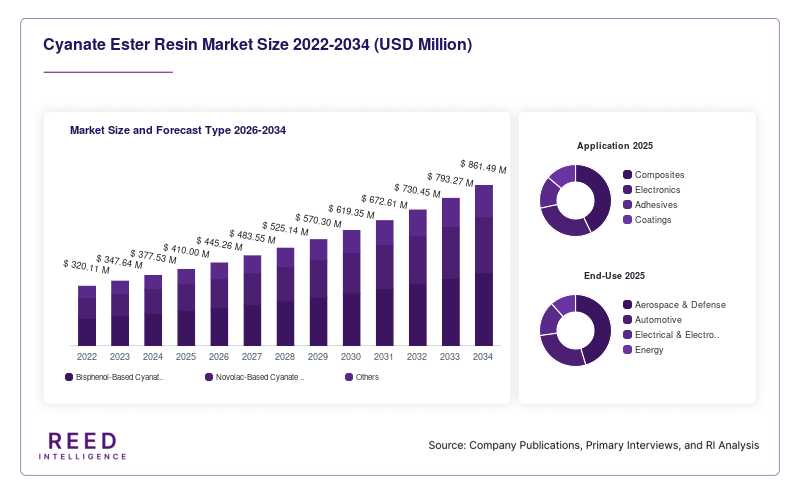
- By type, bisphenol-based cyanate ester resins accounted for the largest share of 42.7%, while novolac-based variants are projected to grow at a CAGR of 9.5%.
- By application, composites led with a 46.3% share, whereas electronics is expected to expand at a CAGR of 9.2%.
- The United States remained the dominant country, with market values of USD 150 million in 2024 and USD 165 million in 2025.
Market Trends
Increasing utilization in high-frequency electronics
The growing deployment of high-frequency communication systems has influenced the adoption of cyanate ester resins in electronics manufacturing. These resins exhibit low dielectric loss and stable electrical properties across a wide frequency range, making them suitable for applications such as printed circuit boards, antennas, and radomes. As 5G infrastructure expands globally and the demand for high-speed data transmission increases, manufacturers are shifting toward materials that maintain performance integrity under extreme operating conditions. Cyanate ester resins address these requirements effectively, enabling consistent signal transmission and reduced interference. This trend is particularly noticeable in regions investing heavily in telecommunications infrastructure, where performance and reliability are critical considerations.
Shift toward lightweight composite materials
Industries such as aerospace, automotive, and defense are prioritizing lightweight materials to improve fuel efficiency and reduce emissions. Cyanate ester resins are increasingly used in composite structures due to their high strength-to-weight ratio and resistance to thermal degradation. The trend toward replacing traditional metal components with advanced composites has accelerated the use of these resins in structural applications. In addition, manufacturers are developing hybrid composites that combine cyanate ester resins with carbon fibers to enhance mechanical performance. This shift is further supported by regulatory pressures to reduce carbon footprints, prompting industries to adopt materials that contribute to energy efficiency and sustainability goals.
Market Drivers
Expansion of aerospace and defense industries
The rapid expansion of aerospace and defense sectors is a major driver for the Cyanate Ester Resin Market. These industries require materials that can withstand extreme temperatures, mechanical stress, and environmental exposure. Cyanate ester resins meet these criteria, making them suitable for aircraft components, missile systems, and space applications. Increasing defense budgets and the development of advanced military technologies have fueled demand for high-performance materials. Additionally, the growth of commercial aviation, including the production of fuel-efficient aircraft, has further boosted the adoption of these resins. Manufacturers are also focusing on improving resin formulations to enhance durability and processing efficiency, supporting broader application across the aerospace value chain.
Rising demand in electronics and semiconductor applications
The electronics industry continues to drive demand for cyanate ester resins due to their superior dielectric properties and thermal stability. As semiconductor devices become more compact and powerful, there is a need for materials that can maintain performance under high temperatures and electrical loads. Cyanate ester resins are increasingly used in multilayer circuit boards, chip packaging, and high-frequency components. The growth of consumer electronics, coupled with advancements in computing technologies, has created a steady demand for high-performance materials. Furthermore, the transition toward electric vehicles and smart devices has increased the need for reliable electronic systems, further supporting market growth.
Market Restraints
High production costs and processing complexity
One of the key challenges limiting market expansion is the high cost associated with the production and processing of cyanate ester resins. These materials require specialized manufacturing techniques and raw materials, which increase overall production expenses. In addition, the curing process for cyanate ester resins often involves precise temperature control and extended processing times, adding to operational costs. This can limit their adoption in cost-sensitive applications, particularly in industries where alternative materials such as epoxy resins are available at lower prices. For example, in automotive applications, manufacturers may opt for more economical materials unless high performance is absolutely necessary. The cost factor also affects small and medium-scale manufacturers, restricting their ability to compete in the market.
Market Opportunities
Growth in space exploration and satellite applications
The increasing investment in space exploration and satellite technology presents significant opportunities for the Cyanate Ester Resin Market. These resins are highly suitable for space applications due to their low outgassing properties and resistance to extreme temperature fluctuations. Governments and private companies are launching new satellite programs for communication, navigation, and earth observation, driving demand for advanced materials. Cyanate ester resins are used in structural components, antenna systems, and insulation materials in spacecraft. As the space industry continues to expand, the need for reliable and high-performance materials is expected to increase, creating new growth avenues for manufacturers.
Development of advanced hybrid composites
The development of hybrid composite materials offers another promising opportunity for market growth. Manufacturers are combining cyanate ester resins with other polymers and reinforcing fibers to create materials with enhanced properties. These hybrid composites provide improved strength, durability, and resistance to environmental factors, making them suitable for a wide range of applications. Industries such as automotive and renewable energy are exploring the use of these materials to improve performance and reduce maintenance costs. For instance, wind turbine blades and electric vehicle components can benefit from the enhanced properties of hybrid composites. Continued research and development in this area are expected to unlock new applications and drive market expansion.
Segmental Analysis
By Type
Bisphenol-based cyanate ester resins dominated the market, accounting for a share of approximately 42.7% in 2024. These resins are widely used due to their balanced performance characteristics, including thermal stability, mechanical strength, and ease of processing. They are commonly applied in aerospace and electronics industries where reliability and durability are essential. The widespread availability of bisphenol-based variants and their compatibility with various reinforcement materials have further supported their dominance. Manufacturers continue to enhance these resins to improve their performance in demanding applications, ensuring their continued relevance in the market.
Novolac-based cyanate ester resins are expected to grow at the fastest CAGR of 9.5% during the forecast period. These resins offer higher crosslink density and improved thermal resistance compared to other types. Their ability to perform under extreme conditions makes them suitable for advanced aerospace and defense applications. The growing demand for materials with superior heat resistance and mechanical properties has driven the adoption of novolac-based resins. Additionally, ongoing research and development efforts are focused on improving their processing characteristics, making them more accessible for a wider range of applications.
By Application
Composites represented the largest application segment, accounting for 46.3% of the market share in 2024. Cyanate ester resins are extensively used in composite materials due to their high strength-to-weight ratio and resistance to environmental factors. These properties make them ideal for aerospace components, where weight reduction and durability are critical. The increasing use of composites in various industries, including automotive and renewable energy, has further supported the growth of this segment. Manufacturers are also developing advanced composite materials to meet the evolving requirements of different applications.
The electronics segment is projected to grow at a CAGR of 9.2% during the forecast period. The demand for high-performance materials in electronic devices has increased significantly, driven by advancements in technology. Cyanate ester resins are used in circuit boards, semiconductor packaging, and high-frequency components due to their excellent dielectric properties. The expansion of the electronics industry, particularly in Asia Pacific, has created a strong demand for these materials. Additionally, the development of new electronic devices and communication technologies is expected to further drive growth in this segment.
By End-Use
The aerospace and defense sector dominated the market, accounting for a share of 39.8% in 2024. This sector requires materials that can withstand extreme conditions, including high temperatures and mechanical stress. Cyanate ester resins are widely used in aircraft structures, missile systems, and space applications due to their superior performance characteristics. The increasing investment in defense and aerospace technologies has driven demand for these resins. Manufacturers are also focusing on developing new formulations to meet the specific requirements of this sector.
The automotive sector is expected to grow at the fastest CAGR of 8.9% during the forecast period. The shift toward lightweight materials to improve fuel efficiency and reduce emissions has increased the adoption of cyanate ester resins in automotive applications. These resins are used in structural components and electronic systems, providing enhanced performance and durability. The growing demand for electric vehicles and advanced automotive technologies has further supported the growth of this segment. Additionally, the development of hybrid materials is expected to create new opportunities in the automotive sector.
Regional Analysis
North America
North America held a significant share of the Cyanate Ester Resin Market, accounting for approximately 35.1% in 2025, and is projected to grow at a CAGR of 7.9% during the forecast period. The region’s strong presence in aerospace and defense industries has contributed to its dominance. Advanced manufacturing capabilities and ongoing investments in high-performance materials have further supported market growth. Additionally, the presence of major market players and research institutions has enabled continuous innovation in resin formulations and applications.
The United States is the dominant country in this region, driven by extensive defense spending and a robust aerospace sector. A unique growth factor is the increasing focus on next-generation aircraft and space exploration programs. These initiatives require materials with high thermal stability and mechanical strength, boosting demand for cyanate ester resins. The country’s emphasis on technological advancement continues to drive innovation and adoption.
Europe
Europe accounted for around 27.4% of the market share in 2025 and is expected to grow at a CAGR of 7.5% through 2034. The region benefits from a well-established aerospace industry and strong regulatory frameworks promoting advanced materials. Countries in Europe are investing in sustainable manufacturing processes, which has encouraged the adoption of high-performance resins with improved environmental profiles.
Germany leads the market in Europe, supported by its advanced automotive and engineering sectors. A unique growth factor is the integration of lightweight materials in automotive manufacturing to meet emission standards. Cyanate ester resins are increasingly used in structural components to enhance fuel efficiency. This focus on sustainability and innovation continues to drive market growth in the region.
Asia Pacific
Asia Pacific is expected to witness the fastest growth, with a CAGR of 9.8% during the forecast period, and held a market share of 22.6% in 2025. Rapid industrialization and expanding electronics manufacturing have contributed to the region’s growth. Increasing investments in infrastructure and technology have also supported demand for high-performance materials.
China dominates the Asia Pacific market due to its large manufacturing base and growing aerospace sector. A unique growth factor is the rapid expansion of electronics production, including semiconductors and communication devices. The demand for materials with excellent electrical properties has increased significantly, driving the adoption of cyanate ester resins across various applications.
Middle East & Africa
The Middle East & Africa region accounted for approximately 7.2% of the market share in 2025 and is projected to grow at a CAGR of 6.8% during the forecast period. The region is gradually adopting advanced materials in construction, energy, and defense sectors. Investments in infrastructure development have created opportunities for high-performance resins.
The United Arab Emirates is a key contributor to the market in this region. A unique growth factor is the increasing focus on aerospace and defense capabilities. The country is investing in advanced technologies and materials to support its growing aviation sector. This has led to a steady demand for cyanate ester resins in specialized applications.
Latin America
Latin America held a market share of 7.7% in 2025 and is expected to grow at a CAGR of 7.1% during the forecast period. The region’s growth is driven by increasing industrial activities and the adoption of advanced materials in various sectors. Economic development and infrastructure projects have also contributed to market expansion.
Brazil is the dominant country in Latin America, supported by its growing aerospace and automotive industries. A unique growth factor is the increasing investment in renewable energy projects. Cyanate ester resins are used in components such as wind turbine blades, where durability and performance are critical. This has created new opportunities for market growth in the region.
Competitive Landscape
The Cyanate Ester Resin Market is moderately consolidated, with several key players focusing on product innovation and strategic partnerships to strengthen their market position. Leading companies are investing in research and development to enhance resin properties and expand their application scope. The market leader, Huntsman Corporation, has maintained a strong presence through its extensive product portfolio and global distribution network. The company recently introduced advanced cyanate ester formulations designed for high-frequency electronics and aerospace applications, reflecting its commitment to innovation.
Other major players are also focusing on expanding their production capacities and entering new markets. Strategic collaborations with aerospace and electronics manufacturers have enabled companies to develop customized solutions tailored to specific industry requirements. The competitive landscape is characterized by continuous technological advancements and efforts to improve cost efficiency, ensuring sustained growth in the market.
Key Players
- Huntsman Corporation
- Lonza Group
- Mitsubishi Chemical Corporation
- Solvay S.A.
- Hexcel Corporation
- SABIC
- Toray Industries Inc.
- Jiangsu Hengshen Co., Ltd.
- TenCate Advanced Composites
- Cytec Industries
- Arkema S.A.
- BASF SE
- Kolon Industries
- Evonik Industries AG
- Sumitomo Chemical Co., Ltd.
Recent Developments
- Huntsman Corporation launched a new range of cyanate ester resins tailored for high-frequency electronic applications in 2025.
- Solvay S.A. expanded its production capacity for advanced composite materials, including cyanate ester resins, to meet growing aerospace demand.
- Mitsubishi Chemical Corporation developed a hybrid resin system combining cyanate ester and epoxy technologies to enhance performance in extreme environments.
Cyanate Ester Resin Market Segments
Type
- Bisphenol-Based Cyanate Ester Resins
- Novolac-Based Cyanate Ester Resins
- Others
Application
- Composites
- Electronics
- Adhesives
- Coatings
End-Use
- Aerospace & Defense
- Automotive
- Electrical & Electronics
- Energy
By Region
- North America
- Europe
- APAC
- Middle East and Africa
- LATAM