Cyanocobalamin Market Size, Share Demand Report By Product Type (Pharmaceutical-Grade Cyanocobalamin, Food-Grade Cyanocobalamin), By Application (Dietary Supplements, Fortified Foods, Pharmaceuticals, Animal Nutrition), By Distribution Channel (Direct Institutional Sales, Pharmacies, Online Retail, Specialty Stores), By Region & Segment Forecasts, 2026–2034
USD 3950
Market Overview
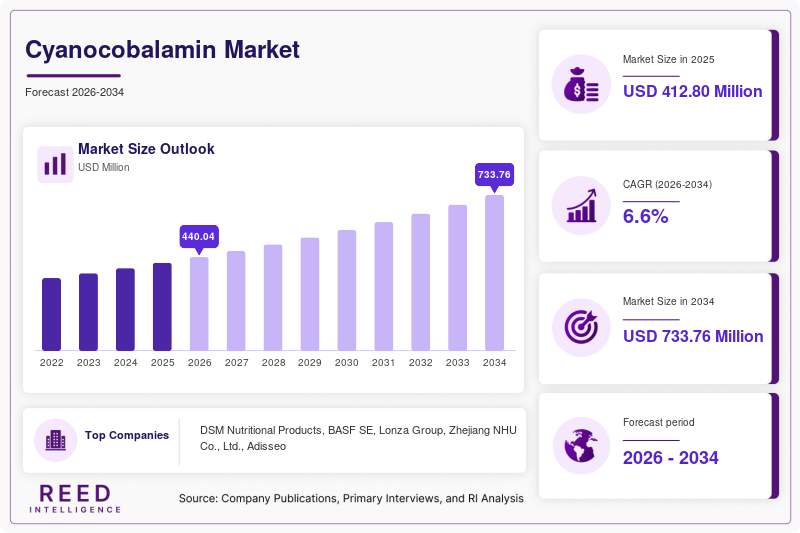
The global Cyanocobalamin Market size was valued at USD 412.8 million in 2026 and is projected to reach USD 689.4 million by 2034, expanding at a CAGR of 6.6% during the forecast period (2026–2034). Market growth has been supported by rising global focus on preventive healthcare and nutritional supplementation, particularly due to increased awareness regarding vitamin B12 deficiencies across aging populations, vegetarian consumer groups, and patients with metabolic disorders.
Demand growth has also been supported by expansion in fortified foods, pharmaceutical formulations, and dietary supplements, while increasing use of cyanocobalamin in injectable formulations and oral dosage products has strengthened volume demand across developed and emerging economies.
Key Highlights
- North America held the dominant market share of 34.8% in 2025, while Asia Pacific is projected to register the fastest CAGR of 7.8% through 2034.
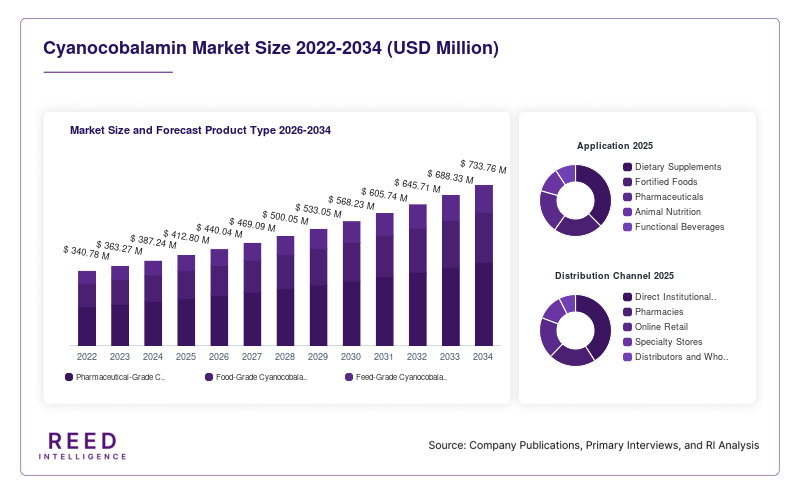
- By product type, pharmaceutical-grade cyanocobalamin accounted for the leading share of 46.5% in 2025, while feed-grade cyanocobalamin is projected to expand at 7.4% CAGR.
- By application, dietary supplements represented the dominant subsegment with 38.2% share in 2025, while fortified foods are anticipated to witness a CAGR of 7.6%.
- By distribution channel, direct institutional sales led with 42.7% share, while online retail is forecast to grow at 8.3% CAGR.
- The United States, the dominant country market, was valued at USD 98.4 million in 2024 and reached USD 103.6 million in 2025.
Market Trends
Expansion of Plant-Based Nutrition and Vitamin Fortification
Growing consumer preference for plant-based diets has increased the need for vitamin B12 fortification in cereals, dairy alternatives, nutritional beverages, and functional foods. Since plant-based food sources naturally contain limited vitamin B12, manufacturers have increased integration of cyanocobalamin into fortified products. This trend is contributing to broader commercial demand and supporting volume growth in the Cyanocobalamin Market.
Growth in Injectable and High-Potency Formulations
Another trend shaping the market is rising demand for high-potency cyanocobalamin formulations used in injectable therapies and prescription-grade products. Healthcare providers are increasingly adopting high-dose B12 treatments for neurological disorders, anemia management, and post-surgical recovery applications. This trend is expected to support product innovation and expand higher-margin product segments.
Market Drivers
Rising Prevalence of Vitamin B12 Deficiency
Increasing incidence of vitamin B12 deficiency remains a major growth driver for the Cyanocobalamin Market. Aging populations, gastrointestinal disorders, poor dietary intake, and growing vegan populations have contributed to rising demand for B12 supplementation products. Increased diagnosis rates and routine nutritional screening have further expanded consumption across clinical and retail channels.
Growth in Pharmaceutical and Nutraceutical Manufacturing
Expansion of pharmaceutical and nutraceutical production has supported demand for cyanocobalamin as an active ingredient in capsules, tablets, injections, and combination therapies. Manufacturers are increasing production capacities to address rising global demand for nutritional products, which continues to support revenue generation across the Cyanocobalamin Market.
Market Restraint
Price Volatility in Raw Material Supply
Volatility in fermentation-derived raw material inputs and supply chain disruptions remain a restraint for the market. Production cost fluctuations can affect pricing consistency and may limit margin expansion for manufacturers, particularly in cost-sensitive emerging markets.
Market Opportunities
Expansion in Animal Nutrition Applications
Growing demand for fortified livestock and aquaculture feed creates opportunity for feed-grade cyanocobalamin producers. Nutritional optimization in animal health is expected to increase adoption, particularly in commercial poultry and dairy farming applications.
Emerging Demand in Personalized Nutrition
The rise of personalized nutrition and tailored supplementation programs creates opportunity for targeted cyanocobalamin products. Companies developing individualized dosage formats and digital health-linked supplement models are expected to gain growth potential over the forecast period.
Segmental Analysis
By Product Type
Pharmaceutical-Grade Cyanocobalamin: Pharmaceutical-grade cyanocobalamin held the dominant share of 46.5% in 2025 due to extensive use in injections, tablets, and prescription formulations. Its established role in clinical treatment applications supported leadership.
Feed-Grade Cyanocobalamin: Feed-grade cyanocobalamin is projected to register the fastest CAGR of 7.4% through 2034. Rising adoption in livestock productivity applications and increasing demand for fortified animal feed will support segment expansion.
By Application
Dietary Supplements: Dietary supplements accounted for the leading 38.2% market share in 2025 due to broad consumer demand for vitamin B12 tablets, capsules, and multivitamin products.
Fortified Foods: Fortified foods are expected to grow at 7.6% CAGR over the forecast period. Rising use of vitamin-fortified cereals, beverages, and dairy alternatives will support segment growth.
By End Use
Pharmaceutical Companie: Pharmaceutical companies held the dominant share of 41.8% in 2025, supported by large-scale demand for cyanocobalamin in therapeutic formulations and hospital products.
Nutraceutical Manufacturers: Nutraceutical manufacturers are projected to expand at 7.2% CAGR through 2034. Increasing product launches in preventive wellness and personalized nutrition will drive growth.
By Distribution Channel
Direct Institutional Sales
Direct institutional sales accounted for 42.7% of the market in 2025 due to procurement by pharmaceutical companies, hospitals, and bulk ingredient buyers.
Online Retail
Online retail is expected to witness the fastest CAGR of 8.3%. Growth in digital supplement sales platforms and direct-to-consumer channels will support demand.
By Form
Powder Form: Powder cyanocobalamin held a dominant 49.4% share in 2025 owing to broad use in formulations, premixes, and industrial ingredient applications.
Liquid Form: Liquid formulations are projected to grow at 7.1% CAGR through 2034 due to increasing use in pediatric formulations and injectable products.
Regional Analysis
North America
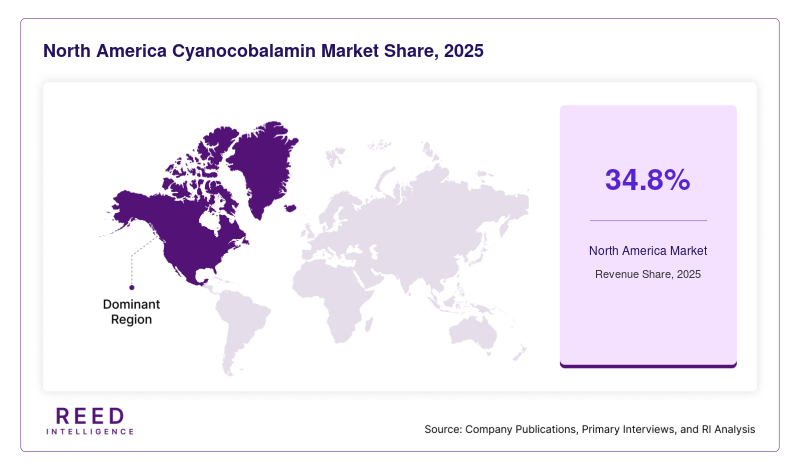
North America accounted for 34.8% of the global Cyanocobalamin Market in 2025. Regional demand was supported by mature dietary supplement consumption and established pharmaceutical production infrastructure. The region is projected to expand at a CAGR of 5.9% through 2034.
The United States dominated the regional market due to rising use of preventive nutritional products. Increasing clinical diagnosis of B12 deficiency and growth in premium supplement formulations contributed to country-level expansion.
Europe
Europe represented 27.4% of the global market in 2025. Demand was driven by food fortification adoption and strong regulatory support for nutritional products. The regional market is projected to grow at a CAGR of 6.1% during the forecast period.
Germany remained the leading country market, supported by demand for pharmaceutical-grade vitamins and growing production of nutraceutical formulations. Advanced contract manufacturing activity contributed to growth momentum.
Asia Pacific
Asia Pacific held 23.6% market share in 2025 and is expected to register the fastest CAGR of 7.8% through 2034. Growth is projected to be supported by increasing healthcare expenditure and expanding vitamin supplement consumption.
China dominated the regional market due to large-scale vitamin ingredient production and expanding domestic demand for fortified nutrition products. Rising industrial fermentation capacity is expected to support long-term growth.
Middle East & Africa
Middle East & Africa accounted for 7.1% share in 2025. The market is projected to grow at 6.5% CAGR during the forecast period. Growth is expected to be supported by expanding healthcare access and rising nutritional awareness.
Saudi Arabia led the region due to increasing demand for imported pharmaceutical vitamins and broader use of dietary supplements through pharmacy channels.
Latin America
Latin America represented 7.1% of the global Cyanocobalamin Market in 2025 and is projected to grow at 6.4% CAGR through 2034. Rising demand for fortified food products and improving pharmaceutical distribution networks are expected to support growth.
Brazil dominated the region due to growth in nutritional supplement manufacturing and rising consumer demand for preventive wellness products.
Competitive Landscape
The Cyanocobalamin Market remains moderately consolidated with competition centered on product purity, manufacturing scale, regulatory compliance, and distribution reach. Leading participants are focusing on capacity expansion, formulation innovation, and supply agreements to strengthen market positions. DSM Nutritional Products remained a key market leader due to broad vitamin portfolio integration and established global distribution networks.
BASF SE continued expanding vitamin ingredient production for pharmaceutical and nutrition applications. Zhejiang NHU focused on fermentation efficiency improvements to support cost optimization. Adisseo maintained presence through animal nutrition applications, while Lonza emphasized high-purity formulations for pharmaceutical customers. Recent competitive activity has included process upgrades, strategic partnerships for nutraceutical ingredients, and investments in fermentation-based production technologies. Companies are also increasing focus on regional expansion in Asia Pacific and Latin America to capture growing demand across emerging markets.
Key Players in the Cyanocobalamin Market
- DSM Nutritional Products
- BASF SE
- Lonza Group
- Zhejiang NHU Co., Ltd.
- Adisseo
- Hebei Huarong Pharmaceutical Co., Ltd.
- Sanofi
- Merck KGaA
- Glanbia Nutritionals
- Jiangxi Tianxin Pharmaceutical Co., Ltd.
- Amway Corporation
- Pfizer Inc.
- Nature’s Bounty
- Now Foods
- Koninklijke DSM-Firmenich
Recent Developments
- Several vitamin ingredient manufacturers expanded fermentation capacity for cyanocobalamin production to improve supply reliability and production efficiency.
- Pharmaceutical companies introduced new combination formulations containing cyanocobalamin with folic acid and other B-complex ingredients for deficiency management.
- Nutraceutical producers launched high-potency vitamin B12 supplements targeting aging populations and plant-based consumers.
- Feed nutrition suppliers increased adoption of cyanocobalamin premixes for poultry and dairy productivity applications.
- Manufacturers invested in process optimization technologies to improve purity levels in pharmaceutical-grade cyanocobalamin production.
- Online supplement brands expanded direct-to-consumer distribution models for vitamin B12 products in emerging markets.
- Ingredient suppliers formed partnerships with fortified food manufacturers to support product development in cereals and dairy alternatives.
- Several companies expanded regional distribution networks in Asia Pacific to address growing demand for nutritional ingredients.
Cyanocobalamin Market Segments
Product Type
- Pharmaceutical-Grade Cyanocobalamin
- Food-Grade Cyanocobalamin
- Feed-Grade Cyanocobalamin
Application
- Dietary Supplements
- Fortified Foods
- Pharmaceuticals
- Animal Nutrition
- Functional Beverages
Distribution Channel
- Direct Institutional Sales
- Pharmacies
- Online Retail
- Specialty Stores
- Distributors and Wholesalers
By Region
- North America
- Europe
- APAC
- Middle East and Africa
- LATAM