Cyber Security Market Size, Share & Trends Analysis Report By Component (Solutions, Services), By Security Type (Network Security, Endpoint Security, Cloud Security, Internet of Things Security, Application Security, Others), By Deployment (Cloud, On-Premises), By Organization Size (SMEs, Large Enterprises) and By Region (North America, Europe, Asia Pacific, Latin America, Middle East & Africa) Forecasts, 2026–2034
USD 3950
Cyber Security Market Size
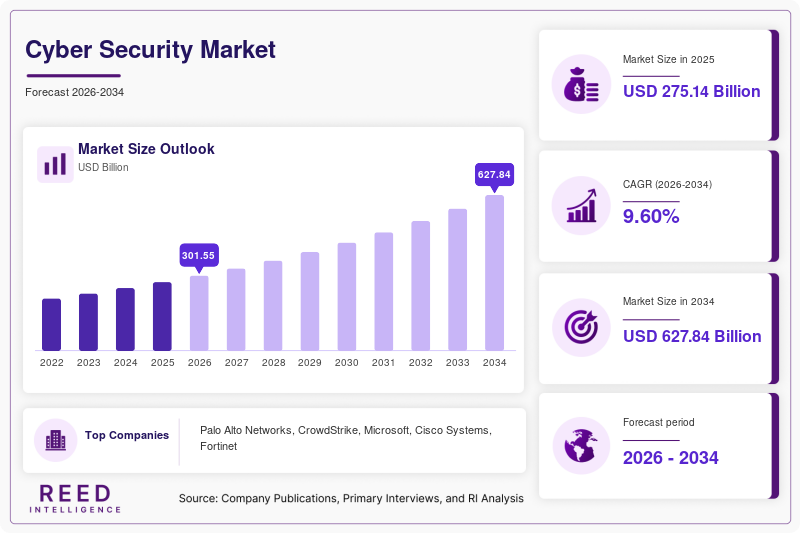
The global cyber security market was valued at USD 275.14 billion in 2025 and is projected to grow from USD 301.55 billion in 2026 to USD 627.84 billion by 2034, registering a CAGR of 9.60% during the forecast period from 2026 to 2034.
Cybersecurity has evolved from perimeter protection into a multilayered security architecture covering identities, endpoints, networks, applications, cloud workloads, data and increasingly autonomous AI systems. Organizations are therefore consolidating security controls while adding specialized technologies for identity protection, exposure management, security operations, cloud-native security and AI security.
The attack surface is expanding as organizations deploy SaaS applications, APIs, remote-access systems, connected devices and AI agents. IBM reported that exploitation of public-facing applications was the most common initial-access vector in its 2025 incident-response data and had risen 44% from the previous year.
Cyber Security Market Drivers
Expansion of Cloud and Digital Infrastructure
Cloud migration has redistributed enterprise workloads across public clouds, SaaS platforms, APIs, remote endpoints and third-party environments. This changes the security control point: organizations must protect identities and workloads that may not reside inside a conventional corporate network.
Gartner's 2026 IT-spending forecast expects worldwide IT spending to reach USD 6.37 trillion, up 14.2% from 2025, with data-center systems and infrastructure-as-a-service among the major growth areas. Increasing digital infrastructure creates additional assets requiring security monitoring, access control, vulnerability management and resilience.
Increasing Frequency and Complexity of Cyberattacks
Cybercrime has become increasingly specialized, with access brokers, ransomware operators, infostealers and data-extortion groups operating as interconnected components of a broader criminal economy. Microsoft reported that data theft occurred in nearly 80% of its incident-response engagements and identified financially motivated attacks as the dominant category.
IBM's 2026 X-Force research also recorded a 49% increase in active ransomware groups compared with the prior year and a 44% increase in exploitation of public-facing software and system applications. These developments increase the requirement for continuous vulnerability management, endpoint protection, identity security, security information and event management, and automated incident response.
AI Adoption and AI-Driven Security Requirements
Organizations are introducing generative AI, autonomous agents and AI-enabled applications into business processes. This creates new security requirements involving model access, prompt manipulation, sensitive-data exposure, agent permissions, model integrity and AI supply chains.
Microsoft identifies AI as a dual-use technology in cybersecurity: attackers use it to scale phishing and intrusion activity while defenders use AI for threat detection, automated remediation and incident response. Its 2025 report also highlights AI-specific risks such as data poisoning, adversarial prompts and model manipulation.
Cyber Security Market Restraints
Cybersecurity Skills and Operational Complexity
Security environments increasingly involve numerous products, cloud platforms, identity systems and security consoles. Organizations need specialists capable of interpreting alerts, managing vulnerabilities, investigating incidents and maintaining controls across heterogeneous infrastructures.
The problem is particularly relevant for smaller organizations, which may lack dedicated security operations teams. Managed security services can address part of this gap, but outsourcing introduces additional requirements around data access, governance, service-level agreements and third-party risk.
Security Investment and Integration Costs
Modern cybersecurity programs frequently require multiple layers rather than a single product. Organizations may need endpoint detection, identity security, cloud security, vulnerability management, email security, network controls, backup protection and security operations.
Integration costs increase when products generate overlapping alerts or use incompatible data structures. Microsoft's security research emphasizes the need for automation and integrated defense because attack timelines are shrinking while security teams must process increasingly large volumes of signals.
Cyber Security Market Opportunities
AI-Powered Security Operations
AI-enabled security operations can automate repetitive analysis, correlate alerts and accelerate investigation. AI agents can also perform selected response actions after predefined conditions are met.
Microsoft describes AI agents capable of responding to high-risk identity signals by suspending compromised accounts and initiating password resets. Palo Alto Networks is similarly expanding agentic security capabilities through its acquisitions of Portkey and Console.
This creates opportunities across security operations, vulnerability management, threat intelligence, identity protection and incident response.
Zero Trust and Identity Security
The expansion of cloud workloads, remote access and machine-to-machine communication increases the importance of continuous identity verification and least-privilege access. Identity security is becoming broader than employee authentication because organizations now manage machine identities, service accounts and AI agents.
Palo Alto Networks completed its acquisition of CyberArk in February 2026, positioning identity security as a core element of its cybersecurity platform and explicitly addressing human, machine and agentic identities.
Security for AI Applications and Agents
AI introduces an additional security layer covering models, AI gateways, agent permissions, data flows and runtime activity. Palo Alto Networks completed its Portkey acquisition in May 2026 to strengthen AI Gateway capabilities for monitoring, orchestrating and governing autonomous agents.
The opportunity extends across AI application security, AI governance, model protection, runtime controls, red teaming and continuous exposure testing.
Cyber Security Market Segmental Analysis
By Component
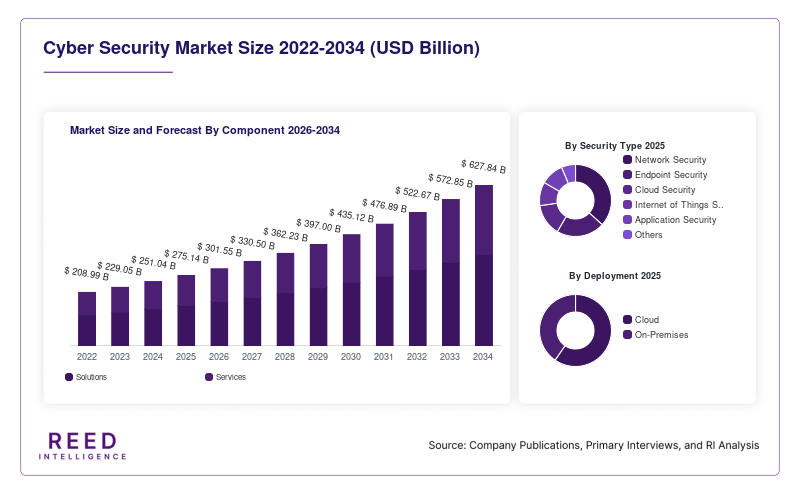
Solutions represent the dominant component category, accounting for approximately 71% share. The category includes network security, endpoint security, identity security, cloud security, application security, data security and security operations technologies. Enterprise demand for integrated protection across distributed environments supports continued investment in security platforms.
Services are projected to register approximately 10.8% CAGR through 2034. Managed security services, consulting, incident response, penetration testing, security assessment and security implementation are increasingly important where organizations lack sufficient internal expertise.
The shift toward managed and automated security also changes the relationship between software and services. Vendors increasingly combine platforms with managed detection and response, threat intelligence, implementation and professional services, creating recurring service relationships around security infrastructure.
By Security Type
Network Security remains the largest category with approximately 25% share, supported by continued requirements for firewalls, secure access, intrusion prevention, secure web gateways and network monitoring.
Cloud Security is projected to be the fastest-growing security type at approximately 13.4% CAGR. Cloud migration creates distributed workloads, identities, APIs and configurations that require continuous monitoring. IBM's 2026 threat research emphasizes the growing importance of protecting public-facing applications as organizations expand their digital infrastructure.
Endpoint Security accounts for approximately 22% share, while Application Security represents approximately 16%. IoT Security contributes approximately 11%, with connected devices creating additional authentication, firmware, network and lifecycle-management requirements. Other technologies account for the remaining share.
By Deployment
Cloud deployment dominates with approximately 68% share. Cloud-delivered security platforms allow organizations to centralize security telemetry and deploy controls across geographically distributed users and workloads without maintaining equivalent on-premises infrastructure.
Cloud deployment is projected to expand at approximately 12.2% CAGR. Security vendors are increasingly developing cloud-native security operations platforms and AI-enabled security services that rely on centralized analytics and continuous data collection.
On-premises deployment represents approximately 32% share and is projected to grow at approximately 5.7% CAGR. It remains relevant for organizations with strict data-residency requirements, specialized infrastructure, operational technology environments and regulatory constraints.
By Organization Size
Large enterprises account for approximately 69% share, reflecting their extensive IT estates, larger exposure surfaces, regulatory obligations and dedicated security teams. Large organizations commonly deploy multiple cybersecurity layers covering networks, endpoints, identities, applications and cloud environments.
SMEs are projected to record approximately 12.6% CAGR. The segment is increasingly served through managed security services, cloud-based security platforms and simplified subscription models.
CrowdStrike's 2026 expansion of Project QuiltWorks to SMBs illustrates the direction of the segment: security vendors are extending advanced AI-risk protection through distributors, cloud marketplaces and channel partners to smaller organizations.
Cyber Security Market Regional Analysis
North America
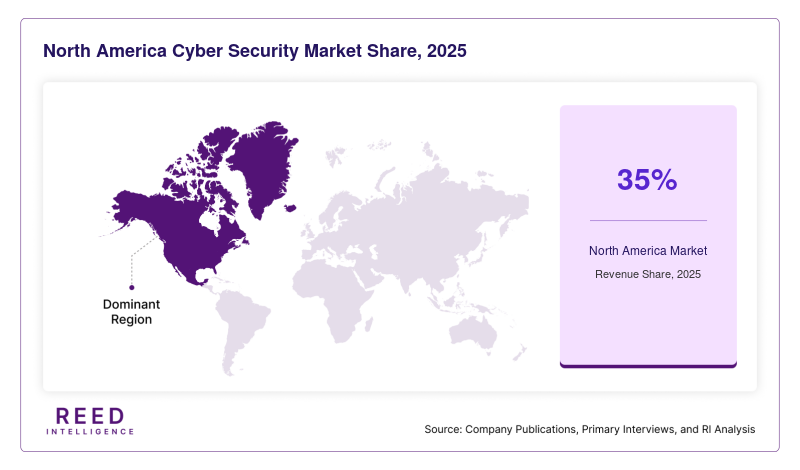
North America represents the dominant region with approximately 35% share. High enterprise technology adoption, extensive cloud infrastructure, strong cybersecurity spending and a large concentration of cybersecurity vendors support the region's position.
The region is also a major center for AI-security development. Palo Alto Networks, CrowdStrike and Microsoft have all expanded AI-related security capabilities during 2026, covering AI agents, threat detection, vulnerability management and automated security operations.
North America is projected to expand at approximately 8.9% CAGR through 2034.
Europe
Europe is projected to grow at approximately 9.1% CAGR. Regulatory requirements surrounding privacy, digital resilience, critical infrastructure and cybersecurity influence enterprise security investment.
The region is also seeing greater emphasis on sovereignty and secure AI adoption. Palo Alto Networks and Deutsche Telekom announced an initiative in June 2026 focused on AI-driven security and sovereignty controls for European regulated industries.
Asia Pacific
Asia Pacific is projected to be the fastest-growing region at approximately 12.3% CAGR. Rapid digitization, cloud adoption, connected-device deployment and expanding digital-payment ecosystems are increasing the number of systems requiring protection.
Indonesia illustrates the expansion of enterprise cybersecurity services. CrowdStrike and Telkom Indonesia signed an August 2026 MoU focused on AI-powered cybersecurity protection and managed security services for Indonesian organizations.
Latin America
Latin America is projected to expand at approximately 10.4% CAGR. Financial services, telecommunications, government services and digital commerce remain important cybersecurity demand centers.
The increasing use of cloud applications and digital payments expands the need for identity security, fraud prevention, endpoint protection and managed security services. Cybersecurity vendors are also using regional distributors and service providers to reach organizations without large internal security teams.
Middle East & Africa
The Middle East & Africa region is projected to grow at approximately 11.1% CAGR. Digital-government programs, financial technology, telecommunications infrastructure and critical infrastructure modernization increase cybersecurity requirements.
Organizations across the region are also adopting cloud and AI technologies, increasing the need for identity protection, cloud workload security and AI governance. Managed security services can be particularly relevant where specialist cybersecurity resources are limited.
Cyber Security Market Competitive Landscape
The cyber security market is highly fragmented across network security, endpoint security, cloud security, identity management, security operations and specialized threat-prevention categories. Competition is increasingly moving toward integrated platforms that combine telemetry, analytics, automation and multiple security controls.
Palo Alto Networks is expanding its platform strategy across network security, cloud security, security operations, identity and AI security. Its 2026 acquisition of CyberArk expanded identity capabilities, while its Portkey acquisition strengthened AI Gateway functionality for autonomous agents. The September 2026 acquisition of Console further extended its agentic security capabilities within Cortex.
Key Market Players
- Palo Alto Networks
- CrowdStrike
- Microsoft
- Cisco Systems
- Fortinet
- Check Point Software Technologies
- IBM
- Broadcom
- Zscaler
- Okta
- Trellix
- Trend Micro
- Sophos
- SentinelOne
- Cloudflare
Recent Market Developments
- September 2026 – Palo Alto Networks: Palo Alto Networks announced its acquisition of Console, an AI-native platform designed to add agentic capabilities to Cortex and automate analysis and action across enterprise security operations.
- August 2026 – CrowdStrike: CrowdStrike expanded Project QuiltWorks to SMBs through distributors and cloud marketplaces, extending its frontier-AI risk protection framework to smaller organizations worldwide.
Cyber Security Market Segments
By Component
- Solutions
- Services
By Security Type
- Network Security
- Endpoint Security
- Cloud Security
- Internet of Things Security
- Application Security
- Others
By Deployment
- Cloud
- On-Premises
By Organization Size
- SMEs
- Large Enterprises
By Region
- North America
- Europe
- APAC
- Middle East and Africa
- LATAM