Cyclic Olefin Copolymer Market Size, Share, Demand Report by Type (Cyclic Olefin Polymer, Cyclic Olefin Copolymer, COC Blends), By Application (Medical & Healthcare, Optical Components, Electronics & Semiconductors, Packaging, Industrial Applications), By End-Use Industry (Healthcare, Electronics, Packaging, Automotive, Industrial Manufacturing) & Regional Forecasts, 2026–2034
USD 3950
Market Overview
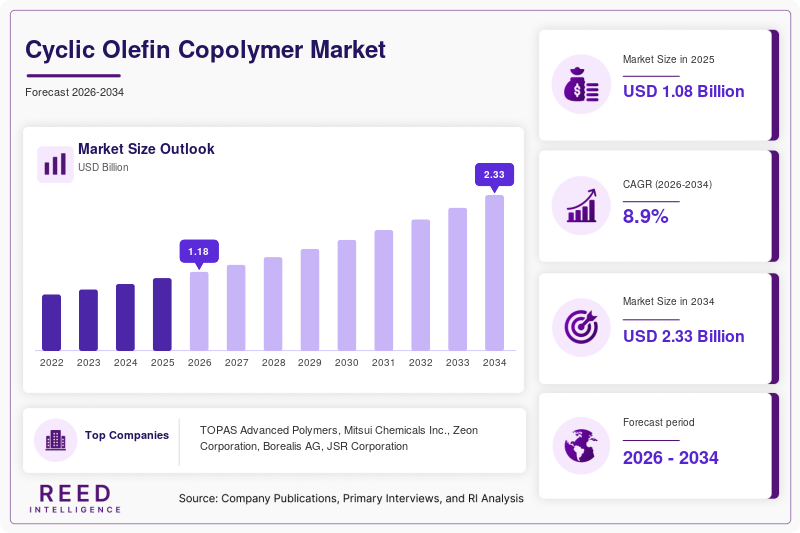
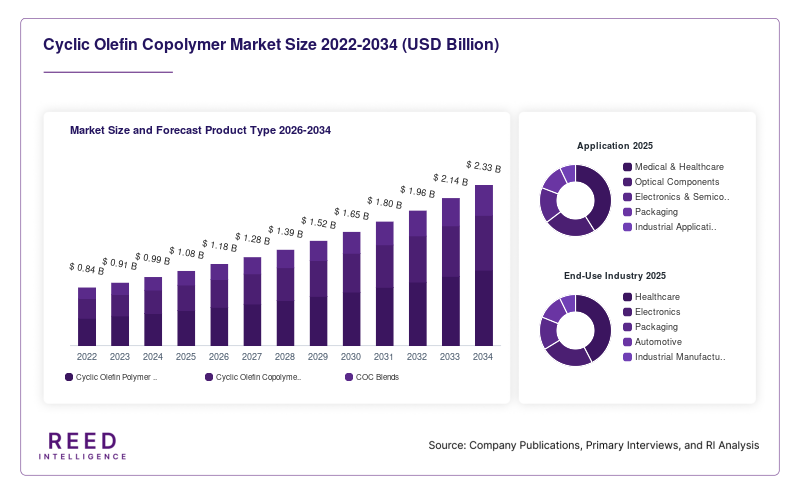
The Cyclic Olefin Copolymer Market size is estimated at USD 1.18 billion, and it is projected to reach USD 2.34 billion by 2034, registering a CAGR of 8.9% during the forecast period.A key global factor supporting the growth of the Cyclic Olefin Copolymer Market is the increasing shift toward advanced polymer materials that offer superior optical clarity, chemical resistance, and low moisture absorption. These properties make cyclic olefin copolymers highly suitable for next-generation healthcare and precision engineering applications.
Key Highlights
- Dominant region share (2025): Asia Pacific held 37.6% share of the global market
- Fastest-growing region CAGR (2026–2034): Middle East & Africa at 9.3% CAGR
- Leading subsegment (Type): Cyclic Olefin Polymer held 54.1% share in 2025
- Fastest-growing subsegment (Type): Cyclic Olefin Copolymer Blends at 9.5% CAGR
- Dominant country: Japan market size was USD 142.3 million in 2024 and USD 151.8 million in 2025
Market Trends
Expansion of Medical-Grade Polymer Applications
The Cyclic Olefin Copolymer Market is witnessing strong adoption in medical diagnostics, drug delivery systems, and laboratory consumables. Its biocompatibility, transparency, and sterilization resistance are driving replacement of conventional plastics in healthcare applications.
Rising Demand in Optical and Electronic Components
Another key trend shaping the Cyclic Olefin Copolymer Market is its growing use in optical lenses, sensors, and semiconductor components. The material’s excellent light transmission and dimensional stability make it highly suitable for precision optical devices and advanced electronic systems.
Market Drivers
Increasing Demand from Medical Device Manufacturing
One of the primary drivers of the Cyclic Olefin Copolymer Market is the rapid expansion of the global medical device industry. COC materials are widely used in syringes, vials, diagnostic cartridges, and microfluidic devices due to their high purity and chemical resistance.
Growth in High-Performance Packaging Solutions
The Cyclic Olefin Copolymer Market is also driven by increasing demand for high-barrier packaging materials in pharmaceuticals and food industries. COC offers excellent moisture barrier properties and transparency, making it suitable for sensitive product packaging applications.
Market Restraint
High Production and Processing Costs
A key restraint affecting the Cyclic Olefin Copolymer Market is the relatively high production cost compared to conventional polymers such as polyethylene and polypropylene. The complex polymerization process and limited manufacturing capacity restrict large-scale adoption in price-sensitive markets.
Market Opportunities
Expansion in Microfluidics and Lab-on-Chip Devices
The rising adoption of microfluidic technologies presents a major opportunity for the Cyclic Olefin Copolymer Market. Its optical clarity, low autofluorescence, and chemical resistance make it ideal for diagnostic chips and biomedical research platforms.
Growth in Lightweight Optical Components
Increasing demand for lightweight optical components in automotive sensors, augmented reality devices, and consumer electronics is creating new growth opportunities. COC materials are being explored as alternatives to glass in precision optical applications.
Segmental Analysis
The Cyclic Olefin Copolymer Market is segmented based on type, application, and end-use industry. Each segment plays a critical role in shaping demand across healthcare, electronics, packaging, and industrial sectors.
By Type Analysis
Cyclic Olefin Polymer (COP) dominated the Cyclic Olefin Copolymer Market in 2025, accounting for 54.1% share. Its dominance is driven by superior optical clarity, high thermal resistance, and strong chemical stability. COP is widely used in medical packaging, diagnostic tools, and optical components where purity and transparency are essential.
Cyclic Olefin Copolymer blends are the fastest-growing subsegment, projected to register a 9.5% CAGR during 2026–2034. These blends offer improved flexibility, impact resistance, and processability, making them suitable for advanced packaging and electronic applications. The Cyclic Olefin Copolymer Market is witnessing increased adoption of blends in high-performance consumer electronics and medical diagnostics.
By Application Analysis
Medical and healthcare applications represented the dominant segment with 46.3% share in 2025. The material is widely used in syringes, diagnostic test kits, IV containers, and microfluidic chips due to its biocompatibility and sterilization resistance.
Optical and electronic applications are the fastest-growing segment, expected to grow at a 9.2% CAGR. Increasing demand for lightweight optical lenses, camera modules, and semiconductor components is driving adoption. The Cyclic Olefin Copolymer Market benefits significantly from rising demand for high-precision optical systems.
Packaging applications also contribute significantly due to rising demand for pharmaceutical blister packs and food-grade containers requiring high barrier protection.
By End-Use Industry Analysis
The healthcare industry dominated the Cyclic Olefin Copolymer Market, holding 49.6% share in 2025. Strong demand for diagnostic devices, drug delivery systems, and sterile packaging continues to support market expansion.
The electronics industry is the fastest-growing end-use segment, projected at a 9.4% CAGR. Growth is driven by increasing semiconductor production, optical sensor integration, and consumer electronics innovation.
The packaging industry also plays a significant role, particularly in pharmaceutical and specialty food packaging where contamination resistance and transparency are critical.
Regional Analysis
North America
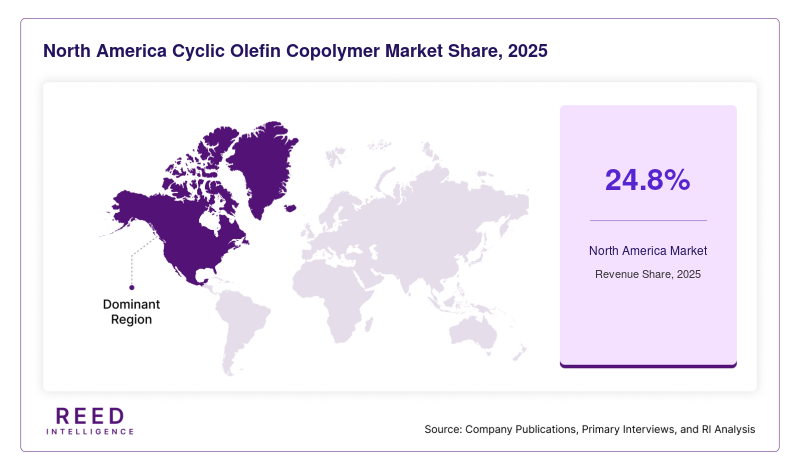
North America accounted for 24.8% share of the global market in 2025. The region is expected to grow at a 8.6% CAGR (2026–2034) due to strong demand from medical device manufacturing and advanced packaging industries. The United States dominates the region due to high healthcare R&D investment and adoption of polymer-based diagnostic systems.
Europe
Europe held 22.9% share in 2025, driven by strong pharmaceutical production and regulatory emphasis on high-performance medical-grade materials. The region is projected to grow at a 8.4% CAGR, with Germany leading due to its advanced medical technology and precision engineering sectors.
Asia Pacific
Asia Pacific dominated the Cyclic Olefin Copolymer Market with 37.6% share in 2025 and is expected to expand at a 9.1% CAGR (2026–2034). Japan, China, and South Korea drive demand due to strong electronics manufacturing, optical device production, and medical device exports.
Middle East & Africa
Middle East & Africa held 7.2% share in 2025 and is expected to register the fastest 9.3% CAGR. Growth is supported by expanding healthcare infrastructure, increasing diagnostic testing facilities, and rising imports of advanced polymer materials.
Latin America
Latin America accounted for 7.5% share in 2025 and is projected to grow at a 8.7% CAGR. Brazil leads the region due to growing pharmaceutical production and increasing adoption of advanced packaging materials in healthcare systems.
Competitive Landscape
The Cyclic Olefin Copolymer Market is moderately consolidated with leading chemical and polymer manufacturers focusing on capacity expansion, product innovation, and application diversification. Companies are investing heavily in high-purity polymer production and advanced material engineering to meet growing demand from healthcare and electronics sectors.
Key players include TOPAS Advanced Polymers, Mitsui Chemicals, Zeon Corporation, Borealis AG, and JSR Corporation. TOPAS Advanced Polymers holds a strong position in the global market due to its specialized cyclic olefin product portfolio and continuous innovation in medical-grade polymers. Mitsui Chemicals continues to expand its production capacity to meet rising demand from Asia Pacific. Zeon Corporation focuses on optical and electronic applications, while Borealis AG strengthens its presence in packaging solutions. JSR Corporation is actively investing in advanced polymer technologies for healthcare and semiconductor industries.
Key Players List
- TOPAS Advanced Polymers
- Mitsui Chemicals Inc.
- Zeon Corporation
- Borealis AG
- JSR Corporation
- LyondellBasell Industries
- SABIC
- Dow Inc.
- ExxonMobil Chemical
- INEOS Group
- LG Chem Ltd.
- Sumitomo Chemical Co., Ltd.
- Kuraray Co., Ltd.
- China Petroleum & Chemical Corporation (Sinopec)
- Formosa Plastics Corporation
Recent Developments
- Expansion of cyclic olefin polymer production capacity in Asia Pacific to meet rising medical demand.
- Increasing investment in microfluidic chip applications using COC materials for diagnostics.
- Development of advanced optical-grade copolymer formulations for consumer electronics.
- Strategic collaborations between polymer manufacturers and healthcare companies for medical device innovation.
- Capacity upgrades in Europe focusing on sustainable and high-purity polymer production.
Cyclic Olefin Copolymer Market Segments
Product Type
- Cyclic Olefin Polymer (COP)
- Cyclic Olefin Copolymer (COC)
- COC Blends
Application
- Medical & Healthcare
- Optical Components
- Electronics & Semiconductors
- Packaging
- Industrial Applications
End-Use Industry
- Healthcare
- Electronics
- Packaging
- Automotive
- Industrial Manufacturing
By Region
- North America
- Europe
- APAC
- Middle East and Africa
- LATAM