Cycling Refrigerated Air Dryers Market Size, Share & Trends Analysis Report By Type, By Capacity, By Application, By End User and By Region, Forecasts 2026–2034
USD 3950
Cycling Refrigerated Air Dryers Market Size
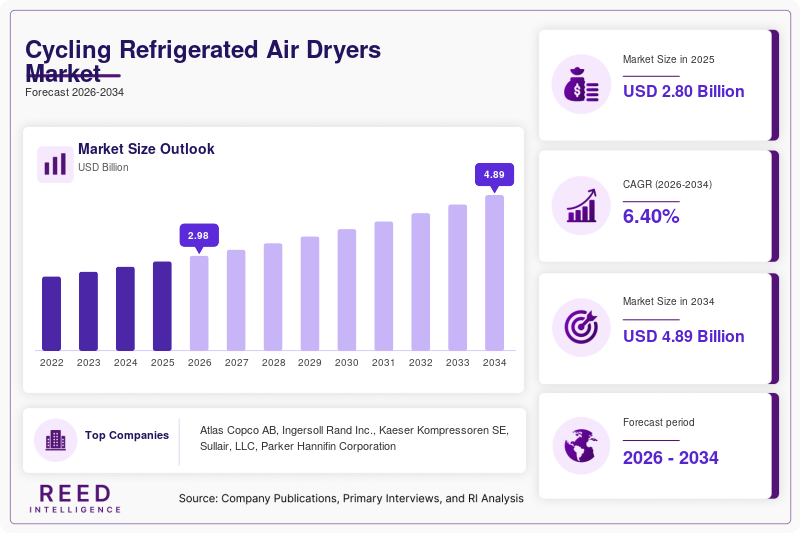
The global cycling refrigerated air dryers market was valued at USD 2.80 billion in 2025 and is projected to grow from USD 2.98 billion in 2026 to USD 4.90 billion by 2034, registering a CAGR of 6.40% during the forecast period from 2026 to 2034.
Cycling refrigerated air dryers are compressed-air treatment systems designed to remove moisture from compressed air while adjusting their cooling operation according to the air-load requirement. Unlike conventional non-cycling dryers, cycling systems can reduce energy consumption by cycling refrigeration capacity when the compressed-air demand decreases.
Compressed air is widely used across manufacturing, food and beverage, pharmaceuticals, chemicals, automotive, electronics, energy and general industrial applications. Moisture in compressed air can cause corrosion, contamination, freezing and malfunction of pneumatic equipment, making effective air drying an important component of compressed-air systems.
Cycling Refrigerated Air Dryers Market Drivers
Increasing Industrial Automation
Compressed air is extensively used for pneumatic actuators, control systems, valves, assembly equipment and automated production lines.
Increasing automation across manufacturing industries is therefore supporting demand for reliable compressed-air treatment equipment.
Growing Focus on Energy Efficiency
Compressed-air systems can represent a significant portion of industrial energy consumption.
Cycling refrigerated dryers can reduce energy use by adjusting refrigeration operation according to demand, supporting their adoption among energy-conscious industrial users.
Expansion of Manufacturing Industries
Growth in automotive, electronics, food processing, chemicals and general manufacturing is increasing the installed base of compressed-air systems.
This is expanding the potential customer base for refrigerated air dryers.
Increasing Need for Compressed-Air Quality
Moisture can damage pneumatic equipment, contaminate processes and reduce the reliability of compressed-air systems.
Industrial operators are therefore investing in air-treatment systems that maintain appropriate compressed-air quality.
Industrial Equipment Modernization
Manufacturers are replacing older compressed-air equipment with more efficient systems.
Modernization programs create opportunities for energy-efficient cycling refrigerated dryers.
Cycling Refrigerated Air Dryers Market Restraints
Higher Initial Cost
Cycling refrigerated air dryers can have higher upfront costs than basic non-cycling systems.
Cost-sensitive users may prioritize lower purchase prices over long-term energy savings.
Maintenance Requirements
Refrigeration circuits, heat exchangers, filters and condensate-management systems require periodic maintenance.
Maintenance requirements can increase the total cost of ownership.
Competition from Alternative Drying Technologies
Desiccant, membrane and deliquescent dryers can provide alternatives for applications requiring different dew points or operating conditions.
This creates competitive pressure in specialized applications.
Sensitivity to Operating Conditions
Refrigerated dryers are generally most suitable for applications where compressed-air dew-point requirements fall within the capabilities of refrigeration-based drying.
Applications requiring very low dew points may require other technologies.
Cycling Refrigerated Air Dryers Market Opportunities
Energy-Efficient Industrial Equipment
Increasing industrial focus on reducing energy consumption creates opportunities for cycling dryers with improved load matching and control systems.
Smart Compressed-Air Systems
Integration of sensors, controllers, remote monitoring and predictive maintenance can improve dryer performance and system visibility.
Smart air-treatment equipment represents an important product-development opportunity.
Food and Beverage Manufacturing
Food-processing facilities use compressed air for packaging, automation and production processes.
Increasing production and quality requirements are creating opportunities for reliable compressed-air treatment systems.
Pharmaceutical Manufacturing
Pharmaceutical production requires controlled manufacturing environments and reliable utilities.
Demand for appropriately treated compressed air creates opportunities for advanced dryer systems.
Replacement of Aging Equipment
A large installed base of older compressed-air equipment creates a replacement opportunity as industrial users seek more efficient and reliable dryers.
Type Segment Analysis
By Type
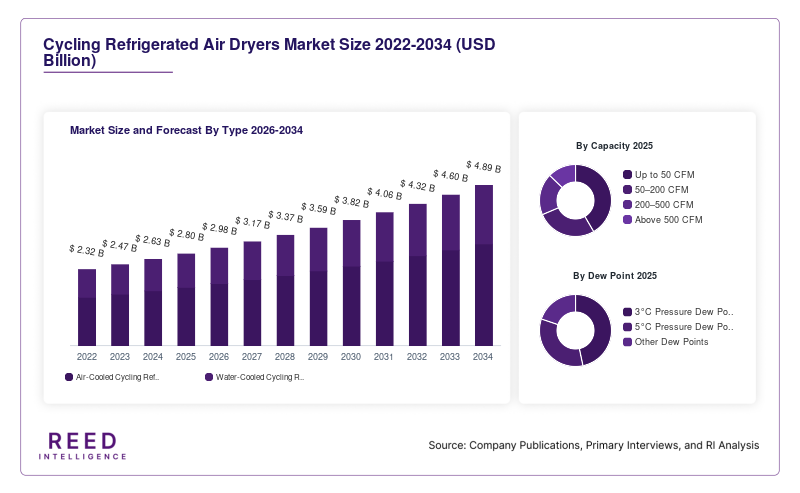
Air-cooled cycling refrigerated air dryers accounted for approximately 61% of the cycling refrigerated air dryers market in 2025, making them the largest type segment. Their relatively simple installation requirements and suitability for a broad range of industrial environments support widespread adoption.
Water-cooled cycling refrigerated air dryers accounted for approximately 39% and are projected to grow at approximately 6.8% CAGR, making them the faster-growing type segment. Their suitability for facilities with available cooling-water infrastructure supports demand in larger industrial installations.
Capacity Segment Analysis
By Capacity
Systems with capacity between 50 and 200 CFM accounted for approximately 35% of the market in 2025, making them the largest capacity segment. This range is suitable for a wide variety of medium-sized industrial compressed-air systems.
Above 500 CFM accounted for approximately 21% and is projected to grow at approximately 7.2% CAGR, making it the fastest-growing major capacity segment. Expansion of large-scale manufacturing facilities and centralized compressed-air systems is supporting demand.
Systems up to 50 CFM represented approximately 20%, while 200–500 CFM represented approximately 24%.
Dew Point Segment Analysis
By Dew Point
3°C pressure dew point systems accounted for approximately 63% of the market in 2025, making them the largest dew-point segment. This performance level is suitable for many general industrial compressed-air applications.
Other specialized dew-point systems accounted for approximately 12% and are projected to grow at approximately 7.0% CAGR, supported by applications requiring specific air-quality and environmental conditions.
5°C pressure dew point systems represented approximately 25% of the market.
Application Segment Analysis
By Application
General manufacturing accounted for approximately 31% of the cycling refrigerated air dryers market in 2025, making it the largest application segment. Manufacturing facilities use compressed air across pneumatic tools, automation, material handling and production processes.
Pharmaceuticals accounted for approximately 10% and are projected to grow at approximately 7.5% CAGR, making it the fastest-growing major application segment. Increasing pharmaceutical manufacturing capacity and stringent process requirements are supporting demand.
Automotive represented approximately 22%, food and beverage 14%, chemicals 9%, electronics 7%, energy 4%, and other applications approximately 3%.
Cycling Refrigerated Air Dryers Market Regional Analysis
Asia-Pacific Holds the Largest Share
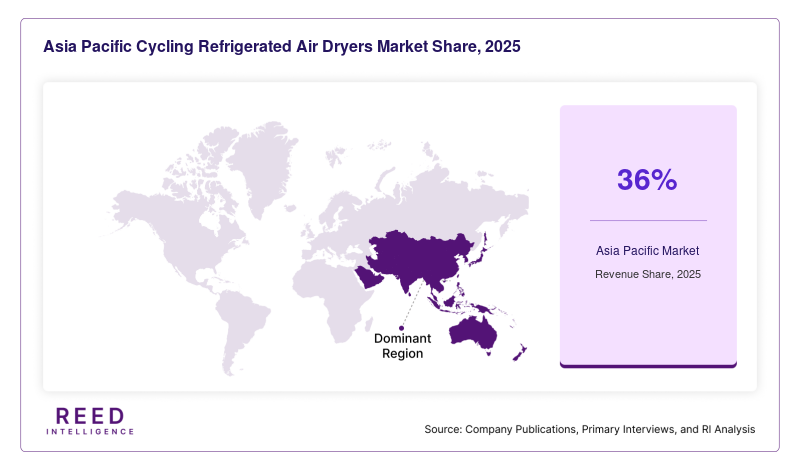
Asia-Pacific accounted for approximately 36% of the global cycling refrigerated air dryers market in 2025, making it the largest regional market. The region benefits from extensive manufacturing activity, industrial automation, expanding production capacity and increasing investment in energy-efficient equipment.
Asia-Pacific is projected to grow at approximately 7.4% CAGR, making it the fastest-growing major region.
North America Maintains Strong Demand
North America accounted for approximately 28% of the market in 2025 and is projected to grow at approximately 5.7% CAGR.
The region benefits from established manufacturing industries, industrial automation and increasing efforts to improve compressed-air energy efficiency.
Europe Focuses on Energy Efficiency
Europe accounted for approximately 24% of the market in 2025 and is projected to grow at approximately 5.5% CAGR.
Industrial energy-efficiency initiatives and modernization of compressed-air infrastructure are supporting demand.
Latin America Shows Moderate Expansion
Latin America accounted for approximately 7% of the market in 2025 and is projected to grow at approximately 5.8% CAGR.
Expansion of manufacturing, food processing and industrial infrastructure is creating additional demand.
Middle East & Africa Represents an Emerging Market
Middle East & Africa accounted for approximately 5% of the market in 2025 and is projected to grow at approximately 5.4% CAGR.
Industrial diversification, energy-sector investment and manufacturing development are supporting adoption.
Cycling Refrigerated Air Dryers Market Competitive Landscape
Competition in the cycling refrigerated air dryers market is based on energy efficiency, cooling performance, pressure dew point, operating reliability, capacity, maintenance requirements, controls, product lifecycle cost and after-sales support.
Manufacturers are increasingly incorporating intelligent controls, variable-capacity operation and monitoring technologies to improve energy performance and system reliability.
Key Market Players
- Atlas Copco AB
- Ingersoll Rand Inc.
- Kaeser Kompressoren SE
- Sullair, LLC
- Parker Hannifin Corporation
- Donaldson Company, Inc.
- BOGE Compressors
- ELGi Equipments Limited
- Gardner Denver
- SPX FLOW, Inc.
Cycling Refrigerated Air Dryers Market Recent Developments
- Industrial operators are increasingly evaluating compressed-air systems based on total energy consumption rather than initial equipment price. Cycling refrigerated dryers can reduce refrigeration-system energy use during periods of lower compressed-air demand.
- Manufacturers are integrating digital controls and sensors that monitor temperature, pressure, dew point and system operating conditions. These capabilities can improve maintenance planning and equipment performance.
Cycling Refrigerated Air Dryers Market Segments
By Type
- Air-Cooled Cycling Refrigerated Air Dryers
- Water-Cooled Cycling Refrigerated Air Dryers
By Capacity
- Up to 50 CFM
- 50–200 CFM
- 200–500 CFM
- Above 500 CFM
By Dew Point
- 3°C Pressure Dew Point
- 5°C Pressure Dew Point
- Other Dew Points
By Application
- General Manufacturing
- Automotive
- Food & Beverage
- Pharmaceuticals
- Chemicals
- Electronics
- Energy
- Others
By Region
- North America
- Europe
- APAC
- Middle East and Africa
- LATAM