Cyclosporine Drugs Market Size, Share & Demand Report By Formulation Type (Oral Capsules, Oral Solutions, Injectable Formulations, Ophthalmic Emulsions), By Application (Organ Transplantation, Autoimmune Diseases, Ophthalmic Disorders), By Distribution Channel (Hospital Pharmacies, Retail Pharmacies, Online Pharmacies), By End User (Hospitals, Specialty Clinics, Ambulatory Surgical Centers) By Region & Segment Forecasts, 2026–2034
USD 3950
Market Overview
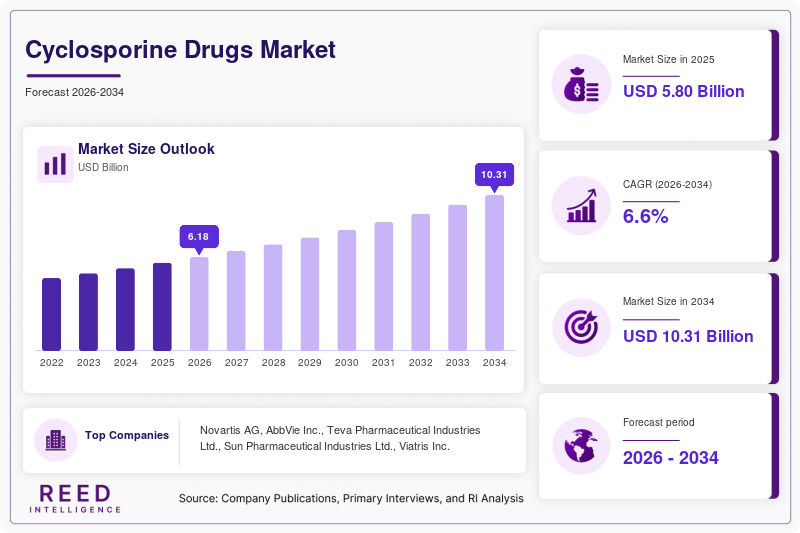
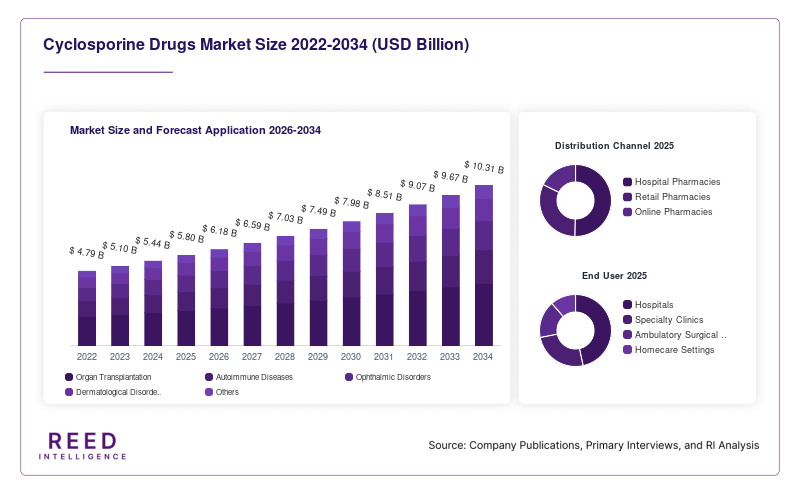
The Cyclosporine Drugs Market size was valued at USD 5.8 billion in 2026 and is projected to reach USD 9.7 billion by 2034, expanding at a CAGR of 6.6% during the forecast period of 2026–2034. The global Cyclosporine Drugs Market growth has been supported by the rising number of organ transplantation procedures and the increasing prevalence of autoimmune disorders worldwide. Cyclosporine-based therapies continue to remain essential in immunosuppressive treatment protocols due to their effectiveness in preventing transplant rejection and controlling inflammatory immune responses. The growing burden of chronic kidney disorders, rheumatoid arthritis, psoriasis, and ophthalmic diseases has further strengthened the demand outlook for cyclosporine formulations across developed and emerging healthcare systems.
The expansion of healthcare infrastructure and broader access to specialty pharmaceutical treatments have also supported the Cyclosporine Drugs Market growth. Pharmaceutical companies are increasingly investing in advanced oral formulations, ophthalmic emulsions, and modified-release products to improve drug bioavailability and patient adherence. In addition, the growing adoption of biologics has not significantly reduced the relevance of cyclosporine drugs because these therapies remain cost-effective and clinically established in several treatment pathways. Favorable reimbursement frameworks in North America and Europe, combined with improving transplant care standards in Asia Pacific, have created a balanced growth environment for the market.
Key Highlights
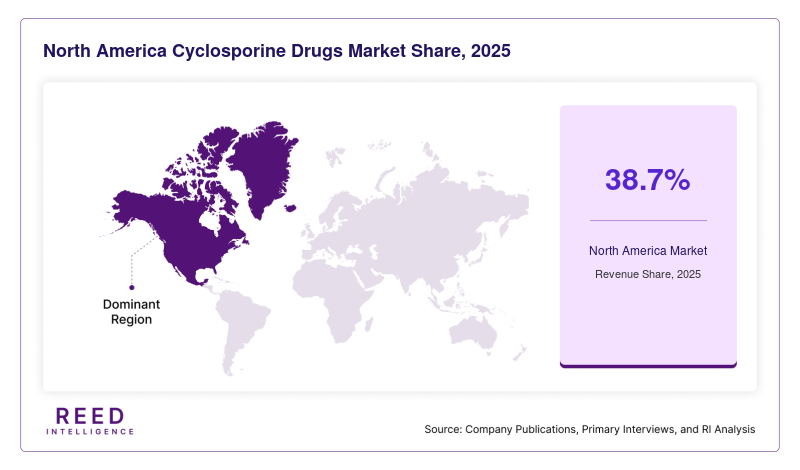
- North America accounted for 38.7% of the global Cyclosporine Drugs Market share in 2025, while Asia Pacific is projected to register the fastest CAGR of 7.8% during 2026–2034.
- By formulation type, oral capsules dominated the market with a 42.4% share in 2025, whereas ophthalmic emulsions are projected to witness the fastest CAGR of 8.1%.
- By application, organ transplantation held the largest market share of 46.8% in 2025, while autoimmune disease treatment is anticipated to expand at a CAGR of 7.3%.
- By distribution channel, hospital pharmacies led the market with a 51.2% share in 2025, whereas online pharmacies are expected to grow at a CAGR of 8.5%.
- The United States dominated the market with values of USD 1.64 billion in 2024 and USD 1.75 billion in 2025.
Market Trends
Rising Adoption of Ophthalmic Cyclosporine Products
One of the significant trends shaping the Cyclosporine Drugs Market is the increasing use of cyclosporine ophthalmic formulations for dry eye syndrome and ocular inflammatory conditions. Aging populations, growing screen exposure, and rising environmental pollution levels have increased the prevalence of chronic eye disorders globally. Pharmaceutical companies are introducing advanced preservative-free eye drop formulations with improved tolerability and therapeutic efficiency. This trend is expected to expand the clinical use of ophthalmic cyclosporine drugs across outpatient care settings and ophthalmology clinics.
Expansion of Generic Immunosuppressive Drug Manufacturing
Another notable trend in the Cyclosporine Drugs Market is the growing penetration of generic formulations. Several branded cyclosporine products have faced patent expiration, allowing generic manufacturers to enter the market with cost-effective alternatives. Healthcare systems in emerging economies are increasingly adopting generic immunosuppressants to reduce treatment costs associated with long-term therapy. This trend has encouraged regional pharmaceutical companies to strengthen production capabilities and improve distribution networks across Asia Pacific, Latin America, and parts of the Middle East.
Market Drivers
Increasing Organ Transplantation Procedures
The rising number of kidney, liver, heart, and lung transplantation procedures globally is a major driver supporting the Cyclosporine Drugs Market growth. Cyclosporine remains a critical immunosuppressive therapy used to prevent graft rejection after organ transplantation. Improvements in surgical outcomes, donor management programs, and post-transplant monitoring have increased the success rate of transplant procedures, thereby driving sustained demand for cyclosporine-based drugs. Healthcare institutions are also investing in specialized transplant centers, contributing to broader treatment adoption.
Growing Prevalence of Autoimmune Diseases
The increasing incidence of autoimmune diseases such as rheumatoid arthritis, psoriasis, nephrotic syndrome, and ulcerative colitis has accelerated the demand for cyclosporine therapies. Changes in lifestyle patterns, environmental exposure, and genetic predisposition have contributed to the growing patient population requiring immunomodulatory treatment. Cyclosporine drugs are widely prescribed in severe autoimmune conditions where conventional therapies provide limited results. Rising awareness regarding early treatment intervention has further strengthened market demand.
Market Restraint
Risk of Long-Term Adverse Effects
One of the primary restraints affecting the Cyclosporine Drugs Market is the risk of nephrotoxicity, hypertension, and other long-term adverse effects associated with prolonged cyclosporine use. Continuous monitoring of drug concentration and organ function increases treatment complexity and healthcare costs. Concerns regarding side effects may encourage physicians to shift selected patients toward alternative biologics or newer immunosuppressive agents, limiting market expansion in some therapeutic areas.
Market Opportunities
Development of Advanced Drug Delivery Systems
The development of improved drug delivery technologies presents a strong opportunity for the Cyclosporine Drugs Market. Pharmaceutical companies are investing in nanoemulsions, lipid-based carriers, and sustained-release formulations to enhance bioavailability and reduce dosing frequency. These innovations are expected to improve patient compliance and support broader clinical adoption across chronic treatment applications.
Expansion in Emerging Healthcare Markets
Emerging economies across Asia Pacific, Latin America, and the Middle East offer substantial growth opportunities for the Cyclosporine Drugs Market. Rising healthcare expenditure, improving hospital infrastructure, and increasing access to specialty medicines are creating favorable market conditions. Government initiatives supporting organ transplantation programs and chronic disease treatment are expected to further expand the regional demand outlook.
Segmental Analysis
By Formulation Type
The oral capsules segment dominated the Cyclosporine Drugs Market with a 42.4% share in 2025 due to widespread use in organ transplantation and autoimmune disease management. Oral formulations remained preferred because of their ease of administration, established clinical efficacy, and broad physician familiarity. Long-term treatment protocols in transplant patients have sustained strong demand for oral cyclosporine capsules across hospital and retail pharmacy settings.
The ophthalmic emulsions segment is projected to register the fastest CAGR of 8.1% during the forecast period. The rising incidence of dry eye syndrome and increasing demand for targeted ocular therapies will support rapid segment growth. Pharmaceutical companies are expected to introduce advanced preservative-free ophthalmic products with enhanced patient comfort and longer therapeutic effectiveness.
By Application
The organ transplantation segment accounted for the largest Cyclosporine Drugs Market share of 46.8% in 2025. Cyclosporine therapies continued to remain an essential component of post-transplant immunosuppressive regimens for kidney, liver, and heart transplant recipients. Rising transplant success rates and improving donor management systems have contributed to sustained segment growth.
The autoimmune diseases segment is expected to expand at a CAGR of 7.3% during 2026–2034. Increasing diagnosis rates for rheumatoid arthritis, psoriasis, and inflammatory disorders are anticipated to support segment growth. Expanding patient awareness regarding early immunosuppressive therapy will further improve treatment adoption across specialty clinics.
By Distribution Channel
Hospital pharmacies led the Cyclosporine Drugs Market with a 51.2% share in 2025 because transplant-related therapies are primarily administered through specialized hospital systems. Hospitals remained key distribution points due to the requirement for close monitoring and physician supervision during treatment initiation and dosage adjustment.
Online pharmacies are anticipated to witness the fastest CAGR of 8.5% during the forecast period. Rising digital healthcare adoption, increasing home-based treatment management, and expanding e-pharmacy infrastructure are expected to support rapid segment expansion. Patients requiring long-term immunosuppressive therapy are increasingly utilizing online channels for prescription refills and medication access.
By End User
Hospitals accounted for the largest market share in 2025 due to the high concentration of transplant surgeries and autoimmune disease treatment procedures within institutional healthcare settings. Hospitals maintained dominance because they offer specialized immunology and transplant care services supported by trained healthcare professionals.
Specialty clinics are projected to register the fastest CAGR during the forecast period. Increasing outpatient treatment adoption and growing demand for specialized autoimmune disease management are expected to support segment expansion. Improved diagnostic capabilities and personalized treatment approaches will further contribute to market growth.
Regional Analysis
North America
North America accounted for 38.7% of the global Cyclosporine Drugs Market share in 2025 and will continue to maintain a strong growth trajectory with a projected CAGR of 6.2% during 2026–2034. The region benefits from advanced healthcare systems, strong reimbursement frameworks, and high organ transplantation volumes. The United States remained the dominant country due to increasing demand for immunosuppressive therapies and strong pharmaceutical research activities. The growing adoption of ophthalmic cyclosporine products for chronic dry eye disease has also contributed to regional market expansion.
Europe
Europe held 27.9% of the global Cyclosporine Drugs Market share in 2025 and is projected to grow at a CAGR of 5.9% during the forecast period. The region has witnessed steady demand for cyclosporine therapies due to increasing autoimmune disease prevalence and expanding geriatric populations. Germany dominated the European market owing to its strong pharmaceutical manufacturing sector and growing investments in transplant medicine. Regulatory support for generic drug approvals has also improved treatment accessibility across several European countries.
Asia Pacific
Asia Pacific represented 22.4% of the global Cyclosporine Drugs Market share in 2025 and is expected to register the fastest CAGR of 7.8% during 2026–2034. Rapid healthcare infrastructure development, rising awareness regarding organ transplantation, and increasing pharmaceutical production capacity are supporting market growth across the region. China emerged as the leading country due to expanding healthcare coverage and rising investments in specialty therapeutics. The increasing prevalence of chronic inflammatory disorders has further strengthened regional demand.
Middle East & Africa
The Middle East & Africa accounted for 6.1% of the global Cyclosporine Drugs Market share in 2025 and is forecast to grow at a CAGR of 5.5% during the assessment period. Improvements in hospital infrastructure and growing access to advanced pharmaceutical treatments have supported regional growth. Saudi Arabia dominated the market because of increasing healthcare modernization initiatives and rising investments in organ transplantation facilities. Expanding public healthcare programs are expected to improve access to immunosuppressive therapies in the coming years.
Latin America
Latin America captured 4.9% of the global Cyclosporine Drugs Market share in 2025 and is projected to expand at a CAGR of 5.7% during 2026–2034. Brazil remained the dominant country due to the growing burden of autoimmune diseases and increasing pharmaceutical imports. Government-supported healthcare programs and expanding specialty pharmacy networks have improved patient access to cyclosporine formulations across the region.
Competitive Landscape
The Cyclosporine Drugs Market remains moderately consolidated with the presence of multinational pharmaceutical companies and regional generic drug manufacturers competing across various therapeutic applications. Companies are focusing on product innovation, geographic expansion, strategic partnerships, and generic formulation development to strengthen market positioning. Market participants are also investing in advanced ophthalmic formulations and modified-release technologies to improve treatment effectiveness and patient adherence.
Novartis AG remained one of the leading companies in the market due to its strong immunology portfolio and established transplant medicine presence. The company continued to expand its specialty pharmaceutical business through product lifecycle management strategies and research investments. AbbVie Inc. maintained a competitive position through its focus on autoimmune disease therapeutics and specialty care solutions. Teva Pharmaceutical Industries Ltd. strengthened its market presence by expanding generic cyclosporine manufacturing capabilities across emerging economies.
Sun Pharmaceutical Industries Ltd. continued to focus on ophthalmic cyclosporine products and regional distribution expansion, particularly in Asia Pacific and Latin America. Viatris Inc. enhanced its immunosuppressive drug portfolio through broader generic product availability and strategic supply agreements with healthcare providers.
Key Players List
- Novartis AG
- AbbVie Inc.
- Teva Pharmaceutical Industries Ltd.
- Sun Pharmaceutical Industries Ltd.
- Viatris Inc.
- Dr. Reddy’s Laboratories Ltd.
- Hikma Pharmaceuticals PLC
- Apotex Inc.
- Santen Pharmaceutical Co., Ltd.
- Lupin Limited
- Glenmark Pharmaceuticals Ltd.
- Cipla Limited
- Aurobindo Pharma Limited
- Bausch + Lomb Corporation
- Akorn Operating Company LLC
Cyclosporine Drugs Market Segments
Formulation Type
A PHP Error was encountered
Severity: Notice
Message: Undefined offset: 0
Filename: reportpages/rd.php
Line Number: 400
Backtrace:
File: /var/www/html/application/views/frontend/reportpages/rd.php
Line: 400
Function: _error_handler
File: /var/www/html/application/controllers/FrontendReportController.php
Line: 420
Function: view
File: /var/www/html/index.php
Line: 315
Function: require_once
- Oral Capsules
- Oral Solutions
- Injectable Formulations
- Ophthalmic Emulsions
- Topical Preparations
Application
- Organ Transplantation
- Autoimmune Diseases
- Ophthalmic Disorders
- Dermatological Disorders
- Others
Distribution Channel
- Hospital Pharmacies
- Retail Pharmacies
- Online Pharmacies
End User
- Hospitals
- Specialty Clinics
- Ambulatory Surgical Centers
- Homecare Settings
By Region
- North America
- Europe
- APAC
- Middle East and Africa
- LATAM