Cylindrical Grinder Market Size, Share & Demand Report By Type (CNC Cylindrical Grinders, Universal Cylindrical Grinders, Plain Cylindrical Grinders), By Application (Automotive, Aerospace, Industrial Machinery, Others), By End-Use (Industrial Manufacturing, Electronics, Energy, Others), By Region & Segment Forecasts, 2026–2034
USD 3950
Market Overview
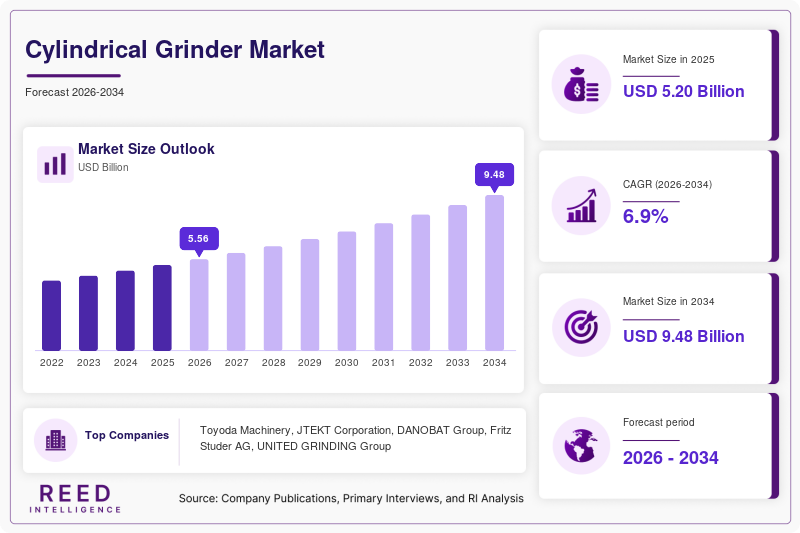
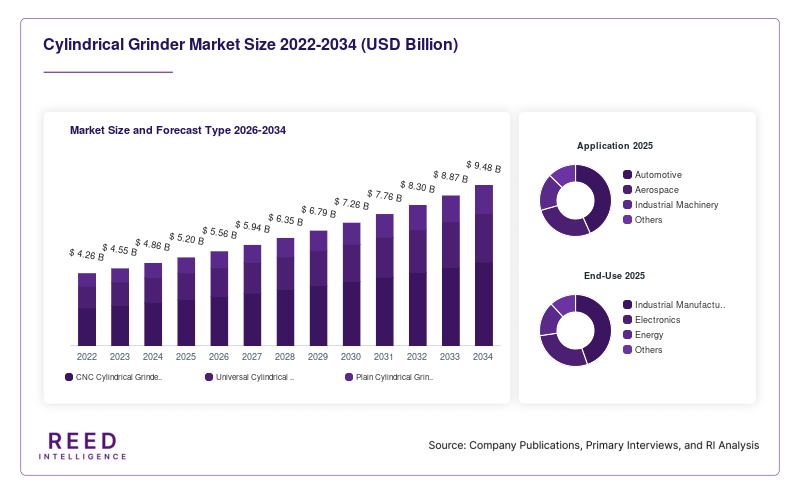
The global Cylindrical Grinder Market size was valued at approximately USD 5.2 billion in 2026 and is projected to reach USD 8.9 billion by 2034, expanding at a compound annual growth rate (CAGR) of 6.9% during the forecast period (2026–2034). The market is experiencing steady growth due to increasing demand for precision machining across automotive, aerospace, and industrial manufacturing sectors. Cylindrical grinders play a critical role in achieving tight tolerances and surface finishes, making them indispensable in high-performance component production.
A key global factor supporting market growth is the increasing adoption of automation and Industry 4.0 technologies in manufacturing environments. Manufacturers are integrating CNC-controlled cylindrical grinders with smart monitoring systems to enhance productivity, reduce downtime, and improve quality consistency. This transformation is enabling companies to optimize machining processes while reducing labor dependency and operational costs.
Key Highlights
- Asia Pacific dominated the market with a 42% share in 2025, while North America is expected to register the fastest CAGR of 7.5%.
- The CNC cylindrical grinder segment led the market with a 58% share, while universal cylindrical grinders are projected to grow at the fastest CAGR of 7.8%.
- Automotive end-use dominated with a 36% share, while aerospace is expected to grow at the fastest CAGR of 7.6%.
- China remained the dominant country, with market values of USD 1.1 billion in 2024 and USD 1.2 billion in 2025.
Market Trends
Increasing Integration of Smart Manufacturing Technologies
The cylindrical grinder market is witnessing a growing trend toward the integration of smart manufacturing technologies. Manufacturers are incorporating sensors, IoT-enabled systems, and predictive maintenance tools into grinding machines. These advancements allow real-time monitoring of machine performance, vibration levels, and temperature variations. As a result, operators can prevent unexpected breakdowns and improve machine utilization rates. Additionally, the use of data analytics helps optimize grinding parameters, leading to enhanced productivity and reduced material wastage. This trend is particularly strong in developed regions where manufacturers are investing heavily in digital transformation initiatives.
Rising Demand for High-Precision Components in Electric Vehicles (EVs)
The rapid expansion of the electric vehicle industry is significantly influencing the cylindrical grinder market. EV components such as motor shafts, transmission parts, and battery housings require high precision and superior surface finishes. Cylindrical grinders are essential in achieving these specifications. As EV production scales globally, the demand for advanced grinding solutions is increasing. Furthermore, manufacturers are developing specialized grinding machines tailored to EV component requirements. This trend is expected to accelerate as governments promote clean energy transportation and automotive companies increase EV production capacities.
Market Drivers
Growth in Automotive and Aerospace Manufacturing
The expansion of automotive and aerospace industries is a major driver for the cylindrical grinder market. These sectors require highly precise components such as crankshafts, camshafts, landing gear parts, and turbine shafts. Cylindrical grinders are essential for achieving the required dimensional accuracy and surface finish. With increasing vehicle production and rising air travel demand, manufacturers are investing in advanced machining technologies. Additionally, the shift toward lightweight materials and complex component designs is further boosting the need for precision grinding solutions.
Adoption of CNC and Automated Grinding Systems
The adoption of CNC and automated cylindrical grinding systems is significantly driving market growth. CNC grinders offer enhanced accuracy, repeatability, and efficiency compared to conventional machines. Automation reduces human error and improves production consistency, which is crucial in high-volume manufacturing. Furthermore, automated loading and unloading systems are reducing cycle times and increasing throughput. Industries are increasingly adopting these systems to remain competitive and meet stringent quality standards. This shift toward automation is particularly prominent in large-scale manufacturing facilities.
Market Restraint
High Initial Investment and Maintenance Costs
One of the key restraints in the cylindrical grinder market is the high initial investment required for advanced grinding machines. CNC cylindrical grinders equipped with automation and smart features involve significant capital expenditure, which can be a barrier for small and medium-sized enterprises. In addition to the initial cost, maintenance and operational expenses are also relatively high. Regular calibration, tool replacement, and skilled labor requirements add to the overall cost burden.
This financial constraint limits the adoption of advanced grinding technologies, particularly in developing regions where budget constraints are more pronounced. For example, small-scale manufacturers often rely on conventional grinding machines due to lower costs, even though they offer lower efficiency and precision. This creates a gap in technological advancement and slows overall market growth. Despite long-term benefits such as improved productivity and reduced waste, the upfront cost remains a critical challenge for many businesses.
Market Opportunities
Expansion of Manufacturing in Emerging Economies
Emerging economies are presenting significant growth opportunities for the cylindrical grinder market. Countries in Asia Pacific, Latin America, and Africa are witnessing rapid industrialization and infrastructure development. Governments are promoting local manufacturing through favorable policies and investments. This is leading to increased demand for machine tools, including cylindrical grinders. Additionally, the availability of low-cost labor and raw materials is attracting global manufacturers to set up production facilities in these regions.
Development of Hybrid and Multi-Functional Grinding Machines
The development of hybrid and multi-functional grinding machines is creating new growth opportunities. Manufacturers are focusing on machines that can perform multiple operations such as grinding, milling, and turning in a single setup. This reduces production time and increases efficiency. Hybrid machines are particularly beneficial for complex components that require multiple machining processes. As industries seek to optimize production workflows and reduce costs, the demand for such advanced machines is expected to grow significantly.
Segmental Analysis
By Type
The CNC cylindrical grinder segment dominated the market in 2024, accounting for approximately 58% of the total share. This dominance is attributed to the superior precision, efficiency, and automation capabilities offered by CNC machines. Industries such as automotive and aerospace rely heavily on CNC grinders to achieve tight tolerances and consistent quality. The ability to program complex grinding operations and reduce manual intervention makes CNC machines highly desirable. Additionally, advancements in software and control systems are enhancing machine performance and productivity.
The universal cylindrical grinder segment is expected to grow at the fastest CAGR of 7.8% during the forecast period. This growth is driven by the versatility of these machines, which can handle a wide range of grinding applications. Universal grinders are particularly useful in small and medium-scale manufacturing where flexibility is essential. The increasing demand for customized components is further supporting the adoption of these machines. Manufacturers are investing in versatile equipment to meet diverse production requirements.
By Application
The automotive segment held the largest share of around 36% in 2024. The demand for cylindrical grinders in this segment is driven by the need for precision components such as shafts, gears, and engine parts. The increasing production of vehicles and the shift toward electric vehicles are further boosting demand. Cylindrical grinders play a crucial role in ensuring the performance and durability of automotive components.
The aerospace segment is projected to grow at the fastest CAGR of 7.6%. This growth is driven by the increasing demand for aircraft and the need for high-precision components. Aerospace components require stringent quality standards, which can be achieved through advanced grinding processes. The use of lightweight materials and complex designs is further increasing the demand for cylindrical grinders in this segment.
By End-Use
The industrial manufacturing segment dominated the market in 2024 with a significant share. This segment includes various industries such as machinery, tools, and equipment manufacturing. The demand for cylindrical grinders is driven by the need for precision machining and high-quality components. Industrial manufacturers are investing in advanced grinding technologies to improve productivity and maintain competitiveness.
The electronics segment is expected to grow at the fastest CAGR of 7.4%. This growth is driven by the increasing demand for electronic devices and components. Cylindrical grinders are used in the production of precision parts such as connectors and housings. The miniaturization of electronic components is further increasing the need for high-precision grinding solutions.
Regional Analysis
North America
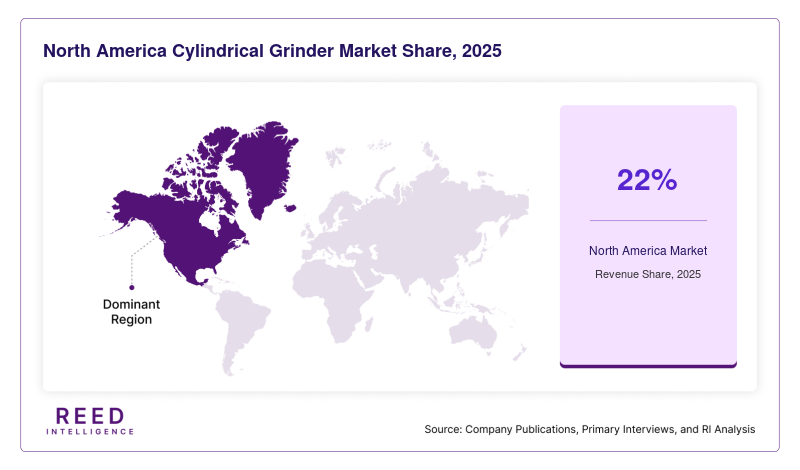
North America accounted for approximately 22% of the cylindrical grinder market share in 2025 and is expected to grow at a CAGR of 7.5% during the forecast period. The region benefits from a strong manufacturing base, particularly in aerospace and automotive sectors. The adoption of advanced machining technologies and automation is driving market growth. Additionally, the presence of established machine tool manufacturers supports innovation and technological advancement in grinding solutions.
The United States dominates the regional market due to its advanced industrial infrastructure and high demand for precision components. A unique growth factor in this region is the increasing investment in reshoring manufacturing activities. Companies are bringing production back to domestic facilities, which is boosting demand for modern grinding equipment. This trend is expected to continue, supporting sustained market growth.
Europe
Europe held a market share of around 20% in 2025 and is projected to grow at a CAGR of 6.7%. The region is known for its strong engineering capabilities and high-quality manufacturing standards. Countries such as Germany, Italy, and France are major contributors to the market. The demand for cylindrical grinders is driven by the automotive and industrial machinery sectors.
Germany leads the European market due to its robust manufacturing ecosystem. A unique growth factor is the region’s focus on precision engineering and innovation. European manufacturers emphasize high-quality production processes, which increases the demand for advanced grinding technologies. This focus on quality and efficiency continues to drive market expansion.
Asia Pacific
Asia Pacific dominated the cylindrical grinder market with a 42% share in 2025 and is expected to grow at a CAGR of 7.2%. The region’s growth is driven by rapid industrialization, increasing manufacturing activities, and rising demand for precision components. Countries such as China, India, and Japan are key contributors to the market.
China is the dominant country in this region, supported by its large manufacturing base. A unique growth factor is the expansion of the automotive and electronics industries. The increasing production of vehicles and electronic components is driving demand for precision grinding machines. Government initiatives supporting industrial growth further enhance market opportunities.
Middle East & Africa
The Middle East & Africa region accounted for approximately 8% of the market share in 2025 and is expected to grow at a CAGR of 6.3%. The region is gradually expanding its manufacturing capabilities, supported by investments in infrastructure and industrial development. The demand for cylindrical grinders is increasing in sectors such as oil and gas, construction, and industrial machinery.
Saudi Arabia is a key contributor to the regional market. A unique growth factor is the diversification of the economy away from oil dependency. Governments are investing in manufacturing and industrial sectors to create sustainable growth. This shift is driving demand for machine tools, including cylindrical grinders.
Latin America
Latin America held a market share of around 8% in 2025 and is projected to grow at a CAGR of 6.5%. The region’s growth is supported by increasing industrialization and expanding manufacturing activities. Countries such as Brazil and Mexico are leading contributors to the market.
Brazil dominates the regional market due to its strong industrial base. A unique growth factor is the growth of the automotive sector, which is driving demand for precision machining tools. Additionally, government initiatives to support local manufacturing are further boosting market growth.
Competitive Landscape
The cylindrical grinder market is moderately fragmented, with several global and regional players competing based on technology, product quality, and pricing. Leading companies are focusing on innovation, product development, and strategic partnerships to strengthen their market position. The market leader is recognized for its advanced CNC grinding solutions and strong global presence.
A key development in the market includes the introduction of smart grinding machines equipped with IoT capabilities. These machines enable real-time monitoring and predictive maintenance, enhancing operational efficiency. Companies are also expanding their product portfolios to cater to diverse industry needs. Additionally, mergers and acquisitions are helping companies expand their market reach and technological capabilities.
Key Players
- Toyoda Machinery
- JTEKT Corporation
- DANOBAT Group
- Fritz Studer AG
- UNITED GRINDING Group
- Okuma Corporation
- EMAG GmbH
- Micromatic Grinding Technologies
- Paragon Machinery
- Shigiya Machinery Works
- Palmary Machinery
- Kellenberger & Co.
- Supertec Machinery
- Ecotech Machinery
- Fortuna GmbH
Recent Developments
- In 2025, a leading manufacturer launched an advanced CNC cylindrical grinder with integrated IoT capabilities for predictive maintenance.
- In 2024, a major company expanded its production facility in Asia Pacific to meet growing regional demand.
- In 2025, a global player introduced a hybrid grinding machine capable of performing multiple machining operations in a single setup.
Cylindrical Grinder Market Segments
Type
- CNC Cylindrical Grinders
- Universal Cylindrical Grinders
- Plain Cylindrical Grinders
Application
- Automotive
- Aerospace
- Industrial Machinery
- Others
End-Use
- Industrial Manufacturing
- Electronics
- Energy
- Others
By Region
- North America
- Europe
- APAC
- Middle East and Africa
- LATAM