Cystatin C Assay Market Size, Share & Demand Report By Product (Reagents & Kits, Instruments), By Assay Type (Particle-Enhanced Turbidimetric Immunoassay, Enzyme-Linked Immunosorbent Assay, Others), By Application (Kidney Function Testing, Cardiovascular Risk Assessment, Others), By End Use (Hospitals, Diagnostic Laboratories, Research Institutes) By Region & Segment Forecasts, 2025–2034
USD 3950
Market Overview
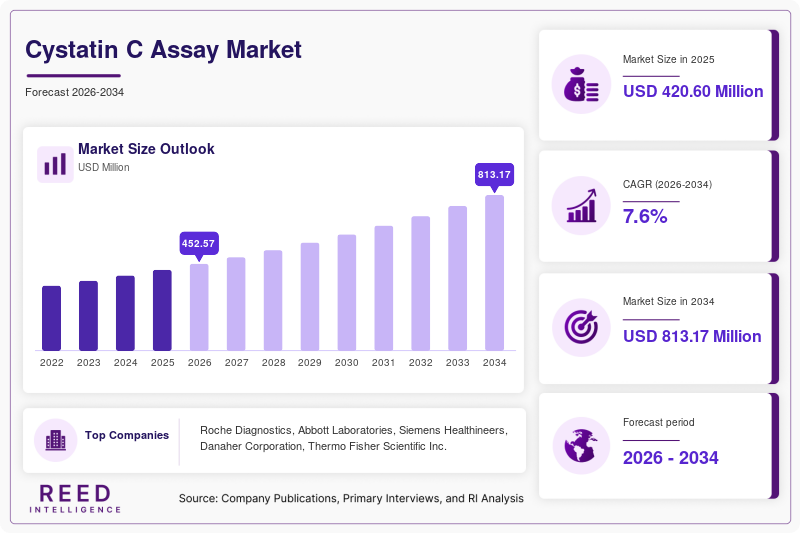
The Cystatin C Assay Market size was valued at USD 420.6 million in 2025 and is projected to reach USD 812.4 million by 2033, expanding at a compound annual growth rate (CAGR) of 7.6% from 2025 to 2034. Growth in the Cystatin C Assay Market is closely associated with the increasing adoption of advanced biomarkers for evaluating kidney function and cardiovascular risk. Compared with conventional creatinine-based testing, cystatin C assays provide improved accuracy in detecting early renal impairment, which has strengthened their clinical relevance in modern diagnostic workflows.
A key global factor supporting the expansion of the Cystatin C Assay Market is the growing burden of chronic kidney disease (CKD) across both developed and emerging healthcare systems. Rising aging populations and increasing prevalence of diabetes and hypertension have intensified demand for reliable renal biomarkers. Healthcare providers and laboratories are increasingly incorporating cystatin C assays into routine diagnostic panels to support earlier intervention and patient monitoring.
Key Highlights
- North America held the dominant regional share of 38.2% in 2025, while Asia Pacific is projected to grow at the fastest CAGR of 9.1% through 2034.
- Within product segments, reagents and kits accounted for the largest share, while particle-enhanced turbidimetric assays are projected to grow at the fastest CAGR of 8.4%.
- The kidney function testing application represented the dominant subsegment, whereas cardiovascular risk assessment is expected to expand at 8.7% CAGR.
- The United States remained the dominant country with a market value of USD 138.5 million in 2025, rising to USD 148.9 million in 2026.
Market Trends
Integration of Cystatin C Testing in Clinical Guidelines
Clinical adoption of cystatin C testing has increased as healthcare organizations integrate the biomarker into diagnostic guidelines for kidney disease evaluation. Physicians are increasingly using cystatin C assays alongside creatinine measurements to improve estimation of glomerular filtration rate (GFR). This trend has strengthened the clinical position of the Cystatin C Assay Market, particularly in hospitals seeking more reliable renal assessment tools for elderly or high-risk patient groups.
Laboratory standardization initiatives are also supporting this shift. Global health authorities and laboratory organizations are encouraging broader adoption of cystatin C assays for CKD screening and disease monitoring. As these recommendations expand across healthcare systems, the demand for cystatin C assays is expected to remain stable over the forecast period.
Automation and High-Throughput Diagnostic Platforms
Another notable trend shaping the Cystatin C Assay Market is the expansion of automated diagnostic platforms capable of handling high-volume testing. Laboratories increasingly rely on automated immunoassay analyzers that integrate cystatin C assays into routine chemistry panels.
Automation enables faster turnaround times, improved reproducibility, and streamlined workflow management. Diagnostic laboratories and hospital networks are adopting these systems to manage rising test volumes while maintaining operational efficiency. As laboratory infrastructure continues to modernize, automated cystatin C assay platforms will play an important role in sustaining market growth.
Market Drivers
Rising Global Prevalence of Chronic Kidney Disease
The growing prevalence of chronic kidney disease has significantly contributed to demand for improved diagnostic biomarkers. CKD often develops without early symptoms, making early detection essential for disease management. Cystatin C assays provide a sensitive measure of kidney filtration efficiency and help detect renal impairment earlier than traditional tests in certain patient populations.
Healthcare systems are increasingly emphasizing preventive diagnostics and early disease detection. As screening programs expand, the Cystatin C Assay Market is benefiting from greater utilization in nephrology clinics, hospitals, and diagnostic laboratories. Rising CKD incidence associated with diabetes, hypertension, and aging populations continues to support steady demand for cystatin C testing.
Expanding Clinical Use in Cardiovascular Risk Assessment
Beyond kidney function evaluation, cystatin C is gaining attention as a biomarker associated with cardiovascular risk. Clinical studies have indicated correlations between elevated cystatin C levels and cardiovascular disease outcomes.
This expanded clinical relevance has encouraged physicians to incorporate cystatin C testing in broader diagnostic panels. Hospitals and research institutions are exploring the biomarker’s potential in identifying high-risk patient groups and supporting preventive care strategies. The widening clinical scope of cystatin C assays is therefore contributing to the growth trajectory of the Cystatin C Assay Market.
Market Restraint
Limited Awareness and Cost Considerations in Emerging Healthcare Systems
Despite its diagnostic advantages, limited awareness of cystatin C testing remains a restraint affecting the Cystatin C Assay Market in certain healthcare systems. Many laboratories continue to rely primarily on creatinine-based tests due to familiarity and cost considerations.
Cystatin C assays typically involve specialized reagents and immunoassay techniques, which can result in higher testing costs compared with traditional renal biomarkers. Budget constraints in smaller hospitals and diagnostic facilities may limit widespread adoption, particularly in developing regions where healthcare spending remains constrained.
Additionally, variability in reimbursement policies for cystatin C testing across healthcare systems can influence purchasing decisions among laboratories. When reimbursement coverage is uncertain, healthcare providers may hesitate to expand routine cystatin C testing programs.
These cost and awareness challenges can slow adoption rates, especially in regions where laboratory infrastructure is still evolving. Addressing these barriers through clinical education, standardized testing guidelines, and cost optimization strategies will be important for the long-term expansion of the Cystatin C Assay Market.
Market Opportunities
Expansion of Preventive Diagnostics and Screening Programs
Preventive healthcare strategies are creating new opportunities for the Cystatin C Assay Market. Healthcare providers are placing greater emphasis on early detection of chronic diseases to reduce long-term treatment costs and improve patient outcomes.
Screening initiatives targeting high-risk populations, including patients with diabetes and hypertension, are increasing the demand for sensitive biomarkers capable of detecting early renal impairment. Cystatin C assays are well positioned to support these programs because they provide reliable measurement of kidney function across diverse patient groups.
As governments and healthcare organizations expand preventive health initiatives, laboratories are expected to incorporate cystatin C testing into routine diagnostic panels, generating additional market growth opportunities.
Growth of Personalized Medicine and Biomarker Research
The rise of personalized medicine is creating further opportunities within the Cystatin C Assay Market. Biomarkers are becoming essential tools for tailoring treatment strategies and monitoring disease progression in individual patients.
Cystatin C has gained interest among researchers studying its role in kidney disease progression and cardiovascular health. Pharmaceutical and clinical research institutions are increasingly incorporating cystatin C measurements into clinical trials and biomarker discovery studies.
This expanding research activity could generate additional demand for cystatin C assays, particularly in academic institutions and specialized laboratories focused on biomarker development.
Segmental Analysis
By Product
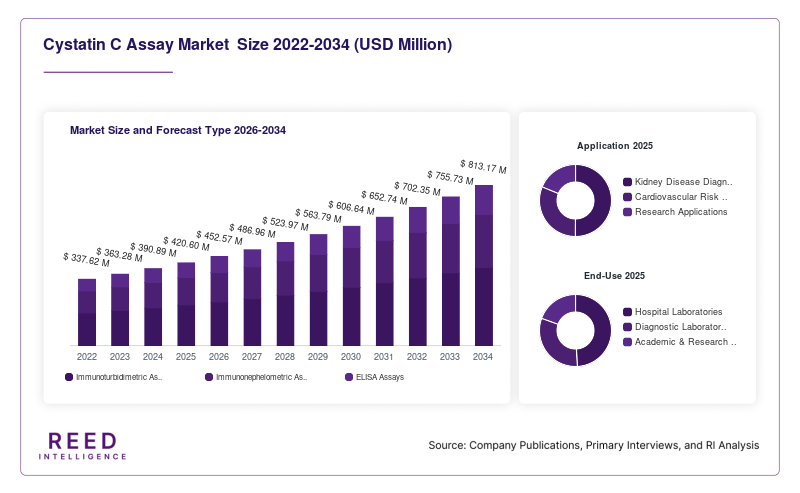
Reagents and kits represented the dominant segment of the Cystatin C Assay Market, accounting for 63.4% of the total market share in 2025. Diagnostic laboratories rely heavily on specialized reagents for performing immunoassay-based cystatin C testing. Hospitals and diagnostic centers typically purchase reagents on a recurring basis, creating stable demand within this segment. The widespread use of automated chemistry analyzers has further strengthened the demand for standardized reagent kits that enable consistent and reliable cystatin C measurements.
The instruments segment will experience the fastest growth with a projected CAGR of 8.1% during the forecast period. Healthcare institutions are expected to increase investment in advanced diagnostic analyzers capable of integrating cystatin C assays into routine testing workflows. These instruments offer high-throughput processing, improved accuracy, and automated calibration features. The continued modernization of laboratory infrastructure will support growth within this segment of the Cystatin C Assay Market.
By Assay Type
Within assay types, particle-enhanced turbidimetric immunoassays (PETIA) held the largest share of the Cystatin C Assay Market, accounting for 48.6% of total revenue in 2025. PETIA assays are widely used in clinical laboratories because they provide rapid and reliable cystatin C measurements compatible with automated chemistry analyzers. Laboratories favor this technique due to its relatively simple workflow and ability to process high sample volumes.
The enzyme-linked immunosorbent assay (ELISA) segment is projected to grow at a CAGR of 8.3% through 2034. ELISA-based cystatin C assays will continue to gain traction in research laboratories and specialized diagnostic facilities that require highly sensitive biomarker detection. Researchers studying renal disease biomarkers often prefer ELISA assays for their analytical precision and adaptability in experimental studies. As biomarker research continues to expand, ELISA-based cystatin C testing will contribute to the growth of the Cystatin C Assay Market.
By Application
Kidney function testing dominated the Cystatin C Assay Market, accounting for 67.8% of total market share in 2025. Cystatin C assays are widely used to estimate glomerular filtration rate and detect early renal impairment. Nephrologists and clinical laboratories rely on cystatin C measurements to complement creatinine-based assessments and improve diagnostic accuracy in specific patient groups.
The cardiovascular risk assessment segment will expand at a projected CAGR of 8.7% during the forecast period. Medical researchers and clinicians increasingly recognize the association between elevated cystatin C levels and cardiovascular disease risk. Hospitals are expected to incorporate cystatin C testing into broader diagnostic panels for evaluating cardiovascular health in high-risk patients. This expanding clinical application will support growth in the Cystatin C Assay Market.
By End Use
Hospitals represented the dominant end-use segment of the Cystatin C Assay Market, accounting for 46.9% of total revenue in 2025. Hospital laboratories perform large volumes of diagnostic testing and are often equipped with automated analyzers capable of conducting cystatin C assays. The growing emphasis on early detection of kidney disease has encouraged hospitals to integrate cystatin C testing into routine diagnostic panels.
The diagnostic laboratories segment will grow at a CAGR of 8.5% through 2034. Independent laboratory networks are expanding their service offerings to include advanced biomarker testing. These facilities process samples from hospitals, clinics, and physicians’ offices, creating consistent demand for cystatin C assays. As diagnostic laboratory networks continue to expand globally, they will play an important role in supporting the growth of the Cystatin C Assay Market.
Regional Analysis
North America
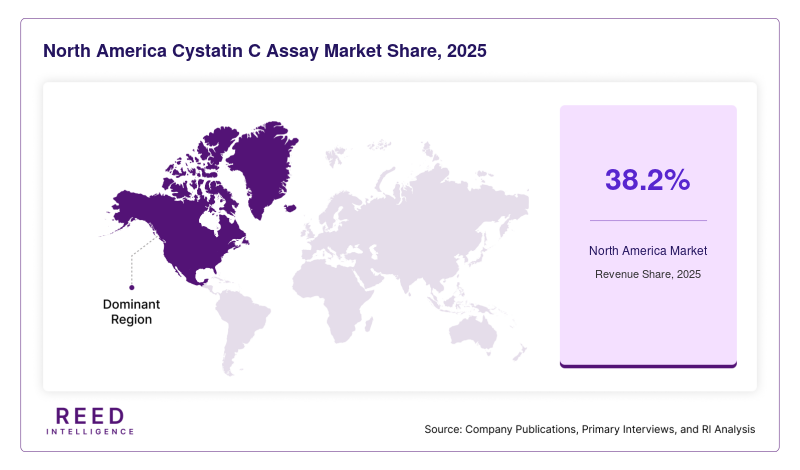
North America accounted for 38.2% of the Cystatin C Assay Market in 2025, reflecting the region’s advanced diagnostic infrastructure and high adoption of biomarker-based testing. The regional market will expand at a projected CAGR of 6.9% between 2025 and 2034 as healthcare providers continue to integrate cystatin C testing into routine renal diagnostics. Hospital laboratories across the United States and Canada have adopted automated immunoassay systems capable of performing cystatin C assays with improved precision and throughput. The presence of established diagnostic manufacturers and well-structured reimbursement frameworks also supported regional market growth.
The United States represented the dominant country within North America. The country’s growth was supported by extensive clinical research on kidney disease biomarkers conducted by medical institutions and nephrology centers. Healthcare providers in the United States increasingly include cystatin C testing as part of advanced renal function evaluation for patients with diabetes and cardiovascular disease. This clinical emphasis on early disease detection has contributed to steady expansion of the Cystatin C Assay Market within the region.
Europe
Europe represented 27.5% of the Cystatin C Assay Market in 2025. The regional market will grow at an estimated CAGR of 6.7% through 2034 as healthcare systems continue to strengthen diagnostic capabilities for chronic disease management. European laboratories have gradually integrated cystatin C assays into clinical practice, particularly in nephrology departments and hospital diagnostic centers. Increasing collaboration between academic institutions and diagnostic companies has also contributed to the development of standardized testing protocols for cystatin C measurement.
Germany remained the dominant country in the European market. The country’s strong laboratory infrastructure and emphasis on clinical research have encouraged adoption of advanced biomarker testing. German hospitals and research institutes have conducted numerous studies examining cystatin C as an indicator of kidney dysfunction and cardiovascular risk. These research initiatives have strengthened awareness of cystatin C testing within the clinical community and supported the expansion of the regional Cystatin C Assay Market.
Asia Pacific
Asia Pacific held 21.4% of the Cystatin C Assay Market in 2025 and is expected to expand at the fastest CAGR of 9.1% during the forecast period. The region’s growth will be supported by rapid improvements in healthcare infrastructure and increasing investment in diagnostic laboratory services. Countries across Asia Pacific are expanding hospital networks and laboratory capacity to address rising chronic disease prevalence.
China dominated the regional market due to its expanding diagnostic testing sector and growing focus on kidney disease management. The Chinese healthcare system has introduced initiatives to strengthen clinical laboratory services in major hospitals. Increasing availability of automated analyzers and diagnostic reagents has enabled wider access to cystatin C testing in urban healthcare centers. As diagnostic infrastructure continues to expand across the country, the Cystatin C Assay Market in Asia Pacific will experience sustained growth.
Middle East & Africa
The Middle East & Africa accounted for 7.1% of the Cystatin C Assay Market in 2025 and will grow at a projected CAGR of 6.4% between 2025 and 2034. Expansion in the region is linked to ongoing investments in healthcare modernization and the development of diagnostic laboratories. Governments in several Middle Eastern countries have prioritized improvements in healthcare services to support early detection of chronic diseases.
The United Arab Emirates emerged as a dominant country within the regional market. Healthcare authorities in the UAE have focused on expanding specialized diagnostic services within hospitals and private laboratories. The increasing presence of international healthcare providers and diagnostic companies has improved access to advanced laboratory technologies. These developments have contributed to the gradual expansion of the Cystatin C Assay Market in the Middle East & Africa.
Latin America
Latin America represented 5.8% of the Cystatin C Assay Market in 2025 and will expand at a projected CAGR of 6.2% through 2034. Regional growth is associated with the gradual strengthening of clinical laboratory networks and improved access to diagnostic testing. Public healthcare systems in several countries have begun investing in advanced laboratory technologies to enhance disease detection capabilities.
Brazil remained the dominant country within the region due to its relatively large healthcare infrastructure and growing diagnostic testing sector. Brazilian hospitals and diagnostic laboratories have expanded the availability of immunoassay platforms capable of performing cystatin C tests. Increasing collaboration between healthcare institutions and diagnostic manufacturers has also supported adoption of biomarker-based testing in clinical practice. As laboratory services continue to develop, the Cystatin C Assay Market in Latin America will experience steady expansion.
Competitive Landscape
The Cystatin C Assay Market is moderately consolidated, with several global diagnostic companies offering immunoassay reagents, kits, and laboratory analyzers. Market participants focus on expanding assay portfolios, improving test accuracy, and strengthening distribution networks to increase market presence.
Roche Diagnostics represents a prominent participant in the market due to its extensive portfolio of clinical chemistry analyzers and diagnostic reagents used in cystatin C testing. The company has continued to expand its biomarker testing capabilities through research initiatives focused on improving kidney disease diagnostics.
Other companies in the market include Abbott Laboratories, Siemens Healthineers, and Danaher Corporation, which provide immunoassay systems and reagents widely used in hospital laboratories. These companies are focusing on developing automated diagnostic platforms capable of integrating multiple biomarker tests, including cystatin C assays, to improve laboratory efficiency.
Strategic partnerships with healthcare institutions and laboratory networks remain a common approach among companies operating in the Cystatin C Assay Market.
Key Players in the Cystatin C Assay Market
- Roche Diagnostics
- Abbott Laboratories
- Siemens Healthineers
- Danaher Corporation
- Thermo Fisher Scientific
- Randox Laboratories
- DiaSys Diagnostic Systems
- BioVendor Group
- Sekisui Diagnostics
- Fujifilm Wako Diagnostics
- Beckman Coulter
- Ortho Clinical Diagnostics
- Tosoh Corporation
- Shenzhen Mindray Bio-Medical Electronics
- Bio-Rad Laboratories
Recent Developments
- 2024: Roche Diagnostics expanded its immunoassay reagent portfolio to support improved cystatin C testing compatibility with automated analyzers.
- 2024: Siemens Healthineers introduced an updated clinical chemistry system designed to integrate multiple biomarker assays, including cystatin C testing.
- 2023: Abbott Laboratories enhanced its laboratory diagnostic solutions with improved reagent kits for kidney function biomarker analysis.
- 2023: Thermo Fisher Scientific expanded biomarker research collaborations involving cystatin C measurement in clinical studies.
- 2022: Beckman Coulter introduced upgraded chemistry analyzer features enabling expanded biomarker testing capabilities.
Cystatin C Assay Market Segments
Type
- Immunoturbidimetric Assays
- Immunonephelometric Assays
- ELISA Assays
Application
- Kidney Disease Diagnostics
- Cardiovascular Risk Assessment
- Research Applications
End-Use
- Hospital Laboratories
- Diagnostic Laboratories
- Academic & Research Institutes
By Region
- North America
- Europe
- APAC
- Middle East and Africa
- LATAM