Dairy Pasteurizer Machines Market Size, Share Demand Report By Product Type (HTST Pasteurizers, Batch Pasteurizers), By Automation Level (Manual Systems, Semi-Automatic Systems), By Capacity (Below 1,000 Liters/Hour, 1,000–5,000 Liters/Hour, Above 5,000 Liters/Hour), By Application (Milk Processing, Cheese Processing, Yogurt Processing, Cream Processing), By End User (Dairy Processing Plants, Dairy Farms, Cooperatives), By Region & Segment Forecasts, 2026–2034
USD 3950
Market Overview
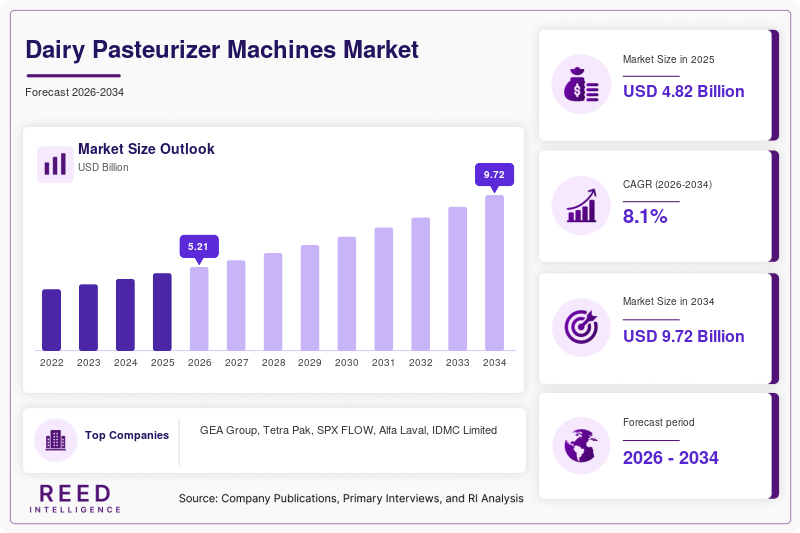
The Dairy Pasteurizer Machines Market size was valued at USD 4.82 billion in 2026 and is projected to reach USD 8.97 billion by 2034, expanding at a CAGR of 8.1% during 2026–2034. The global Dairy Pasteurizer Machines Market growth has been driven by the increasing global demand for safe and hygienic dairy processing systems across commercial dairy farms, milk processing plants, and packaged dairy product manufacturers. Rising urbanization, higher dairy consumption, and stronger food safety regulations have encouraged dairy processors to modernize production infrastructure, supporting the expansion of the Dairy Pasteurizer Machines Market.
The growing adoption of automated processing equipment in emerging economies also contributed to market expansion. Manufacturers increasingly focused on reducing contamination risks, improving shelf life, and maintaining nutritional quality in milk and dairy products. In addition, technological advancements in heat exchange systems, energy-efficient pasteurization processes, and digital monitoring capabilities strengthened the overall market outlook.
Key Highlights
- North America accounted for 34.6% of the global Dairy Pasteurizer Machines Market share in 2025, while Asia Pacific is projected to register the fastest CAGR of 9.4% during 2026–2034.
- By product type, HTST pasteurizers held the leading market share of 46.8% in 2025, while UHT pasteurizers are projected to expand at a CAGR of 9.7% during the forecast period.
- By automation level, fully automatic systems dominated with 57.3% share in 2025, whereas semi-automatic systems are expected to grow at a CAGR of 8.9%.
- By application, milk processing represented 51.2% of the Dairy Pasteurizer Machines Market share in 2025, while yogurt processing applications are anticipated to grow at a CAGR of 9.2%.
- The United States remained the dominant country market and was valued at USD 1.21 billion in 2024 and USD 1.29 billion in 2025.
Market Trends
Integration of Smart Monitoring and IoT-Based Control Systems
One of the major trends shaping the Dairy Pasteurizer Machines Market is the integration of smart automation technologies and IoT-enabled monitoring systems. Dairy processors increasingly adopted digital control panels, remote monitoring solutions, and predictive maintenance software to improve operational reliability. These technologies helped operators monitor temperature consistency, pressure levels, and processing efficiency in real time.
Manufacturers also introduced cloud-connected pasteurization systems capable of storing production data for regulatory compliance and traceability purposes. The trend gained momentum among large dairy cooperatives seeking improved process visibility and reduced product wastage.
Rising Preference for Energy-Efficient Pasteurization Equipment
Energy optimization emerged as another significant trend in the Dairy Pasteurizer Machines Market. Dairy processors focused on lowering utility costs and reducing environmental impact through heat recovery systems and energy-efficient plate heat exchangers. Manufacturers increasingly developed systems with lower steam consumption and optimized thermal transfer capabilities.
The trend became particularly important in regions with rising industrial energy costs. Compact pasteurization units with lower operational footprints gained popularity among small and medium dairy businesses looking to reduce long-term operating expenses.
Market Drivers
Increasing Demand for Processed Dairy Products
The rising consumption of packaged milk, cheese, yogurt, butter, and flavored dairy beverages significantly supported the growth of the Dairy Pasteurizer Machines Market. Consumers increasingly preferred hygienically processed dairy products with longer shelf life and consistent quality standards. This trend encouraged dairy companies to expand processing capacities and upgrade existing pasteurization infrastructure.
Growing demand from urban populations and organized retail chains also strengthened investments in high-capacity dairy processing systems. Expanding cold chain infrastructure across developing economies further accelerated market penetration.
Expansion of Food Safety Regulations in Dairy Processing
Stringent food safety regulations introduced by government authorities and international trade organizations accelerated the adoption of advanced dairy pasteurization systems. Regulatory agencies increasingly emphasized microbial safety, contamination prevention, and product traceability within dairy production operations.
Dairy manufacturers upgraded processing facilities to comply with safety certifications and export standards. The growing need to maintain precise temperature control during dairy processing supported demand for technologically advanced pasteurizer machines with automated monitoring features.
Market Restraint
High Initial Equipment and Maintenance Costs
The high capital investment associated with industrial dairy pasteurizer machines remained a major restraint for the market. Advanced automated systems required substantial expenditure for installation, customization, and operator training. Small dairy processors in developing economies often faced budget limitations, restricting rapid adoption of sophisticated pasteurization equipment.
In addition, maintenance costs related to heat exchangers, pumps, sensors, and control systems created financial pressure for smaller processing facilities.
Market Opportunities
Growing Demand for Modular Dairy Processing Systems
The increasing preference for modular and portable dairy processing solutions presents significant opportunities for the Dairy Pasteurizer Machines Market. Small dairy farms and regional milk cooperatives increasingly adopted compact pasteurization systems that can be installed with limited infrastructure requirements.
Manufacturers are expected to develop scalable systems capable of supporting flexible production volumes, particularly in rural and semi-urban dairy processing facilities.
Expansion of Dairy Exports in Emerging Economies
The growth of dairy exports from countries such as India, New Zealand, and Brazil is expected to create new opportunities for market participants. Export-oriented dairy processors increasingly invested in high-performance pasteurization systems to meet international food quality standards.
The expansion of global dairy trade will likely encourage manufacturers to introduce advanced continuous-flow systems designed for large-scale commercial production.
Segmental Analysis
By Product Type
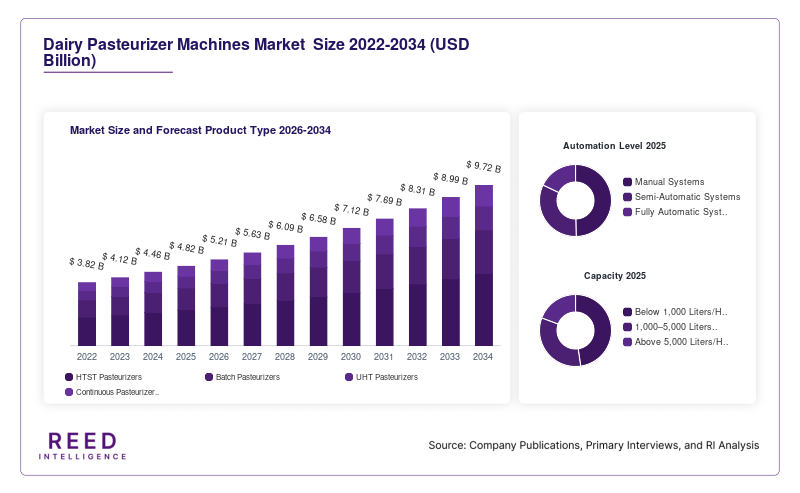
Based on product type, the Dairy Pasteurizer Machines Market is segmented into HTST pasteurizers, batch pasteurizers, UHT pasteurizers, and continuous pasteurizers.
HTST pasteurizers dominated the market with a 46.8% share in 2025 due to their ability to process high milk volumes with shorter heating durations. These systems were widely adopted by commercial dairy processors seeking operational efficiency and consistent microbial reduction performance.
UHT pasteurizers are projected to grow at the fastest CAGR of 9.7% during the forecast period. The growth will be driven by rising demand for long shelf-life dairy beverages and increasing consumption of packaged milk products in regions with limited cold storage infrastructure.
By Automation Level
Based on automation level, the Dairy Pasteurizer Machines Market is categorized into manual systems, semi-automatic systems, and fully automatic systems.
Fully automatic systems accounted for 57.3% of the market share in 2025 due to their superior operational efficiency, process accuracy, and lower labor dependency. Large dairy manufacturers increasingly implemented automated systems to maintain production consistency and regulatory compliance.
Semi-automatic systems are expected to register the fastest CAGR of 8.9% during 2026–2034. Medium-scale dairy enterprises will likely adopt these systems because they offer a balance between affordability and production flexibility.
By Capacity
Based on capacity, the Dairy Pasteurizer Machines Market is segmented into below 1,000 liters/hour, 1,000–5,000 liters/hour, and above 5,000 liters/hour.
The 1,000–5,000 liters/hour segment dominated the market with a 44.5% share in 2025. This capacity range remained highly suitable for medium and large dairy processors operating regional production facilities.
The above 5,000 liters/hour segment is anticipated to grow at a CAGR of 9.1% over the forecast period. Large commercial dairy companies are expected to increase investments in high-capacity systems to support expanding production volumes and export-oriented operations.
By Application
Based on application, the Dairy Pasteurizer Machines Market is divided into milk processing, cheese processing, yogurt processing, cream processing, and flavored dairy beverages.
Milk processing held the dominant market share of 51.2% in 2025 due to high global demand for pasteurized packaged milk products. Dairy processors widely installed large-scale pasteurization systems to ensure product safety and shelf stability.
Yogurt processing is forecast to grow at the fastest CAGR of 9.2% during the assessment period. Increasing consumer demand for probiotic and flavored yogurt products will support investments in specialized pasteurization systems designed for cultured dairy applications.
By End User
Based on end user, the Dairy Pasteurizer Machines Market is segmented into dairy processing plants, dairy farms, cooperatives, and foodservice dairy manufacturers.
Dairy processing plants accounted for 49.7% of the market share in 2025 due to extensive utilization of continuous-flow industrial pasteurizers in large production facilities.
Cooperatives are projected to expand at a CAGR of 8.8% during the forecast period. Regional milk cooperatives are expected to modernize production operations to improve product quality and increase distribution efficiency.
Regional Analysis
North America
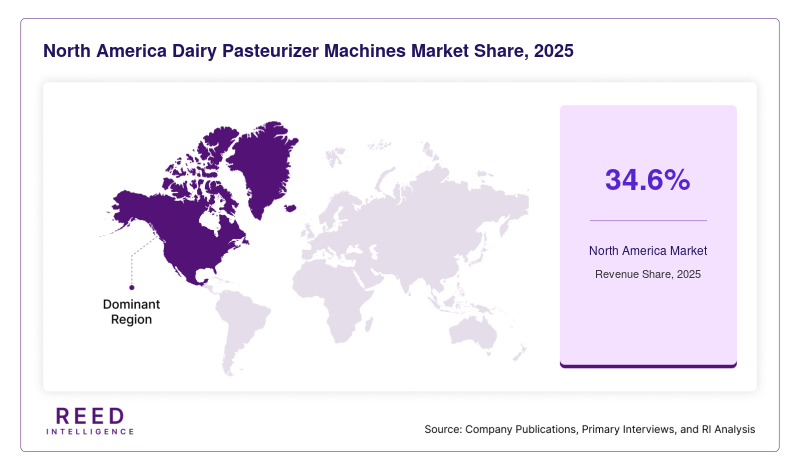
North America accounted for 34.6% of the global Dairy Pasteurizer Machines Market share in 2025 and is projected to grow at a CAGR of 7.4% during 2026–2034. The regional market benefited from the strong presence of industrial dairy processing facilities and high adoption of automated food processing equipment.
The United States dominated the regional market due to rising investments in technologically advanced dairy processing plants. Dairy manufacturers in the country increasingly focused on production efficiency and digital process management, which supported demand for automated pasteurizer systems.
Europe
Europe held 28.1% of the Dairy Pasteurizer Machines Market share in 2025 and is expected to expand at a CAGR of 7.6% over the forecast period. The region experienced stable demand due to the well-established dairy industry and strong regulatory focus on food quality assurance.
Germany represented the leading country market in Europe. The country witnessed increased adoption of energy-efficient dairy machinery as manufacturers focused on reducing industrial energy consumption and improving operational sustainability.
Asia Pacific
Asia Pacific represented 24.3% of the global Dairy Pasteurizer Machines Market share in 2025 and is forecast to register the fastest CAGR of 9.4% during 2026–2034. Rapid urbanization, growing dairy consumption, and expanding organized food retail networks contributed to market growth.
China emerged as the dominant country market due to increasing investments in modern dairy infrastructure. Large-scale dairy producers expanded processing capacities to meet rising domestic demand for packaged dairy products and infant nutrition products.
Middle East & Africa
The Middle East & Africa accounted for 7.2% of the Dairy Pasteurizer Machines Market share in 2025 and is anticipated to grow at a CAGR of 7.9% during the forecast period. Rising investments in food processing industries and improving dairy supply chains supported regional market expansion.
Saudi Arabia remained the leading country market due to increasing government initiatives supporting domestic dairy production and food security programs. Dairy manufacturers adopted advanced pasteurization equipment to improve production reliability in high-temperature environments.
Latin America
Latin America captured 5.8% of the global Dairy Pasteurizer Machines Market share in 2025 and is expected to grow at a CAGR of 8.2% through 2034. The regional market benefited from expanding dairy farming activities and growing demand for processed dairy beverages.
Brazil dominated the Latin American market due to rising investments in commercial dairy processing infrastructure. Local dairy producers increasingly adopted automated processing systems to improve production consistency and export competitiveness.
Competitive Landscape
The Dairy Pasteurizer Machines Market remained moderately consolidated, with leading companies focusing on technological innovation, energy efficiency, and global expansion strategies. Market participants emphasized automation integration, advanced thermal processing systems, and customized dairy solutions to strengthen competitive positioning.
GEA Group remained one of the leading companies in the market due to its extensive dairy processing equipment portfolio and strong global distribution network. The company recently introduced upgraded energy-efficient pasteurization systems with advanced digital monitoring capabilities for large dairy processors.
Tetra Pak focused on integrated dairy processing and packaging solutions designed for high-capacity operations.
SPX FLOW expanded its automated pasteurization product line to improve thermal efficiency and reduce operational downtime.
Alfa Laval concentrated on developing compact heat exchange technologies for dairy processing applications.
IDMC Limited strengthened its regional market presence by expanding manufacturing capabilities for dairy processing machinery.
Key Players List
- GEA Group
- Tetra Pak
- SPX FLOW
- Alfa Laval
- IDMC Limited
- Paul Mueller Company
- Krones AG
- Feldmeier Equipment
- MicroThermics
- Reda S.p.A.
- JBT Corporation
- A&B Process Systems
- Scherjon Equipment Holland
- Neologic Engineers
- Shanghai Beyond Machinery
Recent Developments
- In 2025, GEA Group introduced an upgraded automated dairy pasteurization platform featuring advanced thermal recovery technology for industrial dairy plants.
- In 2025, SPX FLOW expanded its continuous-flow dairy pasteurizer portfolio to support large-scale milk processing operations.
- In 2024, Alfa Laval launched compact heat exchanger solutions designed for energy-efficient dairy processing applications.
- In 2024, Tetra Pak announced investments in integrated dairy processing technologies focused on operational automation.
- In 2025, IDMC Limited expanded manufacturing operations to increase production capacity for dairy processing machinery in Asia Pacific.
Dairy Pasteurizer Machines Market Segments
Product Type
- HTST Pasteurizers
- Batch Pasteurizers
- UHT Pasteurizers
- Continuous Pasteurizers
Automation Level
- Manual Systems
- Semi-Automatic Systems
- Fully Automatic Systems
Capacity
- Below 1,000 Liters/Hour
- 1,000–5,000 Liters/Hour
- Above 5,000 Liters/Hour
Application
- Milk Processing
- Cheese Processing
- Yogurt Processing
- Cream Processing
- Flavored Dairy Beverages
End User
- Dairy Processing Plants
- Dairy Farms
- Cooperatives
- Foodservice Dairy Manufacturers
By Region
- North America
- Europe
- APAC
- Middle East and Africa
- LATAM