Dance School Management System Market Size, Share & Demand Report By Deployment Mode (Cloud-Based, On-Premise, Hybrid Deployment), By Application (Virtual Class Management & Engagement, Performance & Event Management), By End User (Independent Dance Instructors, Community Dance Centers, Educational Institutions, Multi-Location Franchise Dance Schools), By Region & Segment Forecasts, 2026–2034
USD 3950
Market Overview
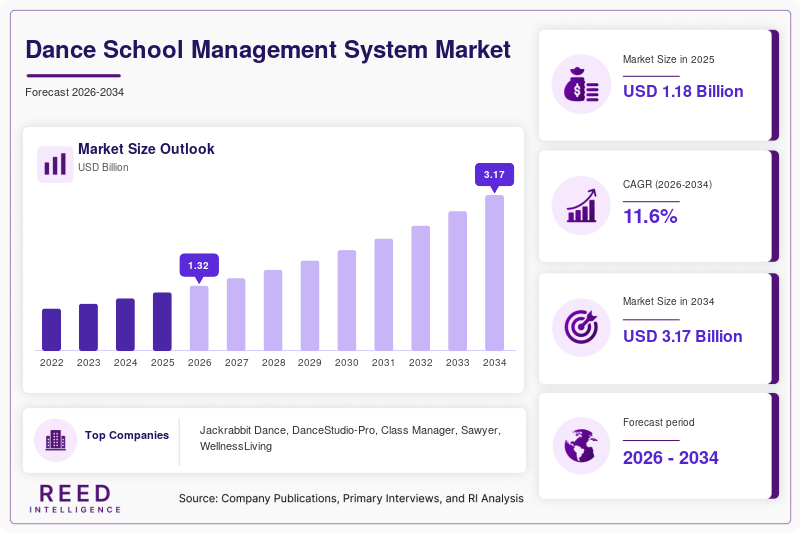
The global Dance School Management System Market size was valued at USD 1.18 billion in 2026 and is projected to reach USD 2.84 billion by 2034, expanding at a CAGR of 11.6% during 2026–2034. The market is experiencing steady expansion as dance academies, performing arts institutions, and independent instructors increasingly adopt digital platforms to streamline administrative functions, student enrollment, attendance tracking, billing, scheduling, communication, and performance management. The transition toward cloud-based business operations across the education and training ecosystem has created favorable conditions for the adoption of specialized management solutions tailored to dance schools.
A major global factor supporting market growth is the accelerated digital transformation of small and medium-sized educational institutions. Dance schools are moving away from manual paperwork and spreadsheet-based administration toward integrated software ecosystems that improve operational efficiency and student engagement. The growing demand for mobile accessibility, automated payment processing, virtual class management, and real-time communication tools has further strengthened software adoption across both developed and emerging economies.
Key Highlights
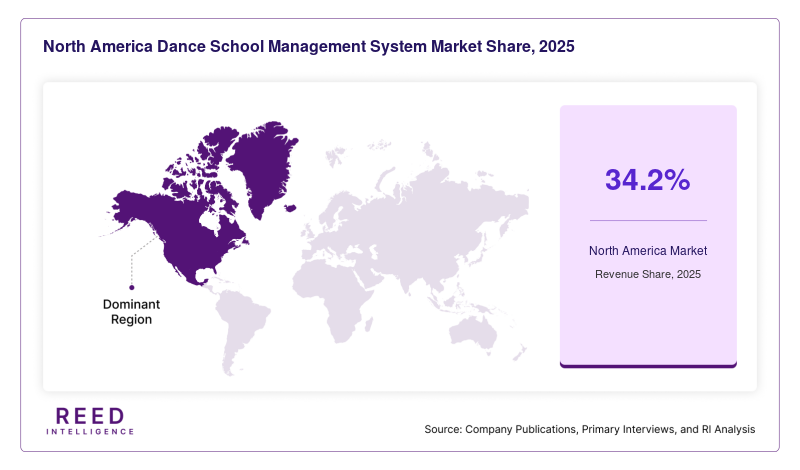
- North America dominated the market with a 34.2% share in 2025.
- while Asia Pacific is expected to grow at the fastest CAGR of 13.1% during 2026–2034.
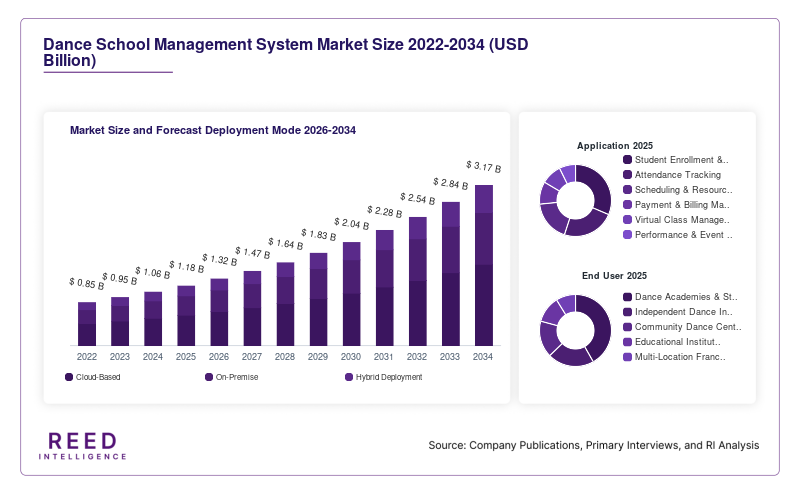
- By deployment mode, cloud-based solutions accounted for the largest share of 67.8%.
- while AI-enabled cloud platforms are projected to grow at a CAGR of 14.5%.
- By application, student enrollment and administration management led with a 39.4% share.
- whereas virtual class management and engagement tools are expected to expand at a CAGR of 14.2%.
- By end user, dance academies and studios held the largest share of 61.3%.
- while multi-location franchise dance schools are projected to grow at a CAGR of 13.8%.
- The United States remained the dominant country, with market values of USD 312 million in 2024 and USD 348 million in 2025.
Market Trends
Expansion of Cloud-Based Subscription Platforms
The Dance School Management System Market is witnessing substantial growth in cloud-based subscription platforms that enable schools to manage operations from any location. Cloud deployment has become attractive because it reduces upfront infrastructure costs while providing continuous software updates and scalability. Dance schools increasingly prefer subscription-based models that align with operational budgets and allow administrators to access data through desktops, tablets, and smartphones. Integrated payment gateways, automated reminders, attendance monitoring, and scheduling features improve operational efficiency and reduce administrative workloads. As institutions seek flexible and cost-effective solutions, cloud-based systems continue to gain traction among both independent studios and large dance education networks operating across multiple locations.
Integration of Student Engagement and Virtual Learning Features
Software vendors are increasingly integrating student engagement tools and virtual learning capabilities into management platforms. Modern dance schools require more than administrative software; they seek solutions that enhance the student experience through online class booking, video content libraries, personalized progress tracking, and digital communication channels. The growing acceptance of hybrid learning models has encouraged vendors to incorporate live-streaming support and virtual classroom functionality. These features enable schools to expand geographic reach and retain students who prefer remote participation. As competition among dance institutions increases, technology-driven engagement strategies are becoming essential for improving retention rates and strengthening relationships between instructors, students, and parents.
Market Drivers
Rising Digitalization Across Performing Arts Education
The increasing digitalization of performing arts education is a significant factor driving the Dance School Management System Market. Dance schools are under pressure to improve operational efficiency while delivering better experiences for students and parents. Traditional administrative processes often involve manual recordkeeping, paper-based registrations, and fragmented communication systems. Management software helps consolidate these activities into a single platform, reducing errors and saving time. Digital tools also enable institutions to generate reports, track financial performance, and monitor attendance in real time. As educational organizations continue investing in digital infrastructure, specialized dance management systems are becoming an important component of long-term operational strategies.
Growing Demand for Automated Scheduling and Payment Solutions
Dance schools frequently manage complex schedules involving multiple instructors, studios, student groups, and performance events. Automated scheduling solutions help eliminate conflicts, improve resource utilization, and reduce administrative burdens. Simultaneously, integrated payment management capabilities streamline tuition collection, invoicing, and recurring billing processes. Parents and students increasingly expect convenient digital payment options and transparent account management. Automated systems improve cash flow management while minimizing missed payments and administrative follow-ups. As dance schools expand enrollment and diversify class offerings, demand for software solutions that automate scheduling and financial operations continues to increase, supporting sustained market growth during the forecast period.
Market Restraint
Budget Constraints Among Small Independent Studios
Budget limitations among small and independent dance studios remain a notable challenge for market expansion. Many local dance schools operate with limited financial resources and prioritize spending on instructors, facilities, costumes, and performance activities. As a result, investment in specialized management software may be delayed despite the operational benefits. Subscription fees, implementation costs, staff training requirements, and system migration expenses can create barriers to adoption, particularly in developing regions. Some institutions continue relying on spreadsheets or generic administrative tools because they perceive dedicated management systems as costly. This challenge can slow software penetration among smaller organizations and create disparities in technology adoption across different market segments. Although vendors are introducing affordable pricing models and modular solutions, budget concerns remain a factor influencing purchasing decisions and implementation timelines.
Market Opportunities
Growth Potential in Emerging Education Markets
Emerging economies present significant opportunities for participants in the Dance School Management System Market. Urbanization, rising disposable income, and growing interest in extracurricular education are contributing to the expansion of dance training institutions across Asia, Latin America, and parts of the Middle East. Many newly established dance schools are adopting digital solutions from the outset rather than transitioning from legacy systems. This environment creates favorable conditions for software providers offering scalable and affordable cloud-based platforms. Vendors that localize language support, payment integration, and regulatory compliance features can strengthen market penetration. As dance education becomes increasingly organized in developing markets, demand for professional management solutions is expected to rise steadily.
Adoption of Artificial Intelligence and Advanced Analytics
Artificial intelligence and advanced analytics offer promising opportunities for software developers operating in this market. Dance schools increasingly seek actionable insights related to enrollment trends, student retention, instructor performance, and revenue generation. AI-powered analytics can help administrators identify growth opportunities, forecast enrollment patterns, and optimize scheduling decisions. Predictive tools can support personalized student engagement strategies and improve operational planning. Additionally, intelligent automation can simplify administrative workflows and reduce repetitive tasks. As educational institutions become more data-driven, the integration of advanced analytics and AI capabilities is expected to create new revenue streams and product differentiation opportunities for software providers.
Segmental Analysis
By Deployment Mode
Cloud-based solutions represented the dominant subsegment within the deployment mode category, accounting for approximately 67.8% of market revenue in 2024. Their leadership position stems from flexibility, scalability, and lower infrastructure requirements compared with on-premise alternatives. Dance schools increasingly favor cloud platforms because they enable remote access to operational data and support collaboration among administrators, instructors, students, and parents. Subscription-based pricing models reduce upfront investment requirements while providing continuous software updates and security enhancements. The ability to integrate scheduling, attendance, billing, communication, and reporting functions within a centralized platform has made cloud deployment the preferred choice for institutions seeking operational efficiency and long-term scalability. Growing internet penetration and expanding adoption of software-as-a-service solutions continue to reinforce the segment's market dominance.
AI-enabled cloud platforms are expected to emerge as the fastest-growing deployment subsegment, advancing at a CAGR of 14.5% through 2034. These platforms incorporate intelligent automation, predictive analytics, and advanced reporting capabilities that support more informed decision-making. Dance schools increasingly seek technology solutions capable of forecasting enrollment trends, optimizing class schedules, and improving student retention strategies. AI-powered systems can automate repetitive administrative tasks while delivering personalized insights that enhance operational performance. The growing availability of affordable artificial intelligence tools is encouraging software vendors to expand platform capabilities. As educational institutions place greater emphasis on efficiency, data-driven management, and customer engagement, demand for AI-enhanced cloud solutions is expected to accelerate significantly throughout the forecast period.
By Application
Student enrollment and administration management constituted the leading application subsegment, accounting for approximately 39.4% of market revenue in 2024. Dance schools rely heavily on software platforms to simplify registration processes, maintain student records, manage attendance, and coordinate communications. Efficient enrollment management is critical because it directly influences operational workflows and revenue generation. Administrative automation reduces paperwork, minimizes errors, and improves data accuracy. Institutions also benefit from centralized record management that enables quick access to student information and performance history. As dance schools continue expanding class offerings and enrollment volumes, demand for solutions that streamline administrative operations remains strong. The broad applicability of enrollment management functionality contributes significantly to its dominant market position.
Virtual class management and engagement tools are projected to register the fastest CAGR of 14.2% during 2026–2034. Growing acceptance of hybrid and remote learning models is creating demand for software features that support online instruction, content sharing, progress tracking, and student interaction. Dance schools are increasingly adopting digital engagement strategies to expand geographic reach and accommodate diverse learning preferences. Virtual tools provide flexibility for students who cannot attend in-person classes while enabling institutions to develop additional revenue streams. The integration of video conferencing, performance analytics, and communication features further enhances platform value. As technology-driven learning experiences become more common, virtual engagement applications are expected to gain substantial market traction.
By End User
Dance academies and studios represented the largest end-user subsegment, capturing approximately 61.3% of market revenue in 2024. These organizations manage large volumes of student registrations, class schedules, instructor assignments, and payment transactions. Dedicated management systems help streamline daily operations while improving communication among stakeholders. Dance academies often require comprehensive platforms capable of supporting multiple administrative functions within a single environment. Increasing competition among institutions has also encouraged investment in technology solutions that enhance customer experience and operational efficiency. The segment's dominance reflects the widespread adoption of management software among independent studios, professional academies, and community-based dance education providers seeking sustainable growth and improved service delivery.
Multi-location franchise dance schools are expected to achieve the fastest growth, registering a CAGR of 13.8% through 2034. These organizations face complex operational requirements involving centralized management, standardized reporting, instructor coordination, and performance monitoring across multiple facilities. Advanced management systems provide scalability and visibility that support franchise expansion strategies. Software platforms enable consistent operational practices while simplifying communication between headquarters and individual locations. The increasing popularity of franchise-based dance education models is generating demand for enterprise-grade solutions capable of supporting larger organizational structures. As franchise networks continue expanding domestically and internationally, technology adoption within this subsegment is expected to increase considerably.
Regional Analysis
North America
North America accounted for approximately 34.2% of the global Dance School Management System Market in 2025 and continues to represent the largest regional market. The region is expected to register a CAGR of 10.8% between 2026 and 2034. Strong technology adoption, widespread use of cloud software, and a mature performing arts education ecosystem contribute to market expansion. Educational institutions increasingly invest in management platforms to streamline operations and improve student engagement. The presence of established software vendors further supports innovation and adoption across the region.
The United States remains the dominant market within North America. A major growth factor is the extensive network of dance studios, academies, and performing arts institutions that require efficient administrative management. Increasing demand for integrated payment processing, attendance tracking, and parent communication tools continues to support software adoption. The country's advanced digital infrastructure and high acceptance of subscription-based software models strengthen long-term market growth prospects.
North American institutions are also increasingly investing in hybrid learning capabilities. Dance schools are expanding their service offerings through virtual classes and digital performance content, creating additional demand for software solutions capable of supporting online engagement and content delivery. These evolving operational requirements are encouraging software vendors to introduce enhanced platform capabilities.
The region also benefits from strong investment in educational technology. Venture capital activity and strategic partnerships among software providers contribute to product innovation. Enhanced cybersecurity features, analytics tools, and mobile applications are becoming important differentiators, further supporting regional market development.
Europe
Europe represented approximately 27.4% of the global market in 2025 and is projected to expand at a CAGR of 10.6% through 2034. The region benefits from a well-established arts and cultural sector, along with increasing digital transformation initiatives across educational institutions. Dance schools are adopting management software to improve administrative efficiency and enhance communication with students and parents. Growing emphasis on operational transparency and financial management is further supporting software deployment.
The United Kingdom leads the European market due to its extensive performing arts ecosystem and strong adoption of educational technology solutions. A unique growth factor is the integration of digital management platforms into community-based dance education programs. These institutions seek software tools that simplify enrollment management, scheduling, and event coordination while supporting student engagement initiatives.
European dance schools are increasingly emphasizing data privacy and compliance requirements. Software providers offering secure cloud infrastructure and regulatory compliance features are gaining competitive advantages. This trend supports market growth while encouraging the development of advanced platform functionalities.
The growing popularity of recreational dance activities among adults and children is also contributing to market expansion. Increasing enrollment levels create greater administrative complexity, making dedicated management systems more valuable for educational institutions throughout the region.
Asia Pacific
Asia Pacific held approximately 24.1% of the market in 2025 and is anticipated to record the fastest CAGR of 13.1% during the forecast period. Rapid urbanization, increasing disposable income, and expanding participation in extracurricular education are driving demand for dance schools and related management software. The region is experiencing significant growth in private educational institutions, creating opportunities for cloud-based software providers seeking new customer segments.
China represents the largest country-level market in Asia Pacific. A key growth factor is the increasing investment in arts education and youth development programs. Growing numbers of dance academies require efficient administrative systems to manage enrollment, attendance, and financial transactions. The scalability of cloud-based platforms makes them particularly attractive for rapidly expanding institutions across urban centers.
Digital payment adoption is accelerating throughout the region, creating favorable conditions for integrated management platforms. Dance schools increasingly seek solutions that combine administrative functionality with modern payment processing and communication tools, supporting broader software adoption.
The expansion of smartphone usage and internet accessibility is further strengthening market growth. Mobile-friendly applications enable administrators, instructors, parents, and students to interact seamlessly, enhancing operational efficiency and user experience across educational organizations.
Middle East & Africa
The Middle East & Africa accounted for approximately 7.2% of global revenue in 2025 and is projected to grow at a CAGR of 11.4% through 2034. Although the market remains relatively smaller than other regions, increasing investment in education and digital transformation initiatives is creating favorable conditions for software adoption. Dance schools are gradually embracing management systems to improve administrative efficiency and support business growth objectives.
The United Arab Emirates is the leading market within the region. A significant growth factor is the expansion of private educational and recreational training institutions. Dance schools are increasingly adopting cloud-based management platforms to manage student registrations, payment processing, and scheduling activities. The country's focus on technology-driven services supports continued market development.
Rising participation in cultural and performing arts activities is contributing to increased demand for professional management tools. Institutions seek solutions that enable better coordination of classes, events, and instructor schedules while improving communication with students and families.
Regional governments are also encouraging digital transformation across educational sectors. Improved technology infrastructure and growing awareness of operational efficiency benefits are expected to support long-term software adoption across the Middle East and selected African markets.
Latin America
Latin America captured approximately 7.1% of the Dance School Management System Market in 2025 and is expected to register a CAGR of 10.9% during the forecast period. The region is experiencing gradual growth in organized dance education and extracurricular learning activities. Educational institutions are increasingly recognizing the benefits of management software in reducing administrative complexity and enhancing operational visibility.
Brazil remains the dominant country in Latin America. A unique growth factor is the strong cultural connection to dance and performing arts activities. The large number of community-based and private dance schools creates demand for solutions that streamline enrollment management, attendance tracking, and payment collection. These operational requirements continue to support software adoption.
Cloud-based deployment models are gaining popularity because they offer cost-effective implementation options for institutions with limited technology budgets. Subscription pricing structures make advanced management tools more accessible to smaller organizations throughout the region.
The increasing use of digital payment systems and mobile applications is also contributing to market growth. Software providers that offer localized payment integration and multilingual support are positioned to capture emerging opportunities across Latin American countries.
Competitive Landscape
The Dance School Management System Market is moderately fragmented, with vendors competing through feature innovation, cloud deployment capabilities, pricing flexibility, and customer support services. Companies are focusing on subscription-based business models and expanding platform functionality to address evolving customer requirements. Integration of payment processing, analytics, mobile applications, and virtual learning tools remains a central competitive strategy.
Jackrabbit Dance maintains a leadership position due to its extensive feature portfolio and broad customer base across dance studios and performing arts institutions. The company recently enhanced its platform with advanced reporting and automated communication capabilities to improve operational efficiency.
Other notable participants include Class Manager, DanceStudio-Pro, Sawyer, and WellnessLiving, all of which continue investing in product development and cloud-based functionality. Strategic partnerships with payment providers, mobile application enhancements, and AI-powered analytics integrations are becoming common competitive initiatives. Market participants are also targeting emerging economies through localized solutions and flexible subscription plans designed to attract smaller institutions.
Key Players
- Jackrabbit Dance
- DanceStudio-Pro
- Class Manager
- Sawyer
- WellnessLiving
- Pike13
- Studio Director
- Akada Software
- DanceBiz
- ClassJuggler
- Udio
- ThinkSmart Software
- Bookeo
- Groovio
- Mindbody
Recent Developments
- Jackrabbit Dance introduced enhanced analytics dashboards and automated parent communication features to improve operational visibility and engagement.
- WellnessLiving expanded mobile application functionality with integrated class booking, attendance monitoring, and digital payment capabilities for performing arts institutions.
- DanceStudio-Pro launched upgraded virtual class management tools designed to support hybrid dance education models and remote student participation.
- Sawyer enhanced its platform through advanced scheduling automation features aimed at reducing administrative workloads for dance schools.
- Class Manager expanded payment processing integrations, enabling broader support for recurring subscriptions and automated billing workflows.
Dance School Management System Market Segments
Deployment Mode
- Cloud-Based
- On-Premise
- Hybrid Deployment
Application
- Student Enrollment & Administration Management
- Attendance Tracking
- Scheduling & Resource Management
- Payment & Billing Management
- Virtual Class Management & Engagement
- Performance & Event Management
End User
- Dance Academies & Studios
- Independent Dance Instructors
- Community Dance Centers
- Educational Institutions
- Multi-Location Franchise Dance Schools
By Region
- North America
- Europe
- APAC
- Middle East and Africa
- LATAM