Dancing Studio Software Market Size, Share & Demand Report By Deployment Mode (Cloud-Based Software, On-Premise Software, AI-Enabled Studio Management Software), By Application (Class Scheduling & Booking Management, Billing & Payment Processing, Attendance Tracking, Customer Relationship Management, Virtual Dance Learning Management, Performance Analytics), By End User (Independent Dance Studios, Dance Fitness Franchises, Performing Arts Schools, Community Recreation Centers, Online Dance Educa
USD 3950
Market Overview
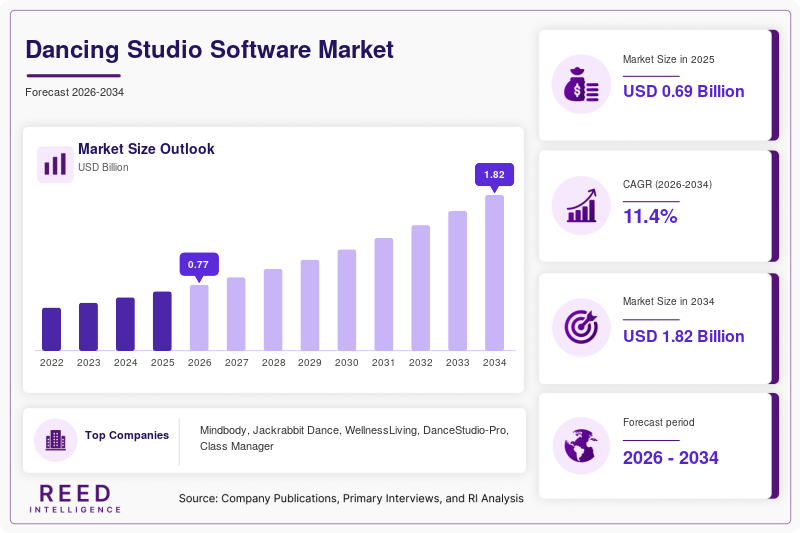
The global Dancing Studio Software Market size was valued at USD 0.685 billion in 2026 and is projected to reach USD 1.62 billion by 2034, expanding at a CAGR of 11.4% during the forecast period from 2026 to 2034. The market continues to gain momentum as dance academies, independent instructors, fitness studios, and performing arts institutions adopt cloud-based management platforms to improve scheduling, automate billing, manage memberships, and enhance student engagement. The increasing shift toward digital administration across recreational and professional dance institutions has strengthened market expansion in both developed and emerging economies.
One of the major global factors supporting market growth is the rapid digital transformation within the fitness and performing arts industry. Dance studios are increasingly integrating software platforms with online class management tools, mobile applications, AI-driven attendance tracking, and customer relationship management systems. The growing popularity of hybrid dance learning models, where students participate through both physical and virtual classes, has increased demand for centralized management systems capable of handling multiple operational functions. In addition, subscription-based software pricing models have improved accessibility for small and medium-sized studios, supporting wider adoption.
Key Highlights
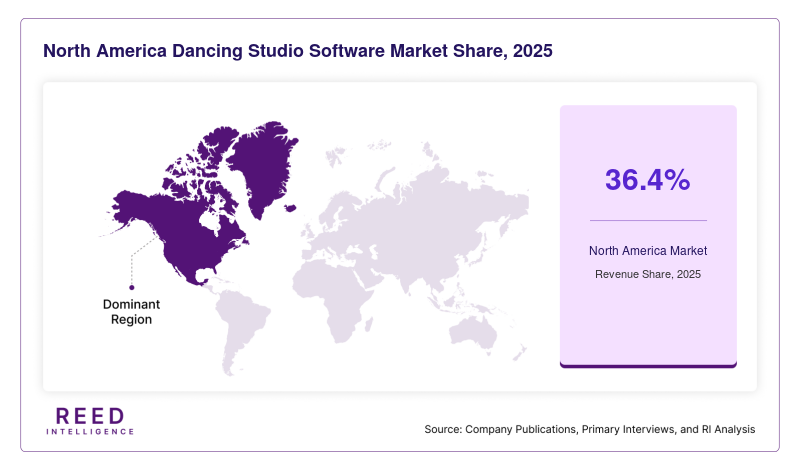
- North America dominated the market with a 36.4% share in 2025.
- Asia Pacific is expected to grow at the fastest CAGR of 13.1% during 2026–2034.
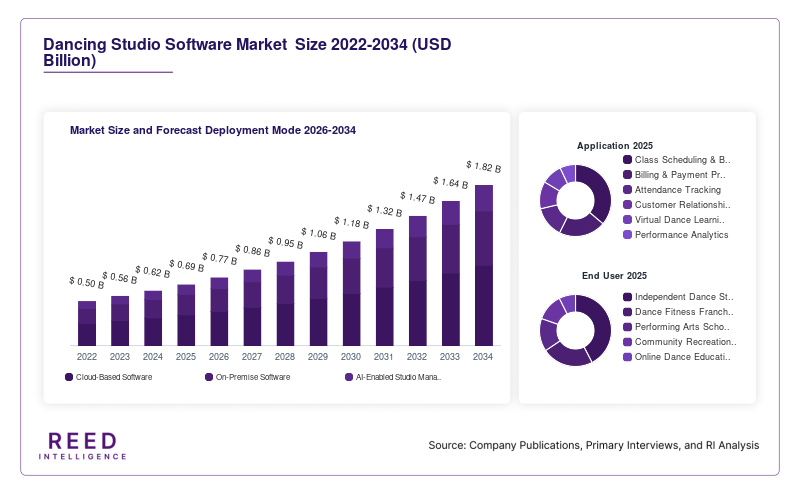
- By deployment mode, cloud-based software accounted for the largest share of 61.8%, while AI-enabled studio management solutions are projected to grow at a CAGR of 14.2%.
- By application, class scheduling and booking management led with a 33.9% share, whereas virtual dance learning management is expected to expand at a CAGR of 14.5%.
- The United States remained the dominant country, with market values of USD 182 million in 2024 and USD 201 million in 2025.
Market Trends
Integration of Artificial Intelligence and Automation in Studio Operations
Artificial intelligence and automation technologies are becoming increasingly important in the Dancing Studio Software Market as studio operators seek improved efficiency and enhanced customer engagement. Software providers are integrating AI-powered attendance systems, automated reminders, dynamic scheduling tools, and predictive analytics to simplify daily administrative tasks. These features help dance studios reduce manual workload while improving student retention and instructor utilization rates. AI-driven recommendation systems are also enabling studios to suggest suitable dance classes based on age, skill level, and participation history, supporting personalized learning experiences.
The growing use of automated marketing tools is another important trend shaping the market. Dance studios are deploying software that can automatically send promotional messages, manage social media campaigns, and track customer interactions through centralized dashboards. This trend is particularly strong among mid-sized studios seeking cost-effective operational improvements. Vendors are also introducing voice-enabled scheduling tools and chatbot integrations to improve customer service responsiveness. As studios continue to prioritize operational productivity and digital engagement, automation-focused software platforms are expected to gain significant traction during the forecast period.
Rising Adoption of Hybrid and Virtual Dance Learning Platforms
The growing popularity of hybrid learning environments is creating substantial demand for integrated virtual dance learning platforms. Dance schools and fitness centers are increasingly offering both in-person and online sessions to accommodate changing consumer preferences and improve accessibility. This transition has encouraged software developers to introduce video streaming integration, digital class libraries, online assessment tools, and remote attendance tracking features. Studios are increasingly relying on centralized software systems capable of managing physical and virtual learning operations simultaneously.
Subscription-based online dance programs are also expanding rapidly among independent instructors and boutique studios. Consumers are showing greater interest in flexible learning schedules, especially for recreational dance and fitness-oriented classes. Mobile applications linked with studio software platforms allow students to register for classes, access recorded tutorials, and communicate directly with instructors. In addition, wearable device compatibility and performance tracking tools are becoming more common in advanced dance training environments. As digital learning ecosystems continue to mature globally, hybrid studio management solutions are expected to remain a major growth trend in the market.
Market Drivers
Increasing Digitalization Across Dance and Fitness Studios
The rising adoption of digital business management solutions across dance and fitness studios is significantly supporting the growth of the Dancing Studio Software Market. Studio operators are increasingly seeking centralized platforms that can manage scheduling, payments, payroll, student enrollment, communication, and performance analytics through a single interface. Manual administrative processes often create inefficiencies, scheduling conflicts, and delayed payments, encouraging studios to migrate toward cloud-based management systems.
The expansion of independent dance academies and specialized performance schools is further strengthening demand for scalable software platforms. Small and medium-sized studios are adopting subscription-based software solutions due to lower implementation costs and simplified maintenance requirements. In addition, the growing use of smartphones and digital payment systems has encouraged studios to provide mobile-friendly booking and payment options for students and parents. The ability of software solutions to improve customer convenience, reduce operational costs, and enhance data management continues to drive widespread market adoption.
Growth of Online Dance Education and Global Student Connectivity
The rapid expansion of online dance education platforms is creating strong growth opportunities for software providers. Dance instructors and academies are increasingly using digital platforms to reach students beyond local geographic boundaries. Virtual dance competitions, online certification programs, and international workshops are becoming more common, creating demand for software capable of supporting multilingual communication, video integration, and global payment processing.
Consumers are also showing growing interest in flexible dance learning formats that fit individual schedules and lifestyles. Professional dancers, fitness enthusiasts, and recreational learners are enrolling in virtual programs that provide access to recorded lessons and live interactive sessions. Software providers are responding by developing integrated ecosystems that combine scheduling, content management, progress tracking, and customer relationship management tools. The expansion of broadband connectivity and increasing affordability of digital devices in emerging economies are expected to further strengthen demand for online dance studio software solutions over the forecast period.
Market Restraint
Data Security Concerns and Limited Technical Expertise Among Small Studios
Data security concerns and limited technical expertise among small studio operators remain key restraints affecting the growth of the Dancing Studio Software Market. Dance studio management systems often handle sensitive customer information, including payment details, attendance records, personal identification data, and communication histories. As software adoption increases, concerns regarding cyberattacks, unauthorized access, and data breaches are becoming more prominent among studio owners. Smaller studios with limited cybersecurity infrastructure may hesitate to transition fully toward cloud-based systems due to fears related to operational disruptions and customer privacy issues.
Another challenge involves the limited digital literacy and technical expertise available within small and family-owned dance studios. Many independent operators continue to rely on traditional spreadsheets or manual scheduling methods because employees may not possess the skills required to manage advanced software systems effectively. Training costs, software migration challenges, and system integration complexities can also discourage adoption, particularly in price-sensitive markets. For example, some small studios in developing economies experience difficulties integrating online payment gateways and mobile applications due to inconsistent internet infrastructure. These limitations may slow software penetration in certain regions despite increasing awareness regarding digital transformation benefits.
Market Opportunities
Expansion of Mobile-Based Studio Management Applications
The increasing use of smartphones and mobile applications among consumers presents a significant opportunity for the Dancing Studio Software Market. Dance students and parents are demanding convenient digital tools that simplify class registration, payment processing, attendance monitoring, and communication with instructors. Software vendors are responding by developing mobile-first platforms that offer real-time notifications, digital payment integration, personalized schedules, and virtual learning support through user-friendly interfaces.
Mobile applications are also helping dance studios improve customer engagement and retention through loyalty programs, progress tracking features, and social media connectivity. Instructors can use mobile dashboards to monitor class participation, manage lesson plans, and communicate directly with students. The growing availability of affordable smartphones in emerging economies is expected to support broader adoption of mobile-enabled studio management platforms. As consumer preference shifts toward app-based service interactions across the education and fitness sectors, mobile software ecosystems are likely to create long-term growth opportunities for market participants.
Increasing Demand from Multi-Location Dance Franchises
The rising expansion of multi-location dance franchises and performance academies is creating new growth opportunities for enterprise-level software providers. Large dance organizations require centralized systems capable of managing multiple branches, instructor schedules, student databases, financial reporting, and marketing campaigns across different geographic locations. This demand is encouraging vendors to develop scalable cloud-based platforms with advanced analytics, role-based access controls, and franchise management capabilities.
Franchise operators are increasingly investing in software solutions that can standardize operational procedures while supporting localized customer engagement strategies. Integrated dashboards help organizations monitor enrollment trends, revenue performance, and instructor productivity across all branches. In addition, growing international expansion of dance fitness brands and performing arts academies is creating demand for multilingual software systems with global payment support. Vendors offering customizable enterprise solutions and API integration capabilities are expected to benefit significantly from this trend during the forecast period.
Segmental Analysis
By Deployment Mode
Cloud-based software emerged as the dominant subsegment within the deployment mode category and accounted for approximately 61.8% of the global market share in 2024. Dance studios are increasingly preferring cloud deployment due to lower infrastructure costs, simplified software updates, and remote accessibility advantages. Cloud platforms enable studio owners and instructors to manage schedules, monitor attendance, process payments, and communicate with students from multiple devices and locations. The flexibility of subscription-based pricing models is also making cloud solutions more attractive for small and medium-sized businesses operating with limited budgets.
Another factor supporting the dominance of cloud deployment is the increasing need for scalable operational systems capable of supporting hybrid learning environments. Dance institutions with multiple locations are using centralized cloud dashboards to manage data synchronization, instructor coordination, and customer engagement activities across branches. Cloud solutions also provide stronger integration capabilities with mobile applications, video conferencing tools, and digital payment gateways. The growing emphasis on operational mobility and digital convenience continues to strengthen the adoption of cloud-based studio management software globally.
By Application
Class scheduling and booking management represented the leading subsegment within the application category and captured approximately 33.9% of the market share in 2024. Dance studios rely heavily on scheduling tools to manage class timetables, instructor assignments, studio space allocation, and student enrollment activities efficiently. Automated booking systems reduce administrative errors and improve customer convenience by allowing students and parents to reserve classes through mobile applications or online portals. These features are particularly important for studios handling large enrollment volumes and multiple dance categories.
The dominance of scheduling and booking management solutions is also supported by rising consumer demand for flexible participation options. Students increasingly expect real-time schedule updates, instant booking confirmations, and digital cancellation features. Integrated calendar synchronization and automated reminder systems help studios reduce absenteeism and improve operational organization. In addition, dance academies offering workshops, competitions, and seasonal programs require advanced scheduling capabilities to coordinate multiple activities simultaneously. The widespread operational importance of scheduling systems continues to support strong demand for this application segment.
By End User
Independent dance studios accounted for the largest share within the end-user segment in 2024, representing nearly 47.3% of total market revenue. Independent studios typically require affordable and flexible software platforms capable of managing scheduling, attendance tracking, billing, and customer communication through centralized interfaces. The growing number of boutique dance schools and community-based performance academies is contributing significantly to demand within this segment. Subscription-based pricing structures and mobile-friendly applications have made professional management software more accessible for smaller operators.
Another factor supporting the dominance of independent dance studios is the increasing emphasis on personalized customer experiences and operational efficiency. Many studio owners are adopting digital tools to improve class organization, reduce administrative workload, and strengthen student retention rates. Independent studios are also increasingly integrating online payment systems and social media marketing tools into their management platforms to improve customer engagement. As competition intensifies among local dance businesses, demand for feature-rich yet cost-effective software solutions is expected to remain strong.
Regional Analysis
North America
North America accounted for the largest share of the Dancing Studio Software Market in 2025, representing approximately 36.4% of global revenue. The region is expected to maintain stable growth at a CAGR of 10.8% during the forecast period due to strong adoption of digital management solutions across dance academies and fitness institutions. High internet penetration, widespread use of cloud computing technologies, and strong consumer spending on recreational activities continue to support regional market expansion. The presence of established software providers and advanced payment infrastructure further strengthens market development across the United States and Canada.
The United States remained the dominant country in North America due to its extensive network of dance studios, performing arts schools, and fitness clubs. One major growth factor supporting the U.S. market is the increasing popularity of hybrid dance instruction models that combine physical and virtual learning experiences. Dance institutions are investing heavily in integrated platforms capable of handling online class streaming, student engagement, and digital payment processing. Rising demand for AI-driven scheduling and analytics tools is also encouraging continuous software innovation within the country.
Europe
Europe represented a significant share of the Dancing Studio Software Market in 2025 and is projected to grow at a CAGR of 10.2% during 2026–2034. The region benefits from strong participation in cultural and performing arts education programs, particularly across Western European countries. Dance studios and performing arts institutions are increasingly adopting cloud-based software systems to improve operational transparency and streamline administrative tasks. Growing regulatory emphasis on secure digital payment systems and customer data protection is also encouraging the use of professional management software platforms.
Germany remained the leading country within the European market due to its well-developed performing arts sector and increasing investments in digital education technologies. A unique growth factor supporting the German market is the integration of dance studio software with local wellness and fitness ecosystems. Many dance schools are collaborating with gyms and recreational centers to provide unified scheduling and membership services. This integration trend is creating demand for customizable software solutions capable of supporting multiple activity categories and customer management functions.
Asia Pacific
Asia Pacific is expected to record the fastest growth in the Dancing Studio Software Market, expanding at a CAGR of 13.1% during the forecast period. The region is experiencing rapid growth in urbanization, disposable income, and digital technology adoption, which collectively support market expansion. Countries including China, India, Japan, and South Korea are witnessing increased participation in recreational dance programs, fitness-oriented dance classes, and online performing arts education. The growing availability of affordable cloud-based software solutions is also supporting adoption among small and mid-sized dance studios.
China emerged as the dominant country in the Asia Pacific region due to the rapid expansion of urban dance academies and digital learning platforms. One major growth factor in the Chinese market is the increasing popularity of youth-focused extracurricular education programs. Parents are investing heavily in structured dance training programs for children, creating demand for software systems capable of managing high enrollment volumes and digital communication with families. In addition, local software vendors are introducing cost-effective mobile applications tailored specifically for regional dance education requirements.
Middle East & Africa
The Middle East & Africa region is gradually emerging as a promising market for dancing studio software solutions, supported by increasing investments in recreational infrastructure and digital business tools. The regional market accounted for a modest share in 2025 but is anticipated to grow at a CAGR of 9.6% during the forecast period. Dance and fitness studios are increasingly adopting management platforms to improve scheduling efficiency, automate payment collection, and support customer engagement activities. Expanding internet penetration and rising smartphone usage are also contributing to software adoption across urban areas.
The United Arab Emirates remained the dominant country within the regional market due to its expanding fitness and entertainment industry. A unique growth factor supporting the UAE market is the rapid development of premium wellness centers and international dance franchises within major cities such as Dubai and Abu Dhabi. These institutions are adopting advanced software systems to manage multilingual customer interactions and high-volume membership operations. The growing expatriate population and rising demand for structured recreational activities continue to strengthen software adoption in the country.
Latin America
Latin America accounted for a moderate share of the Dancing Studio Software Market in 2025 and is projected to grow at a CAGR of 10.1% over the forecast period. The region is benefiting from increasing consumer participation in dance-based fitness programs, particularly in urban centers. Dance studios are gradually adopting digital management tools to improve operational efficiency and customer retention. The expansion of online payment systems and mobile internet connectivity is also supporting the transition from manual administrative methods toward cloud-based software platforms.
Brazil dominated the Latin American market due to its strong cultural connection with dance and widespread popularity of dance-based fitness programs. One important growth factor in Brazil is the rising number of independent dance instructors launching online subscription-based training services. These professionals require affordable and flexible software platforms capable of handling virtual class management, digital payments, and customer communication. Local software providers are increasingly introducing low-cost subscription models tailored to small studio operators and independent instructors across the country.
Competitive Landscape
The Dancing Studio Software Market remains moderately fragmented, with several regional and international software providers competing through product innovation, subscription flexibility, and customer support services. Companies are increasingly investing in cloud infrastructure, AI-powered automation tools, mobile application development, and integrated payment systems to strengthen their competitive positioning. Vendors are also focusing on strategic partnerships with fitness organizations, performing arts schools, and digital learning platforms to expand customer reach.
Mindbody maintained a leading position within the market due to its extensive software ecosystem and broad customer base across wellness and fitness industries. The company recently expanded its AI-driven scheduling and customer engagement features to support multi-location dance and fitness studios more effectively. Other major participants including Jackrabbit Dance, WellnessLiving, DanceStudio-Pro, and Class Manager are also focusing on platform enhancements, mobile integration, and analytics capabilities to improve customer retention.
Key Players
- Mindbody
- Jackrabbit Dance
- WellnessLiving
- DanceStudio-Pro
- Class Manager
- Pike13
- Zen Planner
- Studio Director
- Glofox
- Vagaro
- TeamUp
- Acuity Scheduling
- BookSteam
- RhinoFit
- Sawyer
Recent Developments
- In February 2026, Mindbody introduced an AI-powered customer engagement module designed to improve student retention and automate scheduling workflows for dance studios.
- In August 2025, WellnessLiving launched a multilingual mobile application platform targeting international dance fitness franchises and hybrid learning studios.
- In November 2025, Jackrabbit Dance expanded its cloud infrastructure capabilities to support large-scale virtual dance competitions and online certification programs.
- In March 2026, DanceStudio-Pro announced integration with wearable fitness tracking devices to enhance performance monitoring and virtual dance coaching capabilities.
Dancing Studio Software Market Segments
Deployment Mode
- Cloud-Based Software
- On-Premise Software
- AI-Enabled Studio Management Software
Application
- Class Scheduling & Booking Management
- Billing & Payment Processing
- Attendance Tracking
- Customer Relationship Management
- Virtual Dance Learning Management
- Performance Analytics
End User
- Independent Dance Studios
- Dance Fitness Franchises
- Performing Arts Schools
- Community Recreation Centers
- Online Dance Education Providers
By Region
- North America
- Europe
- APAC
- Middle East and Africa
- LATAM