Dark Kitchen And Virtual Kitchens Market Size, Share & Demand Report By Kitchen Type (Commissary Kitchens, Independent Cloud Kitchens, Kitchen Pods, Shared Kitchen Spaces), By Cuisine Type (Fast Food and Burgers, Pizza and Italian Cuisine, Asian Cuisine, Healthy and Vegan Meals, Desserts and Bakery), By End User (Food Delivery Platforms, Restaurant Chains, Independent Restaurants, Foodservice Startups) By Region & Segment Forecasts, 2026–2034
USD 3950
Market Overview
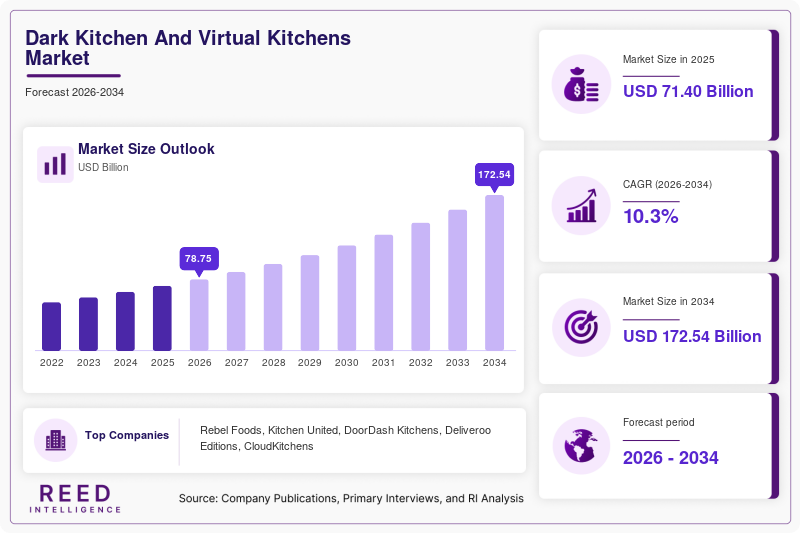
The global Dark Kitchen And Virtual Kitchens Market size was valued at USD 71.4 billion in 2026 and is projected to reach USD 156.8 billion by 2034, expanding at a CAGR of 10.3% during the forecast period. The market continues to expand due to the rapid growth of online food delivery ecosystems, changing urban consumption habits, and the increasing preference for convenience-based dining solutions. Food delivery applications, digital ordering systems, and cloud-based restaurant management platforms have transformed the operational structure of foodservice businesses. Operators are increasingly adopting delivery-only kitchen models to reduce rental costs, improve delivery efficiency, and scale operations across multiple urban locations.
The rising penetration of smartphones and digital payment systems has supported the demand for virtual kitchen models across developed and developing economies. Consumers are increasingly relying on app-based food ordering platforms that offer wider menu options, lower delivery times, and personalized recommendations. Restaurant chains are also entering the market by launching delivery-exclusive brands that operate without traditional dine-in infrastructure. In addition, food aggregators and logistics providers are investing in centralized kitchen facilities to strengthen last-mile delivery networks.
Key Highlights
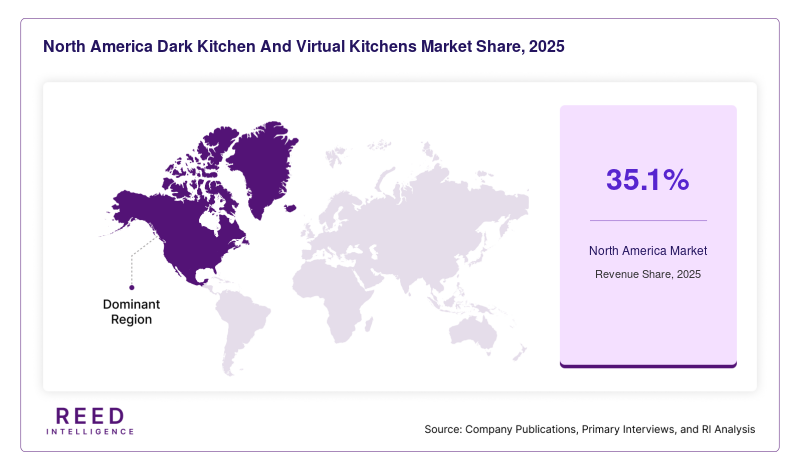
- North America dominated the market with a 35.1% share in 2025, while Asia Pacific is expected to grow at the fastest CAGR of 11.8% during 2026–2034.
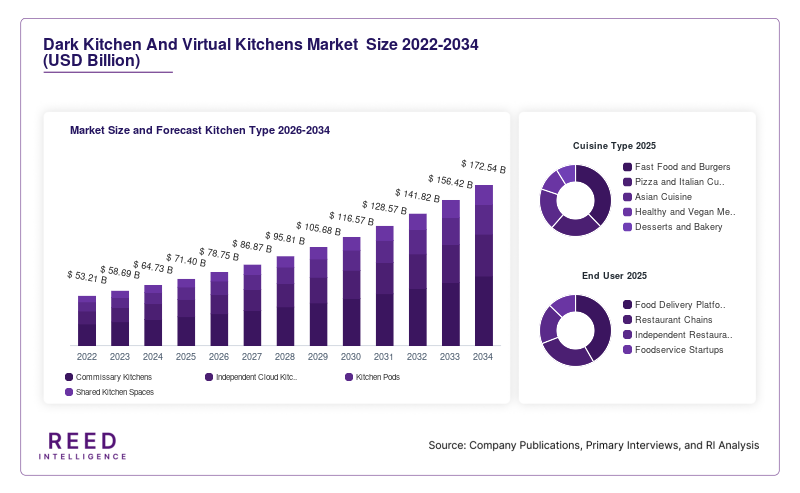
- By kitchen type, commissary kitchens accounted for the largest share of 39.4%, while independent cloud kitchens are projected to grow at a CAGR of 12.1%.
- By cuisine type, fast food and burgers led with a 36.7% share, whereas healthy and vegan meals are expected to expand at a CAGR of 12.8%.
- By end user, food delivery platforms held a 42.3% share, while restaurant chains are anticipated to grow at a CAGR of 11.4%.
- The United States remained the dominant country, with market values of USD 18.6 billion in 2024 and USD 20.1 billion in 2025.
Market Trends
Expansion of Multi-Brand Kitchen Operations
Foodservice operators are increasingly adopting multi-brand kitchen formats to maximize kitchen utilization and improve profit margins. Dark kitchen facilities are now commonly used to operate several virtual restaurant brands from a single location. This trend allows operators to diversify menu offerings while reducing operational expenses related to property leasing, staffing, and infrastructure. Multi-brand operations also help companies respond quickly to changing consumer preferences across meal categories such as burgers, desserts, healthy bowls, and regional cuisines. Advanced analytics tools are supporting this transition by helping operators identify high-demand products and optimize inventory management. The approach is becoming popular among restaurant groups seeking to scale rapidly in urban markets without investing in dine-in expansion.
Integration of Artificial Intelligence and Automation
Artificial intelligence and automation technologies are becoming integral to dark kitchen operations across major markets. Operators are implementing AI-driven demand forecasting systems, automated cooking equipment, and smart inventory management solutions to improve efficiency and reduce food waste. Machine learning tools are also helping businesses personalize menu recommendations and analyze customer ordering behavior. Automated order management systems have reduced preparation time and improved delivery accuracy in high-volume kitchens. In addition, robotics-assisted cooking and packaging solutions are gaining traction in densely populated cities where labor costs are increasing. The integration of technology is supporting operational scalability while enabling kitchen operators to maintain consistency across multiple delivery-only brands.
Market Drivers
Growth of Online Food Delivery Platforms
The rapid expansion of online food delivery applications has become a major factor supporting the growth of the Dark Kitchen And Virtual Kitchens Market. Consumers increasingly prefer app-based ordering due to convenience, flexible payment options, and quick delivery services. Delivery aggregators continue to invest in logistics infrastructure, digital marketing, and customer loyalty programs to increase order frequency. This ecosystem has created favorable conditions for dark kitchens that rely heavily on online visibility rather than physical foot traffic. Small restaurant operators are also entering the market because virtual kitchens require lower upfront investment compared to traditional dine-in establishments. Increasing internet penetration and smartphone usage across emerging economies continue to strengthen the adoption of digital food ordering services.
Rising Demand for Cost-Efficient Restaurant Models
Foodservice companies are actively seeking business models that offer lower operational costs and faster expansion opportunities. Dark kitchens eliminate several expenses associated with traditional restaurants, including premium retail rentals, interior design investments, and front-of-house staffing requirements. This model allows operators to focus primarily on food preparation and delivery optimization. Companies can also establish kitchens in strategic delivery zones where demand is high but commercial real estate costs remain manageable. The lower capital requirements are attracting startups, independent chefs, and franchise operators looking to expand their market presence. Cost efficiency is becoming especially important in urban markets where restaurant operating margins are under pressure from inflation and rising labor expenses.
Market Restraint
Intense Competition and Operational Complexity
The Dark Kitchen And Virtual Kitchens Market faces challenges related to intense competition and increasing operational complexity. The relatively low entry barrier for virtual restaurant businesses has resulted in a crowded market environment across major cities. Many operators struggle to differentiate their brands in highly competitive delivery platforms where pricing and promotional discounts heavily influence consumer choices. Continuous dependence on third-party delivery aggregators can also reduce profit margins because commission fees remain high in several regions.
Operational management presents another significant challenge for kitchen operators managing multiple brands simultaneously. Maintaining food quality, delivery consistency, and customer satisfaction across different cuisines requires strong supply chain coordination and efficient workforce management. Delays in deliveries, packaging failures, and inconsistent menu quality can quickly affect customer ratings and repeat order rates. In some markets, local authorities are also introducing stricter regulations regarding food safety, zoning compliance, and licensing for cloud kitchen facilities. These factors may increase operational costs and slow down expansion plans for smaller operators with limited financial resources.
Market Opportunities
Expansion in Tier-II and Tier-III Cities
The increasing adoption of food delivery services in tier-II and tier-III cities presents strong growth opportunities for dark kitchen operators. Rising urbanization, improving internet connectivity, and changing lifestyle patterns are encouraging consumers in smaller cities to order food online more frequently. Delivery platforms are expanding their presence beyond metropolitan regions and partnering with local restaurants to strengthen market penetration. Dark kitchens can benefit from lower rental costs and reduced operating expenses in these cities while still serving a growing customer base.
Consumers in emerging urban centers are also becoming more willing to experiment with international cuisines and premium meal options. This shift is creating opportunities for operators to launch specialized virtual brands tailored to local demand patterns. Companies that establish early operations in underpenetrated regions may benefit from stronger brand recognition and customer loyalty over the long term.
Rising Demand for Health-Focused and Specialty Menus
Changing dietary preferences are creating new opportunities for operators offering health-focused, organic, and specialty meal options through virtual kitchen platforms. Consumers are increasingly seeking healthier alternatives such as vegan meals, protein-rich diets, gluten-free products, and calorie-controlled menus. Dark kitchens can respond quickly to these preferences because they are not limited by traditional restaurant formats or fixed dining concepts.
The flexibility of virtual kitchen operations allows businesses to test niche menu categories with limited financial risk. Many startups are using data analytics from food delivery applications to identify underserved customer segments and launch targeted meal brands. The growing popularity of fitness-oriented lifestyles and wellness-focused food consumption is expected to support demand for customized meal delivery services during the forecast period. Partnerships with nutrition companies and fitness applications may further strengthen market opportunities for health-focused virtual kitchen brands.
Segmental Analysis
By Kitchen Type
Commissary kitchens represented the dominant subsegment within the Dark Kitchen And Virtual Kitchens Market and accounted for 39.4% of the global share in 2024. These facilities are widely preferred because they allow multiple restaurant brands to operate from centralized infrastructure while sharing equipment, storage space, and logistics resources. Commissary kitchen operators benefit from economies of scale that reduce operational expenses and improve production efficiency. Large delivery platforms and restaurant chains increasingly utilize this model to optimize food preparation across multiple brands and delivery zones. The format also supports standardized food quality and streamlined supply chain management. Growing demand for high-volume food delivery operations in densely populated urban centers continues to strengthen the adoption of commissary kitchens across developed and emerging economies.
Independent cloud kitchens are projected to register the fastest CAGR of 12.1% during the forecast period due to their operational flexibility and lower investment requirements. Independent operators can rapidly launch new virtual brands and experiment with different cuisines without the constraints associated with traditional dine-in restaurants. This model is becoming attractive for startup food entrepreneurs and celebrity chefs seeking direct access to online consumers. The growing popularity of localized cuisine offerings and customized meal services is further supporting segment expansion. Many independent operators are also leveraging social media marketing and customer analytics to build brand recognition. The availability of affordable commercial kitchen spaces and third-party delivery partnerships is expected to continue supporting the growth of this subsegment.
By Cuisine Type
Fast food and burgers accounted for the largest share of 36.7% in 2024 within the cuisine type segment. The popularity of this subsegment is primarily driven by high consumer demand for affordable and quick meal options suitable for delivery. Burgers, fries, sandwiches, and fried snacks maintain strong order volumes because they are easy to prepare, travel efficiently during delivery, and appeal to a broad consumer demographic. Quick-service restaurant brands have aggressively expanded into virtual kitchen formats to improve delivery efficiency and reach new customers. Delivery aggregators also heavily promote fast-food brands through discounts and loyalty programs, further increasing demand. Urban consumers with busy lifestyles continue to rely on quick-service meals, supporting the sustained dominance of this subsegment.
Healthy and vegan meals are anticipated to witness the fastest CAGR of 12.8% during the forecast period due to increasing consumer awareness regarding nutrition and wellness. Consumers are actively seeking low-calorie, plant-based, and protein-rich meal options that align with healthier lifestyles. Virtual kitchen operators are responding by launching specialized menus focused on organic ingredients, gluten-free products, and customized diet plans. The flexibility of cloud kitchen operations enables businesses to adapt quickly to emerging dietary trends without significant infrastructure changes. Younger consumers, particularly in metropolitan areas, are increasingly willing to pay premium prices for health-focused meal delivery services. Collaborations with fitness influencers and nutrition applications are further supporting the visibility and growth of this rapidly expanding subsegment.
By End User
Food delivery platforms dominated the end-user segment and accounted for 42.3% of the global market share in 2024. These platforms play a critical role in connecting consumers with virtual restaurant brands and facilitating digital transactions. Leading delivery aggregators provide logistics support, customer data analytics, promotional tools, and real-time order tracking systems that enhance operational efficiency for dark kitchen operators. The expansion of same-day and rapid delivery services has further strengthened the influence of food delivery platforms in the market. Many platforms are also investing directly in cloud kitchen infrastructure to expand service coverage and improve delivery times. The increasing adoption of subscription-based food delivery services and loyalty programs continues to support segment growth across urban markets.
Restaurant chains are projected to grow at the fastest CAGR of 11.4% during the forecast period as established brands increasingly adopt delivery-only business models. Large restaurant operators are launching virtual brands to reach new customer segments while reducing dependence on dine-in revenue. The model allows chains to expand into new cities with lower capital expenditure and faster operational deployment. Restaurant companies are also using data from food delivery platforms to identify high-demand menu categories and optimize pricing strategies. Growth in this subsegment is further supported by rising consumer trust in established restaurant brands that offer consistent food quality and reliable delivery experiences. Many international chains are expected to continue investing in dark kitchen networks to strengthen their digital presence.
Regional Analysis
North America
North America accounted for 35.1% of the global Dark Kitchen And Virtual Kitchens Market share in 2025 and is expected to maintain a stable growth trajectory during the forecast period. The region is projected to expand at a CAGR of 9.4% from 2026 to 2034 due to the strong presence of food delivery platforms and high consumer spending on convenience food services. Urban consumers increasingly prefer digital ordering systems that provide faster delivery times and wider menu options. The market is also benefiting from growing investments in smart kitchen technologies and automated order management systems.
The United States remains the dominant country in the regional market because of its advanced food delivery infrastructure and high concentration of virtual restaurant brands. Major metropolitan areas such as New York, Los Angeles, and Chicago continue to witness strong demand for cloud kitchen services. A key growth factor in the country is the rapid adoption of multi-brand kitchen models by restaurant chains seeking to reduce operational costs while expanding delivery reach. Partnerships between delivery aggregators and restaurant operators are further supporting regional market growth.
Europe
Europe represented 24.6% of the global market share in 2025 and is forecast to grow at a CAGR of 8.8% during the assessment period. Consumer preference for app-based meal delivery services has increased significantly across countries including the United Kingdom, Germany, and France. The region is witnessing growing demand for delivery-only restaurant concepts due to changing work patterns and busy urban lifestyles. Rising fuel efficiency initiatives and sustainable packaging adoption are also influencing operational strategies among virtual kitchen operators.
The United Kingdom continues to lead the European market due to the strong penetration of digital food ordering applications and high consumer familiarity with online meal delivery services. London has emerged as a major hub for cloud kitchen investments, attracting domestic and international operators. One unique growth factor supporting the country’s market expansion is the increasing popularity of premium virtual dining brands that focus on gourmet meals and specialized cuisines. Consumers are increasingly willing to pay higher prices for curated food experiences delivered directly to their homes.
Asia Pacific
Asia Pacific held 22.8% of the global Dark Kitchen And Virtual Kitchens Market share in 2025 and is projected to record the fastest CAGR of 11.8% between 2026 and 2034. Rapid urbanization, increasing smartphone penetration, and rising disposable income levels are driving market demand across the region. Food delivery applications have experienced strong growth in countries such as China, India, Indonesia, and South Korea. Operators are increasingly launching cloud kitchens in densely populated cities where high delivery demand supports operational scalability.
China dominates the Asia Pacific market because of its extensive digital commerce ecosystem and high volume of online food delivery transactions. Major cities including Shanghai and Beijing continue to attract large investments in centralized kitchen infrastructure. A significant growth factor in the country is the integration of advanced logistics systems and artificial intelligence technologies within food delivery operations. Companies are leveraging predictive analytics and automated delivery management to improve operational efficiency and reduce delivery times.
Middle East & Africa
The Middle East & Africa accounted for 9.1% of the global market share in 2025 and is anticipated to grow at a CAGR of 9.7% over the forecast period. Rising urban populations and increasing adoption of digital payment systems are contributing to the growth of food delivery services in the region. Consumers are increasingly embracing online meal ordering due to convenience and wider cuisine availability. International foodservice companies are also entering regional markets through delivery-only formats to reduce infrastructure investment and improve market penetration.
The United Arab Emirates remains the leading country within the regional market due to strong internet penetration and a rapidly expanding hospitality sector. Dubai has become a key destination for cloud kitchen startups and international food delivery platforms. One important growth factor supporting the UAE market is the increasing demand for late-night delivery services driven by tourism activity and changing consumer dining habits. Operators are introducing specialized menu categories and faster delivery models to capture urban demand.
Latin America
Latin America captured 8.4% of the global market share in 2025 and is expected to grow at a CAGR of 9.2% from 2026 to 2034. The market is expanding due to increasing smartphone adoption and the rising popularity of digital food ordering applications across urban centers. Consumers are increasingly relying on online delivery services because of convenience and promotional pricing offered by delivery platforms. Restaurant operators are adopting cloud kitchen formats to expand their customer reach while minimizing operational expenses.
Brazil dominates the Latin American market due to the strong presence of food delivery applications and a growing urban middle-class population. Cities such as São Paulo and Rio de Janeiro continue to experience strong demand for quick-service food delivery solutions. A unique growth factor driving the Brazilian market is the rising adoption of regional and local cuisine-focused virtual brands. Operators are using digital platforms to promote traditional meal options that appeal to local consumer preferences while improving delivery accessibility.
Competitive Landscape
The Dark Kitchen And Virtual Kitchens Market is characterized by strong competition among food delivery platforms, cloud kitchen operators, and restaurant technology providers. Companies are focusing on strategic partnerships, geographic expansion, and technology integration to strengthen their market position. Market participants are increasingly investing in automated kitchen solutions, delivery optimization systems, and data analytics platforms to improve operational efficiency and customer engagement.
Rebel Foods remains one of the leading companies in the market due to its extensive portfolio of virtual restaurant brands and strong presence across Asia. The company has continued expanding its cloud kitchen network in high-demand urban locations while introducing new cuisine concepts tailored to regional preferences. DoorDash, Kitchen United, and Deliveroo are also strengthening their market presence through partnerships with restaurant operators and investments in shared kitchen infrastructure.
Key Players
- Rebel Foods
- Kitchen United
- DoorDash Kitchens
- Deliveroo Editions
- CloudKitchens
- Zuul Kitchens
- Kitopi
- Ghost Kitchen Orlando
- Swiggy Access
- Zomato Infrastructure Services
- Foodstars
- Dahmakan
- Keatz
- Karma Kitchen
- Taster
Recent Developments
- Rebel Foods expanded its cloud kitchen operations across Southeast Asia in 2025 by launching new multi-brand delivery facilities in Indonesia and Thailand.
- Deliveroo Editions introduced AI-enabled demand forecasting tools in 2025 to improve kitchen productivity and reduce food preparation delays.
- Kitchen United partnered with several quick-service restaurant chains in 2024 to establish shared kitchen facilities across major metropolitan regions in the United States.
- Kitopi announced the deployment of automated cooking systems in selected Middle Eastern cloud kitchen facilities during 2025 to improve operational consistency.
- DoorDash Kitchens expanded its delivery-only restaurant infrastructure in suburban markets during 2024 to strengthen rapid delivery capabilities.
Dark Kitchen And Virtual Kitchens Market Segments
Kitchen Type
- Commissary Kitchens
- Independent Cloud Kitchens
- Kitchen Pods
- Shared Kitchen Spaces
Cuisine Type
- Fast Food and Burgers
- Pizza and Italian Cuisine
- Asian Cuisine
- Healthy and Vegan Meals
- Desserts and Bakery
End User
- Food Delivery Platforms
- Restaurant Chains
- Independent Restaurants
- Foodservice Startups
By Region
- North America
- Europe
- APAC
- Middle East and Africa
- LATAM