Data Bus Market Size, Share & Demand Report By Bus Type (CAN Bus, Ethernet Bus, FlexRay, MIL-STD-1553, ARINC 429, Others), By Application (Automotive Electronics, Industrial Automation, Aerospace Systems, Consumer Electronics, Healthcare Equipment, Defense Systems), By End-Use Industry (Automotive, Aerospace & Defense, Manufacturing, Healthcare, Energy & Utilities, Telecommunications), By Region & Segment Forecasts, 2026–2034
USD 3950
Market Overview
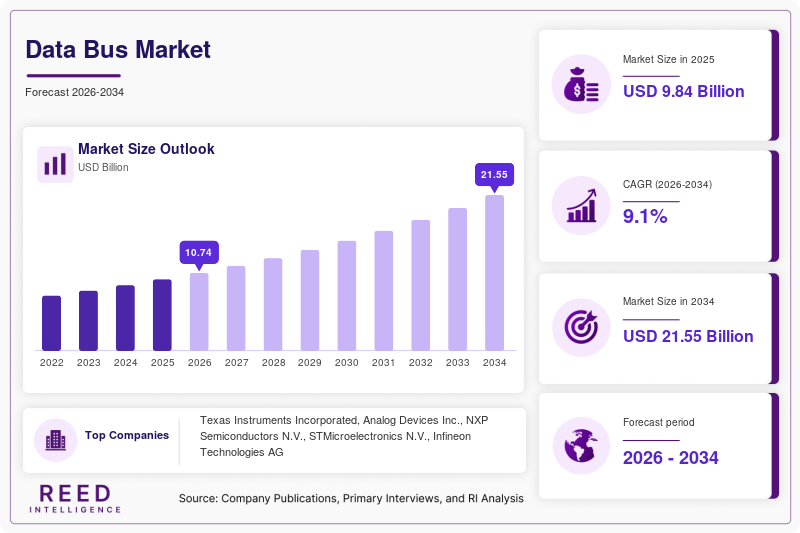
The global Data Bus Market size was valued at USD 9.84 billion in 2026 and is projected to reach USD 19.76 billion by 2034, expanding at a CAGR of 9.1% during the forecast period from 2026 to 2034. The market continues to gain momentum due to rising deployment of high-speed communication architectures across aerospace, automotive, industrial automation, and defense sectors. Data bus systems play a critical role in enabling real-time data transfer between electronic components, sensors, controllers, and embedded devices. Growing adoption of connected systems and intelligent electronics has significantly increased demand for reliable and low-latency communication infrastructure.
A major factor supporting market growth is the global transition toward digital industrial ecosystems. Manufacturers across industries are investing in smart production facilities, autonomous platforms, and edge computing technologies that require seamless communication between multiple hardware components. Data buses such as CAN, MIL-STD-1553, ARINC 429, Ethernet, and FlexRay are increasingly integrated into advanced control systems to improve operational efficiency and system reliability. In addition, rapid modernization of aircraft systems, electric vehicle platforms, and industrial robotics has strengthened demand for scalable data transmission frameworks.
Key Highlights
- North America dominated the market with a 34.2% share in 2025.
- Asia Pacific is expected to grow at the fastest CAGR of 11.2% during 2026–2034.
- By bus type, CAN bus accounted for the largest share of 36.8%, while Ethernet-based data buses are projected to grow at a CAGR of 12.1%.
- By application, automotive electronics led with a 39.4% share, whereas industrial automation is expected to expand at a CAGR of 11.5%.
- The United States remained the dominant country, with market values of USD 2.31 billion in 2024 and USD 2.54 billion in 2025.
Market Trends
Increasing Integration of Ethernet-Based Communication Protocols
The adoption of Ethernet-based data bus technologies is accelerating across multiple industries due to rising requirements for high-speed and high-bandwidth communication systems. Automotive manufacturers are integrating automotive Ethernet into advanced driver assistance systems, infotainment platforms, and autonomous driving architectures to support real-time data transmission. Similarly, industrial automation companies are transitioning from legacy serial communication systems toward Ethernet-enabled architectures that improve scalability and network flexibility. The shift toward Industry 4.0 and smart manufacturing environments has further strengthened the use of Ethernet-based buses in robotics, predictive maintenance systems, and connected production equipment. As organizations seek faster communication and lower latency, Ethernet-enabled bus systems are expected to become a major technology trend during the forecast period.
Rising Demand for Modular Avionics and Defense Electronics
The aerospace and defense sectors are witnessing increased demand for modular avionics and integrated defense electronics, which is positively influencing the Data Bus Market. Modern aircraft platforms require efficient communication frameworks capable of connecting navigation systems, sensors, radar equipment, and flight control modules. Military organizations are investing in advanced mission systems and electronic warfare technologies that rely heavily on secure and fault-tolerant data bus architectures. Demand for lightweight and reliable communication systems has encouraged manufacturers to develop advanced bus protocols with improved durability and cybersecurity capabilities. In addition, next-generation unmanned aerial vehicles and space exploration programs are creating new opportunities for sophisticated embedded communication systems across defense and aerospace environments.
Market Drivers
Expansion of Electric and Autonomous Vehicle Production
The growing production of electric and autonomous vehicles is a major driver for the Data Bus Market. Modern vehicles contain a large number of electronic control units, sensors, cameras, and connectivity modules that require efficient communication channels. Data bus technologies enable synchronization between battery management systems, vehicle diagnostics, braking systems, and autonomous driving software. As automotive manufacturers focus on enhancing vehicle intelligence and safety, the demand for high-speed and low-latency communication systems continues to rise. Government incentives supporting electric vehicle adoption across North America, Europe, and Asia Pacific are also contributing to market expansion. Increasing investments in connected mobility infrastructure are expected to create long-term demand for advanced automotive data buses.
Growth of Industrial Automation and Smart Manufacturing
Industrial automation is becoming increasingly dependent on interconnected systems and real-time communication technologies, which is supporting demand for advanced data bus solutions. Manufacturing facilities are integrating robotics, machine learning systems, and industrial IoT devices to improve productivity and operational efficiency. Data bus architectures enable seamless communication between programmable logic controllers, sensors, motors, and centralized monitoring systems. Companies are prioritizing automation to reduce operational downtime and improve production accuracy, resulting in higher deployment of industrial communication networks. The increasing use of digital twins, predictive analytics, and cloud-connected manufacturing systems is also strengthening the need for reliable data transfer infrastructure across industrial environments.
Market Restraint
High Integration Complexity and Compatibility Challenges
One of the major restraints affecting the Data Bus Market is the complexity associated with integrating multiple communication standards within large electronic systems. Industries such as aerospace, automotive, and industrial manufacturing often use a combination of legacy and modern communication protocols, creating compatibility issues during system upgrades. Integrating advanced Ethernet-based buses with older serial communication frameworks can increase implementation costs and engineering challenges. In addition, maintaining interoperability between hardware vendors and software platforms requires extensive validation and testing procedures. Small and medium-sized enterprises may face budget limitations when transitioning toward next-generation data bus architectures due to the high cost of redesigning embedded systems and communication infrastructure. These challenges can slow deployment timelines and limit adoption in cost-sensitive industries.
Market Opportunities
Rising Investments in Smart Transportation Infrastructure
Governments and private organizations are increasing investments in smart transportation infrastructure, creating strong opportunities for the Data Bus Market. Intelligent transportation systems rely on integrated communication frameworks to connect traffic management systems, autonomous transit platforms, surveillance networks, and connected vehicles. Data bus technologies enable rapid exchange of information between onboard systems and external infrastructure components. Urban mobility initiatives across Asia Pacific and Europe are supporting deployment of connected public transportation systems equipped with advanced electronic communication modules. Growing demand for vehicle-to-everything communication and smart traffic optimization solutions is expected to generate additional demand for scalable and secure data bus architectures over the coming years.
Expansion of Space Exploration and Satellite Communication Programs
The growing focus on commercial space exploration and satellite communication systems is opening new opportunities for data bus manufacturers. Spacecraft and satellite systems require robust communication architectures capable of operating under extreme environmental conditions. Advanced data buses support real-time communication between onboard sensors, navigation systems, propulsion units, and mission control interfaces. Increasing participation from private aerospace companies is accelerating innovation in lightweight and radiation-resistant communication systems. Governments are also investing heavily in defense satellites, Earth observation systems, and deep-space missions, which is expected to increase demand for reliable embedded communication technologies. The need for high-performance avionics systems and modular spacecraft designs is likely to support future market growth.
Segmental Analysis
By Bus Type
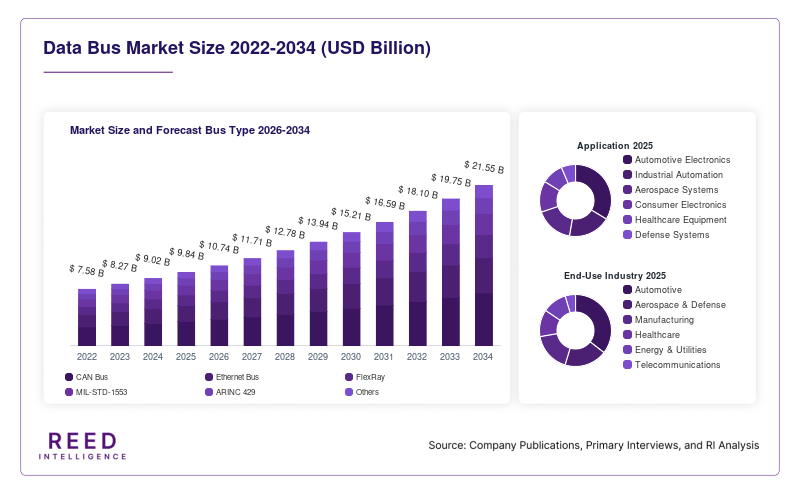
CAN bus accounted for the largest share of the Data Bus Market in 2024, representing 36.8% of total revenue. The segment continues to dominate due to widespread adoption across automotive and industrial applications. CAN bus technology offers reliable communication between microcontrollers and electronic devices without requiring a host computer, making it highly suitable for vehicle systems and factory automation environments. Automotive manufacturers extensively use CAN bus systems in engine management, braking systems, power steering, and diagnostics applications. Industrial machinery manufacturers also prefer CAN-based communication due to its cost efficiency, durability, and fault-tolerant capabilities. The growing use of embedded electronics across transportation and manufacturing industries has further strengthened demand for CAN bus technologies globally.
Ethernet-based data buses are expected to witness the fastest growth during the forecast period, expanding at a CAGR of 12.1%. The increasing need for high-speed data transfer and scalable communication networks is supporting rapid adoption of Ethernet-based architectures across automotive, industrial automation, and aerospace sectors. Advanced driver assistance systems, autonomous vehicles, and connected industrial platforms require large-scale data exchange with minimal latency, which Ethernet technologies can efficiently provide. Industrial organizations are also integrating Ethernet communication systems to support cloud connectivity, remote monitoring, and real-time analytics applications. The growing transition toward digital manufacturing and intelligent transportation systems is expected to create strong long-term opportunities for Ethernet-based bus technologies.
By Application
Automotive electronics represented the largest application segment in 2024, accounting for 39.4% of total market revenue. Modern vehicles rely heavily on advanced electronic systems for safety, connectivity, power management, and infotainment functions. Data buses play a critical role in enabling communication between electronic control units, sensors, battery systems, and onboard software platforms. Increasing production of electric vehicles and connected mobility solutions has significantly increased the demand for robust communication frameworks. Automotive manufacturers are continuously integrating advanced features such as lane assistance, adaptive cruise control, and vehicle diagnostics, all of which depend on reliable data transmission systems. Rising regulatory emphasis on vehicle safety and energy efficiency is further supporting the growth of automotive data bus technologies.
Industrial automation is projected to record the fastest CAGR of 11.5% during the forecast period due to growing deployment of smart manufacturing systems and industrial IoT technologies. Factories are increasingly adopting robotics, machine vision systems, and automated production equipment that require real-time communication infrastructure. Data buses facilitate seamless interaction between sensors, programmable logic controllers, actuators, and centralized control systems. Companies are investing in digital manufacturing technologies to improve operational efficiency and reduce downtime, creating strong demand for scalable communication networks. The growing use of predictive maintenance platforms and AI-enabled industrial systems is also expected to accelerate adoption of advanced data bus architectures within industrial environments.
By End Use Industry
The aerospace and defense segment held the largest share of the Data Bus Market in 2024 due to extensive deployment of mission-critical communication systems in aircraft and military platforms. Aerospace applications require highly reliable and fault-tolerant communication architectures capable of supporting navigation systems, avionics, radar equipment, and flight control systems. Defense organizations are increasingly investing in integrated battlefield communication systems and unmanned aerial vehicles that rely on advanced embedded communication technologies. Data buses such as MIL-STD-1553 and ARINC 429 remain widely used in military aircraft and commercial aviation systems due to their proven operational reliability. Increasing aircraft modernization programs and defense electronics upgrades are expected to sustain segment growth over the coming years.
The healthcare sector is anticipated to emerge as the fastest-growing end-use industry, registering a CAGR of 10.9% during the forecast period. Medical devices and healthcare monitoring systems are becoming increasingly interconnected, driving demand for reliable communication technologies. Advanced imaging systems, patient monitoring equipment, robotic surgical systems, and diagnostic devices rely on embedded communication architectures for efficient data transfer and real-time analysis. Hospitals are also adopting connected healthcare infrastructure and remote patient monitoring technologies that require secure communication frameworks. The growing integration of AI-enabled diagnostics and smart medical devices is expected to create new growth opportunities for data bus manufacturers operating within the healthcare industry.
Regional Analysis
North America
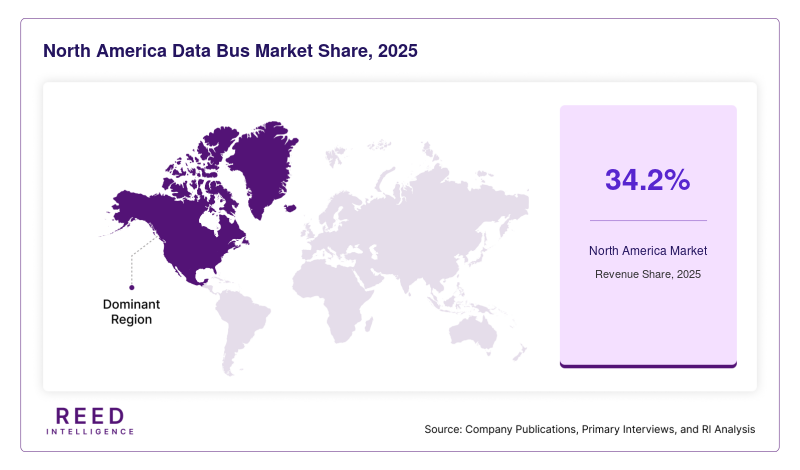
North America accounted for the largest share of the global Data Bus Market in 2025, representing 34.2% of total revenue. The region is projected to maintain steady growth at a CAGR of 8.6% during the forecast period due to strong demand from aerospace, defense, and automotive industries. The presence of established aircraft manufacturers, defense contractors, and industrial automation companies has created a strong ecosystem for advanced communication technologies. Increasing investments in connected mobility platforms and smart manufacturing systems are also supporting adoption of next-generation data bus solutions across the region.
The United States remained the dominant country within North America due to extensive deployment of military communication systems and advanced avionics platforms. The country benefits from significant defense modernization programs and increasing production of electric vehicles equipped with complex electronic architectures. Strong investments in autonomous mobility technologies and industrial robotics have also contributed to growing demand for reliable embedded communication systems. In addition, rising adoption of Industry 4.0 solutions among manufacturing enterprises continues to support long-term market growth.
Europe
Europe represented a substantial share of the Data Bus Market in 2025 and is anticipated to grow at a CAGR of 8.8% during the forecast period. The region benefits from strong automotive manufacturing capabilities and increasing investments in industrial automation technologies. European manufacturers are actively integrating advanced communication systems into electric vehicles, aerospace systems, and factory automation platforms. Demand for energy-efficient and connected transportation systems is also driving the adoption of high-performance data bus architectures across the region.
Germany emerged as the dominant country in Europe due to its leadership in automotive engineering and industrial automation. The country hosts several automotive manufacturers that are accelerating deployment of intelligent vehicle communication networks to support electrification and autonomous driving initiatives. Germany’s strong industrial base and increasing adoption of smart factory technologies have strengthened demand for reliable industrial communication systems. Investments in robotics and precision manufacturing continue to create opportunities for advanced data transmission technologies.
Asia Pacific
Asia Pacific is expected to register the fastest CAGR of 11.2% during the forecast period due to rapid industrialization and expanding electronics manufacturing activities. The region is witnessing increasing demand for automotive electronics, industrial robotics, and connected infrastructure systems. Countries across Asia Pacific are investing heavily in smart manufacturing facilities and advanced transportation technologies, which is boosting adoption of high-speed communication protocols. The growing presence of semiconductor manufacturers and consumer electronics companies is also supporting regional market expansion.
China dominated the Asia Pacific market due to large-scale production of electric vehicles and industrial equipment. The country has become a major hub for electronics manufacturing and connected mobility innovation. Rising investments in autonomous driving technologies and smart transportation systems are strengthening demand for efficient communication architectures. In addition, government initiatives promoting industrial digitalization and intelligent manufacturing continue to support market growth across multiple industries.
Middle East & Africa
The Middle East & Africa Data Bus Market is projected to grow at a CAGR of 7.4% during the forecast period, supported by increasing investments in defense modernization and industrial infrastructure development. Countries across the region are adopting advanced communication systems for military applications, transportation networks, and energy facilities. Demand for industrial automation technologies is gradually increasing as enterprises seek operational efficiency and digital transformation. Expansion of smart infrastructure projects is also creating opportunities for advanced data bus deployment.
Saudi Arabia remained the dominant country in the regional market due to rising investments in defense electronics and smart industrial projects. The country is focusing on modernization of military communication systems and expansion of industrial manufacturing capabilities. Government-backed economic diversification programs are encouraging adoption of advanced technologies across transportation, energy, and manufacturing sectors. Increasing deployment of automated industrial systems is expected to strengthen demand for reliable communication architectures.
Latin America
Latin America accounted for a smaller but steadily growing share of the global Data Bus Market in 2025 and is forecast to expand at a CAGR of 7.8% through 2034. The region is benefiting from increasing industrial automation investments and gradual modernization of transportation infrastructure. Automotive manufacturing activities in several countries are supporting adoption of electronic communication systems within vehicle platforms. Rising interest in digital manufacturing technologies is also contributing to regional market growth.
Brazil emerged as the dominant country in Latin America due to its established automotive and industrial manufacturing sectors. The country is witnessing increasing integration of connected vehicle technologies and industrial automation systems. Investments in logistics infrastructure and smart transportation projects are supporting deployment of reliable communication architectures. Demand for advanced industrial equipment equipped with embedded communication systems is also rising across manufacturing facilities.
Competitive Landscape
The Data Bus Market remains moderately consolidated, with leading companies focusing on technological innovation, product customization, and strategic partnerships to strengthen their market position. Major players are investing in advanced communication architectures designed for automotive electrification, industrial automation, and aerospace modernization programs. Companies are also emphasizing cybersecurity capabilities and high-speed communication performance to meet evolving customer requirements.
Texas Instruments maintained a leading market position due to its broad portfolio of embedded communication solutions and strong presence across automotive and industrial applications. The company recently expanded its automotive communication chipset portfolio to support next-generation electric vehicle architectures and high-speed industrial communication systems. Other major participants are focusing on acquisitions and collaborations to strengthen regional presence and improve product integration capabilities.
Key Players
- Texas Instruments Incorporated
- Analog Devices Inc.
- NXP Semiconductors N.V.
- STMicroelectronics N.V.
- Infineon Technologies AG
- Microchip Technology Inc.
- Broadcom Inc.
- Renesas Electronics Corporation
- TE Connectivity Ltd.
- Curtiss-Wright Corporation
- Amphenol Corporation
- Siemens AG
- Honeywell International Inc.
- Collins Aerospace
- Intel Corporation
Recent Developments
- In February 2026, Texas Instruments introduced a new automotive Ethernet communication chipset designed for electric vehicle architectures and autonomous driving applications.
- In August 2025, NXP Semiconductors expanded its industrial communication solutions portfolio with enhanced CAN FD controllers for smart manufacturing systems.
- In November 2025, Collins Aerospace partnered with an avionics software provider to develop integrated modular communication systems for next-generation commercial aircraft platforms.
Data Bus Market Segments
Bus Type
- CAN Bus
- Ethernet Bus
- FlexRay
- MIL-STD-1553
- ARINC 429
- Others
Application
- Automotive Electronics
- Industrial Automation
- Aerospace Systems
- Consumer Electronics
- Healthcare Equipment
- Defense Systems
End-Use Industry
- Automotive
- Aerospace & Defense
- Manufacturing
- Healthcare
- Energy & Utilities
- Telecommunications
By Region
- North America
- Europe
- APAC
- Middle East and Africa
- LATAM