Data Center Containment Market Size, Share Demand Report By Containment Type (Hot Aisle Containment, Cold Aisle Containment, In-Row Containment), By Data Center Type (Hyperscale Data Centers, Enterprise Data Centers, Colocation Data Centers, Edge Data Centers), By End-Use Industry (IT & Telecommunications, BFSI, Healthcare, Government, Others), By Region & Segment Forecasts, 2026–2034
USD 3950
Market Overview
The Data Center Containment Market size was valued at approximately USD 3.4 billion in 2026 and is projected to reach USD 7.9 billion by 2034, expanding at a CAGR of 11.1% during the forecast period (2026–2034). The market is witnessing consistent expansion due to increasing demand for energy-efficient data center infrastructure and the rising adoption of cloud computing, edge computing, and artificial intelligence workloads. Containment systems, including hot aisle and cold aisle solutions, are becoming essential for optimizing airflow management and reducing energy consumption in modern data centers.
A key global factor supporting market growth is the rapid digital transformation across industries, which has led to a surge in data generation and storage requirements. Enterprises are investing in advanced containment technologies to improve operational efficiency and meet sustainability targets. Additionally, stricter environmental regulations and corporate carbon reduction commitments are accelerating the adoption of containment solutions that enhance cooling efficiency and minimize power usage effectiveness (PUE).
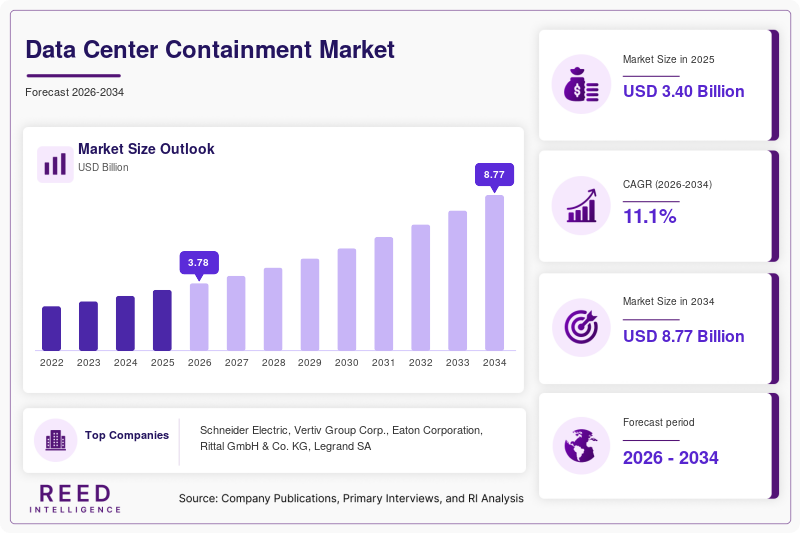
Key Highlights
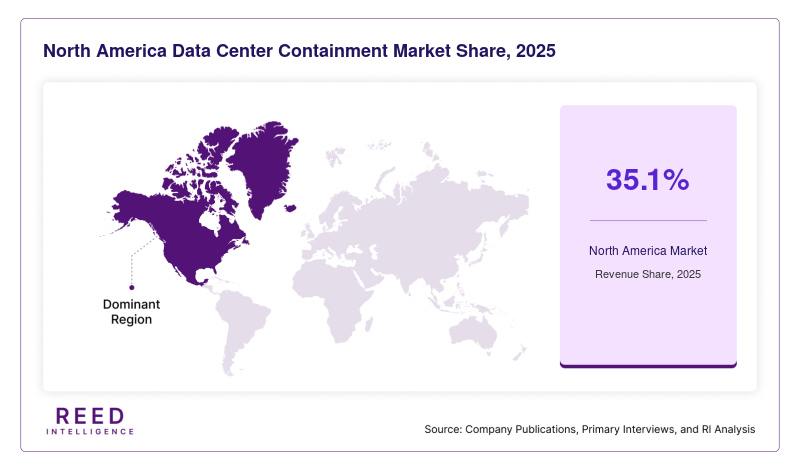
- North America dominated the market with a 35.1% share in 2025.
- Asia Pacific is expected to grow at the fastest CAGR of 12.3% during 2026–2034.
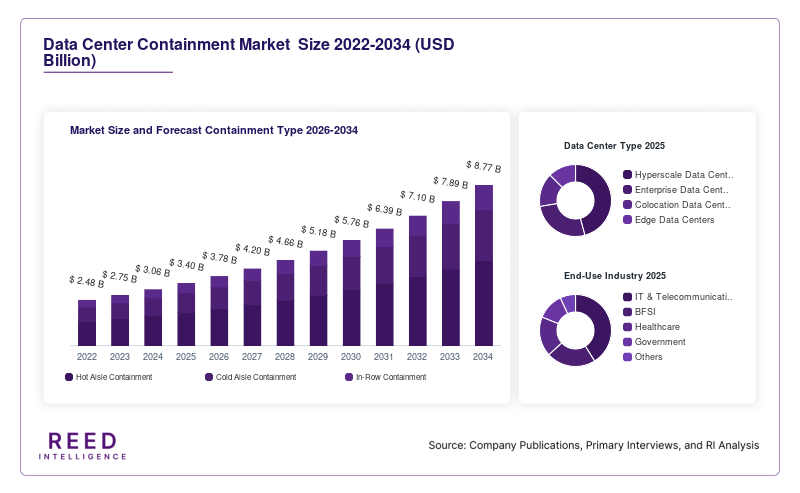
- By containment type, hot aisle containment accounted for the largest share of 42.8%.
- while in-row containment solutions are projected to grow at a CAGR of 12.9%.
- By data center type, hyperscale data centers led with a 46.2% share, whereas edge data centers are expected to expand at a CAGR of 13.5%.
- The United States remained the dominant country, with market values of USD 890 million in 2024 and USD 960 million in 2025.
Market Trends
Growing adoption of modular and prefabricated containment solutions
The increasing preference for modular and prefabricated containment systems is shaping the evolution of the Data Center Containment Market. Organizations are shifting toward scalable and flexible infrastructure that can be deployed quickly and expanded as needed. Modular containment solutions allow data center operators to optimize airflow without requiring extensive structural modifications. This approach reduces installation time and operational disruptions, making it suitable for both new builds and retrofits.
Moreover, prefabricated systems offer improved cost predictability and standardization, which appeals to colocation providers and hyperscale operators. These solutions are designed to integrate seamlessly with existing racks and cooling units, enhancing operational efficiency. As enterprises aim to reduce downtime and improve return on investment, modular containment is becoming a preferred strategy. The trend is further supported by advancements in design engineering, enabling customized configurations tailored to specific workload requirements.
Integration of intelligent monitoring and automation technologies
Another significant trend in the Data Center Containment Market is the integration of intelligent monitoring systems and automation technologies. Modern containment solutions are increasingly equipped with sensors and software platforms that provide real-time insights into temperature, airflow, and energy consumption. This integration enables data center operators to optimize cooling performance and identify inefficiencies promptly.
Automation plays a crucial role in maintaining optimal environmental conditions by dynamically adjusting airflow and cooling parameters. This reduces manual intervention and enhances operational reliability. Additionally, the use of artificial intelligence and machine learning algorithms allows predictive maintenance and improved capacity planning. As data centers become more complex, the demand for smart containment systems is expected to grow, supporting overall market expansion and improving energy efficiency metrics across facilities.
Market Drivers
Rising demand for energy-efficient data center operations
The growing emphasis on energy efficiency is a major driver of the Data Center Containment Market. Data centers consume significant amounts of electricity, with cooling systems accounting for a substantial portion of total energy usage. Containment solutions help separate hot and cold air streams, improving cooling efficiency and reducing energy waste. This leads to lower operational costs and improved sustainability outcomes.
Organizations are increasingly adopting containment systems to achieve better power usage effectiveness and comply with environmental standards. Governments and regulatory bodies are also encouraging energy-efficient infrastructure through incentives and policies. As enterprises seek to reduce their carbon footprint and operational expenses, the adoption of containment technologies is expected to rise steadily. This driver is particularly relevant for large-scale data centers, where even small efficiency improvements can result in significant cost savings.
Expansion of hyperscale and edge data centers
The rapid expansion of hyperscale and edge data centers is another key factor driving market growth. Hyperscale facilities require advanced cooling and airflow management solutions to handle high-density workloads efficiently. Containment systems play a critical role in maintaining optimal operating conditions and preventing overheating.
At the same time, the growth of edge computing is creating demand for compact and efficient containment solutions. Edge data centers are often deployed in remote or space-constrained locations, making efficient cooling essential. Containment technologies enable these facilities to operate reliably while minimizing energy consumption. As digital services continue to expand and latency requirements increase, the deployment of hyperscale and edge data centers is expected to accelerate, further driving demand for containment solutions.
Market Restraint
High initial investment and integration complexity
One of the primary challenges in the Data Center Containment Market is the high initial investment associated with deploying containment systems. While these solutions offer long-term cost savings through improved energy efficiency, the upfront costs can be significant, particularly for small and medium-sized enterprises. The need for specialized design, installation, and integration with existing infrastructure adds to the overall expenditure.
Additionally, retrofitting containment solutions in legacy data centers can be complex and time-consuming. Operators may face challenges related to space constraints, compatibility with existing equipment, and potential disruptions to ongoing operations. These factors can delay adoption and limit market growth in certain segments. For example, older facilities may require extensive modifications to accommodate containment systems, increasing project timelines and costs. As a result, some organizations may hesitate to invest in containment technologies despite their long-term benefits.
Market Opportunities
Increasing focus on sustainable and green data centers
The growing emphasis on sustainability presents significant opportunities for the Data Center Containment Market. Organizations are prioritizing environmentally responsible practices and seeking solutions that reduce energy consumption and carbon emissions. Containment systems play a crucial role in achieving these goals by improving cooling efficiency and minimizing energy waste.
Green data center initiatives are gaining traction globally, supported by government regulations and corporate sustainability commitments. Companies are investing in advanced containment technologies to meet environmental targets and enhance their brand reputation. This trend is expected to create new growth opportunities for market players, particularly those offering innovative and energy-efficient solutions. As sustainability becomes a key consideration in data center design, the demand for containment systems is likely to increase.
Growth of colocation and multi-tenant data centers
The expansion of colocation and multi-tenant data centers is another promising opportunity for the market. These facilities host multiple clients with varying requirements, making efficient cooling and airflow management essential. Containment solutions help optimize resource utilization and ensure consistent performance across different workloads.
Colocation providers are increasingly adopting containment technologies to enhance operational efficiency and attract customers. By offering energy-efficient infrastructure, they can reduce operating costs and provide competitive pricing. Additionally, the growing demand for cloud services and digital transformation is driving the development of new colocation facilities. This trend is expected to create sustained demand for containment systems, supporting market growth over the forecast period.
Segmental Analysis
By Containment Type
Hot aisle containment emerged as the dominant subsegment, accounting for approximately 42.8% of the market share in 2024. This dominance is attributed to its ability to efficiently manage heat generated by high-density server racks. By isolating hot exhaust air, these systems prevent mixing with cold intake air, improving cooling efficiency. Data center operators prefer hot aisle containment due to its compatibility with existing infrastructure and ease of implementation. The growing adoption of high-performance computing and artificial intelligence workloads further supports the demand for this subsegment.
In-row containment solutions are expected to be the fastest-growing subsegment, with a projected CAGR of 12.9% during the forecast period. These systems provide targeted cooling by placing cooling units closer to heat sources, enhancing efficiency. The increasing demand for compact and scalable data center designs is driving the adoption of in-row containment. Additionally, advancements in cooling technologies and the need for precise temperature control are contributing to the growth of this subsegment.
By Data Center Type
Hyperscale data centers held the largest share of approximately 46.2% in 2024, driven by the rapid expansion of cloud service providers and large enterprises. These facilities require advanced containment solutions to manage high-density workloads and ensure efficient cooling. The adoption of hyperscale data centers is increasing due to the growing demand for digital services and data storage. Containment systems play a critical role in optimizing energy usage and maintaining operational reliability in these large-scale facilities.
Edge data centers are projected to be the fastest-growing subsegment, with a CAGR of 13.5% during the forecast period. The rise of edge computing, driven by the need for low-latency data processing, is fueling demand for compact and efficient containment solutions. These data centers are often deployed in remote locations, requiring advanced cooling systems to ensure reliability. The growing adoption of IoT devices and real-time applications is expected to support the expansion of this subsegment.
By End-Use Industry
The IT and telecommunications sector dominated the market, accounting for approximately 48.7% of the share in 2024. This dominance is attributed to the increasing demand for data storage, processing, and connectivity services. The sector relies heavily on data centers to support digital operations, making efficient cooling and containment solutions essential. The growth of cloud computing, 5G networks, and digital transformation initiatives further drives demand in this segment.
The healthcare sector is expected to be the fastest-growing subsegment, with a CAGR of 12.7% during the forecast period. The increasing adoption of electronic health records, telemedicine, and data-driven healthcare solutions is driving demand for data center infrastructure. Containment systems help ensure reliable and efficient operations, which are critical for healthcare applications. The need for secure and efficient data management is expected to support the growth of this subsegment.
Regional Analysis
North America
North America accounted for approximately 35.1% of the Data Center Containment Market share in 2025 and is expected to maintain steady growth with a CAGR of 10.8% during the forecast period. The region’s strong presence of hyperscale data centers and advanced IT infrastructure supports the adoption of containment solutions. Increasing investments in cloud computing and artificial intelligence applications are driving demand for efficient cooling systems.
The United States dominates the regional market due to its extensive network of data centers and continuous technological advancements. A key growth factor is the rising focus on energy efficiency and sustainability, with organizations adopting containment systems to reduce operational costs and meet regulatory requirements. This trend is expected to sustain market growth in the region.
Europe
Europe held a market share of around 24.6% in 2025 and is projected to grow at a CAGR of 10.5% during the forecast period. The region is characterized by stringent environmental regulations and a strong emphasis on energy efficiency. Data center operators are increasingly adopting containment solutions to comply with these regulations and improve operational performance.
Germany is a leading market in Europe, driven by its robust industrial base and advanced digital infrastructure. A unique growth factor is the region’s focus on renewable energy integration, which encourages the adoption of energy-efficient containment systems. This approach supports sustainable data center operations and contributes to market expansion.
Asia Pacific
Asia Pacific is expected to grow at the fastest CAGR of 12.3% during 2026–2034, with a market share of 22.8% in 2025. Rapid digitalization, increasing internet penetration, and the expansion of cloud services are driving the demand for data center infrastructure in the region. Containment solutions are becoming essential for managing the growing volume of data and ensuring efficient operations.
China dominates the regional market due to its large-scale investments in data center development. A key growth factor is the government’s support for digital infrastructure and smart city initiatives, which drive the adoption of advanced containment technologies. This trend is expected to continue, supporting market growth in Asia Pacific.
Middle East & Africa
The Middle East & Africa region accounted for approximately 9.2% of the market share in 2025 and is projected to grow at a CAGR of 11.0% during the forecast period. The increasing adoption of cloud services and digital transformation initiatives is driving demand for data center infrastructure. Containment solutions are gaining traction as operators seek to improve energy efficiency in challenging climatic conditions.
The United Arab Emirates is a dominant market in the region, supported by significant investments in data center development. A unique growth factor is the region’s focus on smart city projects, which require advanced IT infrastructure and efficient cooling solutions. This trend is expected to drive the adoption of containment systems.
Latin America
Latin America held a market share of around 8.3% in 2025 and is expected to grow at a CAGR of 10.7% during the forecast period. The region is witnessing increasing investments in data center infrastructure, driven by the growing demand for cloud services and digital applications. Containment solutions are becoming important for optimizing energy usage and improving operational efficiency.
Brazil is the leading market in Latin America, supported by its expanding digital economy and growing number of data centers. A key growth factor is the rising adoption of colocation services, which require efficient cooling and airflow management. This trend is expected to support the growth of the Data Center Containment Market in the region.
Competitive Landscape
The Data Center Containment Market is characterized by the presence of several established players and emerging companies focusing on innovation and strategic partnerships. Leading companies are investing in research and development to introduce advanced containment solutions that enhance energy efficiency and operational performance. The market is moderately competitive, with players adopting strategies such as mergers, acquisitions, and product launches to strengthen their market position.
Schneider Electric is recognized as a leading player in the market, offering a wide range of containment solutions integrated with advanced monitoring technologies. A recent development includes the launch of modular containment systems designed for rapid deployment and improved scalability. Other key players are also focusing on expanding their product portfolios and geographic presence to capture emerging opportunities in developing regions.
Key Players List
- Schneider Electric
- Vertiv Group Corp.
- Eaton Corporation
- Rittal GmbH & Co. KG
- Legrand SA
- Huawei Technologies Co., Ltd.
- IBM Corporation
- Dell Technologies Inc.
- Hewlett Packard Enterprise
- Stulz GmbH
- Black Box Corporation
- Minkels B.V.
- Panduit Corp.
- Upsite Technologies
- Cannon Technologies Ltd.
Recent Developments
- Schneider Electric introduced a new modular containment solution aimed at improving scalability and reducing deployment time for hyperscale data centers.
- Vertiv Group Corp. expanded its containment product portfolio with advanced airflow management systems designed for high-density computing environments.
- Eaton Corporation announced a strategic partnership with a colocation provider to deploy energy-efficient containment solutions across multiple data center facilities.
Data Center Containment Market Segments
Containment Type
- Hot Aisle Containment
- Cold Aisle Containment
- In-Row Containment
Data Center Type
- Hyperscale Data Centers
- Enterprise Data Centers
- Colocation Data Centers
- Edge Data Centers
End-Use Industry
- IT & Telecommunications
- BFSI
- Healthcare
- Government
- Others
By Region
- North America
- Europe
- APAC
- Middle East and Africa
- LATAM