Date Sugar Market Size, Share & Demand Report By Type (Organic Date Sugar, Conventional Date Sugar), By Form (Powdered Date Sugar, Liquid Date Sugar), By Application (Food & Beverage, Nutraceuticals, Personal Care), By Distribution Channel (Online Retail, Supermarkets & Hypermarkets, Specialty Stores, Convenience Stores), By Region & Segment Forecasts, 2025–2034
USD 3950
Market Overview
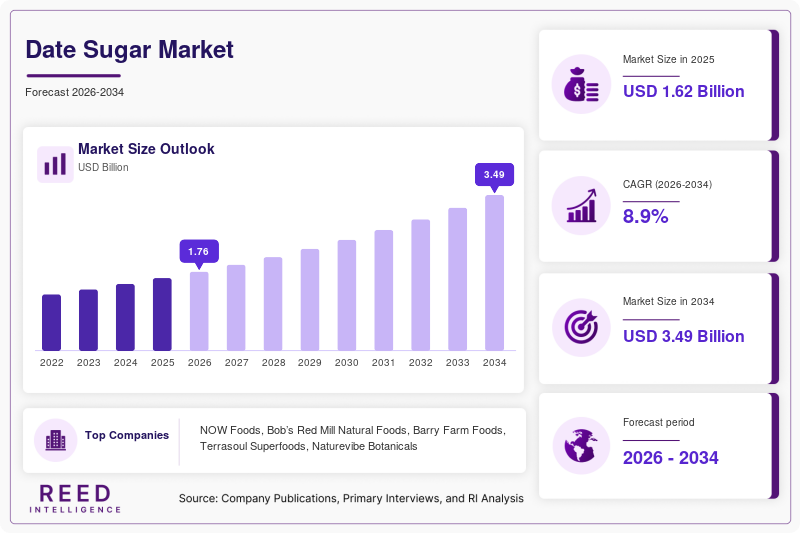
The global Date Sugar Market size was valued at approximately USD 1.62 billion in 2025 and is projected to reach USD 3.48 billion by 2034, expanding at a CAGR of 8.9% during the forecast period (2025–2034). The market growth is being supported by the increasing global preference for natural and minimally processed sweeteners as consumers shift away from refined sugar toward healthier alternatives. Date sugar, derived from dried dates, offers nutritional benefits such as fiber, antioxidants, and minerals, making it an appealing choice for health-conscious consumers and food manufacturers.
A significant global factor supporting the growth of the Date Sugar Market is the rising awareness of clean-label food products. Consumers are actively seeking transparency in ingredient sourcing and processing, which has led to increased demand for plant-based, non-refined sweeteners. Additionally, the growing prevalence of lifestyle-related conditions such as obesity and diabetes has accelerated the adoption of alternatives like date sugar in both household and industrial applications.
Key Highlights
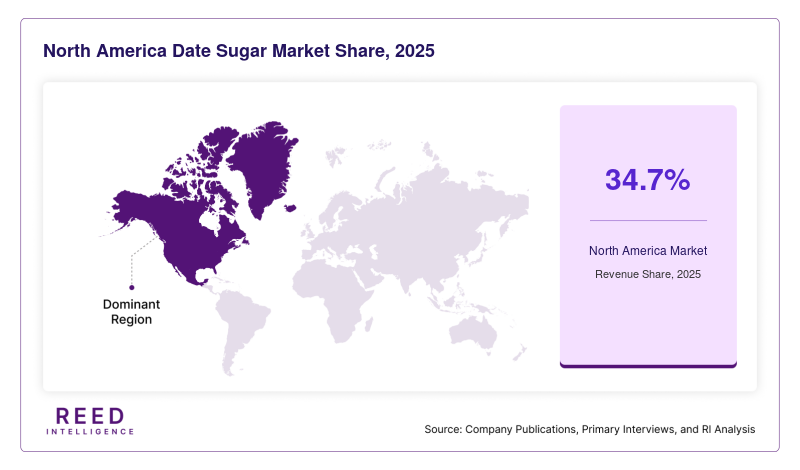
- North America dominated the market with a share of 34.7% in 2025, while Asia Pacific is projected to grow at the fastest CAGR of 10.8% during the forecast period.
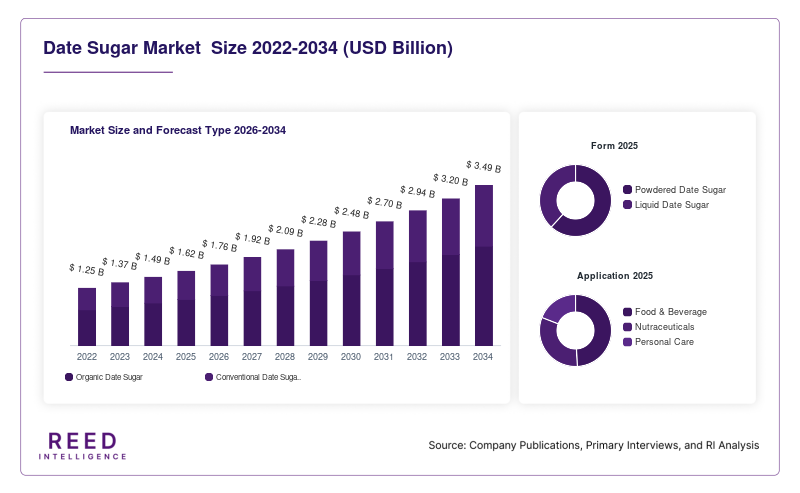
- In terms of segments, organic date sugar held the largest share at 58.2% in 2024, while liquid date sugar is expected to grow at a CAGR of 11.2%.
- The food & beverage application segment accounted for the largest share of 62.5% in 2024, while nutraceuticals are projected to expand at a CAGR of 10.5%.
- The United States remained the dominant country, with market values of USD 420 million in 2024 and USD 455 million in 2025.
Market Trends
Rising Demand for Natural Sweeteners in Functional Foods
The Date Sugar Market is witnessing increased adoption in functional and fortified food products. Manufacturers are incorporating date sugar into protein bars, energy snacks, and breakfast cereals due to its natural origin and nutritional value. This trend is driven by the growing consumer focus on health and wellness, particularly among urban populations seeking clean energy sources without artificial additives.
Expansion of Plant-Based and Vegan Product Lines
The growing popularity of plant-based diets is influencing product innovation across the Date Sugar Market. Date sugar is gaining traction as a vegan-friendly sweetener in dairy alternatives, bakery items, and confectionery products. Companies are increasingly positioning date sugar as a sustainable and ethical ingredient, aligning with consumer demand for environmentally responsible consumption patterns. This trend is further supported by advancements in processing technologies that improve texture and solubility, making date sugar more versatile in food applications.
Market Drivers
Increasing Health Awareness and Dietary Shifts
The growing awareness regarding the adverse effects of refined sugar consumption is a primary driver of the Date Sugar Market. Consumers are actively reducing their intake of processed sugars and replacing them with natural alternatives that provide additional nutritional benefits. Date sugar, with its low glycemic response and micronutrient content, is increasingly being adopted in daily diets, boosting overall market growth.
Growth of the Organic Food Industry
The expansion of the global organic food sector has significantly contributed to the growth of the Date Sugar Market. Organic date sugar is widely used in premium food products due to its clean-label appeal and absence of chemical processing. Retailers and manufacturers are expanding their organic product lines, which has increased the visibility and accessibility of date sugar across supermarkets, specialty stores, and online platforms.
Market Restraint
High Production Costs and Limited Processing Efficiency
One of the major challenges in the Date Sugar Market is the relatively high cost of production compared to conventional sweeteners. The process of converting dates into powdered or granulated sugar involves drying, grinding, and maintaining quality consistency, which increases operational expenses. Additionally, the limited scalability of processing facilities in key producing regions further restricts mass production.
Another factor contributing to this restraint is the variability in raw material supply due to climatic conditions affecting date palm cultivation. This inconsistency impacts pricing stability and supply chain efficiency. As a result, manufacturers may face challenges in maintaining competitive pricing, which can limit widespread adoption, particularly in price-sensitive markets.
Market Opportunities
Expansion in Emerging Economies
Emerging markets present a significant growth opportunity for the Date Sugar Market. Increasing urbanization, rising disposable incomes, and changing dietary patterns are driving demand for healthier food alternatives. Countries in Asia Pacific and Latin America are witnessing increased consumption of natural sweeteners, providing a favorable environment for market expansion.
Innovation in Product Formats and Applications
Continuous innovation in product formats, such as liquid date sugar and date syrup blends, is creating new avenues for growth in the Date Sugar Market. These formats offer improved solubility and ease of use in beverages and processed foods. Additionally, the development of value-added products, including flavored date sugars and fortified variants, is expected to attract a broader consumer base and support long-term market growth.
Segmental Analysis
By Type
The organic date sugar segment held the dominant share of 58.2% in 2024 within the Date Sugar Market. This dominance was attributed to increasing consumer preference for chemical-free and naturally processed food products. Organic variants are widely used in premium bakery and confectionery items, where clean-label claims are essential.
The conventional date sugar segment is expected to grow at a CAGR of 8.1% during the forecast period. This growth will be driven by its affordability and wider availability, making it suitable for large-scale food manufacturing applications.
By Form
Powdered date sugar accounted for the largest share of 64.5% in 2024 in the Date Sugar Market. Its ease of use and compatibility with dry food products such as baked goods and cereals contributed to its widespread adoption.
Liquid date sugar is projected to grow at the fastest CAGR of 11.2%. Its improved solubility and suitability for beverages and sauces will drive its increasing adoption in food processing industries.
By Application
The food & beverage segment dominated the Date Sugar Market with a share of 62.5% in 2024. The extensive use of date sugar in bakery products, snacks, and beverages contributed to this dominance.
The nutraceutical segment is anticipated to grow at a CAGR of 10.5%. The inclusion of date sugar in dietary supplements and functional foods will support this growth due to its nutritional benefits.
By Distribution Channel
Offline retail channels accounted for the largest share of 71.3% in 2024. Supermarkets and specialty stores played a key role in product visibility and consumer access.
Online retail is expected to grow at a CAGR of 12.0%, driven by increasing e-commerce adoption and convenience in purchasing health-focused products.
Regional Analysis
North America
North America accounted for 34.7% of the Date Sugar Market share in 2025 and is expected to grow at a CAGR of 7.8% during the forecast period. The region’s growth will be supported by strong consumer demand for natural and organic food ingredients. The presence of established food processing industries and widespread availability of health-focused retail channels will further contribute to market expansion.
The United States dominated the regional market due to high consumer awareness regarding sugar alternatives. A key growth factor is the increasing adoption of clean-label products in packaged foods, with manufacturers reformulating products to include natural sweeteners such as date sugar.
Europe
Europe held a 26.3% share of the Date Sugar Market in 2025 and is projected to grow at a CAGR of 8.2% through 2034. The region’s growth will be driven by regulatory support for reducing sugar consumption and promoting healthier alternatives. Increasing demand for organic and sustainably sourced ingredients will also contribute to market expansion.
Germany emerged as the dominant country, supported by a strong organic food market. The country’s focus on sustainable consumption and environmentally friendly products has encouraged the adoption of plant-based sweeteners like date sugar.
Asia Pacific
Asia Pacific represented 18.9% of the Date Sugar Market in 2025 and is anticipated to grow at the fastest CAGR of 10.8% during the forecast period. The region’s growth will be fueled by rapid urbanization and increasing awareness of health and nutrition. Expanding middle-class populations and evolving dietary habits will further support demand.
India led the regional market due to its large population and growing preference for natural food ingredients. The increasing use of date sugar in traditional and modern food preparations is a key factor driving growth.
Middle East & Africa
The Middle East & Africa accounted for 12.1% of the Date Sugar Market share in 2025 and is expected to grow at a CAGR of 9.1%. The region’s growth will be supported by abundant availability of raw materials, particularly dates, and increasing investments in food processing infrastructure.
Saudi Arabia dominated the regional market, driven by its significant date production capacity. The country’s focus on diversifying date-based products has contributed to the growth of date sugar manufacturing.
Latin America
Latin America held a 8.0% share of the Date Sugar Market in 2025 and is projected to grow at a CAGR of 8.7% through 2034. The region’s growth will be influenced by rising health awareness and increasing demand for natural sweeteners in food and beverage applications.
Brazil emerged as the dominant country, supported by a growing food processing sector. The increasing adoption of healthier ingredients in packaged foods has driven the demand for date sugar in the country.
Competitive Landscape
The Date Sugar Market is moderately fragmented, with key players focusing on product innovation, organic certifications, and expansion into emerging markets. Companies are investing in advanced processing technologies to improve product quality and shelf life. Strategic partnerships and distribution network expansion are also common strategies among market participants.
One leading player, NOW Foods, has strengthened its market position through continuous product innovation and expansion of its natural sweetener portfolio. The company recently introduced enhanced packaging solutions to improve product shelf stability and consumer convenience.
Other prominent players are focusing on expanding their organic product lines and increasing their presence in online retail channels to capture a broader customer base.
Key Players List
- NOW Foods
- Bob’s Red Mill Natural Foods
- Barry Farm Foods
- Terrasoul Superfoods
- Naturevibe Botanicals
- GloryBee Inc.
- D’vash Organics
- Date Lady
- Ario Co.
- Sahara Dates
- Al Foah Company
- Bateel International
- Rapunzel Naturkost
- Just Date Syrup
- Ziba Foods
Recent Developments
- In 2024, several manufacturers expanded their organic certification portfolios to meet rising consumer demand.
- In early 2025, new liquid date sugar variants were launched targeting beverage applications.
- Strategic collaborations between food manufacturers and date processors increased to improve supply chain efficiency.
- Companies introduced sustainable packaging solutions to align with environmental regulations and consumer expectations.
Date Sugar Market Segments
Type
- Organic Date Sugar
- Conventional Date Sugar
Form
- Powdered Date Sugar
- Liquid Date Sugar
Application
- Food & Beverage
- Nutraceuticals
- Personal Care
Distribution Channel
- Online Retail
- Supermarkets & Hypermarkets
- Specialty Stores
- Convenience Stores
By Region
- North America
- Europe
- APAC
- Middle East and Africa
- LATAM