De Icing Agents Market Size, Share & Demand Report By Product Type (Chloride-Based De Icing Agents, Acetate-Based De Icing Agents), By Application (Roadways and Highways, Airport Runways, Railways, Commercial Facilities), By Form (Solid De Icing Agents, Liquid De Icing Agents), By End User (Municipal Authorities, Airports, Industrial Facilities) By Region & Segment Forecasts, 2026–2034
USD 3950
Market Overview
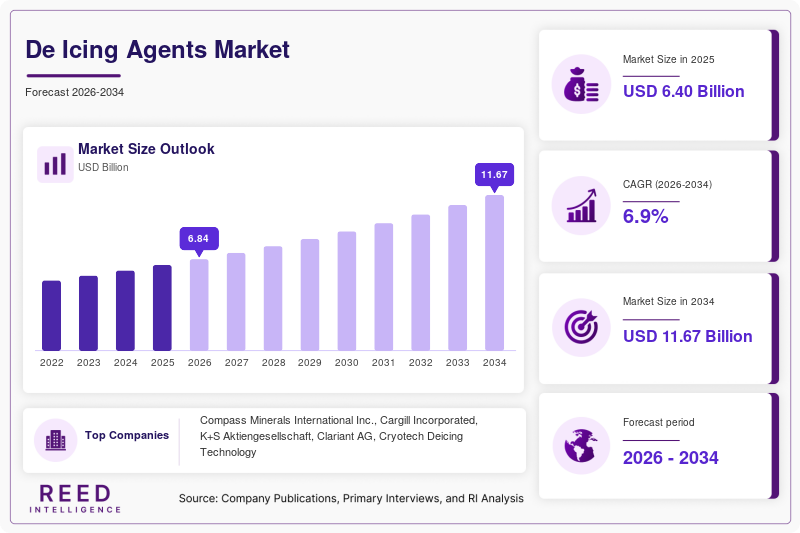
The global De Icing Agents Market was valued at approximately USD 6.4 billion in 2026 and is projected to reach nearly USD 10.9 billion by 2034, expanding at a CAGR of 6.9% during the forecast period from 2026 to 2034. The market is witnessing steady expansion due to increasing winter maintenance activities, rising investments in transportation infrastructure, and growing demand for safe road and airport operations during severe weather conditions. De icing agents are widely used across highways, airports, railways, commercial facilities, and industrial sites to prevent ice accumulation and improve mobility during winter seasons. The increasing frequency of extreme winter weather events in several regions is contributing significantly to market expansion.
A major global factor supporting the growth of the De Icing Agents Market is the rising emphasis on transportation safety and uninterrupted logistics operations during harsh climatic conditions. Governments and municipal authorities are increasing spending on winter road maintenance programs to reduce accident risks and maintain operational efficiency across transportation networks. In addition, the expansion of airport infrastructure and growing air traffic volumes are increasing the demand for advanced runway de icing solutions. Technological developments in eco-friendly and corrosion-resistant formulations are also supporting the long-term outlook of the market.
Key Highlights
- North America dominated the market with 41% share in 2025, while Asia Pacific is projected to witness the fastest growth at a 7.8% CAGR during 2026–2034.
- By product type, chloride-based de icing agents accounted for the largest market share of 48% in 2025, while acetate-based de icing agents are expected to grow at a CAGR of 7.6% during the forecast period.
- By application, roadways and highways remained the dominant segment with 54% market share in 2025, whereas airport runway applications are projected to expand at a CAGR of 7.4% through 2034.
- The United States remained the leading country market and was valued at approximately USD 1.92 billion in 2024 and USD 2.05 billion in 2025.
Market Trends
Increasing Adoption of Environmentally Safer Formulations
One of the major trends shaping the De Icing Agents Market is the growing adoption of environmentally safer and low-corrosion formulations. Conventional chloride-based de icing agents are effective in snow and ice management; however, concerns regarding soil contamination, water pollution, and infrastructure corrosion are encouraging governments and industries to adopt sustainable alternatives. Manufacturers are increasingly developing acetate- and glycol-based formulations with reduced environmental impact.
Municipal authorities and airport operators are focusing on eco-friendly winter maintenance programs to comply with environmental regulations and sustainability goals. Bio-based additives and organic corrosion inhibitors are also gaining traction in the market. This trend is expected to encourage innovation in advanced de icing technologies and create long-term opportunities for environmentally sustainable products.
Rising Integration of Smart Winter Maintenance Systems
Another notable trend in the De Icing Agents Market is the increasing integration of smart winter maintenance technologies. Transportation authorities are adopting weather monitoring systems, automated spray systems, and predictive road condition analytics to optimize de icing operations and reduce material wastage. These technologies help improve operational efficiency while lowering maintenance costs.
Smart infrastructure solutions are also enabling precise application of de icing agents across highways, bridges, and airport runways. The integration of data analytics and connected maintenance systems is improving response times during severe winter storms. As cities continue to modernize transportation management systems, the demand for advanced de icing products compatible with automated distribution systems is expected to rise steadily.
Market Drivers
Growth in Transportation Infrastructure Maintenance
The increasing need for transportation infrastructure maintenance is a major driver supporting the growth of the De Icing Agents Market. Governments across developed and emerging economies are investing heavily in roadways, bridges, airports, and rail networks to support economic growth and improve mobility. Winter weather conditions can severely disrupt transportation operations, making de icing solutions essential for ensuring public safety and uninterrupted logistics movement.
Municipal agencies are expanding winter road management programs to reduce traffic accidents and maintain efficient transportation services during snowfall and freezing conditions. The expansion of airport facilities and rising aircraft movements are also increasing the requirement for advanced runway de icing solutions. These factors are contributing significantly to market growth.
Rising Frequency of Extreme Winter Weather Conditions
Another important growth driver for the De Icing Agents Market is the increasing frequency and intensity of winter storms in several regions. Climate variability is contributing to unpredictable snowfall patterns and freezing temperatures, which are increasing the demand for efficient snow and ice control solutions. Transportation authorities and industrial facilities are investing in high-performance de icing agents to improve winter preparedness.
The growing awareness regarding public safety during winter weather events is encouraging wider adoption of preventive de icing applications. Increased demand from commercial complexes, ports, and logistics facilities is also supporting long-term market expansion.
Market Restraint
Environmental Concerns Associated with Chloride-Based Products
One of the major restraints affecting the De Icing Agents Market is the environmental impact associated with traditional chloride-based de icing products. Excessive use of sodium chloride and calcium chloride can contribute to water contamination, vegetation damage, and infrastructure corrosion. Environmental regulations regarding chemical runoff and soil degradation may limit the adoption of conventional de icing formulations in certain regions.
Market Opportunities
Expansion of Bio-Based De Icing Solutions
The growing focus on sustainable winter maintenance practices is creating strong opportunities for the De Icing Agents Market. Manufacturers are increasingly investing in bio-based and biodegradable de icing formulations derived from agricultural byproducts and renewable materials. These solutions offer reduced environmental impact while maintaining effective ice melting performance.
Rising demand for green infrastructure management and sustainable transportation maintenance programs is expected to support the adoption of eco-friendly de icing agents. This opportunity is likely to encourage innovation and strategic product development initiatives across the market.
Increasing Demand from Airport Infrastructure Projects
The expansion of global airport infrastructure projects presents another major opportunity for the market. Airport operators require specialized de icing solutions to maintain runway safety and operational efficiency during freezing weather conditions. The increasing volume of passenger and cargo air traffic is encouraging investments in advanced airport maintenance systems.
Manufacturers are focusing on high-performance runway de icing fluids with reduced corrosion characteristics and improved environmental compatibility. Growing investments in aviation infrastructure across Asia Pacific and the Middle East are expected to create additional market opportunities.
Segmental Analysis
By Product Type
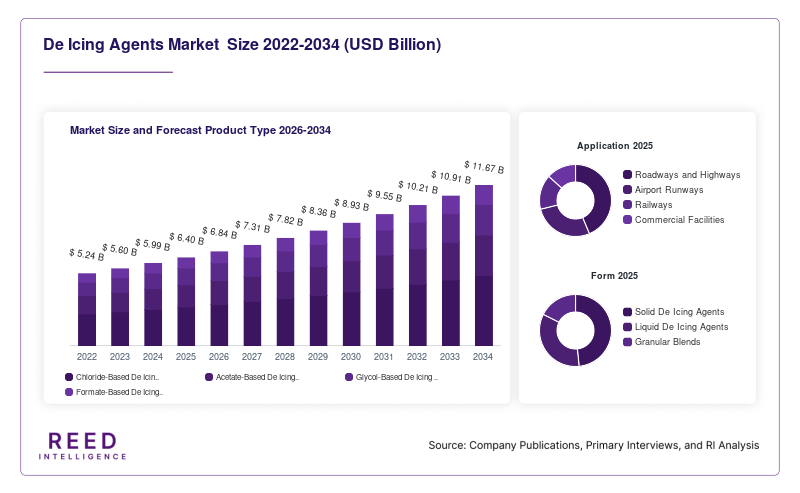
Based on product type, the De Icing Agents Market is segmented into chloride-based de icing agents, acetate-based de icing agents, glycol-based de icing agents, and formate-based de icing agents. Chloride-based de icing agents dominated the market with approximately 48% share in 2025 due to their cost efficiency, widespread availability, and strong ice melting performance. Acetate-based de icing agents are expected to witness the fastest growth at a CAGR of 7.6% during the forecast period because of increasing environmental regulations and rising demand for low-corrosion alternatives across airports and municipal applications.
By Application
By application, the market is segmented into roadways and highways, airport runways, railways, and commercial facilities. Roadways and highways accounted for the largest market share of 54% in 2025 because government agencies continue to invest heavily in winter road maintenance operations and public transportation safety initiatives. Airport runway applications are expected to grow at a CAGR of 7.4% through 2034 due to increasing air traffic volumes and expansion of aviation infrastructure projects in cold-climate regions.
By Form
Based on form, the market includes solid de icing agents, liquid de icing agents, and granular blends. Solid de icing agents held the dominant share of approximately 51% in 2025 due to their large-scale use in municipal snow control operations and ease of storage. Liquid de icing agents are projected to grow at a CAGR of 7.2% during the forecast period because transportation authorities are increasingly adopting pre-treatment spraying systems to improve operational efficiency and reduce chemical consumption.
By End User
The market is segmented into municipal authorities, airports, industrial facilities, and commercial infrastructure operators. Municipal authorities accounted for approximately 49% share in 2025 because local governments represent the largest consumers of de icing materials for roadway maintenance programs. Airports are expected to witness a CAGR of 7.5% during the forecast period owing to increasing demand for specialized runway safety solutions and advanced winter aviation maintenance systems.
Regional Analysis
North America
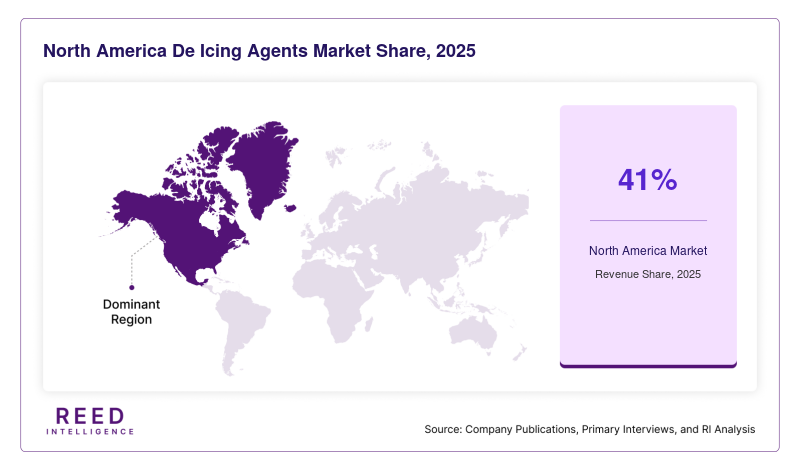
North America accounted for approximately 41% share of the De Icing Agents Market in 2025 and is projected to grow at a CAGR of 6.5% during the forecast period. The region benefits from extensive winter road maintenance operations, advanced transportation infrastructure, and strong government spending on public safety programs. The United States remained the dominant regional market due to increasing highway maintenance budgets and rising airport de icing activities.
Europe
Europe held around 29% share in 2025 and is expected to expand at a CAGR of 6.3% through 2034. Strict transportation safety standards and increasing adoption of environmentally sustainable de icing solutions are supporting regional market growth. Germany dominated the European market because of its advanced roadway maintenance infrastructure and growing investments in smart transportation systems.
Asia Pacific
Asia Pacific represented nearly 18% market share in 2025 and is projected to witness the fastest growth at a CAGR of 7.8% during the forecast period. Expanding airport infrastructure, increasing highway development projects, and growing winter tourism activities are supporting market expansion. China remained the leading regional contributor due to rising transportation modernization programs and increased investment in cold-region infrastructure development.
Middle East & Africa
The Middle East & Africa accounted for approximately 6% share in 2025 and is expected to grow at a CAGR of 5.8% during the forecast period. Increasing airport infrastructure expansion and rising demand for aviation safety solutions are supporting market growth in selected cold-climate areas. Saudi Arabia dominated the region due to growing investments in international airport development and transportation modernization projects.
Latin America
Latin America held around 6% market share in 2025 and is projected to expand at a CAGR of 5.9% through 2034. Chile remained the dominant country market due to growing winter transportation management requirements in mountainous regions. Expanding logistics infrastructure and increasing focus on public roadway safety are supporting regional market development.
Competitive Landscape
The De Icing Agents Market is moderately competitive with the presence of several international and regional participants focusing on sustainable formulations, infrastructure partnerships, and product innovation. Companies are investing in environmentally safer chemical technologies, expansion of production capacity, and strategic collaborations with transportation authorities to strengthen their market presence.
Compass Minerals remained one of the leading participants in the market due to its extensive road salt and winter maintenance product portfolio. The company recently expanded its sustainable de icing product offerings for municipal and airport applications.
Cargill Incorporated continues to strengthen its winter road maintenance business through environmentally optimized de icing solutions and infrastructure partnerships. K+S Aktiengesellschaft is focusing on advanced mineral-based de icing products, while Clariant AG and Cryotech Deicing Technology are expanding their aviation-focused de icing portfolios through technology-driven product development initiatives.
Key Players List
- Compass Minerals International Inc.
- Cargill Incorporated
- K+S Aktiengesellschaft
- Clariant AG
- Cryotech Deicing Technology
- The Dow Chemical Company
- BASF SE
- Kissner Group Holdings LP
- Morton Salt Inc.
- General Atomics
- LyondellBasell Industries Holdings B.V.
- Ecolab Inc.
- S.A. SUEZ
- Occidental Petroleum Corporation
- Peters Chemical Company
De Icing Agents Market Segments
Product Type
- Chloride-Based De Icing Agents
- Acetate-Based De Icing Agents
- Glycol-Based De Icing Agents
- Formate-Based De Icing Agents
Application
- Roadways and Highways
- Airport Runways
- Railways
- Commercial Facilities
Form
- Solid De Icing Agents
- Liquid De Icing Agents
- Granular Blends
End User
- Municipal Authorities
- Airports
- Industrial Facilities
- Commercial Infrastructure Operators
By Region
- North America
- Europe
- APAC
- Middle East and Africa
- LATAM