Deblistering Machine Market Size, Share & Demand Report By Machine Type (Automatic Deblistering Machines, Semi-Automatic Deblistering Machines, Manual Deblistering Machines), By Application (Pharmaceutical Manufacturing, Contract Packaging Services, Research Laboratories, Healthcare Facilities), By End User (Large Pharmaceutical Companies, Small & Medium Pharmaceutical Companies, Contract Manufacturing Organizations, Packaging Service Providers) By Region & Segment Forecasts, 2026–2034
USD 3950
Market Overview
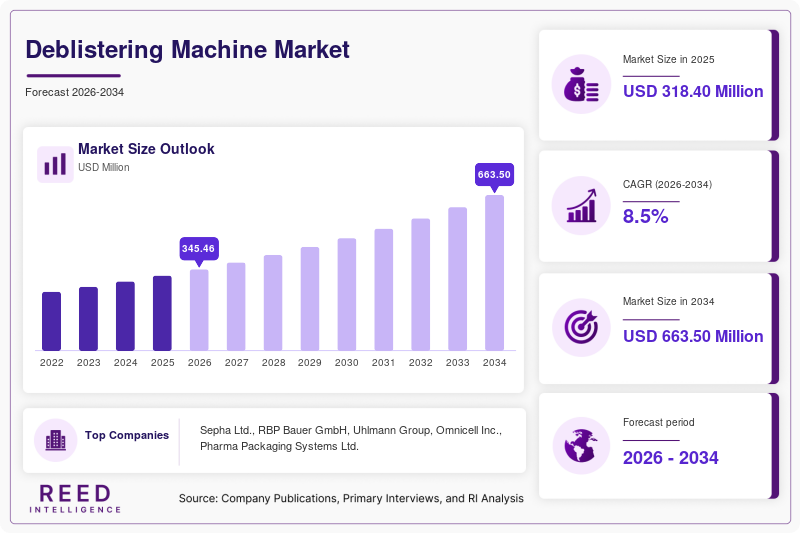
The global Deblistering Machine Market size was valued at USD 318.4 million in 2026 and is projected to reach USD 612.7 million by 2034, expanding at a CAGR of 8.5% during the forecast period from 2026 to 2034. The market is witnessing consistent expansion due to rising pharmaceutical production volumes, increasing demand for medication recovery systems, and growing emphasis on reducing drug wastage during packaging processes. Deblistering machines are increasingly adopted by pharmaceutical manufacturers, contract packaging organizations, and healthcare product companies to recover tablets and capsules from rejected blister packs without causing product damage. These systems support operational efficiency while ensuring compliance with stringent pharmaceutical quality standards.
The growth of the pharmaceutical manufacturing industry globally has remained a major factor supporting market expansion. Rising investments in automated production facilities, especially in emerging economies, have increased the need for advanced packaging and recovery equipment. Manufacturers are also focusing on minimizing financial losses associated with packaging defects, expired batch recalls, and production errors. In addition, increasing adoption of robotic handling systems and smart automation technologies in pharmaceutical packaging facilities is improving the operational performance of deblistering machines.
Key Highlights
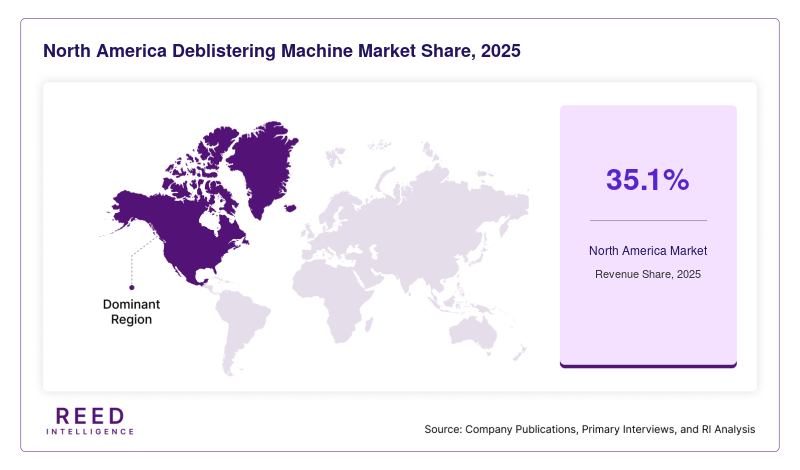
- North America dominated the market with a 35.1% share in 2025, while Asia Pacific is expected to grow at the fastest CAGR of 10.9% during 2026–2034.
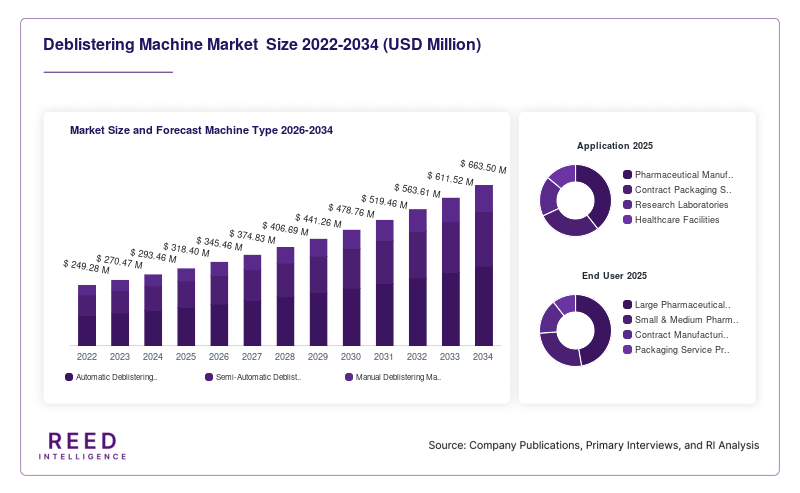
- By machine type, automatic deblistering machines accounted for the largest share of 57.8%, while semi-automatic machines are projected to grow at a CAGR of 9.6%.
- By application, pharmaceutical manufacturing led with a 48.3% share, whereas contract packaging services are expected to expand at a CAGR of 10.4%.
- The United States remained the dominant country, with market values of USD 82.4 million in 2024 and USD 89.7 million in 2025.
Market Trends
Integration of Smart Automation Technologies in Pharmaceutical Packaging
The integration of smart automation technologies is becoming a major trend across the Deblistering Machine Market. Pharmaceutical manufacturers are increasingly investing in automated systems equipped with programmable logic controllers, touch-based interfaces, and sensor-enabled monitoring systems. These technologies improve operational consistency and reduce manual intervention during tablet and capsule recovery processes. Modern deblistering machines are now capable of handling multiple blister formats with limited setup time, which improves production flexibility for pharmaceutical companies operating with diverse product lines.
Manufacturers are also incorporating Industry 4.0 capabilities into packaging equipment to enhance machine monitoring and predictive maintenance. Automated data collection systems enable operators to track machine performance, downtime, and recovery rates in real time. The growing focus on digital manufacturing facilities is expected to support further adoption of technologically advanced deblistering systems across pharmaceutical production plants globally.
Rising Preference for Compact and Portable Deblistering Systems
Compact and portable deblistering systems are gaining traction among small and medium pharmaceutical companies due to their operational flexibility and lower installation costs. These machines occupy limited floor space while maintaining effective product recovery performance. The trend is particularly visible in emerging economies where manufacturers are modernizing production facilities without large-scale infrastructure expansion. Portable systems also support easier machine relocation between packaging lines, increasing manufacturing efficiency in multi-product facilities.
The demand for flexible equipment has increased because pharmaceutical manufacturers frequently handle short production batches and customized medication packaging. Compact systems with modular configurations are helping operators switch between blister pack formats with reduced changeover time. In addition, portable machines improve accessibility for contract packaging organizations that provide outsourced pharmaceutical packaging and recovery services to multiple clients with varying packaging requirements.
Market Drivers
Expansion of Pharmaceutical Manufacturing Capacity Worldwide
The steady expansion of pharmaceutical manufacturing capacity globally is driving demand in the Deblistering Machine Market. Pharmaceutical companies are increasing production volumes to address rising healthcare requirements, aging populations, and growing demand for generic medicines. As production capacity increases, the likelihood of packaging defects, rejected blister packs, and quality control failures also rises, creating greater need for reliable product recovery systems.
Deblistering machines help pharmaceutical manufacturers recover expensive tablets and capsules from defective packaging while maintaining product integrity. This process reduces material wastage and improves overall operational profitability. Emerging economies in Asia Pacific and Latin America are witnessing substantial pharmaceutical infrastructure development, which is further increasing installation of advanced packaging and recovery systems. Growing investment in pharmaceutical exports is also encouraging manufacturers to adopt automated equipment that supports international quality compliance standards.
Increasing Focus on Reducing Pharmaceutical Product Wastage
Pharmaceutical manufacturers are increasingly focused on minimizing financial losses caused by packaging errors, rejected batches, and damaged blister packs. Deblistering machines provide an efficient solution for recovering usable medication from packaging materials without contaminating or damaging the products. This capability has become important for manufacturers handling high-value drugs, specialty medications, and sensitive formulations.
Rising raw material costs and strict inventory management practices are encouraging pharmaceutical companies to improve resource utilization across production facilities. In addition, sustainability initiatives within the pharmaceutical industry are supporting adoption of equipment that reduces packaging waste and production losses. Many companies are integrating recovery systems into automated production lines to improve productivity and reduce operational inefficiencies. These factors continue to strengthen demand for advanced deblistering technologies across global pharmaceutical manufacturing operations.
Market Restraint
High Initial Equipment Costs Limiting Adoption Among Small Manufacturers
High installation and equipment costs remain a significant challenge for the Deblistering Machine Market, particularly among small pharmaceutical manufacturers and regional packaging companies. Advanced automatic deblistering systems require substantial capital investment due to their automation capabilities, stainless-steel construction, precision engineering, and integrated control systems. Many small-scale pharmaceutical firms operating in price-sensitive markets face difficulties allocating sufficient budgets for sophisticated recovery equipment.
The cost challenge becomes more significant when manufacturers require customized machines capable of handling multiple blister formats and product types. In addition to equipment expenses, companies must invest in operator training, maintenance services, spare parts, and production line integration. Smaller firms often continue relying on manual recovery methods because they offer lower short-term operational costs despite reduced efficiency. This restraint may slow market penetration in developing regions where pharmaceutical automation levels remain comparatively low and investment capacity is limited.
Market Opportunities
Growing Demand for Contract Pharmaceutical Packaging Services
The increasing expansion of contract pharmaceutical packaging services is creating substantial growth opportunities for the Deblistering Machine Market. Pharmaceutical companies are outsourcing packaging operations to specialized contract organizations to reduce operational costs and improve production flexibility. Contract packaging providers manage large packaging volumes for multiple pharmaceutical brands, increasing the need for efficient blister recovery systems capable of handling varied packaging formats.
Deblistering machines help contract packaging organizations maintain productivity while reducing losses from defective packaging batches. As outsourced pharmaceutical manufacturing continues to expand globally, service providers are investing in automated packaging technologies to improve turnaround times and operational efficiency. The rising number of small biotechnology firms outsourcing production activities is also expected to increase demand for compact and versatile deblistering systems during the forecast period.
Expansion of Generic Drug Manufacturing in Emerging Economies
The rapid expansion of generic drug manufacturing in emerging economies presents significant opportunities for market participants. Countries such as India, China, Brazil, and Indonesia are increasing pharmaceutical production capabilities to support domestic healthcare demand and export activities. Generic drug manufacturers operate with high-volume production models where packaging efficiency and waste reduction are essential for maintaining profitability.
Deblistering machines support large-scale manufacturing operations by enabling rapid recovery of tablets and capsules from rejected blister packs. Governments in several emerging countries are also promoting pharmaceutical sector development through industrial incentives and healthcare investments. As manufacturers modernize facilities to meet international regulatory requirements, demand for automated packaging recovery systems is expected to rise steadily. Increasing export-oriented pharmaceutical production will further support adoption of advanced deblistering technologies across emerging markets.
Segmental Analysis
By Machine Type
Automatic deblistering machines accounted for the largest share of the Deblistering Machine Market in 2024, representing approximately 57.8% of total revenue. These machines are widely adopted by large pharmaceutical manufacturers because they provide higher operational speed, minimal manual intervention, and improved recovery efficiency. Automatic systems can process large volumes of rejected blister packs while maintaining tablet and capsule integrity, making them suitable for high-capacity pharmaceutical production facilities. The growing integration of automated packaging lines in pharmaceutical manufacturing plants continues to support demand for advanced deblistering systems. In addition, automatic machines help manufacturers reduce labor costs and improve production consistency across large-scale operations. Their compatibility with multiple blister packaging formats also increases operational flexibility for pharmaceutical companies managing diverse product portfolios.
Semi-automatic deblistering machines are projected to register the fastest CAGR of 9.6% during the forecast period due to rising demand among small and medium pharmaceutical manufacturers. These systems offer a balance between operational efficiency and cost-effectiveness, making them suitable for companies with limited automation budgets. Semi-automatic machines require lower initial investment compared to fully automatic systems while still improving product recovery rates over manual methods. Growing pharmaceutical production activities in emerging economies are contributing to increased adoption of semi-automatic equipment. Manufacturers are also introducing compact and portable models designed for smaller production facilities and contract packaging organizations. The flexibility of semi-automatic systems in handling short production runs and varying blister pack designs is expected to further support segment growth throughout the forecast period.
By Application
Pharmaceutical manufacturing represented the dominant application segment in the Deblistering Machine Market during 2024, accounting for 48.3% of total market share. Pharmaceutical manufacturers utilize deblistering machines extensively to recover tablets and capsules from rejected or defective blister packs generated during production processes. Increasing production volumes of generic drugs, over-the-counter medications, and specialty pharmaceuticals continue to strengthen demand for recovery equipment within manufacturing facilities. Deblistering machines help companies reduce operational losses while ensuring compliance with pharmaceutical quality and hygiene standards. The growing focus on production efficiency and waste reduction is encouraging manufacturers to integrate automated recovery systems directly into packaging lines. Furthermore, increasing adoption of advanced pharmaceutical packaging technologies is creating additional demand for high-speed deblistering equipment capable of supporting large-scale manufacturing operations.
Contract packaging services are anticipated to witness the fastest growth, expanding at a CAGR of 10.4% between 2026 and 2034. The rising trend of pharmaceutical outsourcing is increasing demand for specialized packaging service providers capable of managing large packaging volumes for multiple pharmaceutical brands. Contract packaging companies require flexible and efficient deblistering systems that can accommodate various blister formats and product specifications. These organizations are increasingly investing in automated equipment to improve operational productivity and minimize downtime during packaging recovery operations. The expansion of biotechnology startups and small pharmaceutical firms outsourcing packaging activities is further supporting demand within this segment. Growing emphasis on cost optimization and operational flexibility among pharmaceutical companies is expected to accelerate adoption of deblistering machines across outsourced packaging facilities globally.
By End User
Large pharmaceutical companies held the dominant share in the Deblistering Machine Market in 2024 due to their extensive manufacturing capacities and strong investments in automation technologies. These companies operate high-volume production facilities where packaging defects can result in substantial financial losses if product recovery systems are not implemented effectively. Large pharmaceutical manufacturers prioritize automated deblistering equipment because it improves operational consistency, reduces labor dependency, and supports compliance with strict quality standards. The increasing production of specialty medications and high-value pharmaceutical products is also driving adoption of precision recovery systems. Additionally, multinational pharmaceutical firms are integrating advanced packaging technologies into smart manufacturing facilities to improve productivity and resource utilization. Continuous expansion of pharmaceutical production infrastructure globally is expected to maintain strong demand from this end-user category.
Contract manufacturing organizations are projected to record the fastest CAGR of 10.1% during the forecast period. These organizations provide manufacturing and packaging services to multiple pharmaceutical companies, creating demand for versatile and efficient deblistering equipment. Contract manufacturers often handle varying blister formats and production volumes, increasing the importance of flexible recovery systems capable of rapid operational adjustments. Rising pharmaceutical outsourcing trends and increasing investment in contract manufacturing facilities across emerging markets are supporting segment growth. In addition, contract organizations are focusing on improving operational efficiency and reducing product wastage to maintain competitive service pricing. The increasing number of pharmaceutical startups outsourcing production operations is also expected to contribute significantly to rising demand for deblistering machines within this segment.
Regional Analysis
North America
North America accounted for 35.1% of the global Deblistering Machine Market share in 2025 and is expected to maintain a stable growth trajectory during the forecast period. The regional market is projected to expand at a CAGR of 7.8% from 2026 to 2034 due to high pharmaceutical manufacturing activity and strong adoption of automated packaging systems. Pharmaceutical companies across the region continue investing in operational efficiency technologies to reduce packaging waste and improve compliance with quality standards. The presence of established pharmaceutical manufacturers also supports steady equipment replacement demand.
The United States remained the dominant country within North America due to its advanced pharmaceutical manufacturing infrastructure and strong healthcare expenditure levels. Increasing investments in biologics production and specialty drug manufacturing are supporting adoption of high-precision deblistering systems. Pharmaceutical companies in the country are focusing on reducing production losses associated with rejected blister packaging, which continues to drive equipment modernization. The growing use of robotic packaging lines is also contributing to market expansion across large-scale pharmaceutical facilities.
Europe
Europe represented a significant share of the Deblistering Machine Market in 2025 and is anticipated to grow at a CAGR of 7.5% during the forecast period. The region benefits from stringent pharmaceutical quality regulations and strong demand for automated manufacturing solutions. Pharmaceutical companies across Germany, France, Italy, and the United Kingdom are investing in advanced packaging technologies to improve operational accuracy and product recovery efficiency. Increasing adoption of sustainable production practices is also supporting demand for waste-reduction equipment within pharmaceutical packaging operations.
Germany emerged as the leading country within the European market owing to its strong pharmaceutical manufacturing base and industrial automation expertise. The country hosts several pharmaceutical equipment manufacturers and packaging technology providers, creating favorable conditions for market development. German pharmaceutical companies are increasingly adopting automated recovery systems to improve production productivity and comply with strict European packaging quality requirements. Continuous technological innovation in pharmaceutical engineering further supports regional market growth.
Asia Pacific
Asia Pacific is expected to witness the fastest growth in the Deblistering Machine Market, registering a CAGR of 10.9% from 2026 to 2034. Rapid pharmaceutical industry expansion, rising healthcare investments, and increasing generic drug production are driving regional market demand. Countries across the region are modernizing pharmaceutical manufacturing infrastructure to meet growing domestic and export requirements. Demand for automated packaging equipment is increasing as manufacturers focus on improving production efficiency and minimizing operational losses during packaging processes.
China remained the dominant country in Asia Pacific due to its large pharmaceutical manufacturing capacity and expanding export activities. The country has experienced substantial growth in pharmaceutical packaging automation investments during recent years. Local manufacturers are increasingly adopting advanced deblistering machines to improve operational consistency and reduce wastage from rejected blister packs. Government initiatives supporting pharmaceutical sector modernization and industrial automation are also contributing to increased adoption of recovery equipment across manufacturing facilities.
Middle East & Africa
The Middle East & Africa region is gradually expanding within the Deblistering Machine Market and is forecast to grow at a CAGR of 6.8% during the assessment period. Increasing healthcare infrastructure development and rising pharmaceutical production investments are supporting market demand across the region. Pharmaceutical companies are focusing on improving packaging quality standards and operational efficiency, particularly in Gulf Cooperation Council countries. Demand for cost-effective automated equipment is also increasing among regional pharmaceutical manufacturers aiming to reduce packaging-related product losses.
Saudi Arabia emerged as the leading market within the region due to its growing pharmaceutical manufacturing sector and healthcare diversification initiatives. Government programs promoting domestic drug production are encouraging pharmaceutical companies to modernize manufacturing operations. Rising investment in local pharmaceutical production facilities is increasing adoption of automated packaging and recovery systems. Additionally, growing demand for imported pharmaceutical packaging technologies is contributing to market development across the country.
Latin America
Latin America accounted for a moderate share of the Deblistering Machine Market in 2025 and is expected to register a CAGR of 7.1% during the forecast period. Regional pharmaceutical manufacturing activities are increasing steadily due to growing healthcare demand and rising generic medicine production. Pharmaceutical companies are focusing on improving operational productivity and packaging efficiency to remain competitive in domestic and export markets. Adoption of semi-automatic and compact deblistering systems is increasing among medium-scale manufacturers across the region.
Brazil remained the dominant country in Latin America because of its large pharmaceutical production industry and expanding healthcare investments. Local pharmaceutical companies are increasingly adopting automated packaging equipment to improve manufacturing standards and reduce production losses. Government support for domestic pharmaceutical production and rising demand for affordable medicines are contributing to market growth. The expansion of regional contract packaging services is also creating new opportunities for deblistering machine suppliers in the Brazilian market.
Competitive Landscape
The Deblistering Machine Market is moderately fragmented, with several international and regional manufacturers competing based on automation capabilities, machine efficiency, product flexibility, and pricing strategies. Companies are focusing on developing high-speed, compact, and multi-format deblistering systems to address evolving pharmaceutical packaging requirements. Technological advancements related to automated controls, touchscreen interfaces, and contamination-free recovery processes are becoming key competitive factors within the industry.
Sepha Ltd. remains one of the leading participants in the market due to its extensive pharmaceutical packaging expertise and diversified deblistering equipment portfolio. The company continues to focus on product innovation and international market expansion strategies. Recent developments in automated recovery systems with improved blister compatibility have strengthened its market position. Other prominent companies are increasing investment in research and development activities to introduce energy-efficient and operator-friendly machines for pharmaceutical manufacturers.
Key Players
- Sepha Ltd.
- RBP Bauer GmbH
- Uhlmann Group
- Omnicell Inc.
- Pharma Packaging Systems Ltd.
- Stripfoil Deblistering Technology
- Jornen Machinery Co. Ltd.
- Rondo-Pak LLC
- Accutek Packaging Equipment Companies Inc.
- Marchesini Group S.p.A.
- ACG Worldwide
- Zhejiang Future Machinery Co. Ltd.
- Fabrima Maquinas Automáticas Ltda.
- Harsiddh Engineering Co.
- SaintyCo
Recent Developments
- Sepha Ltd. introduced an upgraded automatic deblistering system with enhanced touchscreen controls and multi-format blister handling capabilities in 2025.
- Marchesini Group S.p.A. expanded its pharmaceutical packaging automation portfolio through the launch of a compact recovery machine designed for medium-scale manufacturers in 2024.
- Uhlmann Group announced the integration of smart monitoring software into its pharmaceutical packaging equipment line to improve operational efficiency and predictive maintenance capabilities in 2025.
- Jornen Machinery Co. Ltd. increased production capacity for pharmaceutical packaging equipment in Asia Pacific to address growing regional demand in 2024.
- ACG Worldwide launched a modular semi-automatic deblistering machine focused on flexible pharmaceutical packaging operations in 2025.
Deblistering Machine Market Segments
Machine Type
- Automatic Deblistering Machines
- Semi-Automatic Deblistering Machines
- Manual Deblistering Machines
Application
- Pharmaceutical Manufacturing
- Contract Packaging Services
- Research Laboratories
- Healthcare Facilities
End User
- Large Pharmaceutical Companies
- Small & Medium Pharmaceutical Companies
- Contract Manufacturing Organizations
- Packaging Service Providers
By Region
- North America
- Europe
- APAC
- Middle East and Africa
- LATAM