Dehydrated Fruits and Vegetables Market Size, Share & Trends Analysis Report By Product Type (Dehydrated Fruits, Dehydrated Vegetables), By Dehydration Technology (Hot-Air Drying, Freeze Drying, Vacuum Drying), By Form (Whole, Slices & Dices, Chunks & Pieces), By Application (Food Processing, Snacks, Foodservice, Household Consumption), By Distribution Channel (Business-to-Business, Retail, Foodservice Suppliers) Forecasts, 2026–2034
USD 3950
Dehydrated Fruits and Vegetables Market Size
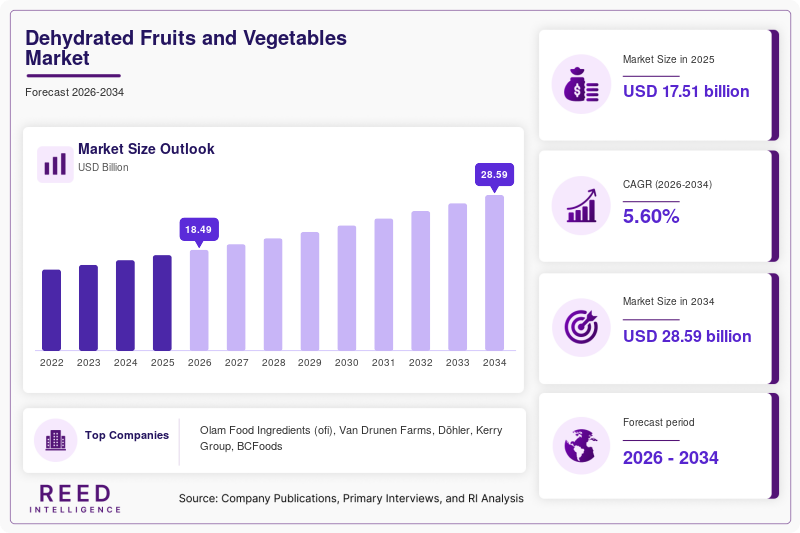
The Dehydrated Fruits and Vegetables Market was valued at USD 17.51 billion in 2025 and is estimated to reach USD 18.49 billion in 2026. Based on the supplied forecast, the market is projected to reach USD 28.59 billion by 2034.
The supplied CAGR is 5.60%. However, the 2026 market value of USD 18.49 billion and the 2034 forecast of USD 30.19 billion imply a CAGR of approximately 6.32%. The 2025 and 2034 endpoints imply approximately 6.24%. The report retains the supplied market values and flags the inconsistency rather than presenting the figures as mathematically reconciled.
Dehydrated fruits and vegetables are fresh produce products processed to reduce moisture content, extend shelf life and lower storage and transportation requirements. Common products include dried mango, apple, banana, berries, onion, garlic, carrot, tomato, potato and leafy vegetables. Commercial formats range from whole pieces and slices to flakes, powders and granules.
The market serves both consumer-facing products and industrial ingredients. Food manufacturers use dehydrated produce in soups, sauces, seasonings, bakery products, snack foods, instant meals, beverage mixes and prepared foods. Retail consumers purchase dried fruits as snacks and use dehydrated vegetables in cooking, while foodservice operators value ingredients that can be stored, portioned and prepared with less fresh-produce handling.
A central market driver is the need to balance food availability, shelf life and processing costs. FAO estimates that global food losses across the supply chain reached 13.3% in 2023, while fruits and vegetables recorded a loss rate of 25.4%. Dehydration can help preserve suitable produce and create products for longer storage, but its economics depend on energy use, raw-material quality, processing yield, packaging and the intended end application. These loss statistics describe the wider food system and should not be interpreted as the share of produce that can economically be converted into dehydrated products.
Dehydrated Fruits and Vegetables Market Drivers
Food Manufacturers Need Shelf-Stable Ingredients for Processed Foods
Dehydrated produce allows food manufacturers to store ingredients for longer periods than fresh produce under suitable packaging and storage conditions. It also reduces the need to wash, peel, chop or otherwise prepare fresh ingredients at the point of use.
Manufacturers use dried vegetables in soups, noodles, sauces, seasonings, snack products and instant meals. Dried fruits are used in cereals, bakery products, snack bars, confectionery and beverage applications. The format can improve inventory flexibility and reduce dependence on daily fresh-produce deliveries.
The commercial benefit depends on the full recipe and process. Dehydrated ingredients may lower handling and storage costs, but the processor must account for rehydration behavior, flavor intensity, color, texture and the cost of converting fresh produce into a concentrated ingredient.
Convenience Foods Support Demand for Dried Fruit and Vegetable Ingredients
Convenience-oriented foods require ingredients that are easy to store, measure, transport and incorporate into standardized production lines. Dehydrated products fit these requirements because they are available in consistent formats and can be supplied throughout the year when appropriate sourcing and inventory management are in place.
Instant soups, ready meals, seasoning blends, noodle products, snack mixes and baking ingredients can all use dehydrated produce. Industrial customers may prefer flakes or granules for controlled dosing, while slices and pieces may be selected when the final product needs visible ingredients.
The strongest demand is likely to come from applications where dehydration provides a practical operational advantage, not simply from the broad popularity of convenience foods. Product performance and total ingredient cost remain decisive in formulation decisions.
Dehydrated Fruits and Vegetables Market Restraints
Energy and Processing Costs Can Limit Margins
Industrial drying requires energy to remove moisture, and the amount varies by technology, product and initial water content. Energy costs can materially influence the economics of hot-air, vacuum and freeze-drying operations.
Freeze drying may support premium quality, but the capital and operating costs can make it unsuitable for price-sensitive applications. Hot-air drying may offer lower processing costs for many products, although quality and yield must still meet customer specifications.
Processors must manage energy efficiency, equipment utilization and throughput to remain competitive. When raw-material or energy costs rise, suppliers may be unable to pass the full increase to customers immediately.
Raw-Material Quality and Seasonality Affect Supply
Dehydrated fruit and vegetable processors depend on consistent access to suitable fresh produce. Weather events, crop disease, harvest timing and competing fresh-market demand can affect both price and availability.
Different varieties may behave differently during drying and rehydration. Changes in sugar content, maturity, size or moisture can affect the final product and processing yield, creating additional quality-control requirements.
Processors may mitigate these risks through multiple sourcing regions, long-term grower relationships, contracted procurement and careful inventory planning. These measures add coordination costs and cannot fully eliminate crop-related uncertainty.
Product Quality Can Deteriorate Without Appropriate Processing and Packaging
Dehydration does not remove every food-safety or quality risk. Products may be vulnerable to moisture reabsorption, oxidation, color changes, flavor loss and microbial contamination if processing, packaging or storage is inadequate.
Manufacturers must select suitable packaging barriers, maintain hygienic processing conditions and verify that products meet customer and regulatory requirements. These controls increase costs but are essential for reliable commercial supply.
Dehydrated Fruits and Vegetables Market Opportunities
Higher-Value Freeze-Dried and Specialty Products
Freeze-dried fruit and vegetables can serve premium snacks, breakfast products, confectionery, beverage mixes, outdoor foods and selected specialty applications. Their lightweight structure and rehydration characteristics can be useful where appearance, texture or rapid preparation is important.
The opportunity is strongest for products that can support the additional processing cost through differentiated quality or performance. Suppliers need to validate demand and production economics before expanding capacity, as premium positioning alone does not guarantee sufficient volume or margin.
Powders, Flakes and Granules for Industrial Formulations
Powders and granules are suitable for seasoning blends, soups, sauces, beverage mixes and prepared foods. Their small particle size can make them easier to dose and distribute in formulations than larger pieces.
Ingredient suppliers can offer different mesh sizes, flavor profiles, moisture specifications and blends tailored to a customer's process. Customization can improve customer retention, although it may increase production complexity and require more stringent quality control.
Private Label and Direct-to-Consumer Retail
Retail opportunities include dried fruit snacks, mixed fruit packs, trail mixes and cooking ingredients. Private-label products can help retailers build category offerings, while online channels provide a route to specialized varieties and multipacks.
Commercial success depends on taste, texture, packaging, brand trust and value per serving. Retailers and brands must also manage the risk that consumers switch to fresh fruit, nuts, bars or other snacks when relative prices change.
Segmental Analysis
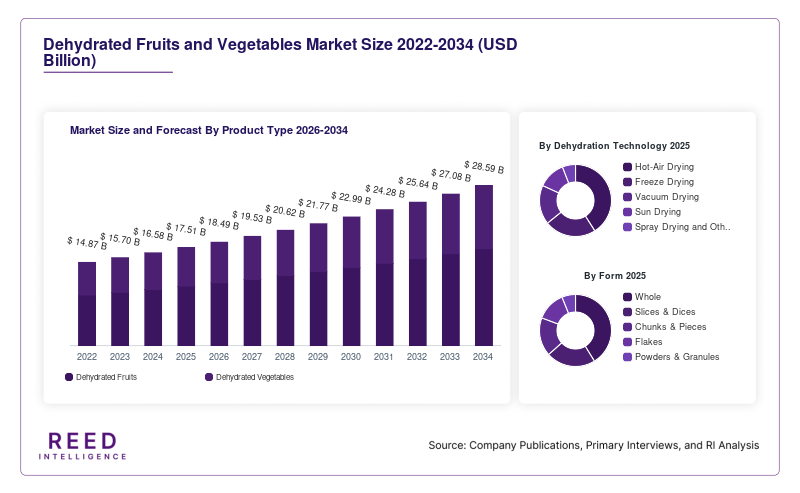
The segment shares, values, growth rates and 2034 values below are internal analytical allocations, not independently published market estimates. They are modeled to provide a planning framework around the supplied global market values. Actual segment sizes may differ, and the indicative values should be validated against company disclosures, product-level sales data and trade statistics.
By Product Type
Dehydrated Fruits represent approximately 40% of the 2025 market, equivalent to about USD 7.00 billion under the internal allocation. The segment is modeled to reach approximately USD 12.98 billion by 2034, corresponding to an indicative CAGR of about 7.1%. Demand is associated with snack foods, cereals, bakery products, confectionery and beverage ingredients. The growth assumption reflects opportunities in convenient snack formats and industrial fruit inclusions, but actual performance depends on raw-fruit costs and competition from other ingredients.
Dehydrated Vegetables represent approximately 60% of the 2025 market, equivalent to about USD 10.51 billion. The segment is modeled to reach approximately USD 17.21 billion by 2034, implying an indicative CAGR of about 5.6%. Vegetable ingredients are used widely in soups, sauces, seasonings, instant meals and foodservice. Industrial demand is supported by storage and preparation advantages, while price competition and the availability of fresh, frozen or other preserved ingredients can constrain growth.
By Dehydration Technology
Hot-Air Drying represents approximately 42% of the 2025 market, equivalent to about USD 7.35 billion. It is modeled to reach approximately USD 12.08 billion by 2034, at an indicative CAGR of about 5.7%. Hot-air systems are relevant to many high-volume applications because they can process a range of produce types at industrial scale. Their economics depend on energy efficiency, drying time, product quality and plant utilization.
Freeze Drying represents approximately 18% of the 2025 market, equivalent to about USD 3.15 billion. It is modeled to reach approximately USD 6.64 billion by 2034, implying an indicative CAGR of about 8.7%. Freeze drying is used where texture, appearance, low weight or rehydration characteristics justify higher processing costs. Premium snacks and specialty food ingredients are potential applications, although the segment remains sensitive to energy and capital costs.
Vacuum Drying represents approximately 12% of the 2025 market, equivalent to about USD 2.10 billion. It is modeled to reach approximately USD 4.23 billion by 2034, corresponding to an indicative CAGR of about 8.1%. Vacuum drying can be selected for products requiring controlled processing conditions. Adoption depends on equipment economics, desired product characteristics and the availability of alternatives.
Sun Drying represents approximately 16% of the 2025 market, equivalent to about USD 2.80 billion. It is modeled to reach approximately USD 3.93 billion by 2034, at an indicative CAGR of about 3.8%. Sun drying can offer low direct energy requirements in suitable climates, but weather dependence, contamination control and process consistency may limit its use in some export-oriented and tightly specified applications.
Spray Drying and Other Technologies represent approximately 12% of the 2025 market, equivalent to about USD 2.10 billion. The category is modeled to reach approximately USD 3.32 billion by 2034, implying an indicative CAGR of about 5.2%. These technologies serve selected applications such as fruit and vegetable powders, concentrated ingredients and specialty formulations. Their performance depends on product composition, carrier requirements, powder stability and end-use specifications.
By Form
Whole Dehydrated Products represent approximately 20% of the 2025 market, equivalent to about USD 3.50 billion. The segment is modeled to reach approximately USD 5.74 billion by 2034, at an indicative CAGR of about 5.6%. Whole products are used in selected snack and specialty applications where appearance and recognizable product identity matter.
Slices & Dices represent approximately 35% of the 2025 market, equivalent to about USD 6.13 billion. They are modeled to reach approximately USD 9.66 billion by 2034, at an indicative CAGR of about 5.2%. Slices and diced products can provide visible ingredients in cereals, bakery products, snacks and ready meals, with uniformity supporting portion control and predictable rehydration.
Chunks & Pieces represent approximately 20% of the 2025 market, equivalent to about USD 3.50 billion. The segment is modeled to reach approximately USD 6.04 billion by 2034, at an indicative CAGR of about 6.2%. Chunks and pieces serve products that require a noticeable fruit or vegetable texture, including prepared foods, snack mixes and ingredient blends.
Flakes represent approximately 15% of the 2025 market, equivalent to about USD 2.63 billion. They are modeled to reach approximately USD 4.83 billion by 2034, corresponding to an indicative CAGR of about 7.0%. Flakes can be incorporated into soups, seasonings, instant meals and dry mixes, where rapid handling and predictable dispersion are important.
Powders & Granules represent approximately 10% of the 2025 market, equivalent to about USD 1.75 billion. They are modeled to reach approximately USD 3.93 billion by 2034, at an indicative CAGR of about 9.4%. Powder and granule formats support seasoning, flavoring, sauces, beverages and blended ingredients. Growth depends on solubility or dispersion, flavor stability, particle size and the ability to meet customer specifications.
By Application
Food Processing represents approximately 50% of the 2025 market, equivalent to about USD 8.76 billion. It is modeled to reach approximately USD 14.49 billion by 2034, at an indicative CAGR of about 5.8%. Applications include soups, sauces, instant meals, bakery products, cereals, noodles, confectionery and beverage formulations. This segment benefits from repeat industrial demand, although purchases are sensitive to recipe economics and alternative ingredients.
Snacks represent approximately 18% of the 2025 market, equivalent to about USD 3.15 billion. The segment is modeled to reach approximately USD 6.34 billion by 2034, implying an indicative CAGR of about 8.1%. Dried fruit snacks and specialty freeze-dried products can compete on convenience, portability and flavor. Success depends on price, taste, texture, portion size and consumer response to the product's nutritional profile.
Foodservice represents approximately 14% of the 2025 market, equivalent to about USD 2.45 billion. It is modeled to reach approximately USD 4.23 billion by 2034, at an indicative CAGR of about 6.3%. Restaurants, caterers and institutional kitchens use dehydrated ingredients to simplify preparation and storage. The economic benefit depends on labor savings, consistency, menu requirements and the cost of rehydrating or incorporating the product.
By Distribution Channel
Business-to-Business represents approximately 70% of the 2025 market, equivalent to about USD 12.26 billion. It is modeled to reach approximately USD 21.74 billion by 2034, at an indicative CAGR of about 6.6%. B2B sales supply food manufacturers, ingredient blenders, distributors and industrial users. The channel benefits from recurring orders and customized specifications, but it is exposed to contract pricing, customer concentration and supplier qualification requirements.
Retail represents approximately 18% of the 2025 market, equivalent to about USD 3.15 billion. It is modeled to reach approximately USD 5.13 billion by 2034, implying an indicative CAGR of about 5.6%. Retail covers packaged dried fruits and vegetables sold through supermarkets, convenience stores, specialty food retailers and online platforms. Brand positioning, packaging, shelf placement and price per serving influence demand.
Foodservice Suppliers represent approximately 12% of the 2025 market, equivalent to about USD 2.10 billion. The segment is modeled to reach approximately USD 3.32 billion by 2034, at an indicative CAGR of about 5.2%. These suppliers serve restaurants, catering companies, institutional kitchens and other commercial food operators. Product consistency and ease of preparation matter, while purchasing decisions are often driven by total kitchen cost and reliable availability.
Regional Analysis
Regional shares and forecast values below are internal analytical allocations intended to reconcile with the supplied global market forecast. They are not independently published regional market estimates.
North America Dehydrated Fruits and Vegetables Market
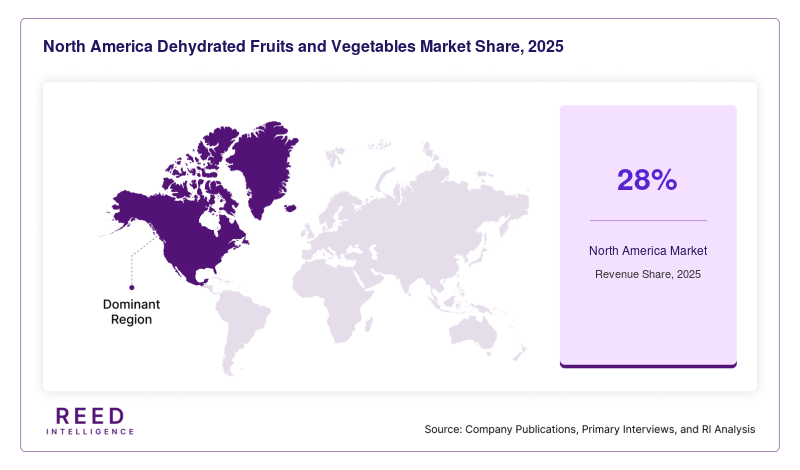
North America is modeled to account for approximately 28% of the 2025 market, equivalent to about USD 4.90 billion. It is modeled to reach approximately USD 7.55 billion by 2034, corresponding to an indicative CAGR of about 4.9%.
Demand is linked to packaged foods, snacks, foodservice and industrial ingredient use. Dehydrated onion, garlic, tomato, potato and other vegetables are used in seasonings, soups, sauces, instant meals and prepared foods. Dried fruit products also serve snack and bakery applications.
USDA's Economic Research Service provides monthly and annual trade data that distinguish dried and dehydrated vegetables from other vegetable categories. This enables importers, processors and distributors to monitor commodity-specific trade values and volumes. The data are useful indicators of supply conditions but do not measure the entire regional market.
Competition centers on ingredient specifications, quality assurance, delivery reliability and cost. Manufacturers must balance the convenience of dehydrated products against fresh and frozen alternatives, while processors manage raw-material prices, energy costs and customer concentration.
Europe Dehydrated Fruits and Vegetables Market
Europe is modeled to represent approximately 25% of the 2025 market, equivalent to about USD 4.38 billion. It is modeled to reach approximately USD 6.95 billion by 2034, at an indicative CAGR of about 5.3%.
Demand comes from industrial food processing, bakery products, soups, sauces, snacks and specialty ingredients. Food manufacturers may use dehydrated produce to standardize recipes and maintain supply across seasons, while consumers purchase dried fruit products for snacking and home use.
Suppliers face requirements around food safety, traceability, labeling and product quality. Exporters must also account for the regulatory and documentation requirements of their destination markets. Organic and specialty products can offer differentiation, but certification, sourcing and segregation may increase operating costs.
Processors that can maintain consistent quality, provide traceable raw materials and develop tailored ingredients for industrial customers may be better positioned to secure recurring contracts.
APAC Dehydrated Fruits and Vegetables Market
APAC is modeled to account for approximately 30% of the 2025 market, equivalent to about USD 5.25 billion. It is modeled to reach approximately USD 10.57 billion by 2034, at an indicative CAGR of about 8.1%, the fastest rate among the regions in this allocation.
The region includes large agricultural production bases, food-processing industries and export suppliers. Demand varies across markets: some producers specialize in processing crops for export, while food manufacturers and retail brands in other markets use dehydrated ingredients in packaged foods, snacks and seasonings.
Processing capacity, labor, energy costs, raw-material access and export logistics shape regional competitiveness. Proximity to agricultural production can support sourcing, but it does not guarantee competitive finished-product costs if energy, quality control, packaging or transportation is expensive.
APAC's modeled growth reflects the potential to expand processing and industrial ingredient use. Actual performance will depend on investment, food-safety compliance, consumer demand, trade conditions and competition among producing countries.
Middle East and Africa Dehydrated Fruits and Vegetables Market
Middle East and Africa are modeled to represent approximately 7% of the 2025 market, equivalent to about USD 1.23 billion. The region is modeled to reach approximately USD 1.81 billion by 2034, at an indicative CAGR of about 4.4%.
Demand is associated with imported ingredients, packaged food production, foodservice and selected retail products. Dehydrated products can be useful where long storage life and reduced handling are important, but adoption depends on purchasing power, product availability and the economics of importing finished goods versus processing locally.
Climate conditions and post-harvest infrastructure vary widely across the region. Local processing may offer opportunities where suitable crops, energy, water, logistics and quality-control systems are available. However, investment requirements and access to consistent raw material can constrain expansion.
LATAM Dehydrated Fruits and Vegetables Market
LATAM is modeled to represent approximately 10% of the 2025 market, equivalent to about USD 1.75 billion. It is modeled to reach approximately USD 3.32 billion by 2034, at an indicative CAGR of about 7.4%.
The region has agricultural production that can support dehydrated fruit and vegetable processing, alongside demand from food manufacturers and export customers. Dried fruit products and vegetable ingredients can serve retail, foodservice and industrial markets.
Commercial opportunities depend on crop availability, processing technology, quality consistency, access to export markets and the cost of moving finished goods. Currency fluctuations and differences in domestic purchasing power may influence investment and consumer demand.
Suppliers that combine reliable agricultural sourcing with efficient processing and international food-safety compliance may be better positioned to serve both domestic manufacturers and export customers.
Competitive Landscape
The Dehydrated Fruits and Vegetables Market includes agricultural processors, industrial ingredient manufacturers, specialist drying companies, private-label suppliers and food ingredient distributors. Competition depends on sourcing access, drying technology, product quality, cost efficiency, food-safety systems and the ability to meet customer specifications.
Large ingredient suppliers compete through scale, product range and relationships with multinational food manufacturers. Specialist processors may differentiate through freeze drying, organic sourcing, custom particle sizes, specialty fruit varieties or tailored vegetable blends. Regional producers can compete on proximity to agricultural supply and cost, while exporters need reliable traceability and compliance with destination-market requirements.
Key Market Players
The following companies are relevant participants in dehydrated fruit and vegetable processing, specialty ingredients, freeze-dried products or adjacent ingredient supply. Their inclusion does not imply equal market share or that all generate revenue exclusively from dehydrated fruits and vegetables.
- Olam Food Ingredients (ofi)
- Van Drunen Farms
- Döhler
- Kerry Group
- BCFoods
- Silva International
- Chaucer Foods
- European Freeze Dry
- Freeze-Dry Foods GmbH
- Mercer Foods
- Paradise Fruits
- Sensient Technologies
- Symrise
- Nutradried
- Harmony House Foods
Recent Market Developments
- In 2026, the Food and Agriculture Organization of the United Nations published guidance on measuring harvest and post-harvest losses for fruits and vegetables. The guidance is intended to improve the methodology and tools used to estimate losses at national and subnational levels. Better loss measurement can help governments, growers and processors identify where preservation, storage and processing investments may be most useful. For dehydrated-product suppliers, the commercial opportunity depends on whether suitable produce can be sourced and processed at a competitive cost.
- In October 2026, the USDA Economic Research Service updated its vegetables and pulses trade and price data. The dataset tracks monthly imports and exports by commodity and category, including dried vegetables, as well as selected producer, consumer and retail price information. More current trade and price information helps market participants assess supply patterns, import dependence and commodity-specific changes. It is an important monitoring resource, but it should not be treated as a direct estimate of global dehydrated vegetable market revenue.
Dehydrated Fruits and Vegetables Market Segments
By Product Type
- Dehydrated Fruits
- Dehydrated Vegetables
By Dehydration Technology
- Hot-Air Drying
- Freeze Drying
- Vacuum Drying
- Sun Drying
- Spray Drying and Other Technologies
By Form
- Whole
- Slices & Dices
- Chunks & Pieces
- Flakes
- Powders & Granules
By Application
- Food Processing
- Snacks
- Foodservice
- Household Consumption
- Other Applications
By Distribution Channel
- Business-to-Business
- Retail
- Foodservice Suppliers
By Region
- North America
- Europe
- APAC
- Middle East and Africa
- LATAM