Dental Alloy Market Size, Share, Demand Report By Type (Base Metal Alloys, Noble Metal Alloys, Titanium-Based Alloys, Others), By Application (Prosthodontics, Implantology, Orthodontics, Others), By End Use (Dental Clinics, Dental Laboratories, Hospitals) By Region & Segment Forecasts, 2026–2034
USD 3950
Market Overview
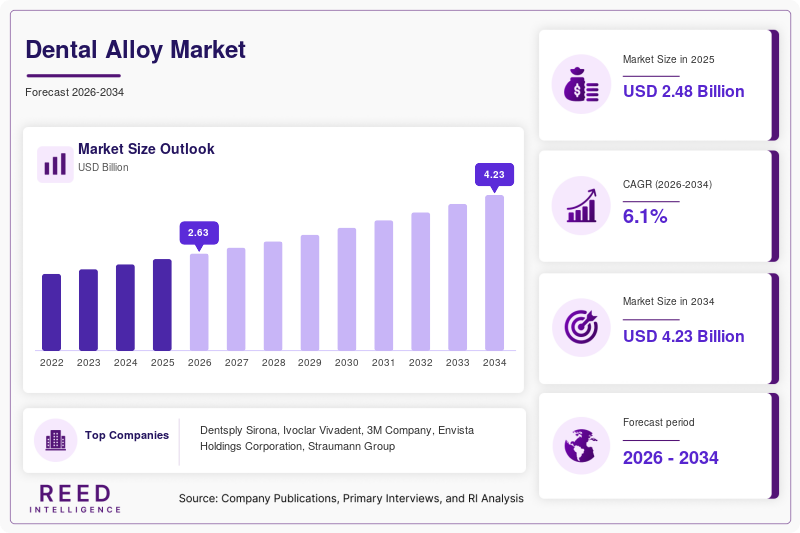
The global Dental Alloy Market size is valued at approximately USD 2.48 billion in 2026 and is projected to reach USD 3.96 billion by 2034, registering a CAGR of 6.1% during the forecast period 2026–2034. The steady expansion of the Dental Alloy Market is driven by increasing demand for restorative and prosthetic dental procedures, supported by rising awareness of oral health and improved access to dental care services across developed and emerging economies.
The growing geriatric population worldwide has significantly increased the need for durable dental restorations, further strengthening market demand for high-performance alloys used in crowns, bridges, implants, and dentures. Advancements in dental materials science and the integration of digital dentistry technologies have further enhanced the adoption of precision-engineered alloys. A global shift toward aesthetic dentistry and minimally invasive procedures is also contributing to market expansion.
Key Highlights
- North America held 34.2% share of the Dental Alloy Market in 2025
- Asia Pacific is expected to register the fastest CAGR of 7.4% during 2026–2034
- Base metal alloys dominated the material segment in 2025
- Titanium-based alloys are expected to be the fastest-growing subsegment
- The United States market was valued at USD 0.78 billion in 2024 and USD 0.82 billion in 2025
Market Trends
Rising integration of digital dentistry and CAD/CAM systems
The Dental Alloy Market is increasingly influenced by the adoption of CAD/CAM technology in dental laboratories and clinics. These systems require alloys with high machinability, consistency, and compatibility with automated milling processes. Manufacturers are developing advanced formulations that support precise shaping and reduced material waste. This trend is improving workflow efficiency and enabling faster turnaround times in restorative dentistry, especially for crowns and bridges.
Shift toward biocompatible and nickel-free dental materials
There is a growing preference for biocompatible alloys due to rising concerns about metal allergies and long-term tissue compatibility. Nickel-free and titanium-based alloys are gaining strong traction as safer alternatives. This transition is reshaping material selection in dental procedures, particularly in implantology and prosthodontics, where patient safety and durability are critical considerations.
Market Drivers
Increasing prevalence of dental disorders and tooth loss
The rising incidence of dental caries, periodontal diseases, and tooth loss is significantly driving the Dental Alloy Market. Poor dietary habits, aging populations, and limited oral hygiene awareness in developing regions are contributing to higher demand for restorative dental procedures. Dental alloys are widely used due to their strength, corrosion resistance, and long-term reliability in oral environments.
Growing demand for cosmetic and restorative dentistry
Increasing focus on dental aesthetics is accelerating the demand for advanced restorative solutions. Patients are seeking durable yet natural-looking dental restorations, boosting the use of metal-ceramic combinations and high-performance alloys. Rising disposable income and improved access to dental care services are further supporting market growth across both urban and semi-urban regions.
Market Restraints
High cost of advanced dental alloy materials
The Dental Alloy Market faces constraints due to the high cost of premium materials such as titanium, gold, and palladium-based alloys. These materials involve complex manufacturing processes and strict quality standards, which increase overall product costs. Price fluctuations in raw materials also impact production stability. In cost-sensitive regions, dental professionals often prefer alternative materials such as ceramics and composites, limiting the widespread adoption of dental alloys in some applications.
Market Opportunities
Expansion of dental implant procedures globally
The increasing adoption of dental implants presents a strong growth opportunity for the Dental Alloy Market. Titanium-based alloys are widely used in implants due to their excellent biocompatibility and ability to integrate with bone tissue. Rising awareness of permanent tooth replacement solutions and increasing dental tourism are further supporting demand growth, particularly in emerging economies.
Advancements in additive manufacturing and alloy processing
Technological improvements in additive manufacturing and laser sintering are creating new opportunities in the Dental Alloy Market. These innovations enable the production of highly customized dental prosthetics with improved precision and reduced material wastage. Enhanced manufacturing processes are improving mechanical strength, corrosion resistance, and overall performance of dental alloys, expanding their application scope.
Segmental Analysis
By Type
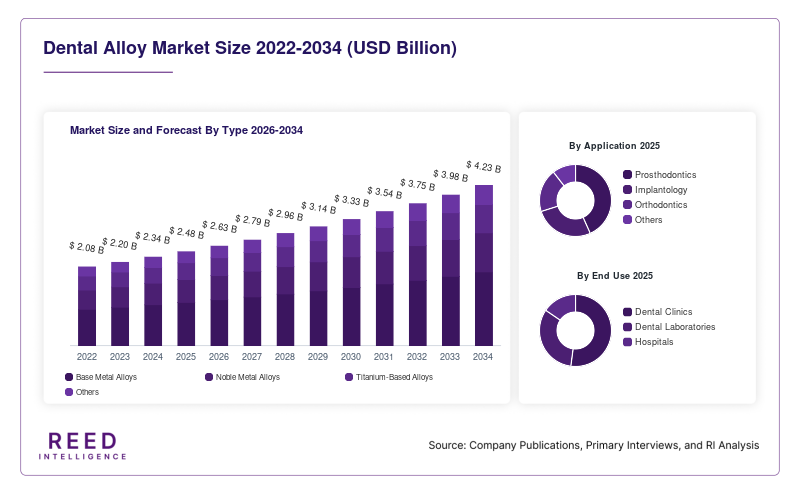
Base metal alloys dominated the Dental Alloy Market in 2025 with a share of 42.6% due to their cost efficiency, mechanical strength, and wide availability. These alloys are widely used in crowns and bridges across both developed and emerging markets. Their durability and corrosion resistance make them suitable for long-term dental applications.
Titanium-based alloys are expected to be the fastest-growing segment during 2026–2034 due to their superior biocompatibility and increasing use in dental implants. Their ability to integrate with bone tissue and reduce allergic reactions is driving adoption in advanced restorative procedures.
By Application
Prosthodontics dominated the Dental Alloy Market in 2025 with a share of 38.1% due to high demand for crowns, bridges, and dentures. The rising geriatric population is a key factor supporting this segment as tooth replacement procedures continue to increase globally.
Implantology is expected to be the fastest-growing application segment due to increasing preference for permanent tooth replacement solutions. Technological advancements in implant materials are improving success rates and long-term durability, supporting strong growth in this segment.
By End Use
Dental clinics dominated the Dental Alloy Market in 2025 with a share of 46.3% due to high patient inflow and availability of advanced restorative procedures. Clinics serve as the primary point of care for dental alloy-based treatments.
Dental laboratories are expected to be the fastest-growing end-use segment due to increasing outsourcing of prosthetic fabrication. Adoption of CAD/CAM systems and digital workflows is improving efficiency and customization capabilities in laboratories.
Regional Analysis
North America
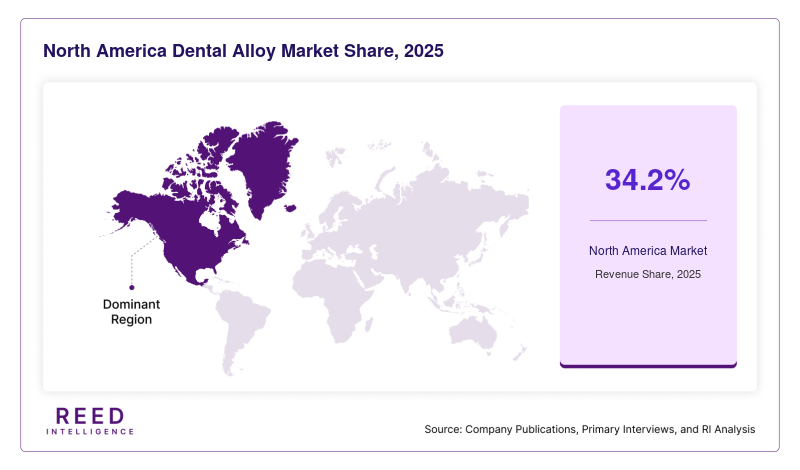
North America accounted for 34.2% share of the Dental Alloy Market in 2025 and is expected to grow steadily during 2026–2034. The region benefits from advanced healthcare infrastructure, high dental expenditure, and strong insurance coverage. Increasing demand for restorative and implant dentistry continues to support alloy consumption across dental clinics and laboratories. The United States leads the regional market due to high adoption of digital dentistry and advanced restorative procedures. A key growth factor is the rapid integration of CAD/CAM systems that require precision-engineered dental alloys for improved clinical outcomes.
Europe
Europe held a significant share of the Dental Alloy Market in 2025 and is expected to grow at a stable pace during the forecast period. Strong regulatory frameworks and high awareness of oral health support market expansion. Germany remains the dominant country due to its advanced dental manufacturing base and strong research capabilities in dental materials. A major growth factor is the increasing demand for biocompatible and nickel-free alloys driven by stringent safety regulations.
Asia Pacific
Asia Pacific represented a rapidly expanding share of the Dental Alloy Market in 2025 and is projected to register the fastest growth during 2026–2034. Rising dental tourism, growing middle-class population, and expanding healthcare infrastructure are key growth drivers. China dominates the regional market due to its large patient base and increasing investment in dental healthcare services. A key growth factor is rising affordability and accessibility of advanced dental treatments in urban centers.
Middle East & Africa
Middle East & Africa accounted for a moderate share of the Dental Alloy Market in 2025 and is expected to grow steadily during the forecast period. Expanding private healthcare infrastructure and rising awareness of dental care are supporting market growth. Saudi Arabia leads the region due to government investment in healthcare modernization and increasing demand for cosmetic dentistry. A key factor is the growing adoption of advanced restorative dental procedures in urban hospitals and clinics.
Latin America
Latin America held a smaller share of the Dental Alloy Market in 2025 but is expected to grow gradually during 2026–2034. Brazil dominates the region due to its strong cosmetic dentistry industry and increasing demand for restorative procedures. A key growth factor is rising awareness of oral health and expanding access to affordable dental care services across urban populations.
Competitive Landscape
The Dental Alloy Market is moderately consolidated with strong competition among global dental material manufacturers. Key players focus on innovation in biocompatible alloys, digital dentistry integration, and expansion of product portfolios. Companies such as Dentsply Sirona, Ivoclar Vivadent, 3M Company, Envista Holdings, and Straumann Group hold significant market presence. Dentsply Sirona leads the market with a strong global distribution network and continuous product innovation in titanium and cobalt-chromium alloys. The company has recently expanded its advanced material solutions to support CAD/CAM-based restorative dentistry, strengthening its position in the global Dental Alloy Market.
Key Players List
- Dentsply Sirona
- Ivoclar Vivadent
- 3M Company
- Envista Holdings Corporation
- Henry Schein Inc.
- Straumann Group
- Zimmer Biomet Holdings Inc.
- BEGO GmbH & Co. KG
- GC Corporation
- Shofu Inc.
- Kuraray Noritake Dental Inc.
- Heraeus Holding
- Dentaurum GmbH
- Coltene Holding AG
- SDI Limited
Recent Developments
- Manufacturers expanded titanium alloy production capacity to meet rising implant demand
- CAD/CAM-compatible dental alloys were introduced to support digital dentistry workflows
- Nickel-free alloy formulations gained traction due to increasing biocompatibility requirements
- Strategic collaborations between dental laboratories and material suppliers increased to enhance customization capabilities
Dental Alloy Market Segments
By Type
- Base Metal Alloys
- Noble Metal Alloys
- Titanium-Based Alloys
- Others
By Application
- Prosthodontics
- Implantology
- Orthodontics
- Others
By End Use
- Dental Clinics
- Dental Laboratories
- Hospitals
By Region
- North America
- Europe
- APAC
- Middle East and Africa
- LATAM