Dental Caries Detector Market Size, Share & Demand Report By Technology Type (Laser Fluorescence, Fiber Optic Transillumination, Digital Imaging, AI-Based Detection), By Product Type (Portable Devices, Fixed Systems), By Application (Occlusal Caries, Interproximal Caries, Root Caries), By End-Use (Dental Clinics, Hospitals, Academic & Research Institutes), By Region & Segment Forecasts, 2025–2033
USD 3950
Market Overview (250 words)
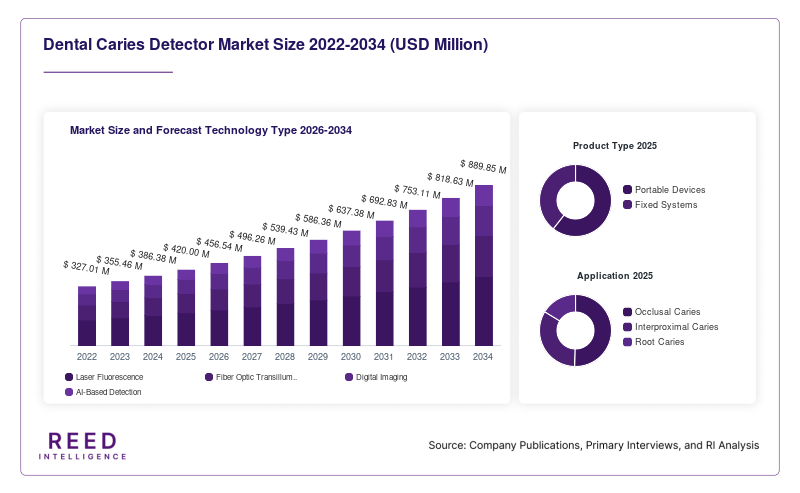
The Dental Caries Detector Market size was valued at approximately USD 420 million in 2025 and is projected to reach USD 890 million by 2034, expanding at a CAGR of 8.7% during the forecast period (2025–2034). The market growth is being driven by the increasing global burden of dental diseases, particularly untreated dental caries, which remains one of the most prevalent chronic conditions worldwide. Rising awareness regarding early diagnosis and preventive dental care has significantly contributed to the adoption of advanced caries detection technologies.
A key global factor supporting the expansion of the Dental Caries Detector Market is the growing integration of digital diagnostic tools in dental practices. Technological advancements, including laser fluorescence devices, digital imaging systems, and AI-assisted diagnostics, are enhancing detection accuracy and enabling early intervention, thereby improving patient outcomes and reducing long-term treatment costs.
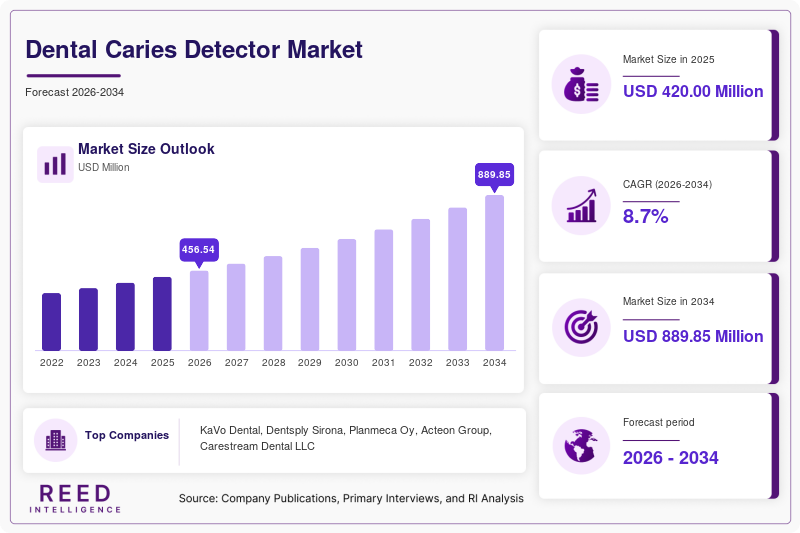
Key Highlights
- North America dominated the market with a share of 38% in 2025, while Asia Pacific is projected to be the fastest-growing region with a CAGR of 10.2%.
- Among segments, laser fluorescence-based detectors led with a 42% share, while AI-based detection systems are expected to register the fastest CAGR of 11.5%.
- The dental clinics segment dominated end-use with a 55% share, while hospitals are anticipated to grow at a CAGR of 9.6%.
- The United States remained the dominant country with market values of USD 145 million in 2025 and USD 158 million in 2026.
Market Trends
Integration of Artificial Intelligence in Diagnostics
The Dental Caries Detector Market is witnessing a shift toward AI-enabled diagnostic solutions. AI algorithms are increasingly being integrated into dental imaging systems to enhance detection precision and reduce human error. These tools analyze radiographs and intraoral images to identify early-stage caries that may not be visible through traditional examination methods. This trend is improving diagnostic consistency and is gaining traction among technologically advanced dental clinics.
Rising Adoption of Non-Invasive Detection Technologies
Non-invasive and radiation-free detection technologies, such as laser fluorescence and optical transillumination devices, are gaining popularity. These methods allow dentists to detect caries at an early stage without exposing patients to X-rays. The growing preference for patient-friendly and minimally invasive procedures is driving demand for such technologies, particularly in pediatric and preventive dentistry.
Market Drivers
Increasing Prevalence of Dental Caries Globally
The rising incidence of dental caries across all age groups is a major driver of the Dental Caries Detector Market. Sedentary lifestyles, high sugar consumption, and inadequate oral hygiene practices have contributed to the growing burden of dental diseases. This has increased the need for early detection tools that can identify caries before they progress to advanced stages.
Growth in Preventive Dental Care Awareness
There is a growing emphasis on preventive healthcare, including oral health. Patients are becoming more proactive in seeking early diagnosis and treatment, which is encouraging dental professionals to adopt advanced detection technologies. Government initiatives and public health campaigns promoting oral hygiene are also supporting the expansion of the market.
Market Restraint
High Cost of Advanced Diagnostic Devices
The high cost associated with advanced dental caries detection devices remains a significant restraint for market growth. Technologies such as laser fluorescence devices and AI-integrated systems require substantial initial investment, which can be a barrier for small and mid-sized dental practices. Additionally, the cost of maintenance and training further adds to the financial burden. In developing regions, limited healthcare budgets and lack of reimbursement policies for advanced diagnostic procedures restrict widespread adoption. As a result, many dental practitioners continue to rely on conventional diagnostic methods, which may hinder the overall growth potential of the Dental Caries Detector Market.
Market Opportunities
Expansion in Emerging Markets
Emerging economies present significant growth opportunities for the Dental Caries Detector Market. Rapid urbanization, increasing disposable income, and improving healthcare infrastructure are driving the demand for advanced dental services. Governments in these regions are investing in healthcare development, which is expected to facilitate the adoption of modern diagnostic tools in dental practices.
Development of Portable and Affordable Devices
The development of portable and cost-effective dental caries detectors is creating new opportunities for market expansion. Manufacturers are focusing on designing compact devices that can be used in remote and underserved areas. These innovations are expected to improve accessibility to dental diagnostics and expand the market reach, particularly in rural and low-resource settings.
Segmental Analysis
By Technology Type
Laser fluorescence-based detectors dominated the Dental Caries Detector Market in 2025, accounting for 42% of the total share. These devices gained popularity due to their high accuracy in detecting early-stage caries and their non-invasive nature. Dental professionals preferred these systems for routine diagnostics because they provide real-time results and improve clinical efficiency.
AI-based detection systems are expected to be the fastest-growing subsegment, with a projected CAGR of 11.5%. The integration of artificial intelligence enables automated analysis of dental images, improving diagnostic accuracy and reducing dependency on manual interpretation. This technological advancement is anticipated to drive significant adoption in the coming years.
By Product Type
Portable dental caries detectors held the largest share of 48% in 2025. Their ease of use, compact design, and suitability for various clinical settings contributed to their dominance. These devices are widely used in dental clinics and outreach programs.
Fixed systems are projected to grow at a CAGR of 9.8% during the forecast period. These systems offer advanced imaging capabilities and are commonly used in large hospitals and specialized dental centers. Their ability to provide detailed diagnostic insights is expected to drive their growth.
By Application
Occlusal caries detection accounted for the largest share of 46% in 2025. These types of caries are more common and often require precise detection methods, leading to higher adoption of advanced diagnostic tools.
Interproximal caries detection is expected to grow at a CAGR of 10.1%. The difficulty in detecting these caries using conventional methods has increased the demand for advanced technologies that can accurately identify hidden lesions.
By End-Use
Dental clinics dominated the market with a 55% share in 2025. The high volume of patient visits and routine dental check-ups contributed to the widespread adoption of caries detection devices in these settings.
Hospitals are expected to witness the fastest growth, with a CAGR of 9.6%. The increasing integration of dental departments in hospitals and the availability of advanced diagnostic infrastructure are driving this growth.
Regional Analysis
North America
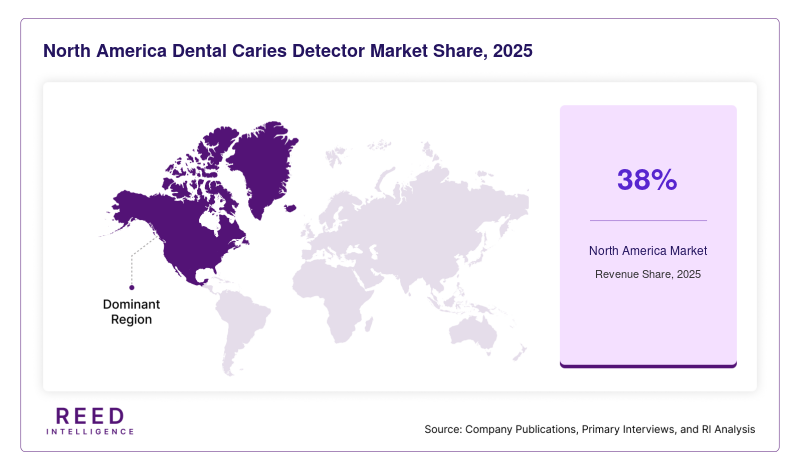
North America accounted for 38% of the Dental Caries Detector Market share in 2025 and will continue to maintain a steady growth trajectory, with a projected CAGR of 7.9% during 2025–2034. The region’s mature healthcare infrastructure and high adoption of advanced dental technologies supported its dominant position.
The United States led the regional market due to its well-established dental care system and strong presence of technology providers. The increasing number of dental visits and routine screenings has contributed to the adoption of advanced diagnostic tools. Additionally, the growing use of digital dentistry solutions is further supporting market expansion in the country.
Europe
Europe held a 27% share of the Dental Caries Detector Market in 2025 and is expected to grow at a CAGR of 7.5% over the forecast period. The region’s growth has been supported by strong healthcare systems and increasing awareness of oral health.
Germany emerged as the dominant country due to its advanced dental care infrastructure and focus on preventive dentistry. The country’s emphasis on regular dental check-ups and early diagnosis has encouraged the use of modern caries detection technologies.
Asia Pacific
Asia Pacific captured 20% of the market share in 2025 and is anticipated to grow at the fastest CAGR of 10.2% during the forecast period. Rapid economic development and increasing healthcare investments have been key contributors to the region’s growth.
China dominated the regional market due to its large population base and rising demand for dental care services. The expansion of private dental clinics and increasing awareness about oral hygiene have significantly boosted the adoption of dental caries detection devices.
Middle East & Africa
The Middle East & Africa region accounted for 8% of the Dental Caries Detector Market share in 2025 and is expected to grow at a CAGR of 8.3% through 2034. The region’s growth has been supported by improving healthcare infrastructure and increasing investment in dental care services.
The United Arab Emirates emerged as the leading country due to its advanced healthcare facilities and growing dental tourism industry. The demand for high-quality dental diagnostics is driving the adoption of advanced detection technologies.
Latin America
Latin America held a 7% share of the Dental Caries Detector Market in 2025 and is projected to grow at a CAGR of 8.0% during the forecast period. Increasing awareness of oral health and improving access to dental services are driving regional growth.
Brazil dominated the market due to its large population and expanding dental care sector. Government initiatives aimed at improving oral healthcare access have contributed to the adoption of modern diagnostic tools.
Competitive Landscape
The Dental Caries Detector Market is characterized by the presence of several established players focusing on technological innovation and product development. Companies are investing in research and development to introduce advanced diagnostic solutions and strengthen their market position.
The market leader, KaVo Dental, has been actively involved in developing advanced laser fluorescence devices. The company recently introduced an upgraded diagnostic system with enhanced sensitivity and user-friendly features, reinforcing its leadership position.
Other key players are focusing on expanding their product portfolios and entering emerging markets to capitalize on growth opportunities. Strategic partnerships and collaborations are also being adopted to enhance technological capabilities and market reach.
Key Players List
- KaVo Dental
- Dentsply Sirona
- Planmeca Oy
- Acteon Group
- Air Techniques Inc.
- Carestream Dental LLC
- GC Corporation
- Ivoclar Vivadent AG
- 3M Company
- Danaher Corporation
- Midmark Corporation
- Vatech Co., Ltd.
- LED Medical Diagnostics Inc.
- Bien-Air Dental SA
- Yoshida Dental Mfg. Co., Ltd
Recent Developments
- 2024: A leading manufacturer launched an AI-integrated dental imaging system for early caries detection.
- 2023: A global dental technology firm introduced a portable fluorescence-based detector for remote diagnostics.
- 2023: Strategic collaboration between diagnostic companies to enhance AI capabilities in dental imaging.
- 2022: Expansion of product distribution networks in Asia Pacific to capture emerging market opportunities.
- 2022: Introduction of cost-effective detection devices targeting small dental practices.
Dental Caries Detector Market Segments
Technology Type
- Laser Fluorescence
- Fiber Optic Transillumination
- Digital Imaging
- AI-Based Detection
Product Type
- Portable Devices
- Fixed Systems
Application
- Occlusal Caries
- Interproximal Caries
- Root Caries
End-Use
- Dental Clinics
- Hospitals
- Academic & Research Institutes
Distribution Channel
- Direct Sales
- Distributors & Dealers
- Online Sales
By Region
- North America
- Europe
- APAC
- Middle East and Africa
- LATAM