Dental Curing Light Market Size, Share Demand Report By Product Type (LED Curing Lights, Halogen Curing Lights, Plasma Arc Curing Lights, Multi-Wavelength LED Systems), By Application (Restorative Dentistry, Orthodontics, Sealants, Adhesive Procedures), By End Use (Dental Clinics, Hospitals, Ambulatory Specialty Centers, Academic and Research Institutions), By Region & Segment Forecasts, 2026–2034
USD 3950
Market Overview
The global Dental Curing Light Market size was valued at USD 1.12 billion in 2026 and is projected to reach USD 1.96 billion by 2034, expanding at a CAGR of 7.2% during the forecast period (2026–2034). Market growth is being supported by rising adoption of restorative dentistry procedures, expanding demand for minimally invasive treatments, and growing penetration of advanced light-curing technologies across clinical settings. One major global factor supporting expansion has been the steady increase in preventive and cosmetic dental procedures, which has raised demand for efficient polymerization equipment in both developed and emerging healthcare systems.
Dental curing lights are essential in modern dentistry for hardening light-sensitive resin-based materials used in restorations, sealants, adhesives, and orthodontic applications. The market has evolved from conventional halogen-based systems toward LED and multi-wavelength devices with improved curing depth, reduced heat generation, and enhanced procedural efficiency. Demand has also benefited from increasing investments in dental equipment modernization, especially among private clinics and specialty dental chains.
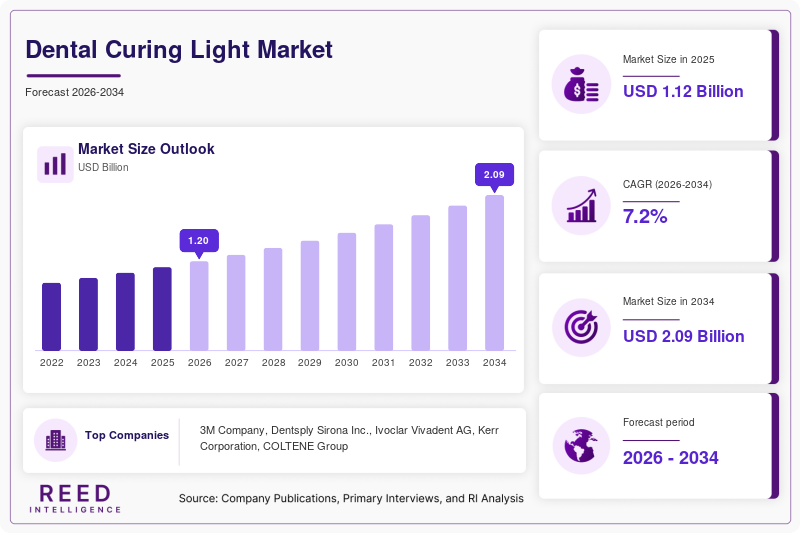
Key Highlights
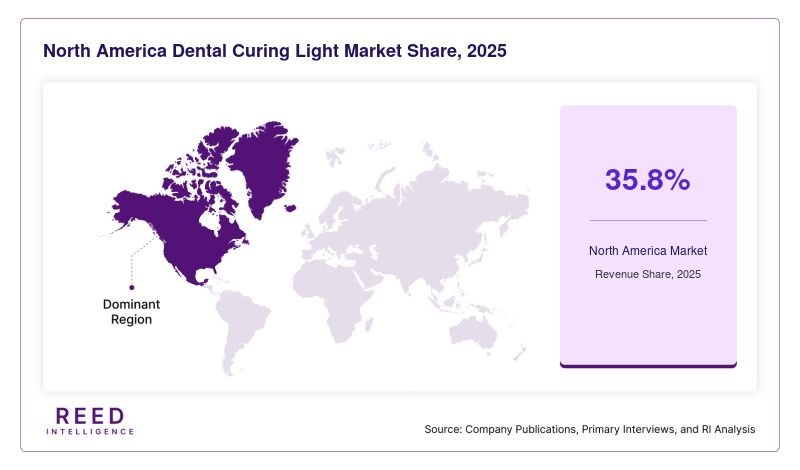
- North America held the dominant regional share of 35.8% in 2025, while Asia Pacific is projected to register the fastest CAGR of 8.6% through 2034.
- By product type, LED curing lights accounted for the leading share of 71.4% in 2025, while multi-wavelength LED systems are projected to grow at 9.1% CAGR.
- By mode, cordless systems held the dominant share of 62.7% in 2025, while smart connected cordless units are expected to expand at 8.8% CAGR.
- By end use, dental clinics represented the leading subsegment with 58.9% share in 2025, while ambulatory specialty centers are projected to grow at 8.3% CAGR.
- The United States, the dominant country, was valued at USD 298.4 million in 2024 and USD 317.6 million in 2025.
Market Trends
Rise of Multi-Wavelength LED Technology
One major trend in the Dental Curing Light Market is the transition toward multi-wavelength LED curing systems. These devices support polymerization across broader photoinitiator ranges and improve compatibility with advanced restorative materials. Their adoption has increased due to efficiency gains, reduced chair time, and improved clinical reliability. Demand for high-output curing systems with adaptive light intensity has further strengthened this trend.
Growing Demand for Portable and Smart Devices
Another notable trend is growing demand for cordless and digitally integrated curing lights. Lightweight designs, rechargeable batteries, and automated curing modes are reshaping purchasing preferences. Smart devices featuring timers, intensity control, and treatment monitoring functions are supporting workflow optimization in modern practices. This trend is expected to influence premium equipment adoption in both developed and emerging markets.
Market Drivers
Increasing Volume of Restorative Dental Procedures
Growth in restorative treatments has remained a major driver for the Dental Curing Light Market. Rising use of composite fillings, adhesive dentistry, and resin-based materials has generated consistent demand for efficient curing technologies. Increasing patient preference for tooth-colored restorations has further supported equipment demand across general and cosmetic dentistry.
Expansion of Private Dental Clinics
The growing number of private clinics and organized dental service providers has also contributed to market expansion. Equipment upgrades, expanding procedure capacity, and higher investment in compact clinical devices have supported demand for advanced curing lights. Private providers have shown strong interest in systems that improve speed and treatment consistency.
Market Restraint
High Cost of Advanced Premium Systems
One major restraint in the Dental Curing Light Market is the relatively high acquisition cost of advanced multi-wavelength and smart-connected devices. Cost sensitivity among smaller clinics and budget-constrained practices has limited rapid replacement of legacy systems in some markets.
Market Opportunities
Expansion in Emerging Dental Care Infrastructure
Emerging economies present strong opportunities as dental infrastructure continues to expand. Growing clinic penetration, improving oral health awareness, and equipment modernization initiatives are expected to create sustained demand for curing light systems.
Integration with Digital Dentistry Workflows
The integration of curing systems into broader digital dentistry workflows is another emerging opportunity. Compatibility with digital restorative procedures, guided workflows, and connected treatment systems is expected to create value for premium product categories.
Segmental Analysis
By Product Type
LED Curing Lights Dominated the Market: LED curing lights held the dominant share of 71.4% in 2025. Their market leadership was supported by energy efficiency, lower maintenance requirements, and consistent light output. Their widespread use across general restorative procedures supported strong market penetration.
Multi-Wavelength LED Systems Will Be the Fastest Growing: Multi-wavelength LED systems are projected to grow at 9.1% CAGR through 2034. Growth will be driven by compatibility with broader restorative materials and increasing demand for optimized polymerization performance.
By Mode
Cordless Systems Led Demand: Cordless curing lights accounted for 62.7% share in 2025. Their leadership was linked to mobility advantages, ergonomic handling, and suitability for high-volume clinical environments.
Smart Connected Cordless Units Will Expand Faster:Smart connected cordless units are projected to grow at 8.8% CAGR. Growth will be supported by increasing demand for automated settings, treatment monitoring, and integrated workflow management.
By Intensity Range
Standard Intensity Systems Held the Largest Share: Standard intensity systems represented 54.9% share in 2025. These devices remained widely adopted due to balanced performance and affordability for routine procedures.
High-Intensity Systems Will Register Faster Growth:High-intensity systems are expected to grow at 8.4% CAGR. Their expansion will be supported by demand for shorter curing cycles and improved productivity in high-volume practices.
By Application
Restorative Dentistry Dominated: Restorative dentistry accounted for 49.6% share in 2025. Composite restorations and adhesive procedures contributed significantly to segment leadership.
Orthodontic Applications Will Grow Faster: Orthodontic applications are projected to expand at 8.2% CAGR through 2034. Growth will be supported by rising bracket bonding procedures and increasing orthodontic treatment demand.
By End Use
Dental Clinics Led the Market: Dental clinics held 58.9% share in 2025. Their dominance reflected higher procedure volumes and broad equipment usage across routine and advanced treatments.
Ambulatory Specialty Centers Will Expand Rapidly: Ambulatory specialty centers are projected to grow at 8.3% CAGR. Growth will be driven by rising specialty treatment capacity and demand for compact high-performance devices.
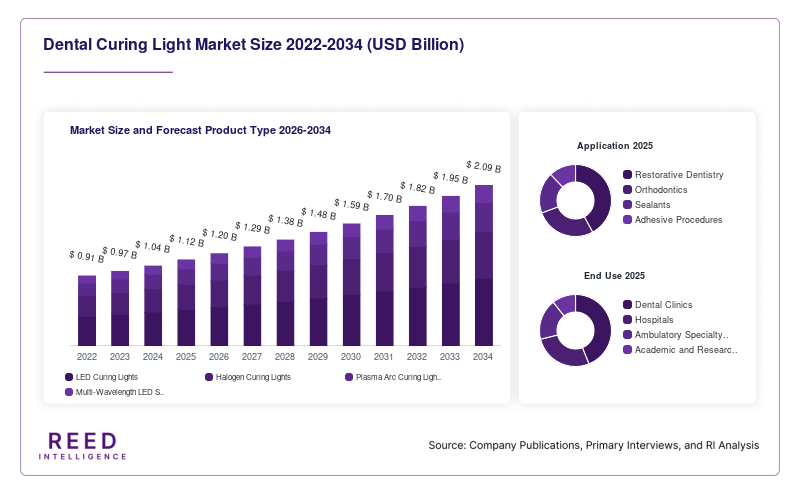
Regional Analysis
North America
North America accounted for 35.8% of the Dental Curing Light Market in 2025. The region benefited from high procedural volumes, advanced dental equipment penetration, and strong replacement demand. The region is projected to grow at a CAGR of 6.8% through 2034. The United States remained the dominant country due to increasing adoption of premium restorative devices and higher spending on dental technology upgrades.
Europe
Europe represented 27.4% share of the Dental Curing Light Market in 2025. Demand was supported by mature dental care systems and widespread use of restorative procedures. The regional market is expected to grow at 6.6% CAGR during the forecast period. Germany remained the leading country, supported by strong equipment manufacturing presence and demand for advanced clinical technologies.
Asia Pacific
Asia Pacific held 23.6% share in 2025 and is projected to record the fastest CAGR of 8.6% through 2034. Growth will be supported by rising dental procedure volumes, growing private practice investments, and improving access to advanced equipment. China remained the dominant country due to expanding dental infrastructure and increased demand for modern treatment devices.
Middle East & Africa
Middle East & Africa accounted for 7.2% share in 2025. The market was supported by growing specialty clinic investments and increasing oral care awareness. The region is projected to expand at 7.4% CAGR through 2034. Saudi Arabia remained the dominant country due to healthcare investment programs supporting dental equipment adoption.
Latin America
Latin America captured 6.0% share in 2025. Market demand was driven by growing restorative dentistry adoption and expanding private dental networks. The region is forecast to grow at 7.1% CAGR. Brazil remained the leading country due to rising demand for cosmetic and restorative procedures.
Competitive Landscape
The Dental Curing Light Market remains moderately consolidated, with established dental equipment manufacturers competing through technology innovation, product upgrades, and distribution expansion. Leading participants focus on advanced LED platforms, ergonomic design improvements, and integration with digital dentistry workflows. Premium product differentiation increasingly centers on wavelength range, curing efficiency, and battery performance.
The market leader, 3M, has maintained a strong position through broad restorative product compatibility and continued portfolio refinement. A recent development involved expansion of advanced LED curing systems designed for enhanced polymerization consistency and improved workflow support.
Other major participants including Dentsply Sirona, Ivoclar, Kerr Corporation, and COLTENE continue to strengthen their positions through product launches, regional partnerships, and expanded dental distributor networks. Competition is also increasing from emerging manufacturers offering cost-competitive cordless systems in developing markets. Strategic focus across the industry is shifting toward smart-enabled devices, premium portable systems, and material-specific curing solutions.
Key Players List
- 3M Company
- Dentsply Sirona Inc.
- Ivoclar Vivadent AG
- Kerr Corporation
- COLTENE Group
- Ultradent Products Inc.
- GC Corporation
- VOCO GmbH
- Planmeca Oy
- DenMat Holdings LLC
- Woodpecker Medical Instruments
- Acteon Group
- Morita Corporation
- Shofu Inc.
- Kulzer GmbH
Recent Developments
- Several manufacturers introduced enhanced multi-wavelength LED curing lights with broader photoinitiator compatibility to support advanced restorative materials.
- Product launches increasingly focused on high-intensity cordless systems designed to reduce curing time and improve procedural efficiency.
- Multiple companies expanded rechargeable battery platforms to improve portability and reduce operational interruptions in high-volume clinics.
- Smart-enabled curing lights with programmable curing modes and treatment monitoring features entered broader commercial deployment.
- Manufacturers increased investment in ergonomic lightweight handpiece designs aimed at improving clinician comfort during extended procedures.
- Regional distributors expanded partnerships to improve access to advanced curing systems in emerging dental equipment markets.
- Companies broadened product compatibility strategies by optimizing devices for newer composite and adhesive formulations.
- Several players strengthened digital dentistry positioning through product development aligned with connected clinical workflows.
- Mid-tier manufacturers launched cost-focused cordless curing lights targeting independent clinics and price-sensitive markets.
- Premium market participants expanded training and education programs supporting adoption of advanced curing technologies.
- Product refinement activity increased around thermal control features designed to support patient comfort and procedural safety.
Dental Curing Light Market Segments
Product Type
- LED Curing Lights
- Halogen Curing Lights
- Plasma Arc Curing Lights
- Multi-Wavelength LED Systems
Application
- Restorative Dentistry
- Orthodontics
- Sealants
- Adhesive Procedures
End Use
- Dental Clinics
- Hospitals
- Ambulatory Specialty Centers
- Academic and Research Institutions
Distribution Channel
- Direct Sales
- Dental Equipment Distributors
- Online Procurement Platforms
- Specialty Dental Suppliers
By Region
- North America
- Europe
- APAC
- Middle East and Africa
- LATAM