Dental Dust Collector Market Size, Share & Demand Report By Type (Centralized Dust Collectors, Portable Dust Collectors), By Application (Dental Laboratories, Dental Clinics), By End-Use (Commercial, Individual Practitioners), By Region & Segment Forecasts, 2025–2034
USD 3950
Market Overview
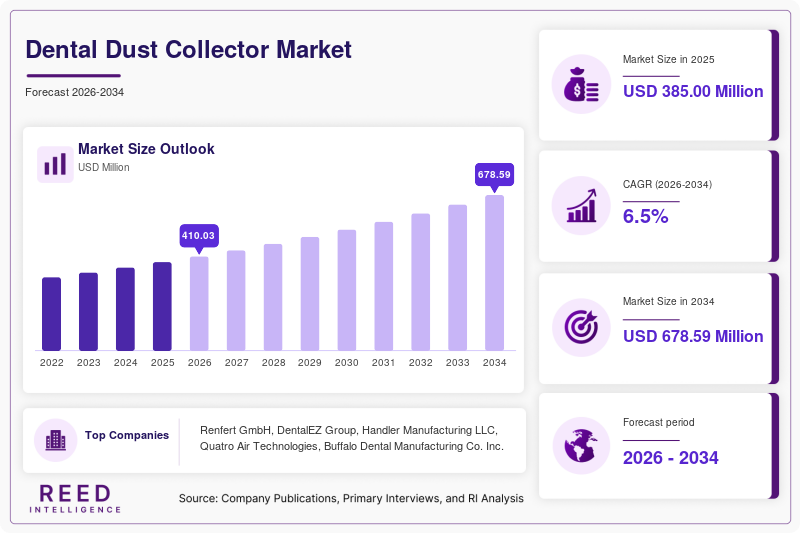
The Dental Dust Collector Market size is estimated to reach USD 385 million, and it is projected to grow to approximately USD 410 million in 2026. By 2034, the market is forecasted to achieve a valuation of nearly USD 720 million, registering a compound annual growth rate (CAGR) of 6.5% from 2025 to 2034.
This growth is primarily fueled by the rising adoption of advanced dental equipment, stricter workplace safety regulations, and increasing awareness regarding airborne contaminants generated during dental procedures. Dental dust collectors are essential in maintaining hygienic environments by capturing particulate matter such as acrylic dust, metal shavings, and ceramic residues produced during grinding and polishing activities.
Key Highlights
- Market size is estimated at USD 385 million in 2025, reflecting steady demand from dental laboratories and clinics. Growth at this stage is supported by rising awareness of air filtration requirements in dental environments.
- The market is expected to reach USD 720 million by 2034, indicating sustained expansion over the forecast period. This growth highlights increasing adoption of advanced dust collection systems across both developed and emerging regions.
- The market is projected to grow at a CAGR of 6.5% from 2025 to 2034. Consistent demand from dental labs and technological improvements are key contributors to this stable growth rate.
- Increasing demand is primarily driven by the expansion of dental laboratories and stricter safety regulations. Regulatory compliance is encouraging facilities to invest in efficient dust collection systems.
Market Trends
Integration of Advanced Filtration Technologies
A significant trend shaping the Dental Dust Collector Market is the integration of advanced filtration technologies such as HEPA filters, multi-stage filtration systems, and electrostatic filters. These technologies are designed to capture ultrafine particles and improve air quality within dental laboratories. Manufacturers are increasingly focusing on developing systems that offer higher filtration efficiency while maintaining compact designs suitable for small clinics. The demand for quiet and energy-efficient machines is also rising, as dental professionals seek to enhance patient comfort and reduce operational costs. This trend is expected to continue as environmental standards become stricter and awareness regarding indoor air quality increases.
Growing Adoption of Portable and Compact Systems
Another notable trend is the growing adoption of portable and compact dental dust collectors. These systems are particularly popular among small clinics and mobile dental units due to their flexibility and ease of installation. Unlike traditional centralized systems, portable units require less infrastructure investment and can be easily relocated as needed. Additionally, manufacturers are incorporating user-friendly interfaces and automated features, such as filter change alerts and airflow monitoring, to improve usability. This trend aligns with the broader shift toward decentralized dental care services and is expected to contribute significantly to market growth in the coming years.
Market Drivers
Increasing Awareness of Occupational Health Risks
The rising awareness of occupational health risks associated with dental dust exposure is a major driver of market growth. Dental technicians and professionals are frequently exposed to hazardous particles, including silica, metal dust, and acrylic debris, which can lead to respiratory issues and long-term health complications. As awareness grows, dental facilities are prioritizing the adoption of dust collection systems to ensure a safer working environment. Regulatory agencies are also emphasizing compliance with workplace safety standards, further encouraging the installation of efficient dust collectors. This driver is particularly strong in developed regions where occupational safety norms are strictly enforced.
Expansion of Dental Laboratories and Cosmetic Dentistry
The expansion of dental laboratories and the increasing demand for cosmetic dentistry procedures are significantly driving the market. The rise in dental restorations, implants, and prosthetics has led to higher production volumes in dental labs, generating more dust and debris. Consequently, there is a growing need for effective dust management solutions. Additionally, advancements in dental materials and technologies have increased the complexity of procedures, further necessitating high-performance dust collectors. Emerging economies are witnessing rapid growth in dental services, which is expected to create substantial opportunities for market expansion.
Market Restraint
High Initial Investment and Maintenance Costs
One of the primary restraints affecting the Dental Dust Collector Market is the high initial investment and ongoing maintenance costs associated with advanced systems. High-efficiency dust collectors equipped with multi-stage filtration and noise reduction features can be expensive, making them less accessible for small dental clinics and laboratories with limited budgets. Additionally, maintenance requirements such as regular filter replacement, system cleaning, and technical servicing add to the overall cost of ownership.
This financial burden can discourage adoption, particularly in developing regions where cost sensitivity is high. For example, small-scale dental labs may opt for basic ventilation systems instead of investing in specialized dust collectors, compromising efficiency and safety. The lack of awareness regarding long-term benefits also contributes to slower adoption rates. As a result, manufacturers need to focus on developing cost-effective solutions and offering flexible pricing models to address this challenge and improve market penetration.
Market Opportunities
Growing Demand in Emerging Markets
Emerging markets present significant growth opportunities for the Dental Dust Collector Market. Countries in Asia Pacific, Latin America, and parts of the Middle East are experiencing rapid growth in dental healthcare infrastructure. Increasing disposable income, urbanization, and improved access to dental services are driving demand for advanced dental equipment. As dental laboratories expand in these regions, the need for efficient dust collection systems is expected to rise. Manufacturers can capitalize on this opportunity by offering affordable and scalable solutions tailored to the needs of these markets.
Technological Innovation and Smart Systems
Technological innovation is another key opportunity in the market. The development of smart dental dust collectors with features such as real-time monitoring, automated maintenance alerts, and IoT connectivity is gaining traction. These systems enable dental professionals to monitor performance and ensure optimal operation, reducing downtime and maintenance costs. Additionally, advancements in energy-efficient designs and eco-friendly materials are attracting environmentally conscious buyers. As technology continues to evolve, manufacturers have the opportunity to differentiate their products and capture a larger market share.
Segmental Analysis
By Type
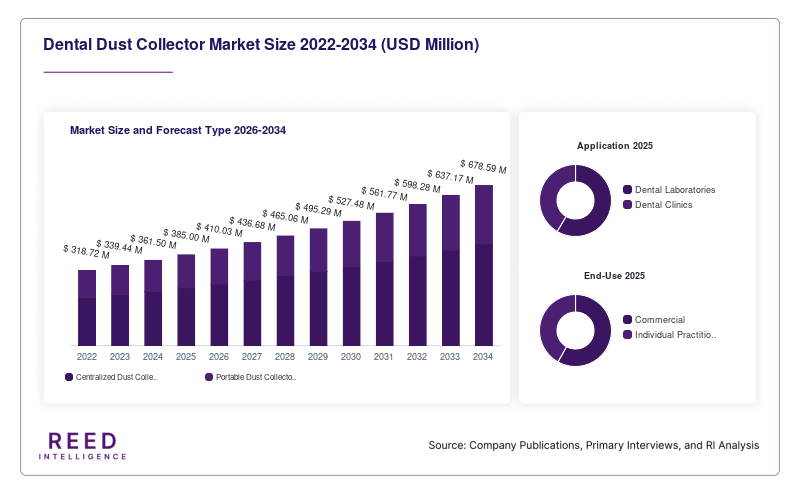
The centralized dental dust collector segment dominated the market in 2024, accounting for approximately 58% of the total share. These systems are widely used in large dental laboratories due to their ability to handle high volumes of dust and provide consistent performance. Centralized systems offer advantages such as improved efficiency, reduced noise levels, and better workspace organization. Their ability to connect multiple workstations makes them suitable for large-scale operations. Additionally, advancements in filtration technology have enhanced their effectiveness, making them a preferred choice for professional settings.
The portable dental dust collector segment is expected to be the fastest-growing, with a CAGR of 7.8% during the forecast period. The growth is driven by increasing demand from small clinics and mobile dental units. Portable systems are cost-effective, easy to install, and require minimal maintenance. Their flexibility allows users to move them between workstations, making them highly versatile. As dental practices become more decentralized, the demand for portable solutions is expected to increase significantly.
By Application
The dental laboratories segment held the largest market share in 2024, accounting for around 65%. Dental labs generate a significant amount of dust during processes such as grinding, polishing, and milling. As a result, the need for efficient dust collection systems is high. The increasing demand for dental prosthetics and restorations further drives this segment. Laboratories are also adopting advanced systems to comply with safety regulations and improve working conditions.
The dental clinics segment is expected to grow at the fastest CAGR of 7.2%. The growth is attributed to the increasing adoption of dust collectors in clinics to enhance hygiene and patient safety. Modern clinics are focusing on improving air quality and reducing contamination risks. The integration of compact and aesthetically designed dust collectors is also contributing to segment growth.
By End-Use
The commercial segment, including large dental labs and institutions, dominated the market in 2024 with a share of approximately 62%. These facilities require high-capacity dust collectors to manage large volumes of dust. The adoption of advanced systems is driven by the need for efficiency and compliance with safety standards. Commercial users also benefit from economies of scale, making it easier to invest in high-end equipment.
The individual practitioners segment is projected to grow at the fastest CAGR of 7.0%. The increasing number of independent dental clinics and practitioners is driving demand for compact and affordable dust collectors. These users prioritize ease of use, low maintenance, and cost-effectiveness. As awareness of air quality improves, more individual practitioners are expected to adopt these systems.
Regional Analysis
North America
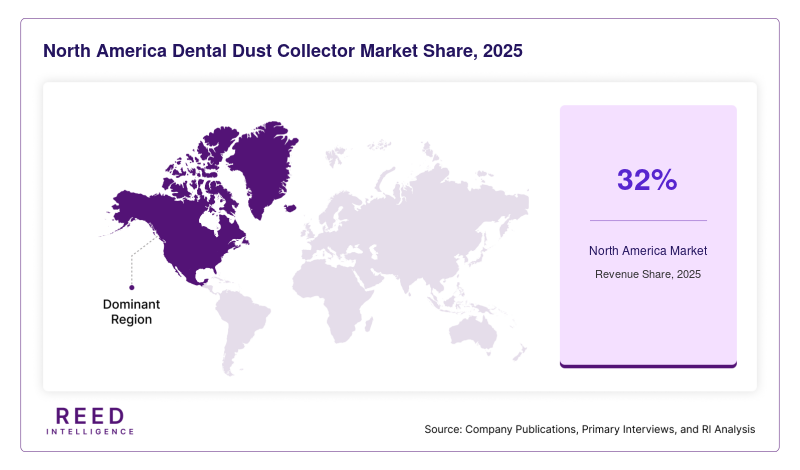
North America accounted for a significant share of the Dental Dust Collector Market in 2025, holding approximately 32% of the global market. The region is expected to grow at a CAGR of around 5.8% during the forecast period. The presence of advanced healthcare infrastructure and high adoption of dental technologies contributes to market growth. Additionally, strict occupational safety regulations drive the demand for efficient dust collection systems.
The United States dominates the regional market due to its well-established dental industry. A key growth factor is the strong emphasis on workplace safety standards enforced by regulatory bodies. Dental laboratories are increasingly investing in advanced equipment to comply with these regulations, boosting market demand.
Europe
Europe held a market share of about 25% in 2025 and is projected to grow at a CAGR of 5.5%. The region benefits from a well-developed healthcare system and increasing awareness regarding air quality in dental settings. The adoption of advanced filtration technologies is also driving market growth.
Germany leads the European market due to its strong dental manufacturing sector. A unique growth factor is the presence of stringent environmental regulations, which encourage the use of energy-efficient and eco-friendly dust collectors in dental laboratories.
Asia Pacific
Asia Pacific accounted for approximately 22% of the market in 2025 and is expected to grow at the highest CAGR of 7.5%. Rapid urbanization and increasing healthcare investments are key factors driving growth in the region. The expansion of dental clinics and laboratories further supports market development.
China dominates the regional market due to its large population and growing dental industry. A major growth factor is the increasing outsourcing of dental prosthetics production, which drives demand for dust collection systems in laboratories.
Middle East & Africa
The Middle East & Africa region held a market share of around 11% in 2025 and is projected to grow at a CAGR of 6.2%. The market is driven by improving healthcare infrastructure and increasing awareness of dental hygiene.
The United Arab Emirates leads the region due to its advanced healthcare facilities. A unique growth factor is the growing medical tourism industry, which increases demand for high-quality dental services and associated equipment.
Latin America
Latin America accounted for nearly 10% of the market in 2025 and is expected to grow at a CAGR of 6.0%. The region is witnessing gradual improvements in healthcare infrastructure and rising demand for dental services.
Brazil dominates the market due to its large dental care industry. A key growth factor is the increasing adoption of modern dental technologies, which drives the need for efficient dust collection systems.
Competitive Landscape
The Dental Dust Collector Market is moderately fragmented, with several global and regional players competing based on product innovation, pricing, and distribution networks. Key companies are focusing on expanding their product portfolios and enhancing filtration efficiency to gain a competitive edge. Strategic partnerships, mergers, and acquisitions are also common strategies used to strengthen market presence.
One of the leading players in the market is Renfert GmbH, known for its advanced dental equipment and strong global presence. The company has recently introduced a new range of energy-efficient dust collectors with enhanced filtration capabilities, catering to the evolving needs of dental laboratories. Other major players are also investing in research and development to introduce innovative solutions and improve product performance.
Key Players
- Renfert GmbH
- DentalEZ Group
- Handler Manufacturing LLC
- Quatro Air Technologies
- Buffalo Dental Manufacturing Co. Inc.
- Vaniman Manufacturing Co.
- Dentsply Sirona
- KaVo Dental
- Wassermann Dental-Maschinen GmbH
- Zubler USA
- Nakanishi Inc.
- Sinol Dental Limited
- Silent TS
- BPR Swiss
- CATO SRL
Recent Developments
- In 2024, Renfert GmbH launched a new compact dust collector with improved energy efficiency and noise reduction features.
- In 2023, Quatro Air Technologies expanded its product line by introducing smart dust collectors with real-time monitoring capabilities.
- In 2024, Vaniman Manufacturing Co. upgraded its filtration technology to enhance particle capture efficiency and extend filter life.
Dental Dust Collector Market Segments
Type
- Centralized Dust Collectors
- Portable Dust Collectors
Application
- Dental Laboratories
- Dental Clinics
End-Use
- Commercial
- Individual Practitioners
By Region
- North America
- Europe
- APAC
- Middle East and Africa
- LATAM