Dental Laboratory Handpiece Market Size, Share & Demand Report By Type (Electric Handpieces, Air-Driven Handpieces), By Speed Range (High-Speed, Low-Speed), By Application (Polishing, Cutting, Finishing), By End-Use (Dental Laboratories, Dental Clinics), By Distribution Channel (Direct Sales, Distributors, Online Channels), By Region & Segment Forecasts, 2025–2034
USD 3950
Market Overview
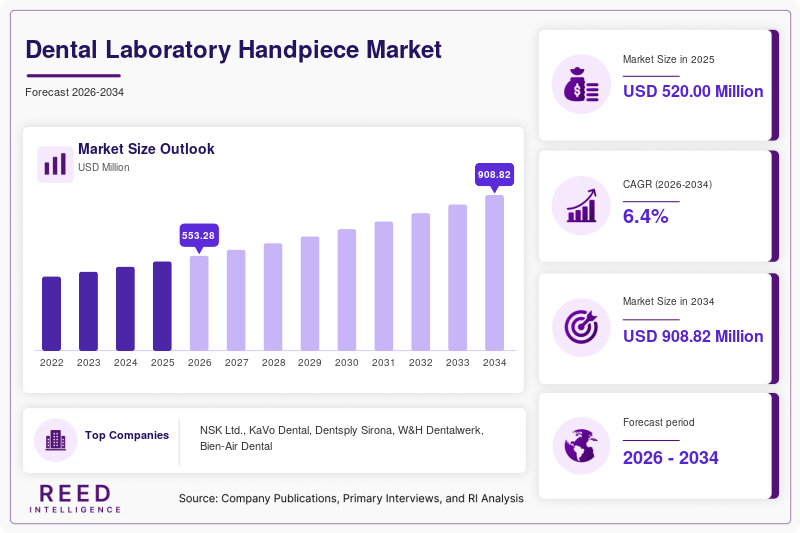
The Dental Laboratory Handpiece Market size was valued at approximately USD 520 million in 2025 and is projected to reach USD 910 million by 2034, expanding at a CAGR of 6.4% during 2025–2034. The market is witnessing steady expansion driven by the increasing demand for precision dental restorations and the continuous modernization of dental laboratories worldwide.
A key global factor supporting market growth is the rising adoption of advanced dental prosthetics and cosmetic dentistry procedures. As patients increasingly seek high-quality aesthetic outcomes, dental laboratories are investing in efficient and accurate equipment such as high-speed and micromotor handpieces. This shift toward customization and digital dentistry has significantly influenced equipment demand.
Key Highlights
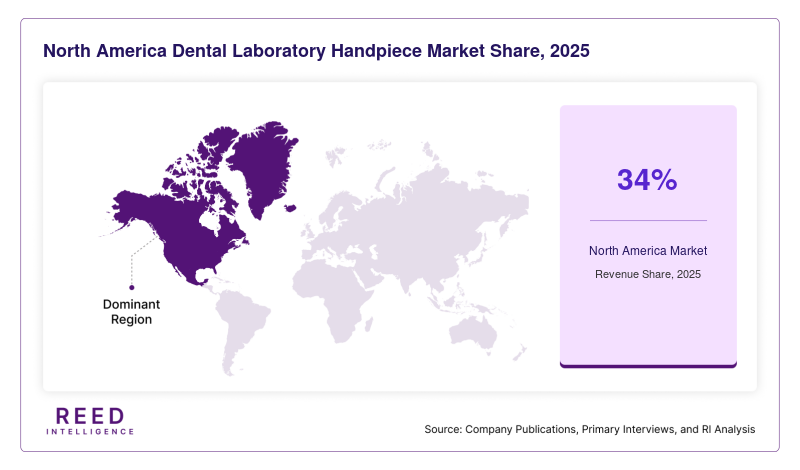
- Dominant region: North America accounted for approximately 34% market share in 2025, while Asia Pacific is expected to register the fastest growth at a CAGR of 7.8%.
- Leading subsegments: Electric handpieces dominated the type segment with 58% share, while air-driven handpieces are projected to grow at a CAGR of 6.9%.
- End-use leadership: Dental laboratories led with 65% share, whereas dental clinics are anticipated to grow at a CAGR of 7.1%.
- Dominant country: The United States market was valued at USD 140 million in 2025 and is expected to reach USD 150 million in 2026.
Market Trends
Integration of Digital Dentistry Technologies
The integration of digital technologies into dental workflows is reshaping the Dental Laboratory Handpiece Market. CAD/CAM systems, 3D printing, and digital scanning technologies are increasingly being adopted by dental laboratories to enhance accuracy and productivity. As a result, handpieces designed to work seamlessly with digital tools are gaining traction. These modern handpieces offer improved speed control, reduced vibration, and better compatibility with automated systems. This trend is contributing to enhanced consistency in dental prosthetics production and reduced manual errors, making digital-compatible handpieces a preferred choice among laboratories.
Rising Preference for Ergonomic and Low-Noise Equipment
Another notable trend is the growing demand for ergonomic and low-noise dental laboratory handpieces. Dental technicians often work for extended hours, making comfort and usability critical factors. Manufacturers are focusing on lightweight designs, noise reduction technologies, and improved grip features to minimize fatigue and improve efficiency. Additionally, low-noise equipment contributes to a better working environment, especially in high-volume laboratories. This shift toward user-centric design is influencing purchasing decisions and encouraging innovation in handpiece development. As a result, ergonomic advancements are becoming a key differentiator in the competitive landscape.
Market Drivers
Increasing Demand for Dental Restorative Procedures
The growing prevalence of dental disorders and the rising demand for restorative and prosthetic treatments are key drivers of the Dental Laboratory Handpiece Market. Procedures such as crowns, bridges, dentures, and implants require precision tools for fabrication and finishing. Dental laboratories rely heavily on handpieces to perform tasks such as polishing, trimming, and shaping materials. As the global population ages and awareness of oral health improves, the volume of restorative procedures continues to rise, thereby increasing demand for reliable and efficient handpieces.
Technological Advancements in Dental Equipment
Continuous innovation in dental equipment is another major driver fueling market growth. Modern dental laboratory handpieces are equipped with advanced features such as variable speed control, high torque output, and improved durability. These enhancements allow technicians to work with a variety of materials, including ceramics, zirconia, and composites. Additionally, the development of electric micromotor handpieces has improved precision and control compared to traditional air-driven models. These technological improvements are enabling laboratories to achieve better results while optimizing workflow efficiency, thereby driving market adoption.
Market Restraint
High Cost of Advanced Handpieces
One of the major restraints in the Dental Laboratory Handpiece Market is the high cost associated with advanced handpiece systems. Electric handpieces and micromotor-based systems often require significant initial investment, which can be a challenge for small and medium-sized dental laboratories. In addition to the purchase cost, maintenance and repair expenses further add to the financial burden.
Many laboratories in developing regions operate with limited budgets, leading to slower adoption of technologically advanced equipment. This cost barrier restricts market penetration, particularly in price-sensitive markets. Furthermore, the availability of low-cost alternatives may discourage investment in premium products, affecting overall market growth.
Market Opportunities
Expansion in Emerging Markets
Emerging economies present significant growth opportunities for the Dental Laboratory Handpiece Market. Countries in Asia Pacific, Latin America, and parts of the Middle East are witnessing improvements in healthcare infrastructure and increasing access to dental care. Rising disposable income and growing awareness of dental aesthetics are contributing to higher demand for dental treatments. As dental laboratories expand in these regions, the need for efficient and affordable handpieces is expected to grow. Manufacturers can capitalize on this opportunity by offering cost-effective and durable products tailored to regional needs.
Increasing Adoption of Portable and Compact Devices
The demand for portable and compact dental laboratory equipment is creating new opportunities in the market. Smaller laboratories and mobile dental units require space-saving and easy-to-use devices. Compact handpieces with high performance capabilities are gaining popularity due to their convenience and flexibility. These devices are particularly useful in settings with limited space or where mobility is essential. As innovation continues in miniaturization and performance optimization, portable handpieces are expected to gain wider acceptance, opening new avenues for market growth.
Segmental Analysis
By Type
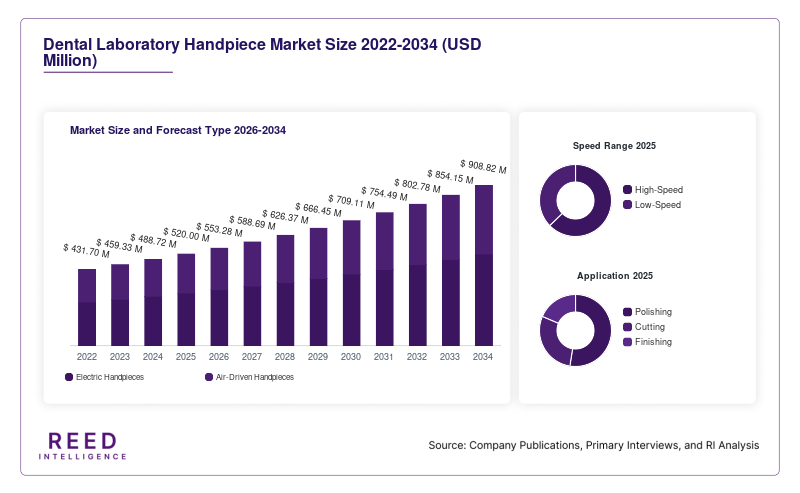
Electric handpieces dominated the Dental Laboratory Handpiece Market in 2025, accounting for approximately 58% share. Their superior torque control, precision, and compatibility with modern dental materials made them the preferred choice among dental laboratories.
Air-driven handpieces will witness the fastest growth, expanding at a CAGR of 6.9%. Their cost-effectiveness and ease of maintenance will drive adoption, particularly in small laboratories and emerging markets.
By Speed Range
High-speed handpieces held the largest share at 52% in 2025, as they are widely used for cutting and shaping dental materials efficiently.
Low-speed handpieces are expected to grow at a CAGR of 6.8%, driven by their suitability for polishing and finishing applications, which are essential for aesthetic dental procedures.
By Application
Polishing applications accounted for around 45% share in 2025, reflecting the importance of finishing processes in dental prosthetics production.
Cutting applications will grow at a CAGR of 7.0%, supported by increasing demand for precision shaping of advanced materials such as zirconia and ceramics.
By End-Use
Dental laboratories dominated with a 65% share in 2025, as they are the primary users of handpieces for fabrication processes.
Dental clinics will grow at a CAGR of 7.1%, driven by the rising trend of in-house dental labs and chairside manufacturing capabilities.
By Distribution Channel
Direct sales accounted for approximately 60% share in 2025, as manufacturers prefer direct engagement with large laboratories and institutions.
Online sales channels will grow at a CAGR of 7.3%, driven by increasing digitalization and convenience in purchasing equipment.
Regional Analysis
North America
North America held approximately 34% share of the Dental Laboratory Handpiece Market in 2025 and will grow at a CAGR of 5.9% during the forecast period. The region’s growth is supported by a well-established dental healthcare system and widespread adoption of advanced technologies.
The United States dominated the regional market due to high demand for cosmetic and restorative dentistry. The presence of advanced dental laboratories and strong investment in digital dentistry infrastructure has contributed to steady demand for high-performance handpieces.
Europe
Europe accounted for nearly 27% market share in 2025 and is expected to grow at a CAGR of 5.7% through 2034. The region benefits from strong regulatory frameworks and a focus on quality dental care.
Germany emerged as the leading country, driven by its advanced dental manufacturing industry and emphasis on precision engineering. The country’s strong export capabilities and technological expertise have supported market expansion.
Asia Pacific
Asia Pacific captured around 22% share in 2025 and is projected to grow at the fastest CAGR of 7.8%. Rapid urbanization and increasing healthcare investments are driving regional growth.
China dominated the region due to its expanding dental infrastructure and large patient population. The growing number of dental laboratories and rising adoption of modern equipment have accelerated demand for handpieces.
Middle East & Africa
The Middle East & Africa region held approximately 9% share in 2025 and is expected to grow at a CAGR of 6.2%. Improving healthcare access and government initiatives are supporting market growth.
The United Arab Emirates led the region, supported by investments in advanced healthcare facilities and a growing focus on dental tourism.
Latin America
Latin America accounted for about 8% share in 2025 and is projected to grow at a CAGR of 6.0%. Increasing awareness of oral health and expanding dental services are driving demand.
Brazil dominated the regional market due to its large population and growing dental industry. The country’s focus on expanding dental education and services has supported market development.
Competitive Landscape
The Dental Laboratory Handpiece Market is moderately fragmented, with several global and regional players competing based on product innovation, pricing, and distribution networks. Key companies are focusing on developing advanced handpieces with improved ergonomics, durability, and digital compatibility.
The market leader, NSK Ltd., has maintained a strong position through continuous product innovation and global distribution expansion. The company recently introduced a new range of electric micromotor handpieces designed for enhanced precision and reduced noise levels.
Other players are investing in research and development to introduce cost-effective solutions tailored for emerging markets. Strategic partnerships and product launches remain key strategies adopted by companies to strengthen their market presence.
Key Players
- NSK Ltd.
- KaVo Dental
- Dentsply Sirona
- W&H Dentalwerk
- Bien-Air Dental
- Dentamerica Inc.
- Saeyang Microtech
- Nouvag AG
- Marathon Dental Equipment
- MTI Dental
- Strong Handpiece
- Handler Manufacturing
- Aseptico Inc.
- Beyes Dental Canada
- Being Foshan Medical Equipment
Recent Developments
- In 2024, NSK Ltd. launched an advanced micromotor handpiece with improved torque stability for dental laboratories.
- Dentsply Sirona expanded its product portfolio with new ergonomic handpieces targeting digital dentistry applications.
- Bien-Air Dental introduced a compact and portable handpiece model designed for small-scale laboratories.
- W&H Dentalwerk enhanced its electric handpiece range with noise reduction features.
- Saeyang Microtech focused on expanding its presence in Asia Pacific through strategic distribution partnerships.
Dental Laboratory Handpiece Market Segments
Type
- Electric Handpieces
- Air-Driven Handpieces
Speed Range
- High-Speed
- Low-Speed
Application
- Polishing
- Cutting
- Finishing
End-Use
- Dental Laboratories
- Dental Clinics
Distribution Channel
- Direct Sales
- Distributors
- Online Channels
By Region
- North America
- Europe
- APAC
- Middle East and Africa
- LATAM