Dental Membrane Market Size, Share & Trends Analysis Report By Product Type (Resorbable Membranes, Non-Resorbable Membranes), By Material Type (Collagen, Synthetic Polymers), By Application (Guided Bone Regeneration, Guided Tissue Regeneration, Ridge Preservation), By End User (Dental Clinics, Hospitals, Dental Specialty Centers) and By Region (North America, Europe, APAC, Middle East and Africa, LATAM) Forecasts, 2026-2034
USD 3950
Dental Membrane Market Size
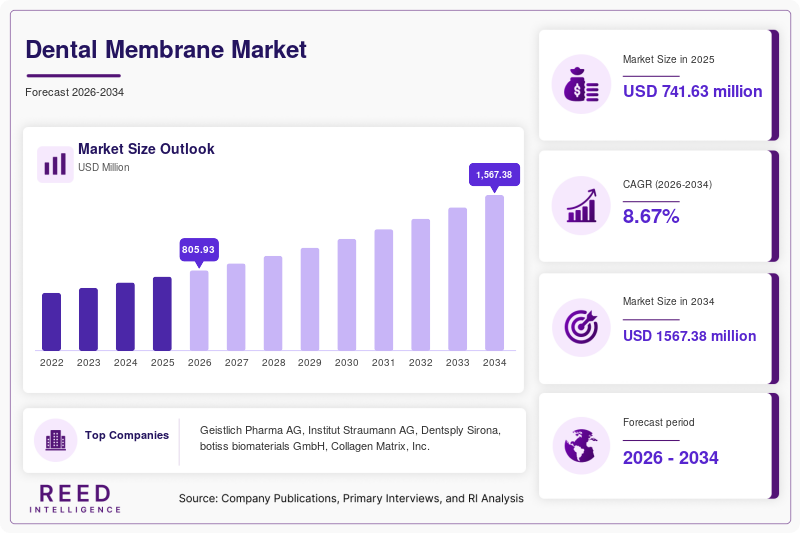
The Dental Membrane Market was valued at USD 741.63 million in 2025 and is estimated to reach USD 805.93 million in 2026. Based on the supplied forecast, the market is projected to reach USD 1,567.38 million by 2034, representing a CAGR of 8.67% from 2026 to 2034.
The supplied figures are mathematically consistent: applying 8.67% annual growth to the 2025 market produces approximately USD 1.57 billion in 2034. The 2026 value represents an increase of approximately 8.67% over 2025.
For historical context, applying the supplied CAGR backward gives an analytical market trajectory of approximately USD 629.7 million in 2024, USD 576.8 million in 2023 and USD 530.8 million in 2022. These historical figures are back-calculated estimates, not externally reported market values.
Dental membranes are barrier materials used mainly in guided bone regeneration (GBR) and guided tissue regeneration (GTR). Their purpose is to prevent faster-growing soft-tissue cells from occupying a bone defect while allowing bone or periodontal tissue regeneration to proceed. The FDA's cleared indications for collagen dental membranes include implant-associated augmentation, ridge augmentation, alveolar ridge reconstruction, bone defects, GBR and GTR procedures.
The clinical role of membranes is closely connected with implant dentistry. When bone volume is inadequate, clinicians may combine a bone graft with a membrane to stabilize the regenerative site. Geistlich's Bio-Gide membrane, for example, is positioned for bone regeneration, extraction-socket management, ridge augmentation, sinus-floor elevation, periodontal treatment and peri-implantitis-related procedures.
Resorbable collagen membranes currently have the strongest commercial position because they provide barrier function without requiring a second procedure for membrane removal. A 2025 systematic review and meta-analysis covering 11 clinical controlled and cohort studies involving 1,003 patients reported higher success rates, greater graft thickness and fewer adverse reactions with absorbable oral barrier membranes than the comparator group, although the authors called for higher-quality and longer-term studies.
Dental Membrane Market Drivers
Implant dentistry is expanding the clinical use case for membranes
Dental membranes benefit directly from procedures that require regeneration of deficient bone around implants. FDA-cleared collagen membrane indications cover immediate and delayed extraction sockets, localized ridge augmentation, alveolar ridge reconstruction and GBR around implants.
The underlying oral-health burden is substantial. WHO estimates that oral diseases affect roughly 3.5 billion people globally, with tooth loss and severe periodontal disease among the major conditions contributing to the need for restorative and regenerative dental care. The burden is expected to remain important as populations age.
The commercial mechanism is straightforward: greater demand for implant-supported restoration increases the number of cases in which clinicians need to evaluate bone volume, preserve extraction sites or regenerate deficient ridges. Membranes therefore function as an enabling biomaterial within a wider implant and regenerative-dentistry procedure.
Resorbable membranes reduce the burden associated with second-stage removal
Resorbable membranes are increasingly attractive because they can provide temporary barrier function and then degrade naturally. Geistlich Bio-Gide, for example, does not normally require a second surgery for removal, while Straumann's Jason membrane is designed as a native collagen membrane with a prolonged barrier function.
The clinical trade-off is important. Non-resorbable materials can offer stronger space maintenance and dimensional stability, but they can require removal and may present higher exposure-related complication risks. This creates a commercial advantage for resorbable products in routine GBR and GTR procedures where ease of treatment and reduced intervention burden are priorities.
Product differentiation is shifting toward handling and defect-specific performance
Membrane performance depends on more than the material's biological properties. Clinicians also need predictable handling, adequate tensile strength, appropriate degradation time, tissue integration and resistance to displacement.
Straumann describes these characteristics as core requirements for GBR/GTR membranes, while its Jason membrane emphasizes tensile strength, low thickness, surface adaptation and slow degradation. Geistlich's Bio-Gide Forte similarly targets improved strength and handling for complex clinical cases.
This changes competitive behavior. Manufacturers are not competing only on whether a product is collagen or PTFE; they are increasingly competing on how easily the clinician can position, adapt, fix and maintain the membrane during a procedure.
Regenerative dentistry is becoming more specialized
Dental regeneration is moving toward more indication-specific products. Geistlich's portfolio includes standard Bio-Gide, Bio-Gide Perio, Bio-Gide Shape and Bio-Gide Forte, while botiss offers collagen, PTFE and resorbable magnesium membrane options.
The commercial effect is portfolio expansion. Instead of a single membrane serving every procedure, manufacturers can develop products optimized for periodontal defects, extraction sockets, large augmentations, soft-tissue conditions or cases requiring greater dimensional stability.
Dental Membrane Market Restraints
Membrane exposure and infection remain clinical concerns
Membrane exposure is one of the most important complications affecting GBR procedures. The 2026 systematic review of 25 randomized clinical trials found that non-resorbable membranes had higher complication rates, including exposure rates reported as high as 71% in some study settings.
This limits adoption of technically demanding procedures and can influence clinician preference toward resorbable membranes. However, resorbable products also have limitations when the defect requires long-lasting mechanical support.
Clinical technique strongly affects outcomes
GBR and GTR procedures are technique-sensitive. Membrane positioning, fixation, flap management, soft-tissue closure, graft selection and patient factors can influence regeneration outcomes.
This means membrane manufacturers cannot rely entirely on product performance. Clinical training, professional education and procedure-specific protocols remain important parts of commercialization.
Cost can restrict advanced biomaterial adoption
Dental regenerative procedures often involve multiple materials, including bone grafts, membranes, fixation components and implant systems. In markets where dental treatment is primarily paid out of pocket, the cost of the complete procedure can limit access.
WHO notes that oral-health treatment remains expensive and that oral-health conditions are not routinely included in universal health coverage packages in many countries. This creates a particular barrier in emerging markets.
Animal-derived collagen creates patient and clinician restrictions
Many established collagen membranes use porcine or bovine-derived materials. Geistlich Bio-Gide is made from porcine collagen, while Straumann's Jason membrane uses porcine pericardium.
Some patients or clinicians may prefer non-animal materials because of religious, ethical, cultural or clinical considerations. Manufacturers therefore have an incentive to develop synthetic, PTFE, magnesium and other alternatives.
Dental Membrane Market Opportunities
Development of stronger resorbable membranes
A major opportunity is combining the convenience of resorption with the dimensional stability traditionally associated with non-resorbable barriers.
The launch of Bio-Gide Forte demonstrates this product direction. Geistlich introduced the membrane in North America in October 2025 and subsequently launched it in Europe in April 2026, emphasizing greater strength, stability and handling.
Growth of minimally invasive ridge preservation
Extraction-socket and ridge-preservation procedures provide a large practical application area. Pre-shaped products such as Bio-Gide Shape are designed specifically for extraction sockets and can reduce the need for extensive flap elevation.
This creates an opportunity for membranes designed around standardized, repeatable procedures rather than only complex reconstructive surgery.
Magnesium and other next-generation resorbable materials
botiss offers NOVAMag membranes and shields made from resorbable magnesium, illustrating a move beyond traditional collagen and PTFE materials.
These products create a potential middle ground between biological resorption and structural support. The opportunity will depend on clinical evidence, handling characteristics, degradation behavior and physician acceptance.
Emerging-market penetration
Advanced regenerative dentistry remains concentrated in developed dental markets, creating room for lower-cost products designed for routine procedures.
Geistlich announced in November 2025 that it was expanding its portfolio toward specialists, DSOs, general dentists and emerging markets, including new SwissMembrane X products intended to provide more cost-efficient solutions.
Integration with digital dentistry
Digital treatment planning, CBCT imaging, guided implant surgery and patient-specific regenerative planning can improve the selection and positioning of membranes.
FDI's March 2025 call for integrating oral-health information into electronic health records also reflects a wider movement toward digitally connected dental care. Better integration of clinical records, imaging and treatment planning can support more standardized regenerative workflows.
Segmental Analysis
By Product Type
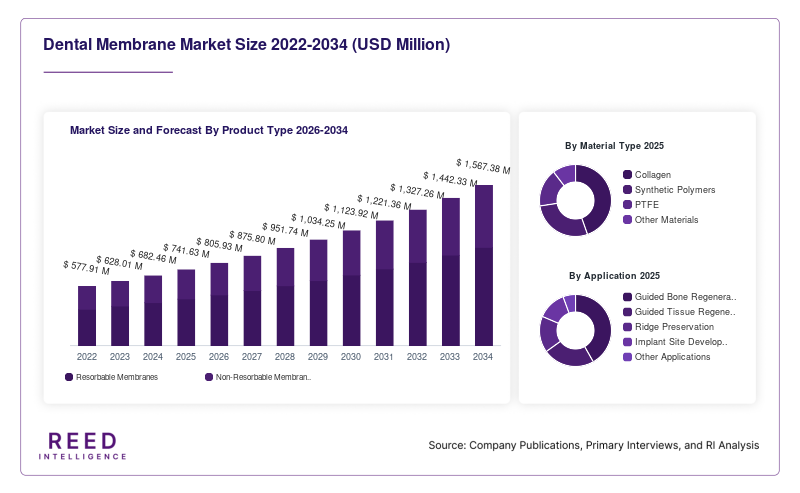
Resorbable Membranes represent approximately 70% of the 2025 market, equivalent to about USD 519.14 million under the internal analytical allocation. The segment is modeled at approximately 9.18% CAGR through 2034, producing an indicative 2034 value of about USD 1.15 billion. Its leading position reflects the clinical advantage of providing temporary barrier function without routine membrane-removal surgery. Recent clinical evidence also supports the favorable safety profile of absorbable membranes.
Non-Resorbable Membranes represent approximately 30% of the 2025 market, equivalent to about USD 222.49 million under the internal allocation. The segment is modeled at approximately 7.40% CAGR, reaching an indicative USD 423.01 million by 2034. PTFE and reinforced membrane systems retain a role in larger or more mechanically demanding defects where clinicians prioritize space maintenance and dimensional stability.
By Material Type
Collagen represents approximately 64% of the 2025 market, equivalent to about USD 474.64 million under the internal analytical allocation. It is modeled at approximately 9.0% CAGR, producing an indicative USD 1.05 billion by 2034. Collagen remains commercially important because of its biological compatibility, resorption characteristics and established clinical history. Geistlich, Straumann/botiss and Dentsply Sirona all maintain collagen-based membrane portfolios.
Synthetic Polymers represent approximately 22% of the 2025 market, or about USD 163.16 million. The segment is modeled at approximately 8.5% CAGR, reaching approximately USD 344.00 million by 2034. Synthetic materials offer opportunities where clinicians seek controlled degradation, material consistency or alternatives to animal-derived biomaterials.
PTFE represents approximately 10% of the 2025 market, equivalent to about USD 74.16 million. It is modeled at approximately 7.5% CAGR, reaching about USD 143.83 million by 2034. PTFE maintains relevance where high barrier stability and space maintenance are priorities, although the requirement for removal with many non-resorbable configurations can limit use.
Other Materials account for approximately 4% of the 2025 market, or about USD 29.67 million, and are modeled at approximately 7.0% CAGR, reaching around USD 54.00 million by 2034. This category includes emerging biomaterials such as magnesium-based membranes and other developing regenerative platforms.
By Application
Guided Bone Regeneration represents approximately 50% of the 2025 market, equivalent to about USD 370.82 million under the internal allocation. It is modeled at approximately 9.2% CAGR, reaching about USD 829 million by 2034. GBR is the principal commercial application because membranes provide a physical barrier that supports bone regeneration around implants and in deficient alveolar ridges.
Guided Tissue Regeneration represents approximately 27% of the 2025 market, or about USD 200.24 million. It is modeled at approximately 8.8% CAGR, reaching around USD 431 million by 2034. The segment is closely associated with periodontal regeneration, where membranes are used to control cellular migration and support regeneration of periodontal structures.
Ridge Preservation represents approximately 15% of the 2025 market, equivalent to about USD 111.24 million, and is modeled at approximately 7.5% CAGR, reaching around USD 213 million by 2034. The application benefits from increasing emphasis on maintaining alveolar bone volume after tooth extraction, particularly when implant placement is planned.
Implant Site Development represents approximately 8% of the 2025 market, or about USD 59.33 million, and is modeled at approximately 6.8% CAGR, producing an indicative USD 107 million by 2034. This includes membrane use for localized augmentation and preparation of sites that lack sufficient bone for predictable implant placement.
By End User
Dental Clinics represent approximately 62% of the 2025 market, equivalent to about USD 459.81 million under the internal allocation. The segment is modeled at approximately 8.7% CAGR, reaching approximately USD 993 million by 2034. Specialist and general dental practices increasingly perform implant and regenerative procedures, making clinics the principal point of membrane utilization.
Hospitals represent approximately 25% of the 2025 market, or about USD 185.41 million, and are modeled at approximately 8.5% CAGR, reaching approximately USD 390 million by 2034. Hospitals remain important for complex maxillofacial reconstruction, trauma, medically complicated cases and procedures requiring multidisciplinary care.
Dental Specialty Centers represent approximately 13% of the 2025 market, equivalent to about USD 96.41 million. The segment is modeled at approximately 7.5% CAGR, reaching approximately USD 187 million by 2034. These centers can support higher-value regenerative procedures because they concentrate implantology, periodontology, oral surgery and related expertise.
Regional Analysis
North America Dental Membrane Market
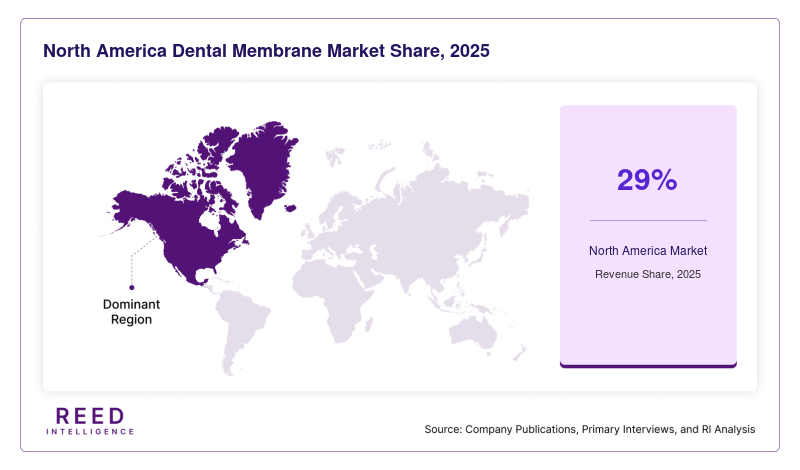
North America represents approximately 29% of the 2025 market, equivalent to about USD 215.07 million under the internal analytical allocation. It is modeled at approximately 7.8% CAGR, reaching approximately USD 425 million by 2034.
The region benefits from an established implant-dentistry market, sophisticated dental specialty infrastructure and regulatory pathways for dental biomaterials. The FDA maintains a specific device classification for intraoral animal-source barriers, with collagen dental membranes cleared through the 510(k) pathway.
Recent product launches also support the competitive depth of the region. Geistlich Bio-Gide Forte became available in North America in October 2025, providing an example of manufacturers introducing differentiated collagen membranes into the U.S. market.
Europe Dental Membrane Market
Europe represents approximately 27% of the 2025 market, or about USD 200.24 million, under the internal allocation. It is modeled at approximately 7.9% CAGR, reaching about USD 396 million by 2034.
Europe has a strong regenerative-dentistry research and manufacturing base. Geistlich, Straumann and botiss maintain significant biomaterials portfolios in the region, while European academic centers contribute substantially to evidence on GBR, GTR and membrane performance.
In April 2026, Geistlich launched Bio-Gide Forte for the European market at the International Osteology Symposium in Vienna, illustrating continued demand for differentiated regenerative biomaterials.
APAC Dental Membrane Market
APAC represents approximately 30% of the 2025 market, equivalent to about USD 222.49 million. It is modeled at approximately 10.37% CAGR, making it the fastest-growing regional market and producing an indicative USD 547 million by 2034.
The region's opportunity is supported by its large population, rising dental-treatment needs and increasing access to implant and regenerative procedures. WHO's oral-health data indicate particularly high oral-disease burdens across Asia, while South-East Asia alone accounts for approximately 900 million oral-disease cases.
The region also provides significant opportunity for lower-cost regenerative biomaterials. Manufacturers targeting emerging markets are increasingly developing products that preserve essential clinical characteristics while reducing cost and simplifying handling.
Middle East and Africa Dental Membrane Market
The Middle East and Africa represent approximately 6% of the 2025 market, equivalent to about USD 44.50 million. The segment is modeled at approximately 7.2% CAGR, reaching approximately USD 83 million by 2034.
Adoption is concentrated in countries with stronger private dental infrastructure, implant centers and medical-tourism activity. Growth is constrained by uneven access to advanced dental care and differences in reimbursement and healthcare spending.
LATAM Dental Membrane Market
LATAM represents approximately 8% of the 2025 market, or about USD 59.33 million, under the internal allocation. It is modeled at approximately 8.5% CAGR, reaching approximately USD 123 million by 2034.
The region provides growth opportunities through expanding private dental networks, implant dentistry and specialist practices. However, affordability remains important because regenerative procedures can add significant cost to implant treatment.
Competitive Landscape
The competitive landscape is characterized by established regenerative-dentistry specialists, global dental companies and biomaterial manufacturers competing through clinical evidence, material performance, product breadth and clinician education.
Geistlich Pharma maintains a broad regenerative portfolio centered on Bio-Gide collagen membranes and Bio-Oss bone substitutes. Its Bio-Gide family includes conventional, compressed, periodontal, shaped and Forte variants, allowing the company to target different clinical requirements.
Straumann competes through its advanced biomaterials portfolio, including Jason and collprotect membranes. Jason uses porcine pericardium and emphasizes high tensile strength, thin construction and prolonged barrier function.
Dentsply Sirona competes through its OSSIX membrane portfolio. OSSIX includes resorbable collagen products designed for GBR and GTR, while the company's broader regenerative portfolio combines membranes with bone graft materials.
Key Market Players
- Geistlich Pharma AG
- Institut Straumann AG
- Dentsply Sirona
- botiss biomaterials GmbH
- Collagen Matrix, Inc.
- Osteogenics Biomedical
- Zimmer Biomet
- ACE Surgical Supply
- BioHorizons
- BEGO
- Medtronic
- Dentium
Recent Market Developments
April 2026 – Geistlich launches Bio-Gide Forte in Europe
Geistlich Pharma launched Geistlich Bio-Gide Forte in Europe at the International Osteology Symposium in Vienna in April 2026. The product is an advanced bilayer collagen membrane designed with increased strength, improved stability and easier handling. The European launch followed its introduction in North America in October 2025. Geistlich stated that the company planned to launch 20 new products in more than 40 countries by the end of 2026, making the membrane part of a broader regenerative-dentistry portfolio expansion.
September 2026 – botiss highlights magnesium membranes for ridge reconstruction
In September 2026, botiss reported the use of NOVAMag SHIELD in post-extraction alveolar ridge reconstruction and immediate implant placement. The company's September 2026 educational program also focused on how magnesium-based membranes and hyaluronic-acid biomaterials can be used in implant-regeneration procedures.
Dental Membrane Market Segments
By Product Type
- Resorbable Membranes
- Non-Resorbable Membranes
By Material Type
- Collagen
- Synthetic Polymers
- PTFE
- Other Materials
By Application
- Guided Bone Regeneration
- Guided Tissue Regeneration
- Ridge Preservation
- Implant Site Development
- Other Applications
By End User
- Dental Clinics
- Hospitals
- Dental Specialty Centers
By Region
- North America
- Europe
- APAC
- Middle East and Africa
- LATAM