Dental Resin Market Size, Share & Demand Report By Type (Composite Resins, Adhesive Resins, Restorative Resins, Prosthetic Resins), By Application (Restorative Dentistry, Prosthodontics, Orthodontics, Endodontics) By Region & Segment Forecasts, 2026–2034
USD 3950
Dental Resin Market Size
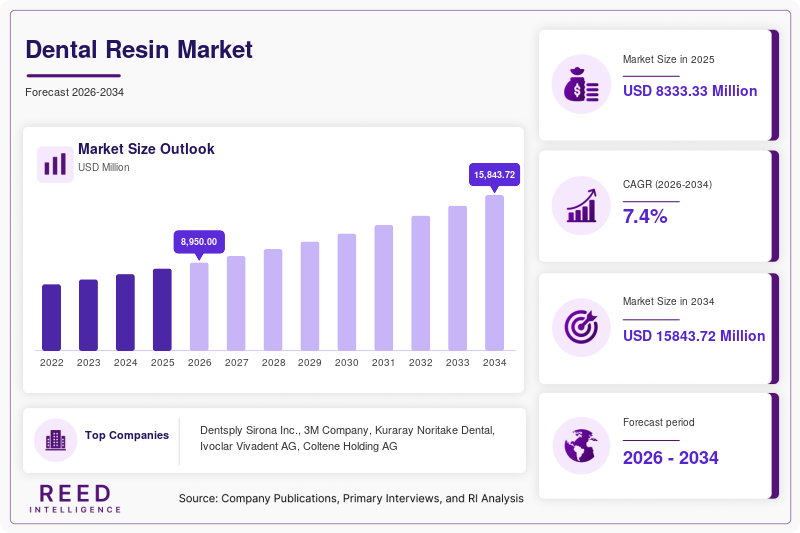
The Dental Resin market size is projected at USD 8,950.0 million in 2026 and is expected to hit USD 15,843.72.0 million by 2034 with a CAGR of 7.4% during the forecast period. The increasing prevalence of dental caries and tooth decay, the growing demand for aesthetic dental procedures, and the rising adoption of minimally invasive dentistry underpin market expansion. This report delivers a comprehensive analysis of the Dental Resin market, including segmentation by type and application, competitive dynamics, and regional growth patterns, equipping stakeholders with critical intelligence to navigate this evolving dental materials landscape.
Key Takeaways
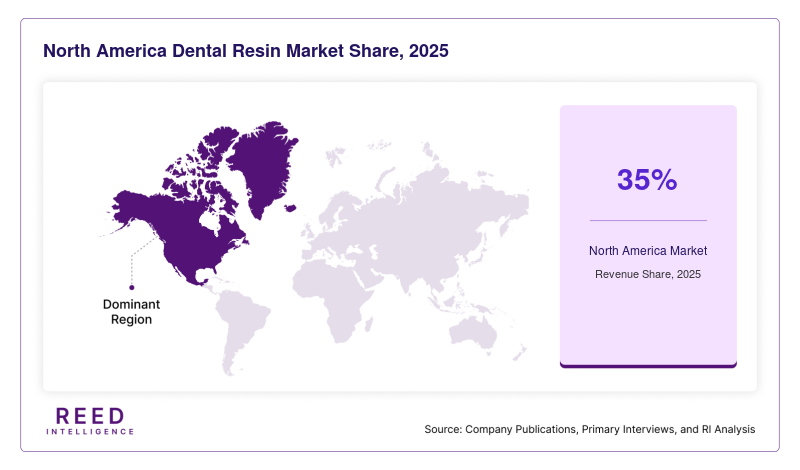
- Dominant Region: North America leads the Dental Resin market with a 35% share, while Asia-Pacific is the fastest-growing region with a projected CAGR of 9.2% through 2034.
- Dominant Segment: The Composite Resins type dominates the market with a 38% share, while the Restorative Dentistry application is the leading segment with a 45% share.
- Emerging Country: China is projected to reach USD 1,850.0 million by 2034, expanding at a CAGR of 10.5%.
- Key Drivers: The increasing global burden of dental diseases, the growing awareness about oral health, and the rising demand for tooth-colored restorative materials are driving market growth.
Dental Resin Market Trends
Advancements in Nanotechnology and Bioactive Materials
The Dental Resin market is witnessing a significant trend toward the development of nanotechnology-enhanced and bioactive dental resins that offer improved mechanical properties, better aesthetics, and active therapeutic benefits. This shift is driven by the growing demand for longer-lasting restorations with enhanced performance characteristics. Manufacturers are incorporating nano-fillers and bioactive glass particles into resin formulations to improve wear resistance, reduce shrinkage, and provide remineralization properties. The development of antimicrobial and self-healing resin formulations is gaining momentum, enabling proactive management of secondary caries. This trend is supported by continuous research in dental materials science and growing clinical evidence of the benefits of advanced resin technologies.
Growing Demand for Aesthetic and Tooth-Colored Restorations
The increasing demand for aesthetic and tooth-colored restorations is a major trend shaping the Dental Resin market. The development of resin systems with improved shade matching, translucency, and optical properties is gaining traction, driven by patient preference for natural-looking dental restorations. The emergence of layering techniques and advanced shade guides is enabling more aesthetic outcomes in composite restorations. This trend is supported by growing awareness of dental aesthetics and the preference for metal-free restorations. The availability of universal shade resins and simplified application techniques is enabling broader adoption of aesthetic restorations.
Dental Resin Market Drivers
The Dental Resin market's expansion is primarily driven by the increasing global burden of dental diseases, with dental caries affecting approximately 2.5 billion people worldwide. The growing awareness about oral health and the importance of timely dental restorations has been a major driver, with resin materials being the preferred choice for restorative procedures. The rising demand for aesthetic dental procedures and the preference for tooth-colored restorations over amalgam have further fueled market demand. The technological advancements in resin materials, including improved durability, wear resistance, and handling characteristics, have expanded clinical applications. Additionally, the increasing geriatric population, which has higher rates of tooth decay and tooth loss, has supported market growth.
Dental Resin Market Restraints
Despite favorable growth prospects, the Dental Resin market faces significant constraints, primarily related to the higher costs of resin-based restorations compared to traditional amalgam restorations, which can limit adoption in cost-sensitive markets. The technical challenges associated with achieving optimal bonding and longevity of resin restorations can also limit their use. The market's growth is further tempered by the potential for polymerization shrinkage and the need for careful clinical technique to ensure optimal outcomes. Additionally, the competition from alternative restorative materials, such as ceramics and glass ionomers, can limit growth in certain applications.
Dental Resin Market Opportunities
The Dental Resin market presents significant opportunities in the rapidly expanding segment of bioactive and therapeutic dental resins that offer active dental health benefits. The development of resin-based materials for minimally invasive and tissue-preserving dentistry represents another promising avenue. Emerging opportunities also exist in the application of CAD/CAM technology for resin-based restorations and the development of resin materials for new clinical applications, including regenerative dentistry. Furthermore, the untapped potential in developing economies, driven by improving dental care access and growing aesthetic awareness, offers a fertile ground for market expansion.
Challenges in Dental Resin Market
The Dental Resin market grapples with persistent challenges related to the need for continuous innovation to develop materials with improved properties, including enhanced wear resistance, reduced shrinkage, and better long-term stability. The complexity of achieving optimal bonding to tooth structure and ensuring clinical success presents ongoing challenges. The market is also contending with the challenge of managing the rising costs of raw materials and regulatory compliance. Moreover, the need for effective clinical training and education on proper resin placement techniques poses challenges for broader adoption.
Dental Resin Market Segmentation Analysis
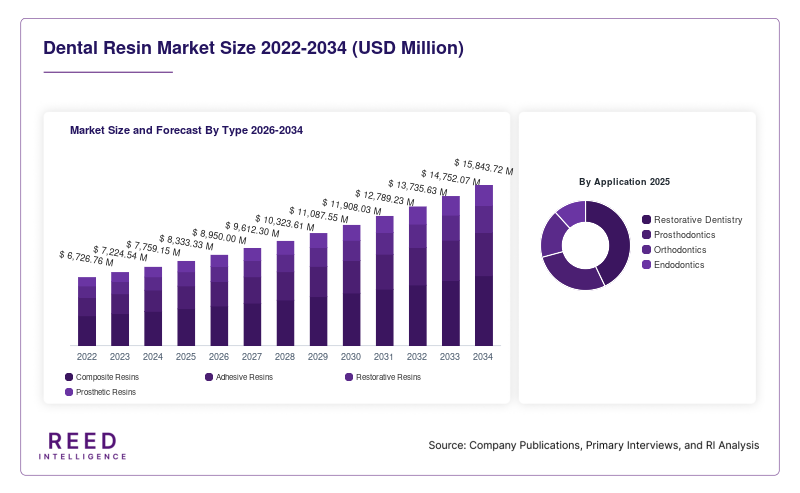
The Dental Resin market is segmented by Type and Application to provide a comprehensive market perspective. By Type, Composite Resins dominate with a 38% market share, driven by their widespread clinical use. The Application segment is led by Restorative Dentistry, which accounts for 45% of the market, followed by Prosthodontics at 25%, Orthodontics at 18%, and Endodontics at 12%.
By Type
Composite Resins represent the largest segment in the Dental Resin market, commanding a 38% share, with revenue exceeding USD 3,401 million in 2025. These include hybrid, microfilled, and nanofilled composites used for direct restorations. Technical specifications include filler loading, particle size, and polymerization characteristics. The market's Composite Resins segment is driven by their use in aesthetic direct restorations and dental bonding procedures.
Adhesive Resins capture a 28% share of the Dental Resin market, with revenue of USD 2,506 million in 2025. These include bonding agents, etchants, and primers used in adhesive dentistry. Technical specifications include bond strength, application technique, and compatibility. The market's Adhesive Resins segment is driven by their use in bonding composite restorations, orthodontic brackets, and indirect restorations.
Restorative Resins represent 20% of the market, with revenue of USD 1,790 million in 2025, characterized by bulk-fill, flowable, and core build-up materials. Technical specifications include viscosity, flow characteristics, and handling properties. The market's Restorative Resins segment is driven by their use in deep cavity restorations and core build-ups.
Prosthetic Resins account for 14% of the market, with revenue of USD 1,253 million in 2025, involving acrylic resins, denture base materials, and temporary crown resins. Technical specifications include flexural strength, color stability, and processing characteristics. The market's Prosthetic Resins segment is driven by their use in removable prosthetics and temporary restorations.
By Application
Restorative Dentistry dominates the Dental Resin market, accounting for 45% of sales, representing USD 4,028 million in 2025. This segment includes the use of dental resins for direct restorations, cavity fillings, and tooth repairs. Usage penetration exceeds 70% in aesthetic restorative procedures. The market's Restorative Dentistry segment is characterized by its focus on aesthetics and functional restoration.
Prosthodontics accounts for 25% of the Dental Resin market, with revenue of USD 2,237 million in 2025. This segment encompasses the use of resins for crowns, bridges, dentures, and other prosthetic applications. The segment is growing at a steady rate, driven by the increasing demand for prosthetic solutions. The market's Prosthodontics segment is characterized by its focus on fit, function, and durability.
Orthodontics represents 18% of the market, with revenue of USD 1,611 million in 2025, involving the use of resins for bracket bonding, adhesives, and aligner materials. The segment's growth is fueled by the increasing demand for orthodontic treatment. The market's Orthodontics segment is characterized by its focus on bond strength and aesthetics.
Endodontics accounts for 12% of the market, with revenue of USD 1,074 million in 2025, encompassing the use of resins for root canal sealing and post-endodontic restorations. The market's Endodontics segment is driven by the need for effective root canal sealing and tooth restoration.
Dental Resin Market Outlook
North America Dental Resin Market
Leads the Dental Resin market, commanding a 35% share, with revenue of USD 3,133 million in 2025. The United States is the primary driver, accounting for 87% of regional demand, driven by high dental expenditure, strong aesthetic awareness, and advanced clinical practice. The North American market is characterized by its focus on innovation and technology adoption.
Europe Dental Resin Market
Represents the second-largest market, capturing a 30% share with revenue of USD 2,685 million in 2025. Germany, the United Kingdom, and France are the primary drivers, together accounting for 58% of regional demand, driven by well-established dental care systems and high aesthetic standards. The European market is projected to grow at a steady CAGR, supported by continuous innovation and dental care investment.
Asia-Pacific Dental Resin Market
Accounts for 25% of the global Dental Resin market, with revenue of USD 2,237 million in 2025. China, Japan, and South Korea are the primary drivers, accounting for 62% of regional demand, fueled by rapidly improving dental services, increasing disposable income, and growing aesthetic awareness. The Asia-Pacific market is projected to grow at the fastest CAGR of 9.2% through 2034, driven by expanding dental care infrastructure and growing patient demand.
Latin America and Middle East & Africa Dental Resin Market
Together account for the remaining 10% of the Dental Resin market, with Brazil and South Africa leading their respective regions. Both regions are projected to grow at CAGRs exceeding 8%, driven by improving dental care access and growing aesthetic awareness.
Top players in Dental Resin Market
- Dentsply Sirona Inc.
- 3M Company
- Kuraray Noritake Dental
- Ivoclar Vivadent AG
- Coltene Holding AG
- GC Corporation
- Mitsui Chemicals (Shofu)
- VOCO GmbH
- Ultradent Products Inc.
- Tokuyama Corporation
- Bisco, Inc.
- Kerr Corporation
- Mydent International
- Parkell Inc.
- Pentron Clinical Technologies
Dental Resin Market Segments
By Type
- Composite Resins
- Adhesive Resins
- Restorative Resins
- Prosthetic Resins
By Application
- Restorative Dentistry
- Prosthodontics
- Orthodontics
- Endodontics
By Region
- North America
- Europe
- APAC
- Middle East and Africa
- LATAM