Dental Wax Market Size, Share Demand Report By Product Type (Baseplate Wax, Sticky Wax, Utility Wax, Bite Registration Wax, Casting Wax, Boxing Wax), By Material Type (Natural Wax, Synthetic Wax, Blended Wax), By Application (Prosthodontics, Orthodontics, Restorative Dentistry, Implant Dentistry), By End Use (Dental Laboratories, Dental Clinics, Academic Institutes), By Distribution Channel (Direct Sales, Distributors, Online Channels), By Region & Segment Forecasts, 2026–2034
USD 3950
Market Overview
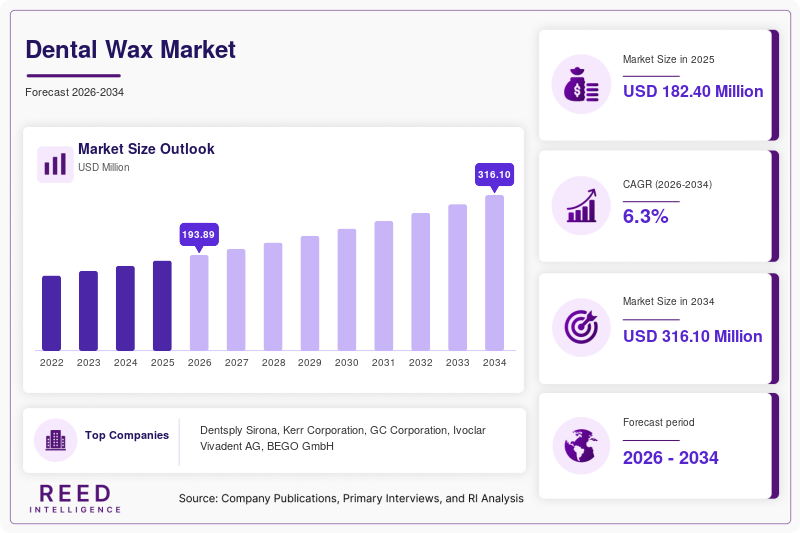
The global Dental Wax Market size was valued at USD 182.4 million in 2026 and is projected to reach USD 296.8 million by 2034, expanding at a CAGR of 6.3% during the forecast period (2026–2034). The market is witnessing steady expansion due to the rising volume of restorative and prosthodontic dental procedures worldwide. Increasing demand for dental crowns, bridges, dentures, and orthodontic appliances has accelerated the use of dental wax products in clinical and laboratory workflows. Dental wax remains a critical consumable in impression taking, bite registration, denture setup, and casting applications because of its moldability, dimensional stability, and precision support in prosthetic fabrication.
A major global factor supporting market growth is the rapid increase in aging populations, particularly in developed and emerging economies. Older adults require more restorative dental care, including removable and fixed prostheses, which directly increases demand for utility waxes, baseplate waxes, and sticky waxes used in dental labs and clinics.
Key Highlights:
- North America dominated the Dental Wax Market in 2025 with 36.2% market share, while Asia Pacific is forecast to register the fastest CAGR of 8.1% through 2034.
- By type, modeling wax led with 31.8% share, while orthodontic wax is projected to grow fastest at 8.5% CAGR.
- By application, prosthodontics remained dominant with 42.6% share, while orthodontics is expected to expand fastest at 8.3% CAGR.
- The United States remained the leading country market, valued at USD 49.6 million in 2024 and USD 52.3 million in 2025.
Market Trends
Rising Adoption of CAD/CAM-Compatible Wax Materials
Dental laboratories are increasingly adopting CAD/CAM-integrated workflows, creating demand for milling-compatible dental wax blocks and discs. These products are used for digital pattern fabrication in crowns, bridges, and implant restorations. As dental clinics modernize production processes, wax manufacturers are introducing precision-engineered wax materials compatible with automated carving systems. This trend is improving workflow consistency and reducing manual errors in restoration modeling.
Shift Toward Specialty Orthodontic Wax Solutions
Orthodontic care expansion is creating new demand for patient-comfort wax products designed for braces irritation relief. Manufacturers are launching flavored, hypoallergenic, and portable wax packaging formats aimed at retail and chairside distribution. Growing adolescent orthodontic treatment volumes and cosmetic dentistry awareness are encouraging innovation in therapeutic orthodontic wax offerings. This trend is broadening market scope beyond laboratory-only applications into direct patient-use segments.
Market Drivers
Increasing Global Prosthetic Dental Procedures
The rising prevalence of tooth loss, enamel erosion, and oral rehabilitation procedures is driving consumption of dental wax in denture and crown fabrication. Prosthodontic laboratories rely heavily on modeling wax and casting wax for accurate pattern shaping. As dental restoration demand rises across aging populations, recurring wax consumption is expected to increase steadily.
Expansion of Dental Laboratory Infrastructure in Emerging Economies
Emerging markets are seeing rapid establishment of independent dental laboratories due to rising oral healthcare spending. Countries in Asia and Latin America are investing in dental manufacturing ecosystems, increasing procurement of consumables such as utility wax and sticky wax. This infrastructure expansion is supporting long-term Dental Wax Market growth.
Market Restraint
Availability of Wax Alternatives in Digital Dentistry
The increasing use of resin-based 3D printing materials and digital modeling polymers presents a restraint for conventional wax demand. Advanced restorative systems are replacing manual wax-up techniques in certain high-end laboratories. As additive manufacturing becomes more affordable, traditional dental wax products may face substitution pressure in digitally mature markets.
Market Opportunitie
Growth in Cosmetic Dentistry Clinics
The expansion of cosmetic dental centers presents new opportunities for premium wax products used in veneer mock-ups, smile design planning, and esthetic modeling. Cosmetic treatment growth in urban markets will create demand for specialized sculpting wax formulations.
Development of Biocompatible Natural Wax Formulations
Demand for cleaner and sustainable dental materials is opening opportunities for plant-derived and hypoallergenic wax compounds. Manufacturers investing in low-residue, biodegradable dental wax products may gain traction among environmentally conscious clinics and laboratories.
Segmental Analysis
By Product Type
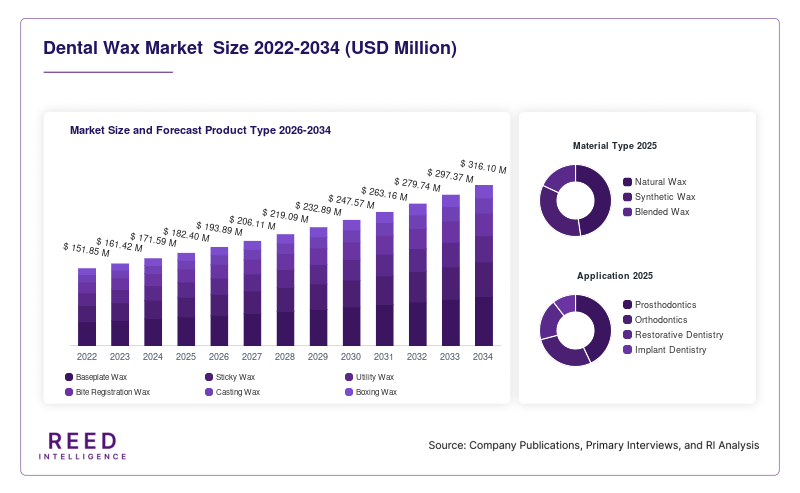
Baseplate wax dominated the Dental Wax Market in 2025 with 31.4% share due to its extensive use in denture base construction and occlusion rim fabrication. Its ease of shaping and thermal stability supported strong laboratory adoption.
Bite registration wax will be the fastest-growing subsegment, projected at 7.9% CAGR through 2034. Rising digital occlusion assessment integration will increase demand for precision bite recording materials.
By Material Type
Synthetic wax held the largest share at 44.2% in 2025 because of consistent melting properties and improved formulation uniformity in laboratory procedures.
Natural wax blends are projected to grow fastest at 7.1% CAGR as clinics seek biocompatible and residue-reducing alternatives for sensitive applications.
By Application
Prosthodontics led with 38.6% share in 2025 due to high wax consumption in dentures, crowns, and bridge modeling.
Orthodontics will expand fastest at 7.4% CAGR as brace-related patient comfort wax and appliance modeling applications continue rising globally.
By End Use
Dental laboratories accounted for 56.8% share in 2025, remaining the largest end-user segment due to continuous bulk wax consumption for restoration manufacturing.
Dental clinics are forecast to grow fastest at 6.9% CAGR as chairside wax applications expand in same-day prosthetic adjustments and impression refinement.
By Distribution Channel
Direct sales dominated with 47.3% share in 2025 because laboratories prefer long-term supply agreements with manufacturers for volume purchasing consistency.
Online distribution will grow fastest at 8.2% CAGR as smaller clinics increasingly source specialized wax products through digital procurement platforms.
Regional Analysis
North America
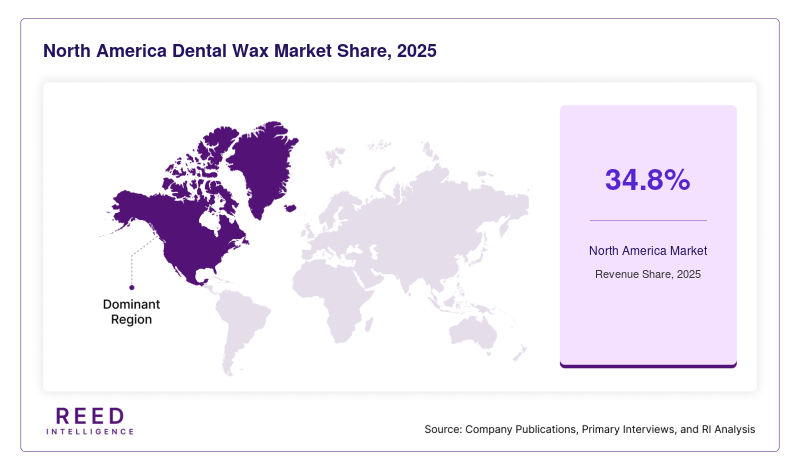
North America accounted for 34.8% of the Dental Wax Market share in 2025 and will expand at a CAGR of 5.8% through 2034. The region maintained leadership due to strong prosthodontic case volumes and established dental laboratory networks. High procedural consistency standards supported repeat demand for calibrated wax materials.
The United States dominated the region because of widespread adoption of restorative dentistry and advanced prosthetic workflows. Growth in implant-supported restorations is increasing demand for pattern wax in crown and bridge laboratories.
Europe
Europe represented 27.6% of the global market in 2025 and will grow at a CAGR of 5.9% during the forecast period. Regional demand remained supported by structured reimbursement systems and aging demographics requiring denture-based rehabilitation.
Germany led Europe due to its strong dental manufacturing base and high concentration of dental laboratories. Precision prosthetic fabrication standards continue driving demand for premium casting wax products.
Asia Pacific
Asia Pacific held 22.4% market share in 2025 and will record the fastest CAGR of 7.6% through 2034. Rapid urban dental clinic expansion and rising oral care awareness are increasing regional product demand.
China dominated the region due to rising dental tourism, expanding dental lab chains, and increasing prosthetic treatment affordability. Domestic manufacturing is also improving supply accessibility.
Middle East & Africa
Middle East & Africa captured 8.1% share in 2025 and will grow at CAGR of 6.4%. Market growth is supported by improving dental healthcare access in Gulf countries and urban African centers.
Saudi Arabia led regional demand due to investments in specialty dental hospitals and prosthetic care modernization. Imported dental consumables remain central to regional supply chains.
Latin America
Latin America accounted for 7.1% share in 2025 and will grow at CAGR of 6.2%. Expanding private dental chains and prosthetic treatment uptake supported regional growth.
Brazil dominated the region owing to large dental practitioner density and increasing removable denture procedures. Local distribution expansion is improving product penetration.
Competitive Landscape
The Dental Wax Market remains moderately fragmented, with established dental consumable manufacturers competing on formulation precision, specialty application range, and laboratory partnerships. Leading players include Kerr Corporation, GC Corporation, BEGO GmbH, Dentsply Sirona, and Ivoclar Vivadent. Dentsply Sirona remains a leading market participant due to its broad dental materials portfolio and global distribution reach. In 2025, the company introduced an upgraded CAD/CAM wax disc line designed for digital milling workflows, strengthening its laboratory segment presence. Regional players are increasingly focusing on biodegradable wax blends and orthodontic specialty products to expand market share in niche applications.
Key Players List
- Dentsply Sirona
- Kerr Corporation
- GC Corporation
- Ivoclar Vivadent AG
- BEGO GmbH
- Kulzer GmbH
- Pyrax Polymars
- Bilkim Ltd.
- Cavex Holland BV
- Metrodent Ltd.
- Whip Mix Corporation
- Renfert GmbH
- SHOFU Inc.
- Yeti Dentalprodukte GmbH
- Keystone Industries
Recent Developments
- In 2025, Dentsply Sirona launched advanced milling wax discs for CAD/CAM prosthetic applications.
- GC Corporation expanded orthodontic wax packaging formats for retail dental clinic distribution.
- BEGO GmbH introduced low-residue casting wax for precision implant frameworks.
- Kerr Corporation upgraded synthetic modeling wax formulations for improved thermal resistance.
- Ivoclar Vivadent expanded Asia Pacific distribution partnerships to strengthen regional supply coverage.
Dental Wax Market Segments
Product Type
- Baseplate Wax
- Sticky Wax
- Utility Wax
- Bite Registration Wax
- Casting Wax
- Boxing Wax
Material Type
- Natural Wax
- Synthetic Wax
- Blended Wax
Application
- Prosthodontics
- Orthodontics
- Restorative Dentistry
- Implant Dentistry
End Use
- Dental Laboratories
- Dental Clinics
- Academic Institutes
Distribution Channel
- Direct Sales
- Distributors
- Online Channels
By Region
- North America
- Europe
- APAC
- Middle East and Africa
- LATAM