Deoiler Chemical Market Size, Share & Demand Report By Product Type (Demulsifiers, Flocculants, Coagulants, Surfactants, Bio-Based Deoiler Chemicals), By Application (Oil & Gas Wastewater Treatment, Refinery Wastewater Treatment), By End-Use Industry (Oil & Gas, Petrochemicals, Power Generation, Marine, Mining, Manufacturing Industries), By Form (Liquid Deoiler Chemicals, Powder Deoiler Chemicals), By Region & Segment Forecasts, 2026–2034
USD 3950
Market Overview
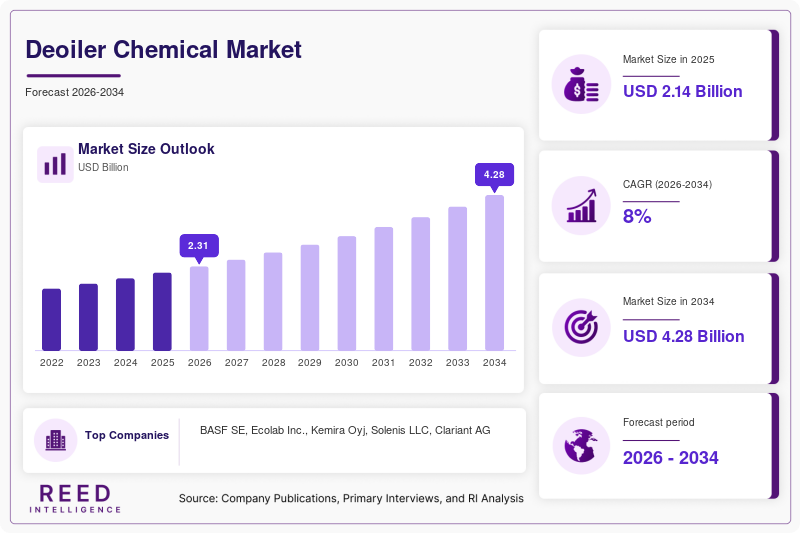
The Deoiler Chemical Market was valued at approximately USD 2.14 billion in 2026 and is projected to reach nearly USD 3.96 billion by 2034, expanding at a CAGR of 8.0% during the forecast period from 2026 to 2034. The global Deoiler Chemical Marke has witnessed consistent growth due to increasing industrial wastewater treatment activities and stricter environmental discharge regulations across major economies. Deoiler chemicals are widely used to separate oil contaminants from water streams in industries such as oil & gas, petrochemicals, power generation, marine, mining, and manufacturing. Growing concerns regarding industrial water reuse and environmental sustainability have strengthened the adoption of advanced deoiling solutions worldwide.
One of the major global factors supporting the growth of the Deoiler Chemical Market has been the rising focus on industrial wastewater management. Governments and environmental agencies have implemented stringent discharge standards for oily wastewater generated during industrial operations. Industries have therefore increased investments in chemical treatment technologies capable of improving separation efficiency and reducing environmental impact. Deoiler chemicals have become essential in achieving regulatory compliance while enhancing operational productivity and water recycling capabilities.
Key Highlights
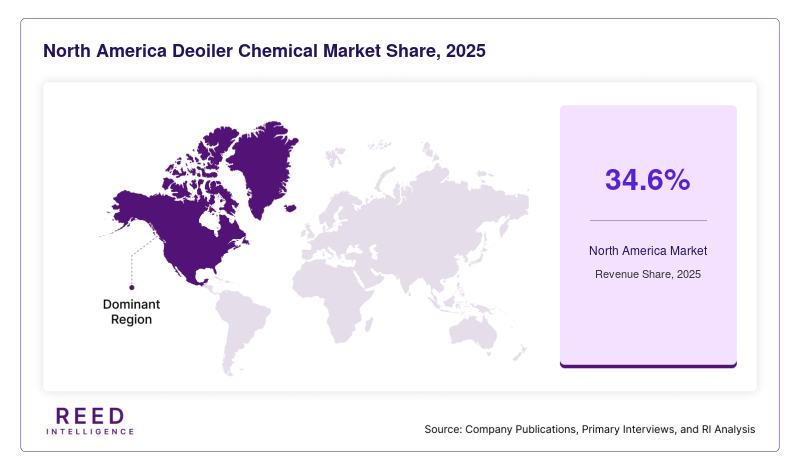
- North America accounted for nearly 34.6% of the global Deoiler Chemical Market share in 2025, while Asia Pacific is projected to register the fastest CAGR of 9.4% during the forecast period.
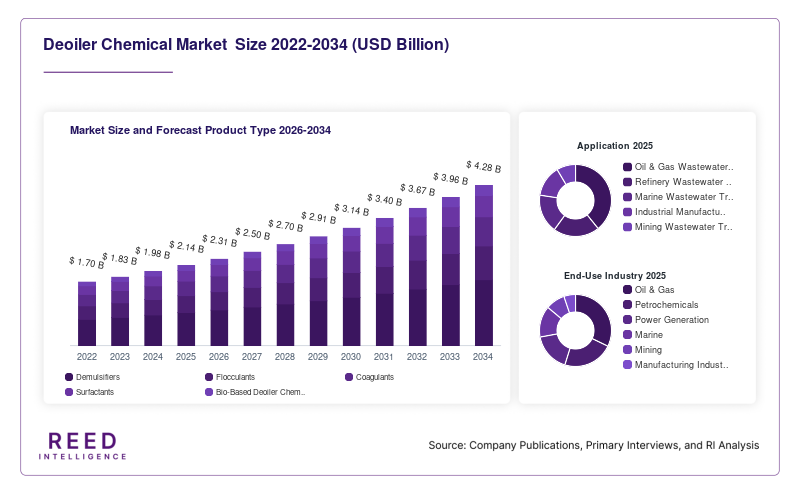
- By product type, demulsifier-based deoiler chemicals held the leading share of 39.2% in 2025, whereas bio-based deoiler chemicals are anticipated to expand at a CAGR of 10.3% through 2034.
- By application, oil & gas wastewater treatment remained the dominant segment with 36.8% market share in 2025, while marine wastewater treatment is expected to witness the fastest growth rate of 9.8%.
- By end-use industry, the oil & gas sector accounted for 41.5% of the global market share in 2025, whereas power generation facilities are forecast to grow at a CAGR of 9.1%.
- The United States represented the dominant country market with values of USD 486 million in 2024 and USD 522 million in 2025 due to increasing refinery wastewater treatment requirements and rising industrial environmental compliance investments.
Market Trends
Increasing Adoption of Bio-Based Deoiler Chemicals
The transition toward environmentally sustainable chemical formulations has emerged as a significant trend influencing the Deoiler Chemical Market. Industrial operators are increasingly preferring biodegradable and low-toxicity deoiler chemicals to reduce environmental impact and comply with evolving wastewater discharge regulations. Traditional chemical formulations often contain substances that may create secondary contamination risks, leading industries to seek safer alternatives.
Manufacturers are therefore investing in bio-based surfactants and plant-derived chemical agents capable of improving oil-water separation performance while minimizing ecological impact. These advanced formulations are gaining traction across offshore drilling, marine operations, and industrial wastewater treatment plants. The growing emphasis on sustainability and green chemistry practices is expected to continue driving demand for environmentally compatible deoiler solutions.
Rising Integration of Automated Wastewater Monitoring Systems
Another major trend shaping the Deoiler Chemical Market is the integration of automated wastewater treatment and monitoring systems. Industrial facilities are increasingly deploying smart monitoring technologies to optimize chemical dosing and improve separation efficiency. Real-time monitoring systems help operators maintain compliance with environmental regulations while reducing chemical wastage and operational downtime.
The adoption of digital treatment management systems has accelerated in industries such as petrochemicals, power generation, and marine transportation. Automated systems enable precise chemical utilization and improve overall wastewater treatment performance. As industries continue to invest in operational efficiency and process automation, demand for compatible high-performance deoiler chemicals is expected to increase steadily.
Market Drivers
Expansion of Oil & Gas Production Activities
The expansion of global oil & gas production activities has remained a key driver supporting the Deoiler Chemical Market. Exploration, drilling, refining, and transportation operations generate significant volumes of oily wastewater that require efficient treatment before disposal or reuse. Deoiler chemicals play a critical role in separating oil contaminants from industrial water streams, improving operational safety and environmental compliance.
Growing investments in offshore drilling projects and refinery upgrades have increased the need for advanced wastewater treatment chemicals. Industrial operators are focusing on improving treatment efficiency while reducing disposal costs, which has accelerated the use of high-performance deoiler formulations. Increasing crude oil production in emerging economies is expected to further strengthen market demand.
Rising Industrial Water Recycling Initiatives
Industrial sectors across the world are increasingly adopting water recycling and reuse practices to address water scarcity concerns and reduce freshwater consumption. This has generated substantial demand for wastewater treatment technologies, including deoiler chemicals capable of removing hydrocarbon contaminants effectively.
Manufacturing facilities, mining operations, and energy plants are implementing advanced water recovery systems to improve resource efficiency and lower operational costs. Deoiler chemicals support these initiatives by enhancing oil-water separation and improving recycled water quality. The growing importance of sustainable water management practices is therefore expected to contribute significantly to market growth.
Market Restraint
Fluctuating Raw Material Prices
One of the major restraints affecting the Deoiler Chemical Market is the volatility in raw material prices used in chemical manufacturing. Deoiler chemicals often rely on petrochemical derivatives and specialty surfactants, which are subject to fluctuating supply and pricing conditions. Variations in crude oil prices and supply chain disruptions can increase production costs for manufacturers.
These pricing fluctuations may create challenges for long-term procurement planning and profit margin stability. Smaller manufacturers may particularly face difficulties in maintaining cost competitiveness within highly regulated industrial markets.
Market Opportunities
Growing Demand from Offshore Marine Operations
The expansion of offshore marine transportation and drilling activities presents significant opportunities for the Deoiler Chemical Market. Marine operations generate oily bilge water and wastewater streams that require effective treatment to comply with international maritime environmental regulations.
Shipping operators and offshore platforms are increasingly adopting advanced deoiling chemicals to improve wastewater treatment efficiency and reduce environmental risks. Rising investments in offshore energy projects are expected to create long-term growth opportunities for market participants.
Emerging Opportunities in Industrial Manufacturing Facilities
Industrial manufacturing facilities across emerging economies are increasingly modernizing wastewater treatment infrastructure. Industries such as automotive manufacturing, metal processing, chemicals, and food processing require efficient oil separation technologies to meet environmental standards.
Manufacturers of deoiler chemicals are expanding product portfolios to address industry-specific treatment requirements. Customized formulations designed for complex industrial effluents are expected to gain strong demand during the forecast period.
Segmental Analysis
By Product Type
Based on product type, the Deoiler Chemical Market is segmented into demulsifiers, flocculants, coagulants, surfactants, and bio-based deoiler chemicals.
Demulsifier-based deoiler chemicals dominated the market with a share of 39.2% in 2025. Their extensive use in separating stable oil-water emulsions across refinery and drilling operations contributed significantly to segment growth. Industrial operators preferred demulsifiers because they improve treatment efficiency while reducing sludge formation.
Bio-based deoiler chemicals are expected to witness the fastest CAGR of 10.3% during the forecast period. Rising environmental awareness and increasing adoption of sustainable wastewater treatment practices will support future growth. Manufacturers are focusing on biodegradable formulations that provide efficient oil separation with lower ecological impact.
By Application
Based on application, the market is categorized into oil & gas wastewater treatment, refinery wastewater treatment, marine wastewater treatment, industrial manufacturing wastewater treatment, and mining wastewater treatment.
Oil & gas wastewater treatment accounted for the largest market share of 36.8% in 2025 due to increasing exploration and drilling activities worldwide. Deoiler chemicals are widely used in upstream and downstream oil processing operations to maintain environmental compliance and improve operational performance.
Marine wastewater treatment is projected to grow at the fastest CAGR of 9.8% through 2034. Increasing maritime environmental regulations and growing international shipping activities are expected to increase demand for advanced deoiling chemicals. Marine operators are adopting efficient wastewater treatment systems to reduce ocean pollution risks.
By End-Use Industry
Based on end-use industry, the Deoiler Chemical Market is segmented into oil & gas, petrochemicals, power generation, marine, mining, and manufacturing industries.
The oil & gas industry remained the dominant end-use segment with 41.5% market share in 2025. Extensive wastewater generation during drilling and refining activities supported significant deoiler chemical consumption across the industry.
Power generation facilities are expected to register the fastest CAGR of 9.1% during the forecast period. Rising investments in thermal and energy generation plants will support demand for wastewater treatment chemicals. Industrial operators are increasingly implementing water recycling systems to improve sustainability performance.
By Form
Based on form, the market is segmented into liquid deoiler chemicals and powder deoiler chemicals.
Liquid deoiler chemicals held the largest share of 67.4% in 2025 because of their ease of handling, rapid mixing capability, and compatibility with automated dosing systems. Industrial facilities preferred liquid formulations for large-scale wastewater treatment operations.
Powder deoiler chemicals are anticipated to grow at the fastest CAGR of 8.7% during the forecast period due to their longer shelf life and lower transportation costs. Increasing demand from remote industrial operations is expected to support future segment growth.
Regional Analysis
North America
North America held approximately 34.6% of the global Deoiler Chemical Market share in 2025. The region benefited from stringent industrial wastewater discharge regulations and extensive oil refining activities. The United States remained the dominant country due to its large refinery infrastructure and increasing adoption of advanced industrial wastewater treatment systems.
The regional market is expected to grow at a CAGR of 7.6% during the forecast period. Rising investments in shale oil production and industrial sustainability initiatives will continue supporting demand for deoiler chemicals across North America.
Europe
Europe accounted for nearly 26.8% of the global Deoiler Chemical Market share in 2025. Environmental sustainability regulations and increasing industrial water reuse projects contributed significantly to market expansion across the region.
The market is projected to expand at a CAGR of 7.4% through 2034. Germany emerged as the dominant country due to its advanced industrial manufacturing sector and growing investments in wastewater treatment modernization. Increasing emphasis on eco-friendly chemical formulations is expected to support future regional growth.
Asia Pacific
Asia Pacific represented around 24.5% of the global Deoiler Chemical Market share in 2025. Rapid industrialization, increasing refinery construction activities, and expanding manufacturing sectors contributed to strong regional demand for wastewater treatment chemicals.
The region is forecast to witness the fastest CAGR of 9.4% during the forecast period. China remained the leading country market because of large-scale industrial wastewater generation and rising environmental compliance investments. Government initiatives supporting industrial pollution reduction are expected to strengthen future demand.
Middle East & Africa
The Middle East & Africa accounted for approximately 7.1% of the global market share in 2025. The region benefited from extensive oil production activities and growing investments in refinery wastewater treatment infrastructure.
The market is anticipated to grow at a CAGR of 8.1% through 2034. Saudi Arabia emerged as the dominant country due to increasing offshore drilling operations and refinery expansion projects. Industrial operators in the region are increasingly investing in advanced wastewater management systems to improve environmental compliance.
Latin America
Latin America captured nearly 7.0% of the global Deoiler Chemical Market share in 2025. Expanding industrial production activities and rising environmental monitoring programs supported market growth across the region.
The market is projected to register a CAGR of 7.8% during the forecast period. Brazil remained the leading country market because of increasing offshore oil exploration activities and growing industrial wastewater treatment investments. Expanding petrochemical production capacity is expected to further support regional demand.
Competitive Landscape
The competitive landscape of the Deoiler Chemical Market remains moderately fragmented, with manufacturers focusing on sustainable product development, industrial partnerships, and wastewater treatment innovation. Companies are investing in advanced chemical formulations capable of improving separation efficiency while reducing operational costs and environmental impact.
BASF SE remained one of the leading market participants due to its extensive specialty chemical portfolio and strong industrial wastewater treatment expertise. The company recently expanded its sustainable water treatment chemical offerings to support industrial environmental compliance requirements.
Other market participants are increasingly focusing on product customization, regional manufacturing expansion, and strategic collaborations with industrial treatment service providers. Advanced bio-based formulations and digital treatment optimization technologies have become important competitive strategies across the market.
Key Players List
- BASF SE
- Ecolab Inc.
- Kemira Oyj
- Solenis LLC
- Clariant AG
- Dow Inc.
- Ashland Inc.
- Veolia Water Technologies
- Baker Hughes Company
- Schlumberger Limited
- Nalco Water
- SNF Group
- Croda International Plc
- Kurita Water Industries Ltd.
- Akzo Nobel N.V.
Recent Developments
- In 2025, BASF SE expanded its eco-friendly wastewater treatment chemical portfolio for refinery applications.
- In 2024, Ecolab Inc. introduced automated wastewater monitoring solutions integrated with deoiler chemical optimization systems.
- In 2025, Kemira Oyj increased production capacity for industrial wastewater treatment chemicals across Asia Pacific.
- In 2024, Solenis LLC launched advanced biodegradable deoiler formulations designed for marine wastewater applications.
- In 2025, Clariant AG partnered with industrial treatment service providers to expand customized wastewater treatment solutions.
Deoiler Chemical Market Segments
Product Type
- Demulsifiers
- Flocculants
- Coagulants
- Surfactants
- Bio-Based Deoiler Chemicals
Application
- Oil & Gas Wastewater Treatment
- Refinery Wastewater Treatment
- Marine Wastewater Treatment
- Industrial Manufacturing Wastewater Treatment
- Mining Wastewater Treatment
End-Use Industry
- Oil & Gas
- Petrochemicals
- Power Generation
- Marine
- Mining
- Manufacturing Industries
Form
- Liquid Deoiler Chemicals
- Powder Deoiler Chemicals
By Region
- North America
- Europe
- APAC
- Middle East and Africa
- LATAM