Deproteinized Whey Market Size, Share Demand Report By Type (Liquid Deproteinized Whey, Powdered Deproteinized Whey), By Application (Fermentation, Food & Beverages, Pharmaceuticals, Animal Feed), By End-Use (Food Processing Industry, Biotechnology Companies, Pharmaceutical Companies, Animal Nutrition), By Distribution Channel (Direct Sales, Distributors) By Region & Segment Forecasts, 2026–2034
USD 3950
Market Overview
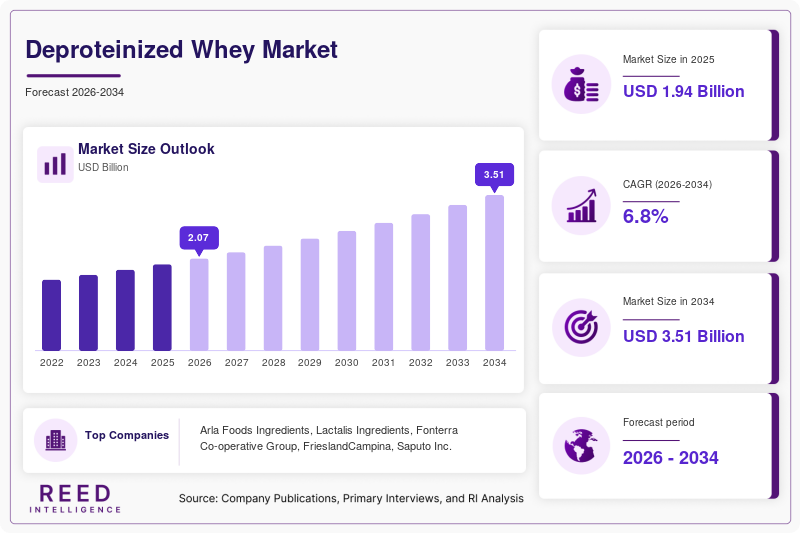
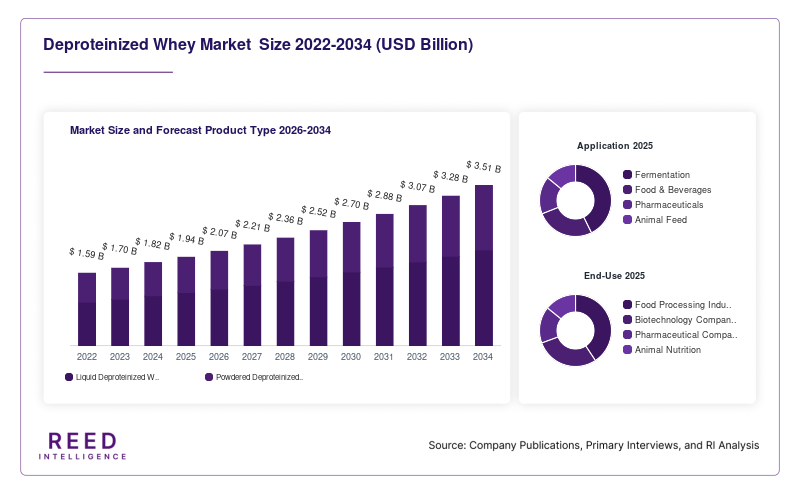
The Deproteinized Whey Market size was valued at USD 1.94 billion in 2026 and is projected to reach USD 3.28 billion by 2034, expanding at a CAGR of 6.8% during the forecast period (2026–2034). The market is gaining traction due to the increasing utilization of dairy by-products in food processing, pharmaceuticals, and fermentation industries. Deproteinized whey, which is rich in lactose and minerals, is widely used as a substrate in microbial fermentation and as a cost-effective ingredient in multiple industrial applications.
A key global factor supporting the growth of the Deproteinized Whey Market is the rising focus on sustainable dairy processing and waste valorization. Manufacturers are increasingly converting whey, a by-product of cheese production, into value-added products, thereby improving resource efficiency and reducing environmental impact.
Key Highlights
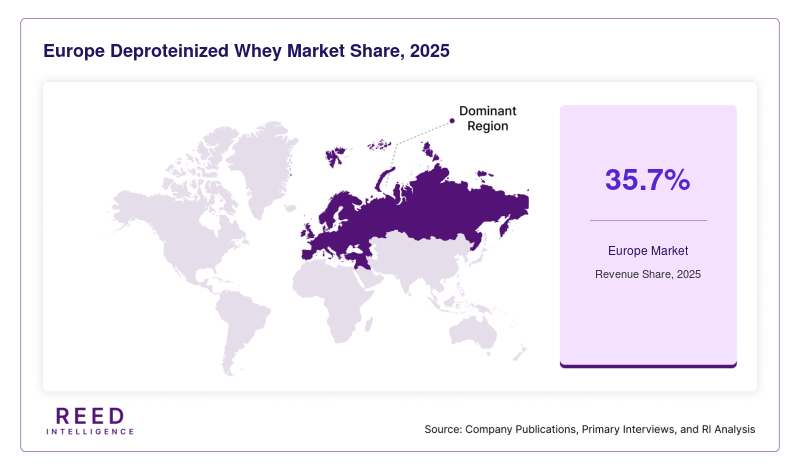
- Dominant region: Europe held 35.7% market share in 2025, while Asia Pacific is projected to grow fastest at a CAGR of 7.9% (2026–2034).
- Leading subsegments: Liquid deproteinized whey dominated the type segment with 57.6% share in 2025, while powdered deproteinized whey is expected to grow fastest at a CAGR of 7.4%.
- Application insights: Fermentation applications accounted for 41.2% share in 2025, while pharmaceutical applications are projected to grow at a CAGR of 8.1%.
- End-use insights: Food processing industry held 46.8% share in 2025, while biotechnology companies are expected to grow at a CAGR of 8.3%.
- Dominant country: Germany market was valued at USD 284 million in 2024 and USD 301 million in 2025.
Market Trends
Expansion of Bio-Based Fermentation Applications
Deproteinized whey is increasingly used as a fermentation substrate in the production of bioethanol, lactic acid, and other bio-based chemicals. This trend is driving demand across biotechnology and industrial fermentation sectors.
Growing Demand for Cost-Effective Dairy Ingredients
Food manufacturers are incorporating deproteinized whey as a cost-efficient alternative to traditional ingredients. Its lactose content and functional properties support its use in confectionery, bakery, and processed food applications.
Market Drivers
Rising Focus on Dairy Waste Utilization
The dairy industry is emphasizing the efficient utilization of by-products such as whey. Converting whey into deproteinized forms helps reduce waste while creating additional revenue streams, driving market growth.
Increasing Applications in Pharmaceutical and Nutraceutical Sectors
Deproteinized whey is used in pharmaceutical formulations and fermentation processes for producing active ingredients. The expanding pharmaceutical industry is supporting increased demand.
Market Restraint
Limited Awareness in Emerging Markets
Lack of awareness regarding the applications and benefits of deproteinized whey in certain regions restricts market penetration and growth potential.
Market Opportunities
Growth in Biotechnology and Biofuel Production
The increasing demand for bio-based products presents opportunities for deproteinized whey as a fermentation substrate, particularly in biofuel and biochemical production.
Technological Advancements in Dairy Processing
Innovations in membrane filtration and drying technologies are improving the efficiency and quality of deproteinized whey production, enabling broader application scope.
Segmental Analysis
By Type
The Deproteinized Whey Market is segmented into liquid deproteinized whey and powdered deproteinized whey.
- Dominant Subsegment: Liquid deproteinized whey held 57.6% share in 2025 due to its direct use in fermentation processes.
- Fastest-Growing Subsegment: Powdered deproteinized whey is expected to grow at a CAGR of 7.4%, driven by ease of storage and transportation.
By Application
The market includes fermentation, food & beverages, pharmaceuticals, and animal feed.
- Dominant Subsegment: Fermentation accounted for 41.2% share in 2025 due to its widespread industrial use.
- Fastest-Growing Subsegment: Pharmaceutical applications are projected to grow at a CAGR of 8.1%, supported by expanding drug manufacturing.
By End-Use
Segments include food processing industry, biotechnology companies, pharmaceutical companies, and animal nutrition.
- Dominant Subsegment: Food processing industry held 46.8% share in 2025 due to its use in cost-effective formulations.
- Fastest-Growing Subsegment: Biotechnology companies are expected to grow at a CAGR of 8.3%, driven by increasing fermentation-based production.
By Distribution Channel
The market is segmented into direct sales and distributors.
- Dominant Subsegment: Direct sales accounted for 62.4% share in 2025 due to bulk purchasing by industrial users.
- Fastest-Growing Subsegment: Distributors are projected to grow at a CAGR of 6.9%, supported by expanding supply networks.
Regional Analysis
Europe
Europe accounted for 35.7% of the Deproteinized Whey Market share in 2025. The region is expected to grow at a CAGR of 6.3% during 2026–2034. Germany dominated the region due to its advanced dairy processing industry and strong focus on sustainability.
North America
North America held 26.8% market share in 2025 and is projected to grow at a CAGR of 6.5%. The United States dominated the region due to high adoption of advanced dairy processing technologies.
Asia Pacific
Asia Pacific represented 21.9% share in 2025 and is anticipated to grow at the fastest CAGR of 7.9%. China led the region due to expanding dairy production and increasing industrial applications.
Middle East & Africa
The region captured 7.4% market share in 2025 and is expected to grow at a CAGR of 6.1%. Saudi Arabia dominated due to increasing investments in food processing industries.
Latin America
Latin America accounted for 8.2% share in 2025 and is forecast to grow at a CAGR of 6.4%. Brazil led the region, driven by growing dairy production and industrial utilization.
Competitive Landscape
The Deproteinized Whey Market is moderately competitive, with key players focusing on product innovation, sustainability, and capacity expansion. Arla Foods Ingredients is recognized as a leading player, leveraging its advanced dairy processing capabilities and strong global presence. The company recently expanded its whey processing facilities to enhance production efficiency and meet rising demand.
Other prominent players include Lactalis Ingredients, Fonterra Co-operative Group, FrieslandCampina, and Saputo Inc. These companies are actively investing in research and development to improve product quality and expand application areas. Strategic collaborations and acquisitions are also shaping the competitive landscape, enabling companies to strengthen their market position.
Manufacturers are increasingly focusing on sustainable production practices and efficient resource utilization. Additionally, efforts to expand distribution networks and improve supply chain efficiency are influencing competitive strategies in the global market.
Key Players List
- Arla Foods Ingredients
- Lactalis Ingredients
- Fonterra Co-operative Group
- FrieslandCampina
- Saputo Inc.
- Glanbia plc
- Hilmar Cheese Company
- Agropur Cooperative
- Leprino Foods Company
- Kerry Group
- Valio Ltd.
- DMK Group
- Amul (GCMMF)
- Nestlé S.A.
- Danone S.A.
Recent Developments
- In 2025, Arla Foods Ingredients expanded its whey processing capacity to meet increasing global demand.
- Fonterra introduced new lactose-rich whey products for fermentation applications.
- FrieslandCampina invested in advanced filtration technologies to improve product quality.
- Lactalis Ingredients enhanced its distribution network across Asia Pacific.
- Kerry Group focused on developing innovative applications for deproteinized whey in food processing.
Deproteinized Whey Market Segments
Product Type
- Liquid Deproteinized Whey
- Powdered Deproteinized Whey
Application
- Fermentation
- Food & Beverages
- Pharmaceuticals
- Animal Feed
End-Use
- Food Processing Industry
- Biotechnology Companies
- Pharmaceutical Companies
- Animal Nutrition
Distribution Channel
- Direct Sales
- Distributors
By Region
- North America
- Europe
- APAC
- Middle East and Africa
- LATAM