Dermal Allograft Market Size, Share & Demand Report By Product Type (Acellular Dermal Matrices, Biologic Dermal Scaffolds, Composite Dermal Allografts), By Application (Chronic Wound Management, Reconstructive Surgery, Burn Treatment, Orthopedic Repair), By End-Use (Hospitals, Ambulatory Surgical Centers), By Tissue Source (Human Donor Tissue, Engineered Tissue Products) By Region & Segment Forecasts, 2026–2034
USD 3950
Market Overview
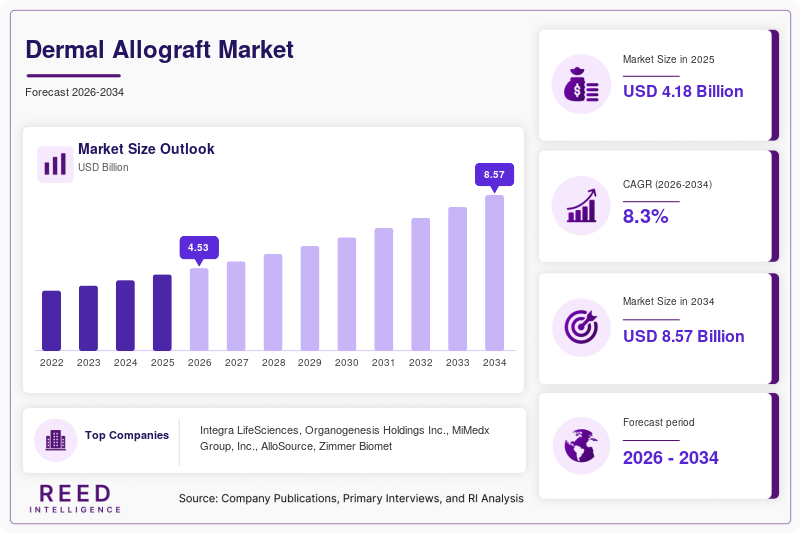
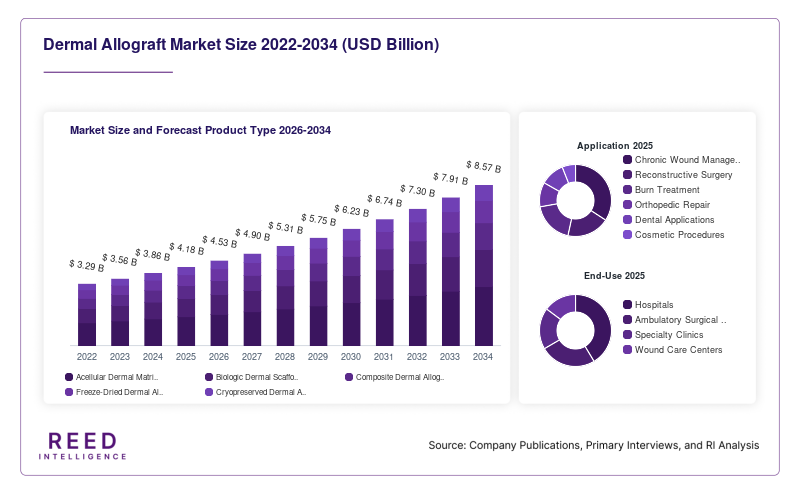
The global Dermal Allograft Market size was valued at USD 4.18 billion in 2026 and is projected to reach USD 7.92 billion by 2034, expanding at a CAGR of 8.3% during the forecast period (2026–2034). The market growth was supported by the increasing number of reconstructive and chronic wound treatment procedures worldwide. Growing demand for biologically compatible tissue repair materials across orthopedic, burn care, and cosmetic surgery applications contributed significantly to market expansion.
The increasing adoption of regenerative medicine technologies also accelerated the utilization of dermal allografts in hospitals, specialty clinics, and ambulatory surgical centers. Healthcare providers increasingly preferred allograft-based tissue matrices due to their reduced healing time, improved tissue integration, and lower complication rates compared with traditional wound closure methods.
Key Highlights
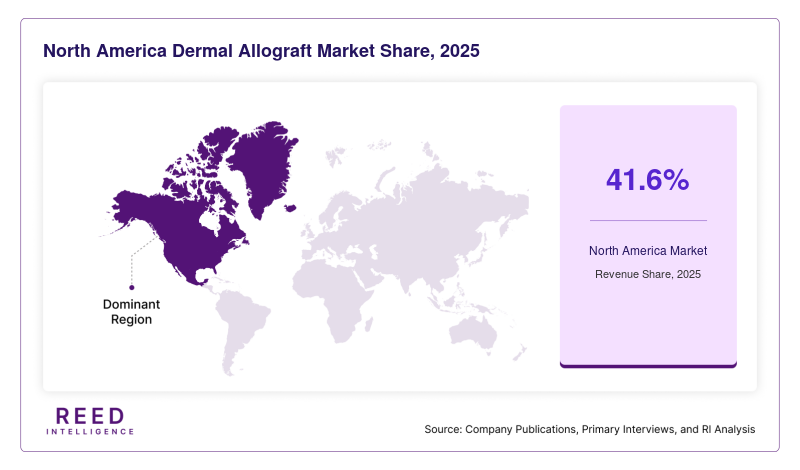
- North America accounted for 41.6% of the global Dermal Allograft Market share in 2025, while Asia Pacific is projected to register the fastest CAGR of 9.7% during the forecast period.
- Among product segments, acellular dermal matrices held the dominant share of 46.8% in 2025, whereas biologic dermal scaffolds are anticipated to grow at a CAGR of 10.1% through 2034.
- By application, chronic wound management represented the leading segment with 38.5% market share in 2025, while reconstructive surgery is expected to expand at a CAGR of 9.4%.
- By end-use, hospitals captured 52.3% market share in 2025, whereas ambulatory surgical centers are projected to grow at a CAGR of 8.9% during the forecast period.
- The United States Dermal Allograft Market was valued at USD 1.21 billion in 2024 and reached USD 1.33 billion in 2025 due to increasing surgical procedure volumes and advanced wound care adoption.
Market Trends
Rising Adoption of Regenerative Medicine Solutions
The increasing adoption of regenerative medicine solutions emerged as a major trend shaping the Dermal Allograft Market. Healthcare providers increasingly integrated biologic tissue matrices into surgical and wound healing procedures to improve patient recovery outcomes. Dermal allografts gained substantial traction due to their ability to support cellular regeneration and vascular integration.
The demand for minimally invasive reconstructive procedures also encouraged surgeons to adopt advanced allograft products with enhanced biocompatibility and reduced rejection risks. Continuous innovation in tissue engineering technologies further strengthened market growth opportunities.
Growing Preference for Advanced Wound Care Products
The growing preference for advanced wound care products significantly influenced the Dermal Allograft Market. Rising incidences of diabetic ulcers, pressure injuries, and burn wounds increased demand for biologically derived skin substitutes and tissue repair products.
Healthcare facilities increasingly shifted toward long-term wound management solutions capable of reducing infection risks and accelerating tissue healing. This trend supported broader adoption of dermal allografts across specialized wound care centers and hospital settings.
Market Drivers
Increasing Volume of Reconstructive Surgical Procedures
The growing number of reconstructive surgical procedures globally significantly supported the Dermal Allograft Market growth. Plastic surgeons and orthopedic specialists increasingly utilized dermal allografts for soft tissue reconstruction, breast reconstruction, tendon repair, and trauma surgeries.
The rising prevalence of sports injuries, burn injuries, and post-cancer reconstructive procedures strengthened the demand for biologically compatible tissue matrices. Improved clinical outcomes associated with allograft applications further accelerated adoption across surgical specialties.
Expansion of Chronic Wound Management Programs
The expansion of chronic wound management programs across healthcare systems contributed substantially to market growth. Hospitals and specialty wound care centers increasingly implemented advanced biologic therapies to address diabetic foot ulcers, venous leg ulcers, and pressure sores.
Dermal allografts provided enhanced healing support and reduced hospitalization durations, making them an attractive option for healthcare providers managing complex wound cases. Increasing elderly populations worldwide also strengthened demand for chronic wound care solutions.
Market Restraint
Regulatory and Tissue Procurement Challenges
Strict regulatory requirements associated with tissue procurement, donor screening, and product approval processes restrained the broader growth of the Dermal Allograft Market. Compliance with safety standards and quality assurance protocols increased operational complexity for manufacturers.
Limited availability of donor tissue in certain regions also affected consistent product supply and increased overall treatment costs, particularly in developing healthcare markets.
Market Opportunities
Expansion of Cosmetic and Aesthetic Procedures
The increasing number of cosmetic and aesthetic procedures is expected to create new opportunities for the Dermal Allograft Market. Surgeons increasingly utilize dermal matrices in facial reconstruction, scar revision, and cosmetic tissue augmentation procedures.
Growing consumer awareness regarding minimally invasive aesthetic treatments is anticipated to support long-term product demand in cosmetic surgery applications.
Growth of Healthcare Infrastructure in Emerging Economies
Rapid healthcare infrastructure development across emerging economies is projected to support market expansion. Governments and private healthcare organizations are increasing investments in specialized wound care facilities and reconstructive surgery centers.
Improved healthcare accessibility and rising adoption of advanced biologic therapies are expected to strengthen dermal allograft demand across Asia Pacific, Latin America, and Middle Eastern countries.
Segmental Analysis
By Product Type
Acellular Dermal Matrices Dominated the Market
Acellular dermal matrices accounted for 46.8% of the global Dermal Allograft Market share in 2025. These products gained substantial adoption due to their ability to support tissue regeneration while minimizing immune rejection risks.
Healthcare providers increasingly preferred acellular dermal matrices for reconstructive surgeries and chronic wound treatment procedures because of their structural integrity and enhanced healing performance.
Biologic Dermal Scaffolds to Witness Fastest Growth
Biologic dermal scaffolds are projected to grow at a CAGR of 10.1% during the forecast period. Their improved cellular integration and regenerative support capabilities are expected to increase adoption across advanced tissue repair applications.
Ongoing innovation in scaffold engineering and biomaterial development will further support segment expansion globally.
By Application
Chronic Wound Management Held the Largest Share
Chronic wound management represented 38.5% of the Dermal Allograft Market share in 2025. Dermal allografts are increasingly utilized for diabetic ulcers, venous ulcers, and pressure injuries due to their ability to accelerate healing and improve tissue recovery.
The growing burden of chronic wound conditions worldwide supported strong product demand across healthcare facilities.
Reconstructive Surgery to Register Fastest Growth
Reconstructive surgery is projected to expand at a CAGR of 9.4% through 2034. Increasing utilization of dermal allografts in trauma repair, breast reconstruction, and soft tissue augmentation procedures is expected to support segment growth.
Advancements in surgical techniques and improved graft compatibility are likely to increase adoption across reconstructive treatment applications.
By End-Use
Hospitals Dominated the Market
Hospitals accounted for 52.3% of the global Dermal Allograft Market share in 2025. The dominance of this segment was attributed to increasing inpatient surgical procedures and rising adoption of advanced wound management solutions.
Hospitals maintained strong purchasing capabilities and access to specialized surgical teams, supporting extensive use of dermal allograft products.
Ambulatory Surgical Centers to Grow Rapidly
Ambulatory surgical centers are anticipated to grow at a CAGR of 8.9% during the forecast period. The increasing preference for outpatient surgical procedures and cost-efficient treatment models is expected to drive demand within this segment.
Improved procedural efficiency and shorter recovery durations are likely to strengthen adoption across ambulatory care facilities.
By Tissue Source
Human Donor Tissue Accounted for the Largest Share
Human donor tissue represented 63.7% of the Dermal Allograft Market share in 2025. These allografts gained widespread preference due to their superior compatibility and reduced risk of inflammatory complications.
Healthcare professionals increasingly utilized human-derived dermal matrices for complex reconstructive procedures and chronic wound healing applications.
Engineered Tissue Products to Witness Strong Growth
Engineered tissue products are expected to grow at a CAGR of 9.8% during the forecast period. Advances in bioengineering technologies and increasing demand for scalable tissue repair solutions are projected to support segment expansion.
The development of synthetic-biologic hybrid tissue matrices is expected to create new opportunities across regenerative medicine applications.
Regional Analysis
North America
North America accounted for 41.6% of the global Dermal Allograft Market share in 2025 and is projected to grow at a CAGR of 7.6% during the forecast period. The region benefited from advanced healthcare infrastructure, strong reimbursement systems, and increasing demand for regenerative medicine products.
The United States dominated the regional market due to rising reconstructive surgery volumes and increased utilization of biologic wound care therapies. Strong presence of tissue processing companies and growing investments in tissue engineering technologies also supported market expansion.
Canada experienced stable market growth due to increased awareness regarding advanced wound management solutions and improved healthcare accessibility.
Europe
Europe held 26.8% of the global Dermal Allograft Market share in 2025 and is anticipated to grow at a CAGR of 7.9% through 2034. The region maintained steady growth due to increasing adoption of tissue regeneration products and expanding surgical treatment volumes.
Germany represented the dominant country market owing to its established healthcare infrastructure and rising demand for advanced reconstructive procedures. Increasing research activities in biologic tissue engineering further supported regional product adoption.
France, Italy, and the United Kingdom also contributed to market growth through increased investments in wound care management programs and cosmetic surgery services.
Asia Pacific
Asia Pacific accounted for 19.7% of the global Dermal Allograft Market share in 2025 and is forecast to register the fastest CAGR of 9.7% during the assessment period. The region benefited from rising healthcare expenditure, expanding hospital infrastructure, and increasing awareness regarding regenerative medicine.
China dominated the regional market due to rapid healthcare modernization and increasing prevalence of chronic wounds and trauma injuries. Growing medical tourism and expanding reconstructive surgery procedures further supported market development.
India emerged as a rapidly developing market due to rising diabetic patient populations and growing investments in advanced wound care technologies. Japan and South Korea also maintained significant market presence due to increasing cosmetic surgery demand.
Middle East & Africa
The Middle East & Africa represented 6.4% of the global Dermal Allograft Market share in 2025 and is expected to expand at a CAGR of 6.8% during the forecast period. Increasing healthcare modernization projects and improving surgical treatment accessibility supported regional demand.
Saudi Arabia dominated the regional market due to growing healthcare investments and increasing adoption of advanced reconstructive procedures. Expansion of specialized treatment centers also contributed to market growth.
South Africa experienced moderate growth due to rising demand for burn treatment and chronic wound management solutions.
Latin America
Latin America captured 5.5% of the global Dermal Allograft Market share in 2025 and is projected to grow at a CAGR of 7.1% through 2034. The region benefited from increasing healthcare awareness and rising adoption of biologic wound healing therapies.
Brazil dominated the regional market due to growing cosmetic surgery procedures and expanding hospital infrastructure. Increased focus on reconstructive treatment accessibility supported dermal allograft utilization across the country.
Mexico and Argentina also contributed to regional demand through growing investments in specialized surgical care facilities.
Competitive Landscape
The Dermal Allograft Market remained competitive with companies focusing on tissue engineering innovation, strategic acquisitions, and expansion of regenerative medicine product portfolios. Market participants emphasized product approvals, biologic material development, and partnerships with healthcare institutions to strengthen their market position.
Market Leader
Integra LifeSciences maintained a leading position in the Dermal Allograft Market due to its diversified regenerative tissue product portfolio and strong global distribution network. The company recently expanded its advanced wound reconstruction product line with enhanced biologic tissue integration capabilities.
Other Major Players
- Organogenesis Holdings Inc. focused on advanced wound healing and tissue regeneration technologies.
- MiMedx Group, Inc. expanded its placental and dermal tissue allograft portfolio.
- AlloSource strengthened its reconstructive surgery product offerings.
- Zimmer Biomet increased investments in biologic repair solutions for orthopedic and wound care applications.
Key Players List
- Integra LifeSciences
- Organogenesis Holdings Inc.
- MiMedx Group, Inc.
- AlloSource
- Zimmer Biomet
- Stryker Corporation
- LifeNet Health
- Smith & Nephew plc
- Arthrex, Inc.
- Baxter International Inc.
- RTI Surgical
- Johnson & Johnson MedTech
- Medtronic plc
- Cook Biotech Incorporated
- Surgenex
Recent Developments
- In 2025, Integra LifeSciences expanded its regenerative wound care portfolio with a next-generation dermal repair matrix.
- In 2025, Organogenesis Holdings Inc. increased manufacturing capacity for advanced wound healing products.
- In 2024, MiMedx Group, Inc. launched a new biologic tissue allograft platform targeting reconstructive surgery applications.
- In 2024, Zimmer Biomet expanded partnerships with surgical centers for biologic implant distribution.
- In 2025, LifeNet Health introduced enhanced tissue preservation technologies for dermal graft products.
Dermal Allograft Market Segments
Product Type
- Acellular Dermal Matrices
- Biologic Dermal Scaffolds
- Composite Dermal Allografts
- Freeze-Dried Dermal Allografts
- Cryopreserved Dermal Allografts
Application
- Chronic Wound Management
- Reconstructive Surgery
- Burn Treatment
- Orthopedic Repair
- Dental Applications
- Cosmetic Procedures
End-Use
- Hospitals
- Ambulatory Surgical Centers
- Specialty Clinics
- Wound Care Centers
Tissue Source
- Human Donor Tissue
- Engineered Tissue Products
- Hybrid Tissue Matrices
By Region
- North America
- Europe
- APAC
- Middle East and Africa
- LATAM