Desiccated Organic Coconut Market Size, Share & Demand Report By Type (Fine Grade, Medium Grade, Coarse Grade), By Application (Bakery Products, Confectionery, Dairy Alternatives, Snacks), By End-Use (Food Processing Industry, Foodservice, Retail), By Region & Segment Forecasts, 2026–2034
USD 3950
Market Overview
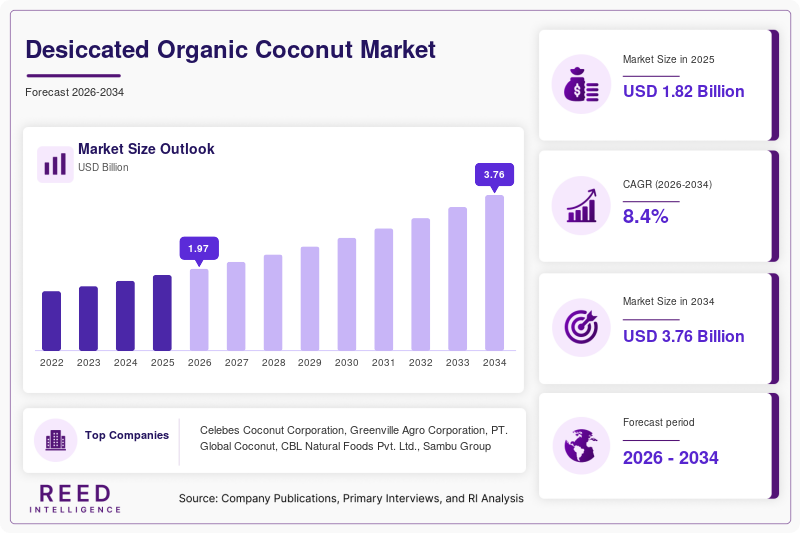
The Desiccated Organic Coconut Market size was valued at approximately USD 1.82 billion in 2026 and is projected to reach USD 3.46 billion by 2034, expanding at a CAGR of 8.4% during the forecast period from 2026 to 2034. The steady growth trajectory reflects increasing consumer preference for natural, minimally processed food ingredients across bakery, confectionery, and dairy alternatives. Rising awareness about organic certification and clean-label products has also contributed to sustained demand across both developed and emerging economies.
A key global factor supporting market expansion is the shift toward plant-based and allergen-free food products. Consumers are actively seeking alternatives to synthetic additives and processed ingredients, leading manufacturers to incorporate organic coconut derivatives in various applications. Desiccated organic coconut is widely used due to its extended shelf life, versatility, and nutritional benefits, including fiber content and healthy fats. This trend has encouraged food processors to expand their product lines, thereby increasing market penetration.
Key Highlights
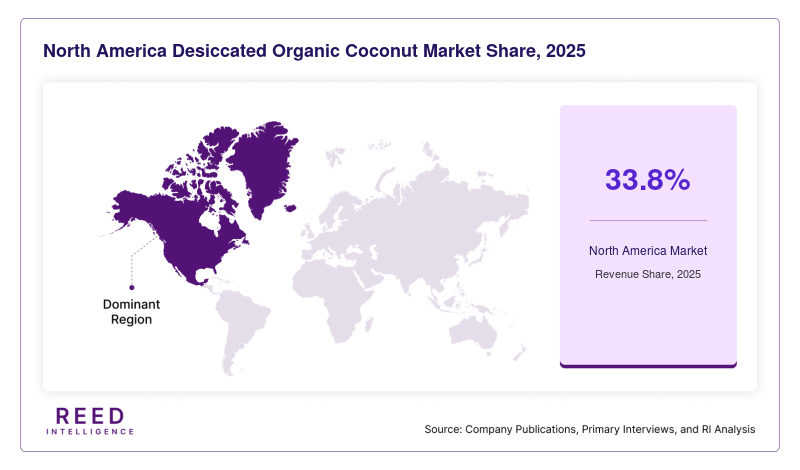
- North America dominated the market with a 33.8% share in 2025.
- Asia Pacific is expected to grow at the fastest CAGR of 10.6% during 2026–2034.
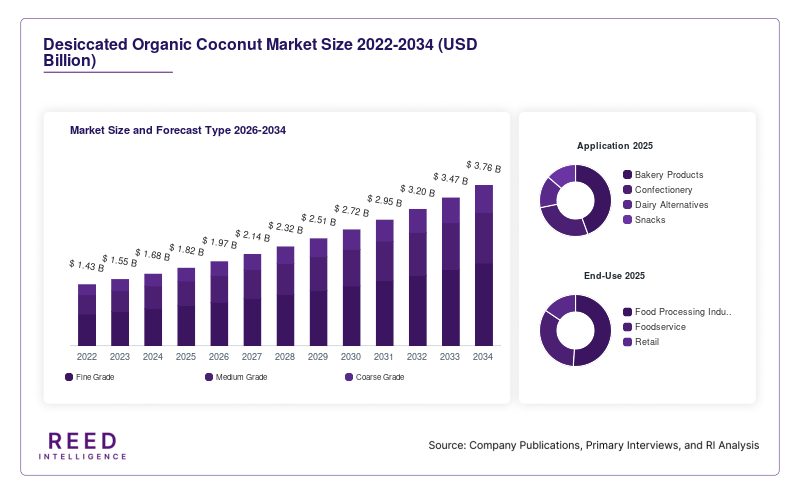
- By type, fine grade desiccated coconut accounted for the largest share of 41.2%, while medium grade is projected to grow at a CAGR of 9.3%.
- By application, bakery products led with a 38.6% share, whereas dairy alternatives are expected to expand at a CAGR of 10.1%.
- India remained the dominant country, with market values of USD 210 million in 2024 and USD 232 million in 2025.
Market Trends
Rising Demand for Clean-Label and Organic Food Ingredients
The increasing consumer preference for transparency in food labeling is shaping the Desiccated Organic Coconut Market. Buyers are actively reading ingredient lists and avoiding artificial preservatives, genetically modified organisms, and synthetic additives. This shift has led to a growing demand for certified organic desiccated coconut, which is perceived as a healthier alternative. Food manufacturers are responding by reformulating products to include organic coconut ingredients, particularly in bakery mixes, snacks, and ready-to-eat items. Retailers are also expanding shelf space for organic products, further strengthening visibility and accessibility. This trend is expected to sustain long-term growth as regulatory frameworks continue to support organic labeling standards globally.
Expansion of Plant-Based and Vegan Product Portfolios
The rapid expansion of plant-based diets has significantly influenced product innovation within the market. Desiccated organic coconut is increasingly used in vegan desserts, dairy-free beverages, and plant-based protein bars. Manufacturers are leveraging coconut’s natural sweetness and texture to enhance product appeal without relying on synthetic ingredients. This trend is particularly strong in urban markets where health-conscious consumers seek functional foods with nutritional benefits. Additionally, foodservice providers are incorporating coconut-based ingredients into menus, further boosting demand. The integration of desiccated coconut into diverse product categories is expected to accelerate its adoption across multiple industries.
Market Drivers
Increasing Adoption of Organic Certification Standards
The growing emphasis on food safety and sustainability has encouraged producers to adopt organic certification standards. Governments and regulatory bodies are promoting organic farming practices, which has resulted in improved supply chain transparency. As a result, consumers are more confident in purchasing organic desiccated coconut products. This driver is particularly evident in North America and Europe, where certification plays a critical role in influencing purchasing decisions. Manufacturers are investing in certification processes to meet international standards, thereby enhancing product credibility and expanding export opportunities.
Growth of the Bakery and Confectionery Industry
The expanding bakery and confectionery sector is a significant contributor to market growth. Desiccated organic coconut is widely used in cakes, cookies, pastries, and chocolates due to its flavor and texture-enhancing properties. The rise of artisanal bakeries and premium confectionery brands has further increased demand for high-quality organic ingredients. Additionally, the growing popularity of home baking has created new consumption channels, especially through e-commerce platforms. This driver is expected to remain strong as consumer interest in premium and specialty baked goods continues to rise globally.
Market Restraint
Fluctuating Raw Material Supply and Price Volatility
One of the primary challenges in the Desiccated Organic Coconut Market is the fluctuation in raw material supply. Coconut production is highly dependent on climatic conditions, making it vulnerable to weather disruptions such as cyclones, droughts, and irregular rainfall patterns. These factors can significantly impact yield and quality, leading to price volatility. For instance, a decline in coconut harvest in key producing countries can result in increased procurement costs for manufacturers. This volatility affects profit margins and creates uncertainty in pricing strategies. Additionally, the limited availability of certified organic coconuts further constrains supply, making it difficult for producers to meet growing demand consistently.
Market Opportunities
Expansion in Emerging Markets and Retail Channels
Emerging economies present significant growth opportunities for the market. Rising disposable incomes and increasing awareness of organic food products are driving demand in regions such as Asia Pacific and Latin America. Modern retail formats, including supermarkets and online platforms, are improving product accessibility. Manufacturers are focusing on localized marketing strategies to cater to regional preferences, which is expected to enhance market penetration. The expansion of distribution networks in these regions will likely create new revenue streams for industry participants.
Innovation in Value-Added Coconut-Based Products
Product innovation is creating new opportunities within the market. Companies are developing value-added products such as flavored desiccated coconut, fortified variants, and ready-to-use baking mixes. These innovations cater to evolving consumer preferences for convenience and functionality. Additionally, the integration of coconut-based ingredients into health-focused products, such as protein bars and energy snacks, is gaining traction. This opportunity is expected to drive product differentiation and increase competitive advantage for manufacturers operating in the market.
Segmental Analysis
By Type
Fine grade desiccated coconut held the largest market share of 41.2% in 2024. This segment is widely used in bakery and confectionery applications due to its smooth texture and uniform particle size. Manufacturers prefer fine grade variants for products that require consistent quality and appearance. The segment’s dominance is also attributed to its versatility, as it can be used in both sweet and savory applications. Additionally, the growing demand for premium baked goods has further increased the adoption of fine grade desiccated coconut.
Medium grade desiccated coconut is expected to grow at the fastest CAGR of 9.3% during the forecast period. This growth is driven by its increasing use in ready-to-eat snacks and breakfast cereals. The segment offers a balance between texture and cost, making it suitable for large-scale food production. Additionally, the rising demand for convenience foods is expected to support the growth of this segment.
By Application
Bakery products accounted for the largest share of 38.6% in 2024. Desiccated organic coconut is widely used in cakes, cookies, and pastries to enhance flavor and texture. The growth of artisanal bakeries and premium confectionery brands has further increased demand for organic ingredients. Additionally, the rising popularity of home baking has created new opportunities for market expansion.
Dairy alternatives are projected to grow at the fastest CAGR of 10.1% during the forecast period. This growth is driven by the increasing adoption of plant-based diets and lactose intolerance among consumers. Desiccated coconut is used in the production of coconut milk, yogurt, and cream alternatives. The segment is expected to benefit from ongoing innovation in plant-based food products.
By End-Use
The food processing industry dominated the market with a share of 46.8% in 2024. Manufacturers in this segment use desiccated organic coconut as a key ingredient in various products, including snacks, desserts, and ready-to-eat meals. The segment’s dominance is supported by the growing demand for processed and convenience foods. Additionally, the increasing focus on clean-label ingredients has encouraged manufacturers to incorporate organic coconut into their formulations.
The retail segment is expected to grow at the fastest CAGR of 9.7% during the forecast period. This growth is driven by increasing consumer demand for organic products and the expansion of e-commerce platforms. Retailers are offering a wide range of packaged desiccated coconut products, catering to both household and commercial users. The segment is expected to benefit from improved distribution networks and rising consumer awareness.
Regional Analysis
North America
North America accounted for a significant share of 33.8% in 2025 and is projected to grow at a CAGR of 7.9% during the forecast period. The region’s growth is driven by strong demand for organic and clean-label food products. Consumers in the United States and Canada are increasingly adopting plant-based diets, which has boosted the consumption of coconut-based ingredients. The presence of well-established retail infrastructure and high consumer awareness further supports market expansion.
The United States dominates the regional market, supported by a well-developed food processing industry. A key growth factor is the increasing demand for gluten-free and allergen-free products. Manufacturers are incorporating desiccated organic coconut into a wide range of food applications to meet these dietary requirements. This trend is expected to sustain growth in the region over the forecast period.
Europe
Europe held a market share of 26.4% in 2025 and is expected to grow at a CAGR of 7.6% from 2026 to 2034. The region’s growth is supported by stringent regulations promoting organic food consumption. Countries such as Germany, France, and the United Kingdom have a strong preference for sustainably sourced ingredients. This has encouraged manufacturers to invest in organic certification and traceability systems.
Germany remains the dominant country in the region, driven by high consumer awareness and demand for premium organic products. A unique growth factor is the increasing popularity of vegan and vegetarian diets. This has led to higher adoption of coconut-based ingredients in food manufacturing, particularly in dairy alternatives and confectionery products.
Asia Pacific
Asia Pacific is the fastest-growing region, with a CAGR of 10.6% during the forecast period and a market share of 21.7% in 2025. The region benefits from abundant coconut production and favorable climatic conditions. Countries such as India, Indonesia, and the Philippines are key suppliers of raw materials, which supports cost-effective production. Increasing urbanization and rising disposable incomes are further driving demand.
India leads the regional market, supported by its strong agricultural base and expanding food processing industry. A key growth factor is the increasing export of organic coconut products to international markets. Government initiatives promoting organic farming and sustainable agriculture practices are also contributing to market growth in the country.
Middle East & Africa
The Middle East & Africa region accounted for 9.1% of the market share in 2025 and is projected to grow at a CAGR of 7.2%. The region is witnessing gradual growth due to increasing awareness of organic food products. Rising demand for premium and imported food items is also contributing to market expansion. Retail development and improved supply chains are enhancing product availability.
The United Arab Emirates is a key market in the region, driven by a high concentration of expatriate populations and demand for international food products. A unique growth factor is the expansion of the hospitality sector, which has increased the use of organic ingredients in foodservice applications. This trend is expected to support steady market growth.
Latin America
Latin America held a market share of 9.0% in 2025 and is expected to grow at a CAGR of 8.1% during the forecast period. The region’s growth is supported by increasing consumer awareness of health and wellness. Brazil and Mexico are key markets, driven by expanding retail networks and rising demand for organic food products.
Brazil dominates the regional market, supported by its growing food processing industry. A unique growth factor is the increasing production of coconut-based products for both domestic consumption and export. The country’s favorable climate and agricultural capabilities make it a key contributor to regional market growth.
Competitive Landscape
The Desiccated Organic Coconut Market is moderately fragmented, with several regional and global players competing for market share. Leading companies are focusing on product innovation, sustainable sourcing, and expansion of distribution networks to strengthen their market position. The competitive environment is characterized by strategic partnerships, mergers, and acquisitions aimed at enhancing product portfolios.
Celebes Coconut Corporation is recognized as a leading player in the market, driven by its strong supply chain and commitment to organic certification. The company recently expanded its production capacity to meet increasing global demand. Other key players are also investing in advanced processing technologies to improve product quality and efficiency. The focus on sustainability and traceability is expected to remain a key differentiator in the competitive landscape.
Key Players
- Celebes Coconut Corporation
- Greenville Agro Corporation
- PT. Global Coconut
- CBL Natural Foods Pvt. Ltd.
- Sambu Group
- Sumatera Baru
- Vita Coco Company
- Primex Coco Products Inc.
- Silvermill Group
- Klassic Coconut
- Thai Coconut Public Company Limited
- McCormick & Company
- The Coconut Company Ltd.
- Nutiva Inc.
- Edward & Sons Trading Co.
Recent Developments
- A major coconut processing company expanded its organic product line with new flavored desiccated coconut variants aimed at the snack segment in 2025.
- A leading manufacturer invested in advanced drying technology to improve product quality and shelf life in 2024.
- A global food ingredient supplier entered into a strategic partnership with organic coconut farmers to ensure sustainable sourcing and supply chain stability in 2025.
Desiccated Organic Coconut Market Segments
Type
- Fine Grade
- Medium Grade
- Coarse Grade
Application
- Bakery Products
- Confectionery
- Dairy Alternatives
- Snacks
End-Use
- Food Processing Industry
- Foodservice
- Retail
By Region
- North America
- Europe
- APAC
- Middle East and Africa
- LATAM