Dexa Equipment Market Size, Share & Demand Report By Type (Central DEXA Systems, Portable DEXA Systems), By Application (Osteoporosis Diagnosis, Body Composition Analysis, Others), By End-Use (Hospitals, Diagnostic Imaging Centers, Specialty Clinics), By Technology (Axial DEXA, Peripheral DEXA), By Region & Segment Forecasts, 2026–2034
USD 3950
Market Overview
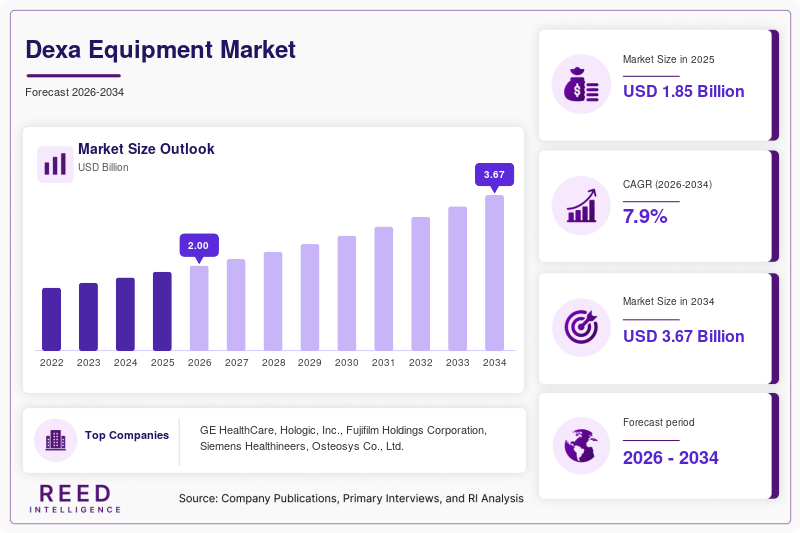
The global Dexa Equipment Market size was valued at approximately USD 1.85 billion in 2026 and is projected to reach USD 3.42 billion by 2034, expanding at a CAGR of 7.9% during the forecast period (2026–2034). The market reflects steady expansion driven by the growing need for precise bone density measurement technologies in clinical diagnostics and preventive healthcare.
A key global factor supporting market growth is the rising burden of osteoporosis and related bone disorders, particularly among aging populations. As healthcare systems increasingly shift toward early diagnosis and preventive screening, dual-energy X-ray absorptiometry (DEXA) has emerged as a preferred standard for assessing bone mineral density (BMD). Additionally, technological advancements in imaging accuracy, portability, and software integration have improved accessibility across hospitals, diagnostic centers, and outpatient clinics.
Key Highlights:
- North America dominated the market with 38.6% share in 2025, while Asia Pacific is projected to be the fastest-growing region at a CAGR of 9.3%.
- Central DEXA systems emerged as the leading subsegment under type with 61.4% share, while portable DEXA systems are expected to grow at a CAGR of 8.7%.
- Osteoporosis diagnosis accounted for the largest application share at 54.2%, while body composition analysis is projected to grow at a CAGR of 9.1%.
- The United States led globally with market values of USD 612 million in 2024 and USD 655 million in 2025.
Market Trends
Integration of AI-Based Diagnostic Software
The incorporation of artificial intelligence (AI) into DEXA imaging systems is shaping the evolution of the Dexa Equipment Market. Modern systems now include AI-enabled software that enhances image interpretation, improves diagnostic accuracy, and reduces operator dependency. Automated analysis tools help clinicians identify early signs of osteoporosis and assess fracture risk more efficiently. This trend is particularly relevant in high-volume diagnostic centers where workflow optimization is critical. Furthermore, AI integration supports predictive analytics, enabling better patient management and long-term monitoring.
Shift Toward Portable and Point-of-Care Systems
The increasing demand for portable DEXA equipment is another notable trend influencing the market. Healthcare providers are prioritizing mobility and convenience, especially in rural and underserved areas where access to large imaging systems is limited. Portable DEXA devices allow point-of-care diagnostics, facilitating early screening and reducing the need for patient travel. These systems are also gaining traction in sports medicine and fitness industries for body composition analysis. Technological improvements in miniaturization and battery efficiency are further accelerating adoption, making portable solutions a critical component of the market’s future landscape.
Market Drivers
Rising Prevalence of Osteoporosis and Aging Population
The increasing incidence of osteoporosis and other bone-related disorders is a primary driver of the Dexa Equipment Market. With a growing global elderly population, the risk of fractures and bone density loss has risen significantly. DEXA scans are widely recognized as a reliable method for diagnosing osteoporosis, leading to higher adoption rates across healthcare facilities. Preventive healthcare initiatives and screening programs targeting at-risk populations further amplify demand for DEXA equipment.
Expansion of Diagnostic Imaging Infrastructure
The rapid development of diagnostic imaging infrastructure across emerging and developed economies is fueling market growth. Governments and private healthcare providers are investing in advanced imaging technologies to improve patient outcomes. The integration of DEXA systems into multi-modality imaging centers enhances diagnostic capabilities and increases patient throughput. Additionally, favorable reimbursement policies in several regions encourage healthcare providers to adopt DEXA equipment, contributing to sustained market expansion.
Market Restraint
High Equipment Cost and Limited Accessibility
The high cost associated with DEXA equipment remains a significant restraint in the market. Central DEXA systems require substantial capital investment, making them less accessible for small healthcare facilities and clinics, particularly in developing regions. Maintenance costs, including calibration and software upgrades, further add to the financial burden. Additionally, the need for trained professionals to operate these systems limits adoption in areas with workforce shortages. These factors collectively restrict market penetration, especially in low- and middle-income countries.
Market Opportunities
Growth in Preventive Healthcare and Screening Programs
The increasing focus on preventive healthcare presents a strong opportunity for the Dexa Equipment Market. Governments and healthcare organizations are promoting early diagnosis of bone disorders through nationwide screening initiatives. This trend is expected to drive demand for DEXA equipment in primary healthcare settings. As awareness regarding bone health improves, individuals are more likely to undergo routine screening, creating a steady demand pipeline.
Expansion into Fitness and Sports Medicine Applications
The use of DEXA equipment for body composition analysis in fitness and sports medicine is emerging as a promising growth avenue. Athletes and fitness enthusiasts are increasingly utilizing DEXA scans to measure fat distribution, muscle mass, and overall body composition. This diversification beyond traditional medical applications broadens the market scope and opens new revenue streams for manufacturers.
Segmental Analysis
By Type
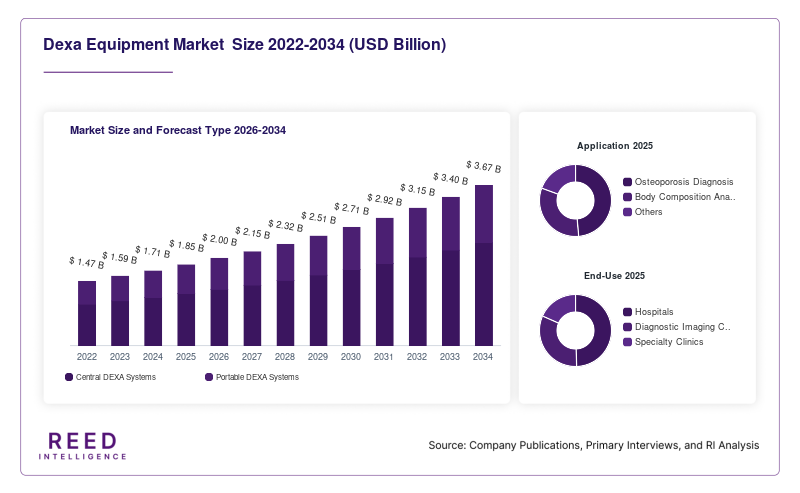
Central DEXA systems dominated the Dexa Equipment Market, accounting for 61.4% of the share in 2025. These systems are widely used in hospitals and diagnostic centers due to their high accuracy and ability to measure bone density at critical anatomical sites such as the spine and hip. Their reliability and clinical acceptance have made them the preferred choice for comprehensive osteoporosis diagnosis.
Portable DEXA systems are expected to be the fastest-growing subsegment, with a projected CAGR of 8.7%. The growth is driven by increasing demand for point-of-care diagnostics and mobile healthcare services. Their compact design and ease of use make them suitable for remote and underserved areas, enhancing accessibility.
By Application
Osteoporosis diagnosis held the largest share at 54.2% in 2025, reflecting the primary use of DEXA equipment in clinical settings. The rising prevalence of bone-related disorders has significantly contributed to this dominance.
Body composition analysis is anticipated to grow at a CAGR of 9.1%, supported by increasing adoption in fitness and wellness industries. The ability to provide detailed insights into fat and muscle distribution is driving its popularity.
By End-Use
Hospitals accounted for 48.7% of the market share in 2025, owing to their advanced infrastructure and high patient inflow. These facilities are equipped with centralized imaging systems, enabling comprehensive diagnostic services.
Diagnostic imaging centers are expected to grow at a CAGR of 8.5%, driven by the increasing outsourcing of diagnostic services and rising demand for specialized imaging facilities.
By Technology
Axial DEXA technology dominated with 66.3% share in 2025, as it provides precise measurements of central skeletal regions. Its clinical reliability has made it a standard in bone density assessment.
Peripheral DEXA technology is projected to grow at a CAGR of 8.2%, supported by its cost-effectiveness and suitability for preliminary screening in smaller healthcare settings.
Regional Analysis
North America
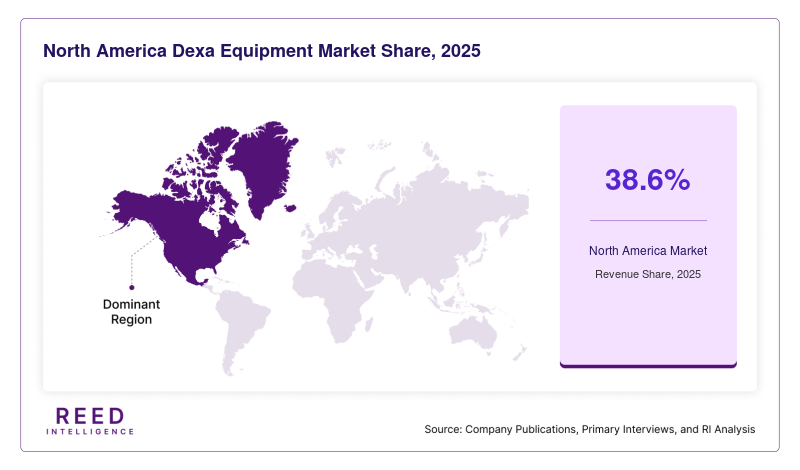
North America accounted for 38.6% of the Dexa Equipment Market share in 2025, reflecting its established healthcare infrastructure and high adoption of advanced diagnostic technologies. The region is expected to grow at a CAGR of 7.2% from 2026 to 2034.
The United States dominated the regional market due to widespread awareness of osteoporosis screening and strong reimbursement frameworks. The presence of advanced healthcare facilities and continuous investment in diagnostic imaging technologies has contributed to sustained demand.
Europe
Europe held 27.4% of the market share in 2025 and is projected to grow at a CAGR of 7.5% during the forecast period. The region benefits from well-structured healthcare systems and increasing focus on preventive diagnostics.
Germany emerged as the leading country, supported by a robust medical device industry and high healthcare spending. The adoption of advanced imaging technologies in public healthcare institutions has strengthened market growth.
Asia Pacific
Asia Pacific captured 19.8% of the market share in 2025 and is expected to register the fastest growth at a CAGR of 9.3%. Rapid urbanization and improving healthcare infrastructure are key contributing factors.
China dominated the region due to its large patient population and increasing government initiatives aimed at improving diagnostic capabilities. Expanding private healthcare sectors also play a significant role.
Middle East & Africa
The Middle East & Africa accounted for 8.1% of the market share in 2025 and is anticipated to grow at a CAGR of 6.8%. The region is gradually adopting advanced diagnostic technologies.
The United Arab Emirates led the market due to its focus on healthcare modernization and investment in state-of-the-art medical facilities.
Latin America
Latin America held 6.1% of the market share in 2025 and is projected to grow at a CAGR of 7.0%. Increasing healthcare awareness and government initiatives are supporting market growth.
Brazil dominated the region, driven by the expansion of diagnostic centers and rising demand for bone health assessments.
Competitive Landscape
The Dexa Equipment Market is moderately competitive, with key players focusing on technological advancements and product innovation. The market leader, GE HealthCare, maintains a strong position through continuous development of advanced imaging systems and global distribution networks. The company recently introduced an upgraded DEXA platform with enhanced AI capabilities for improved diagnostic accuracy.
Other prominent players are investing in portable solutions and software integration to strengthen their market presence. Strategic partnerships, mergers, and acquisitions are also common as companies aim to expand their product portfolios and geographic reach. The competitive environment is characterized by innovation-driven strategies and efforts to address evolving healthcare needs.
Key Players List
- GE HealthCare
- Hologic, Inc.
- Fujifilm Holdings Corporation
- Siemens Healthineers
- Osteosys Co., Ltd.
- Medilink
- Swissray International Inc.
- BeamMed Ltd.
- Diagnostic Medical Systems Group
- Lone Oak Medical Technologies
- Echolight S.p.A.
- Scanflex Healthcare AB
- Compumedics Limited
- Xingaoyi Medical Equipment Co., Ltd.
- Trivitron Healthcare
Recent Developments
- 2025: GE HealthCare launched an AI-integrated DEXA system to enhance diagnostic workflows.
- 2024: Hologic introduced a portable DEXA solution targeting outpatient clinics.
- 2025: Siemens Healthineers expanded its imaging portfolio with upgraded software capabilities.
- 2024: Fujifilm invested in advanced imaging R&D to improve system efficiency.
- 2025: Osteosys partnered with regional distributors to expand market presence in Asia Pacific.
Dexa Equipment Market Segments
Type
- Central DEXA Systems
- Portable DEXA Systems
Application
- Osteoporosis Diagnosis
- Body Composition Analysis
- Others
End-Use
- Hospitals
- Diagnostic Imaging Centers
- Specialty Clinics
Technology
- Axial DEXA
- Peripheral DEXA
By Region
- North America
- Europe
- APAC
- Middle East and Africa
- LATAM