Di-Nitrotoluene Market Size, Share & Demand Report By Isomer Type (2,4-Dinitrotoluene, 2,6-Dinitrotoluene), By Application (Toluene Diisocyanate (TDI) Production, Chemical Intermediates, Dyes & Pigments Manufacturing), By End Use Industry (Polyurethane Manufacturing, Automotive Industry, Construction Industry), By Distribution Channel (Direct Industrial Sales, Chemical Distribution Networks), By Region & Segment Forecasts, 2026–2034
USD 3950
Market Overview
The Di-Nitrotoluene Market Size was valued at USD 2.18 billion in 2026 and is projected to reach USD 3.67 billion by 2034, registering a CAGR of 6.7% during the forecast period (2026–2034). The market continues to expand steadily due to growing demand for polyurethane products, increasing industrial manufacturing activities, and rising consumption of specialty chemicals across automotive, construction, electronics, and industrial sectors. Di-nitrotoluene (DNT) serves as a critical intermediate in the production of toluene diisocyanate (TDI), which is widely used in flexible polyurethane foams, coatings, adhesives, sealants, and elastomers.
One major global factor supporting the growth of the Di-Nitrotoluene Market is the continued expansion of polyurethane consumption worldwide. Polyurethane materials have become essential in modern manufacturing due to their durability, insulation properties, flexibility, and lightweight characteristics. As industrial economies continue investing in infrastructure, transportation, furniture manufacturing, and energy-efficient construction materials, demand for DNT-derived products remains strong.
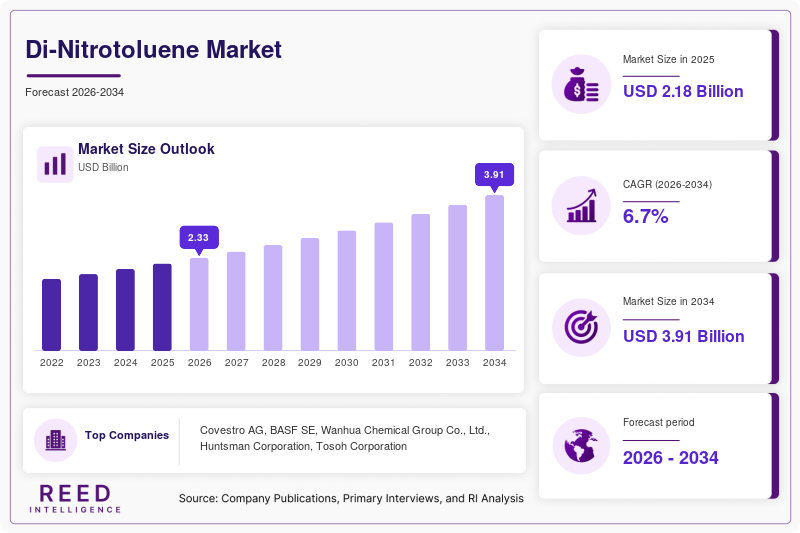
Key Highlights
- Asia Pacific accounted for the largest market share of 46.8% in 2025, while Middle East & Africa is anticipated to register the fastest CAGR of 7.8% during 2026–2034.
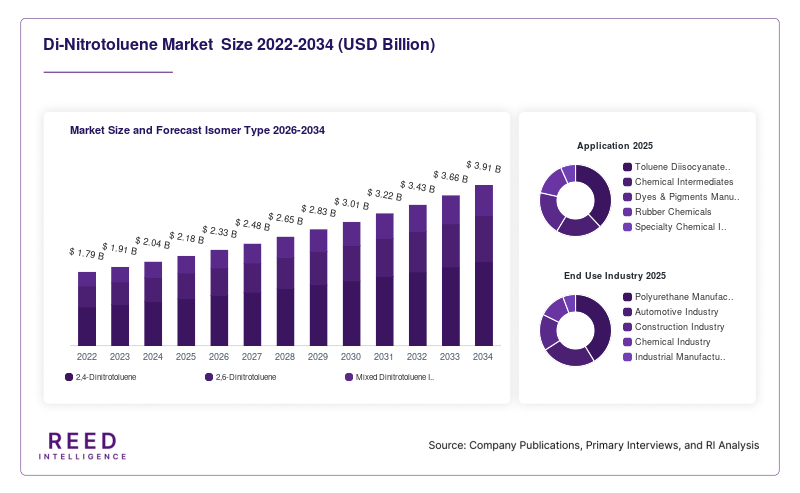
- By Isomer Type, 2,4-Dinitrotoluene held the largest market share of 64.3% in 2025, while Mixed Dinitrotoluene Isomers are projected to grow at a CAGR of 7.1%.
- By Application, Toluene Diisocyanate (TDI) Production represented 72.6% market share in 2025, while Specialty Chemical Intermediates are forecast to expand at 7.5% CAGR.
- By End Use Industry, Polyurethane Manufacturing accounted for 58.9% share in 2025, whereas Automotive Industry Applications are expected to grow at 7.3% CAGR.
- By Distribution Channel, Direct Industrial Sales captured 76.5% market share in 2025, while Chemical Distribution Networks are projected to register a CAGR of 6.9%.
- China, the dominant country market, recorded values of USD 462 million in 2024 and USD 497 million in 2025.
Market Trends
Modernization of Chemical Manufacturing Facilities
Chemical producers are increasingly upgrading production facilities to improve operational efficiency, product consistency, and environmental performance. Advanced automation systems, process monitoring technologies, and energy-efficient production methods are being implemented across DNT manufacturing operations. This trend is improving manufacturing reliability while supporting regulatory compliance objectives.
Expansion of Integrated Polyurethane Value Chains
Manufacturers are focusing on vertical integration strategies that connect raw material production with downstream polyurethane manufacturing. Integrated operations provide better supply chain control, cost optimization, and production flexibility. This trend is strengthening long-term demand stability for di-nitrotoluene within industrial chemical ecosystems.
Market Drivers
Growing Demand for Polyurethane Foams Across Industries
The increasing utilization of polyurethane foams in furniture, bedding, automotive seating, insulation materials, and consumer products remains a primary driver for the Di-Nitrotoluene Market. Polyurethane's versatility and performance characteristics continue to support strong industrial demand, resulting in increased consumption of DNT as a key intermediate.
Rising Construction and Infrastructure Development Activities
Expanding construction projects across residential, commercial, and industrial sectors are driving demand for insulation materials, coatings, adhesives, and sealants manufactured using polyurethane technologies. Growth in infrastructure investment continues to support increased production requirements for DNT-derived products.
Market Restraint
Stringent Environmental and Safety Regulations
The production and handling of aromatic nitration compounds are subject to extensive environmental and occupational safety regulations. Compliance requirements related to emissions control, waste management, and worker safety may increase operational costs and limit expansion opportunities in certain regions.
Market Opportunities
Emergence of Sustainable Polyurethane Manufacturing Technologies
The development of environmentally responsible polyurethane production technologies presents significant opportunities for DNT manufacturers. Investments in cleaner chemical processing and lower-emission manufacturing methods can support market competitiveness and long-term growth.
Industrial Expansion in Emerging Economies
Rapid industrial development across Asia, Africa, and Latin America is creating new opportunities for chemical intermediates used in manufacturing industries. Increasing investments in automotive production, consumer goods manufacturing, and industrial infrastructure are expected to support future demand growth.
Segmental Analysis
By Isomer Type
The Di-Nitrotoluene Market is segmented into:
- 2,4-Dinitrotoluene
- 2,6-Dinitrotoluene
- Mixed Dinitrotoluene Isomers
2,4-Dinitrotoluene accounted for 64.3% market share in 2025. Its extensive use as a precursor in TDI production and widespread industrial acceptance contributed to segment leadership.
Mixed Dinitrotoluene Isomers are projected to register the fastest CAGR of 7.1% during the forecast period. Increasing adoption in diversified chemical processing applications will support segment expansion.
By Application
The market includes:
- Toluene Diisocyanate (TDI) Production
- Chemical Intermediates
- Dyes & Pigments Manufacturing
- Rubber Chemicals
- Specialty Chemical Intermediates
Toluene Diisocyanate (TDI) Production represented 72.6% of market revenue in 2025 due to the dominant role of DNT in polyurethane value chains.
Specialty Chemical Intermediates are anticipated to grow at a CAGR of 7.5% through 2034. Expanding utilization in advanced chemical formulations and industrial specialty products will contribute to future demand.
By End Use Industry
The market is categorized into:
- Polyurethane Manufacturing
- Automotive Industry
- Construction Industry
- Chemical Industry
- Industrial Manufacturing
Polyurethane Manufacturing held 58.9% market share in 2025 because DNT remains a critical feedstock for producing TDI used in multiple polyurethane applications.
Automotive Industry Applications are expected to expand at a CAGR of 7.3% during the forecast period. Increasing production of lightweight vehicle components and interior materials will support segment growth.
By Distribution Channel
The market consists of:
- Direct Industrial Sales
- Chemical Distribution Networks
- Contract Supply Agreements
Direct Industrial Sales accounted for 76.5% share in 2025 due to large-volume procurement practices adopted by chemical manufacturers and industrial processors.
Chemical Distribution Networks are projected to witness the fastest growth at a CAGR of 6.9% through 2034. Expanding regional chemical supply chains and growing demand from medium-scale industrial customers will support market development.
Regional Analysis
North America
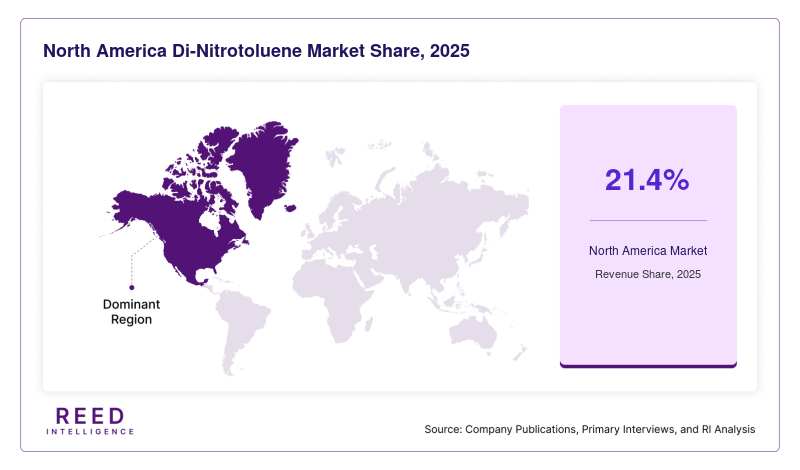
North America accounted for 21.4% of the Di-Nitrotoluene Market share in 2025 and is projected to expand at a CAGR of 5.9% during 2026–2034. Demand remained supported by established polyurethane manufacturing operations and strong industrial chemical production capabilities.
The United States dominated the regional market due to extensive chemical manufacturing infrastructure and continued demand from automotive, construction, and industrial sectors requiring polyurethane-based materials.
Europe
Europe held 24.7% market share in 2025 and is anticipated to grow at a CAGR of 6.1% through 2034. Industrial modernization initiatives and stable demand from advanced manufacturing sectors contributed to market development.
Germany remained the dominant country market because of its strong chemical industry presence, advanced manufacturing ecosystem, and extensive utilization of polyurethane products across industrial applications.
Asia Pacific
Asia Pacific represented 46.8% of the global market in 2025 and is expected to register a CAGR of 7.4% during the forecast period. Rapid industrialization, manufacturing expansion, and infrastructure investments continue to strengthen regional demand for DNT-based products.
China led the regional market owing to large-scale chemical production capacity, strong polyurethane manufacturing activity, and growing demand from construction, automotive, and consumer goods industries.
Middle East & Africa
The Middle East & Africa accounted for 3.4% market share in 2025 and is forecast to expand at the fastest CAGR of 7.8% during 2026–2034. Ongoing industrial diversification programs and increasing investments in downstream chemical manufacturing support regional market growth.
Saudi Arabia emerged as the dominant country market due to expanding petrochemical infrastructure and increasing focus on value-added industrial production activities.
Latin America
Latin America captured 3.7% market share in 2025 and is expected to grow at a CAGR of 6.6% through 2034. Increasing manufacturing investments and gradual expansion of industrial production capacities contributed to regional demand growth.
Brazil dominated the market because of its developing industrial sector and rising utilization of polyurethane products within automotive and construction applications.
Competitive Landscape
The Di-Nitrotoluene Market remains moderately consolidated, with major participants focusing on production efficiency, supply chain integration, technological innovation, and capacity expansion. Companies continue investing in advanced manufacturing technologies and environmental compliance systems to strengthen market competitiveness.
Covestro AG remains a leading participant in the market due to its extensive polyurethane production capabilities and integrated chemical manufacturing operations. The company recently enhanced process optimization initiatives aimed at improving production efficiency and reducing operational emissions across its chemical manufacturing facilities.
BASF SE maintains a strong market position through diversified chemical production operations and integrated supply chains. Wanhua Chemical Group Co., Ltd. continues expanding downstream polyurethane manufacturing capacity. Tosoh Corporation focuses on specialty chemical production and process innovation, while Huntsman Corporation remains active in polyurethane-related chemical markets through ongoing production optimization initiatives.
Key Players List
- Covestro AG
- BASF SE
- Wanhua Chemical Group Co., Ltd.
- Huntsman Corporation
- Tosoh Corporation
- Dow Inc.
- LANXESS AG
- Mitsui Chemicals, Inc.
- Sumitomo Chemical Co., Ltd.
- Sinopec Corporation
- China National Chemical Corporation (ChemChina)
- Kumho Mitsui Chemicals Inc.
- OCI Company Ltd.
- Evonik Industries AG
- Gujarat Narmada Valley Fertilizers & Chemicals Ltd. (GNFC)
Recent Developments
- In 2025, several chemical manufacturers upgraded aromatic nitration facilities to improve production efficiency and environmental performance.
- Integrated polyurethane producers expanded downstream production capacities to strengthen raw material supply security.
- New process optimization technologies were implemented to reduce energy consumption and improve manufacturing consistency.
- Strategic supply agreements were established between chemical producers and polyurethane manufacturers to support long-term production requirements.
- Multiple companies invested in emission control technologies and sustainability-focused modernization initiatives across chemical manufacturing facilities.
Di-Nitrotoluene Market Segments
Isomer Type
- 2,4-Dinitrotoluene
- 2,6-Dinitrotoluene
- Mixed Dinitrotoluene Isomers
Application
- Toluene Diisocyanate (TDI) Production
- Chemical Intermediates
- Dyes & Pigments Manufacturing
- Rubber Chemicals
- Specialty Chemical Intermediates
End Use Industry
- Polyurethane Manufacturing
- Automotive Industry
- Construction Industry
- Chemical Industry
- Industrial Manufacturing
Distribution Channel
- Direct Industrial Sales
- Chemical Distribution Networks
- Contract Supply Agreements
By Region
- North America
- Europe
- APAC
- Middle East and Africa
- LATAM