Diameter Edge Agent Market Size, Share & Demand Report By Component (Managed Services, Consulting and Integration Services), By Deployment Mode (On-Premise, Cloud-Based), By End Use (Telecom Operators, Enterprise Private Network Providers, Cloud Service Providers, Government and Defense Networks), By Region & Segment Forecasts, 2026–2034
USD 3950
Market Overview
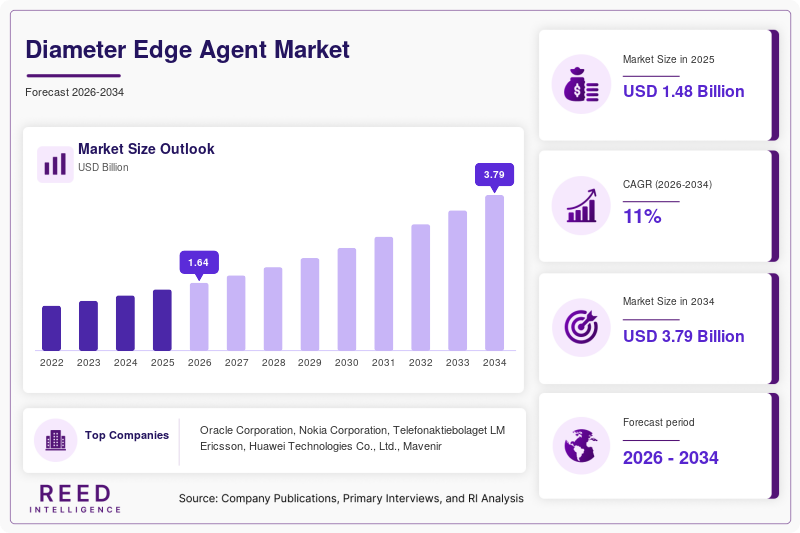
The global Diameter Edge Agent Market size was valued at USD 1.48 billion in 2026 and is projected to reach USD 3.42 billion by 2034, expanding at a CAGR of 11.0% during the forecast period. The market is experiencing consistent growth due to the increasing deployment of LTE and 5G core networks across developed and emerging economies. Diameter edge agents are widely used by telecom operators to manage signaling traffic, improve routing efficiency, support subscriber authentication, and maintain secure communication between network elements. The growing need for reliable signaling infrastructure has encouraged telecom operators to modernize network architectures and invest in scalable traffic management platforms.
The rapid rise in mobile data traffic and connected devices has created strong demand for advanced signaling control solutions. Telecom service providers are increasingly implementing cloud-native and virtualized network functions to optimize operational efficiency and reduce latency. Diameter edge agents play an important role in handling signaling overload, ensuring interoperability, and supporting roaming services within evolving network ecosystems. The expansion of IoT deployments, increasing adoption of VoLTE services, and integration of network slicing within 5G infrastructure are also contributing to market expansion.
Key Highlights
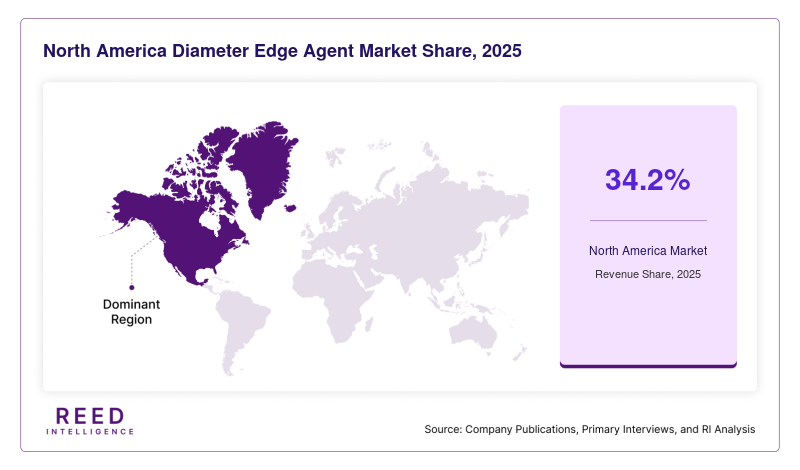
- North America dominated the market with a 34.2% share in 2025.
- Asia Pacific is expected to grow at the fastest CAGR of 12.1% during 2026–2034.
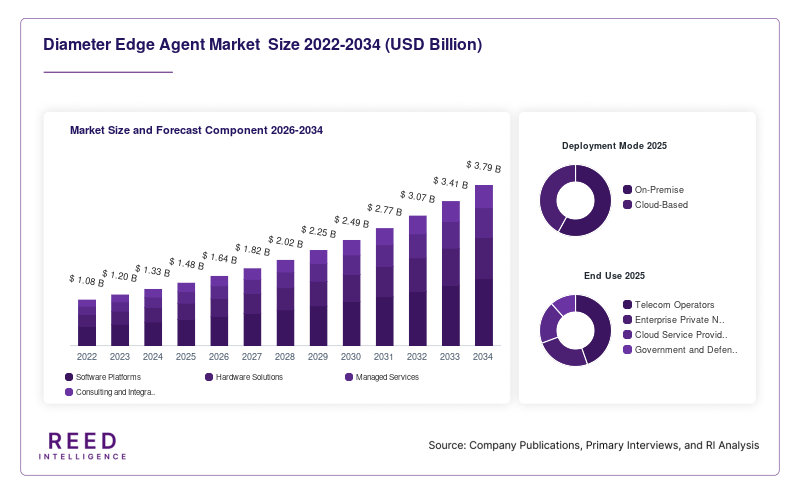
- By component, software platforms accounted for the largest share of 58.4%.
- while managed services are projected to grow at a CAGR of 13.2%.
- By deployment mode, on-premise solutions led with a 61.7% share.
- whereas cloud-based deployment is expected to expand at a CAGR of 14.1%.
- By end use, telecom operators held the highest share of 64.8%.
- while enterprise private network providers are anticipated to grow at a CAGR of 13.4%.
- The United States remained the dominant country, with market values of USD 420 million in 2024 and USD 468 million in 2025.
Market Trends
Cloud-Native Signaling Architecture Adoption
Telecom operators are increasingly shifting toward cloud-native signaling infrastructure to improve network agility and reduce operational complexity. Diameter edge agents are being integrated with virtualized network functions and containerized applications to support scalable signaling management within 5G environments. The growing transition from hardware-centric systems to software-driven network architectures has accelerated demand for flexible signaling control platforms. Service providers are adopting orchestration tools and automation technologies that allow real-time resource allocation and intelligent traffic balancing. This trend is particularly visible among large telecom carriers aiming to improve service continuity while reducing infrastructure costs. Cloud-native deployment also supports faster upgrades, simplified maintenance, and improved interoperability across multiple network domains.
The trend is further supported by increasing investments in open network ecosystems and software-defined networking technologies. Telecom operators are prioritizing network resilience and low-latency communication to support high-bandwidth applications such as video streaming, industrial IoT, and connected mobility. Diameter edge agents are evolving to support dynamic traffic routing and advanced analytics capabilities that enhance network visibility. Vendors are launching modular and subscription-based solutions that align with operator requirements for scalability and rapid deployment. As telecom companies continue modernizing their infrastructure, cloud-native signaling platforms are expected to remain a major market trend.
Integration of AI-Based Traffic Management
Artificial intelligence and machine learning technologies are becoming important components within signaling traffic management systems. Diameter edge agents equipped with AI-based analytics can identify abnormal traffic patterns, predict congestion risks, and optimize routing decisions in real time. Telecom operators are adopting intelligent signaling platforms to improve subscriber experience and maintain network stability during peak traffic periods. AI integration also assists in reducing signaling storms and unauthorized network access by enabling automated anomaly detection and threat mitigation.
The growing complexity of multi-vendor network ecosystems has increased the importance of predictive analytics and self-optimizing network functions. Vendors are investing in AI-enabled network automation tools that improve operational efficiency and minimize downtime. These advanced capabilities are supporting telecom providers in handling rising signaling volumes associated with 5G adoption and IoT expansion. AI-based diameter edge agents can also support proactive maintenance strategies by identifying performance bottlenecks before service disruption occurs. As operators continue prioritizing automation and intelligent network management, AI integration is expected to contribute significantly to future market growth.
Market Drivers
Expansion of 5G Network Infrastructure
The continuous expansion of 5G infrastructure across major economies is driving strong demand for diameter edge agent solutions. Telecom operators are investing heavily in signaling management platforms that can support high-speed connectivity, network slicing, and massive device connectivity. Diameter edge agents enable efficient communication between policy servers, subscriber databases, and charging systems within modern telecom networks. As mobile data consumption continues to rise, signaling traffic volumes are increasing significantly, creating the need for scalable and secure signaling routing solutions.
Governments and telecom regulators are encouraging investments in advanced digital communication infrastructure to support economic growth and industrial connectivity. Telecom providers are deploying standalone 5G core networks that require intelligent signaling control for efficient traffic distribution and subscriber management. Diameter edge agents also assist operators in maintaining interoperability between legacy LTE infrastructure and new 5G systems. The increasing deployment of smart factories, connected transportation systems, and remote healthcare applications is further contributing to signaling traffic growth. These factors are expected to sustain market expansion during the forecast period.
Rising Demand for Secure Roaming and Subscriber Authentication
The growing use of international roaming services and mobile authentication systems is another major factor supporting market growth. Diameter edge agents help telecom operators manage roaming traffic securely while maintaining seamless communication between domestic and international networks. Increasing cybersecurity concerns within telecom infrastructure have encouraged service providers to strengthen signaling protection and fraud detection mechanisms. Diameter edge agents support secure policy enforcement, signaling filtering, and traffic monitoring, reducing the risk of unauthorized access and network attacks.
The rapid increase in mobile subscribers and connected IoT devices has created additional demand for efficient subscriber authentication systems. Telecom companies are adopting advanced signaling solutions to improve customer experience and minimize service disruption during roaming operations. The integration of real-time analytics and automated policy management tools within diameter edge agents is improving operational visibility and network performance. As telecom operators continue expanding their global service offerings and roaming partnerships, the demand for advanced signaling security platforms is projected to increase steadily.
Market Restraint
Complexity Associated with Legacy Network Integration
One of the primary challenges affecting the Diameter Edge Agent Market is the complexity involved in integrating modern signaling platforms with legacy telecom infrastructure. Many telecom operators continue to rely on older LTE and 3G systems that were not originally designed to support highly virtualized and cloud-native network architectures. The integration process often requires substantial investments in network upgrades, interoperability testing, and employee training. Small and mid-sized telecom providers may face operational delays and budget limitations while implementing advanced signaling management systems.
The coexistence of multiple network protocols and vendor-specific systems creates additional technical challenges for operators attempting to modernize their infrastructure. In some cases, inconsistent signaling standards and compatibility issues can reduce network efficiency and increase maintenance costs. Telecom operators operating across multiple regions may also face regulatory and compliance challenges related to signaling data management and cybersecurity requirements. For example, operators transitioning from legacy LTE infrastructure to standalone 5G networks often experience difficulties in maintaining uninterrupted signaling performance during migration phases. These integration challenges can slow technology adoption and affect deployment timelines, particularly in cost-sensitive emerging markets.
Market Opportunities
Growth of Private 5G and Enterprise Networks
The increasing adoption of private 5G networks across industrial facilities, logistics hubs, and smart campuses is creating new growth opportunities for diameter edge agent providers. Enterprises are investing in dedicated communication networks to improve operational control, reduce latency, and support real-time data exchange. Diameter edge agents play an important role in managing authentication, signaling routing, and subscriber management within private wireless environments. Industries such as manufacturing, energy, mining, and transportation are deploying private 5G infrastructure to support automation and connected device ecosystems.
As enterprise demand for secure and scalable wireless communication continues to rise, vendors are introducing compact and software-driven signaling platforms tailored for private network environments. The expansion of industrial IoT applications and edge computing infrastructure is expected to increase signaling traffic within enterprise networks. Telecom vendors and cloud service providers are also forming partnerships to deliver managed private network services with integrated signaling control capabilities. These developments are likely to create long-term revenue opportunities for market participants.
Emergence of Open RAN Ecosystems
The growing adoption of Open RAN architecture is expected to create favorable opportunities within the market. Telecom operators are increasingly moving toward open and interoperable network environments to reduce dependence on proprietary infrastructure vendors. Diameter edge agents are becoming important components within Open RAN ecosystems because they support flexible signaling exchange and interoperability across multi-vendor environments. Open network architectures also encourage innovation and allow operators to deploy scalable solutions at lower operational costs.
The expansion of Open RAN deployments in Asia Pacific, Europe, and North America is driving demand for intelligent signaling management platforms that can support distributed network functions. Vendors are developing virtualized diameter edge agents compatible with cloud-native infrastructure and software-defined networking technologies. Open RAN implementation also supports faster network deployment and simplified network scaling, particularly in rural and underserved regions. As telecom providers continue prioritizing vendor diversification and network flexibility, Open RAN adoption is expected to generate substantial market opportunities over the coming years
Segmental Analysis
By Component
Software platforms accounted for the largest share of the global Diameter Edge Agent Market in 2024, representing 58.4% of total revenue. Telecom operators are increasingly prioritizing software-based signaling management solutions due to their scalability, flexibility, and lower operational costs compared to traditional hardware-centric systems. Software platforms support real-time traffic routing, policy management, and signaling security within LTE and 5G core networks. The rising adoption of cloud-native infrastructure and virtualized network functions is encouraging operators to implement software-driven signaling architectures. Vendors are also integrating AI-enabled analytics and automation features into signaling software to improve network visibility and operational efficiency. Large telecom carriers favor software-based diameter edge agents because they enable easier upgrades and simplified integration with multi-vendor ecosystems.
Managed services are anticipated to record the fastest CAGR of 13.2% during the forecast period. Telecom operators are increasingly outsourcing signaling management and network optimization functions to reduce operational complexity and improve service reliability. Managed service providers offer continuous monitoring, predictive analytics, and cybersecurity support for signaling infrastructure. The growing shortage of skilled telecom professionals and rising pressure to minimize downtime are encouraging operators to adopt outsourced network management models. Small and medium-sized telecom providers are particularly benefiting from managed services because they reduce infrastructure maintenance burdens and capital expenditure requirements. The increasing adoption of cloud-based telecom environments and remote network management solutions is expected to strengthen demand for managed signaling services over the coming years.
By Deployment Mode
On-premise deployment held the dominant market share of 61.7% in 2024 due to the strong preference among telecom operators for direct infrastructure control and enhanced data security. Large telecom providers continue to rely on on-premise signaling systems because they offer better customization capabilities and lower latency for critical network operations. These deployment models are commonly used in large-scale LTE and 5G networks where operators require dedicated traffic management infrastructure. On-premise diameter edge agents also support compliance with regional data protection regulations and internal cybersecurity policies. Many operators prefer retaining direct control over subscriber authentication and roaming management systems to ensure uninterrupted network performance. The continued use of legacy telecom infrastructure across several developed markets is also contributing to the dominance of on-premise deployments.
Cloud-based deployment is expected to expand at the fastest CAGR of 14.1% during the forecast period due to increasing adoption of virtualized telecom infrastructure and software-defined networking technologies. Telecom operators are moving toward cloud-native network architectures to improve scalability, reduce operational costs, and accelerate service deployment timelines. Cloud-based diameter edge agents support dynamic resource allocation and centralized signaling management across distributed network environments. These solutions are particularly beneficial for operators expanding edge computing capabilities and multi-region network operations. Vendors are introducing subscription-based and containerized signaling platforms that simplify deployment and maintenance processes. The growing demand for flexible telecom infrastructure and rapid network scalability is expected to accelerate cloud-based deployment adoption globally.
By End Use
Telecom operators represented the largest end-use segment in 2024, accounting for 64.8% of the global market share. The segment dominates because telecom carriers require advanced signaling control solutions to manage increasing subscriber volumes, roaming traffic, and network complexity. Diameter edge agents help telecom operators maintain signaling efficiency, improve interoperability, and reduce network congestion within LTE and 5G ecosystems. Large operators are investing heavily in AI-enabled signaling analytics and cloud-native infrastructure modernization to improve customer experience and operational resilience. The expansion of mobile broadband services, VoLTE adoption, and connected IoT ecosystems is generating higher signaling traffic across telecom networks. Operators are also deploying intelligent traffic management platforms to support advanced applications such as autonomous transportation, connected healthcare, and industrial automation.
Enterprise private network providers are projected to register the fastest CAGR of 13.4% during the forecast period due to rising adoption of dedicated wireless communication systems across industrial sectors. Enterprises are deploying private LTE and 5G networks to support secure and low-latency communication for automation, robotics, and real-time monitoring applications. Diameter edge agents are becoming essential within these environments because they support subscriber authentication, signaling routing, and network policy enforcement. Industries such as manufacturing, logistics, mining, and energy are increasingly investing in private wireless infrastructure to improve operational efficiency and data security. The expansion of edge computing and industrial IoT applications is further contributing to demand for advanced signaling management solutions within enterprise network environments.
Regional Analysis
North America
North America accounted for 34.2% of the global Diameter Edge Agent Market in 2025 and is projected to expand at a CAGR of 10.4% during the forecast period. The region maintains a strong position due to large-scale 5G infrastructure investments and early adoption of advanced telecom technologies. Major telecom carriers are increasingly deploying virtualized signaling platforms to improve network scalability and reduce latency. The presence of established telecom infrastructure vendors and high mobile data consumption levels also contribute to regional market growth.
The United States remained the leading country within North America due to strong investments in standalone 5G networks and cloud-native telecom infrastructure. Telecom operators in the country are expanding network automation initiatives to improve subscriber experience and signaling efficiency. Increasing deployment of edge computing and private wireless networks is supporting demand for advanced signaling management platforms. Additionally, strong cybersecurity regulations and growing demand for secure roaming services are encouraging telecom providers to strengthen signaling security capabilities.
Europe
Europe represented a significant share of the Diameter Edge Agent Market in 2025 and is anticipated to register a CAGR of 9.8% through 2034. The region is witnessing increased adoption of virtualized telecom infrastructure and software-defined networking technologies. Telecom operators across Europe are modernizing legacy signaling systems to support rising mobile traffic and advanced digital communication services. Government initiatives promoting digital transformation and smart connectivity are further contributing to market expansion.
Germany remained the dominant market within Europe due to extensive industrial digitization and strong investments in advanced telecom infrastructure. The country is actively deploying private 5G networks across manufacturing and automotive industries, increasing demand for intelligent signaling platforms. Telecom operators are also focusing on improving network interoperability and reducing operational complexity through cloud-native network architectures. The growing use of industrial IoT solutions and connected mobility services is supporting continued market growth.
Asia Pacific
Asia Pacific is expected to record the fastest CAGR of 12.1% during the forecast period due to rapid telecom expansion and increasing smartphone penetration. Countries across the region are investing heavily in 5G deployment and digital infrastructure modernization. Telecom providers are implementing advanced signaling control systems to handle increasing mobile subscriber volumes and data traffic. The rising adoption of IoT devices, mobile payment systems, and connected consumer applications is contributing significantly to signaling traffic growth.
China dominated the regional market due to large-scale 5G deployment initiatives and strong government support for digital infrastructure development. Telecom operators in the country are rapidly expanding cloud-native core network deployments and edge computing infrastructure. The growing adoption of smart city projects and industrial automation systems is increasing demand for efficient signaling management platforms. In addition, domestic telecom equipment manufacturers are investing in AI-enabled signaling technologies to improve network performance and operational efficiency.
Middle East & Africa
The Middle East & Africa region is witnessing steady growth in the Diameter Edge Agent Market and is projected to grow at a CAGR of 9.3% through 2034. Telecom operators in the region are investing in advanced network infrastructure to support rising internet penetration and mobile connectivity demand. Governments are encouraging digital transformation programs and smart city initiatives that require scalable telecom signaling infrastructure. Increasing adoption of cloud-based telecom services is also supporting market development.
Saudi Arabia emerged as the dominant country within the region due to strong investments in 5G infrastructure and digital economy initiatives. Telecom providers are deploying intelligent signaling management systems to support expanding enterprise connectivity and consumer data services. The country’s smart city development projects and industrial modernization efforts are contributing to increasing demand for secure signaling platforms. Rising adoption of connected healthcare and smart transportation systems is further supporting market growth.
Latin America
Latin America is expected to experience moderate growth within the global market, supported by expanding telecom infrastructure investments and increasing mobile internet usage. The regional market is projected to grow at a CAGR of 8.9% during the forecast period. Telecom operators are gradually upgrading signaling systems to improve service quality and network reliability. The increasing demand for mobile streaming services and digital banking applications is also contributing to signaling traffic growth.
Brazil remained the dominant country in Latin America due to its large telecom subscriber base and increasing 5G deployment activities. Telecom companies in the country are modernizing signaling infrastructure to improve roaming services and network scalability. The growing expansion of fiber broadband and connected enterprise services is supporting demand for advanced traffic management platforms. In addition, increasing digital transformation initiatives across financial services and retail sectors are contributing to market expansion.
Competitive Landscape
The Diameter Edge Agent Market is moderately consolidated, with global telecom infrastructure vendors competing through software innovation, strategic partnerships, and network modernization services. Major companies are focusing on cloud-native signaling platforms, AI-based traffic analytics, and virtualized network functions to strengthen their market position. Vendors are also investing in research and development activities to improve interoperability and support advanced 5G core network requirements.
Oracle Corporation remains one of the leading participants in the market due to its extensive telecom signaling portfolio and strong relationships with global telecom operators. The company recently expanded its cloud-native signaling solutions portfolio to support scalable 5G core deployments and automated traffic management capabilities. Other major companies such as Nokia Corporation, Telefonaktiebolaget LM Ericsson, Huawei Technologies Co., Ltd., and Mavenir are also focusing on AI-enabled signaling analytics and Open RAN compatibility.
Strategic collaborations between telecom operators and software vendors are becoming increasingly common as network modernization projects accelerate globally. Companies are introducing subscription-based deployment models and managed signaling services to attract mid-sized telecom providers. Market participants are also prioritizing cybersecurity enhancements and real-time analytics features to address rising signaling security concerns.
Key Players
- Oracle Corporation
- Nokia Corporation
- Telefonaktiebolaget LM Ericsson
- Huawei Technologies Co., Ltd.
- Mavenir
- F5, Inc.
- Amdocs Limited
- Hewlett Packard Enterprise
- Cisco Systems, Inc.
- Ribbon Communications Inc.
- ZTE Corporation
- NetNumber, Inc.
- Dialogic Corporation
- Casa Systems, Inc.
- Comviva Technologies Limited
Recent Developments
- Oracle Corporation introduced an upgraded cloud-native diameter signaling controller platform in 2025 to support scalable 5G standalone network deployments and AI-driven traffic optimization.
- Nokia Corporation partnered with multiple telecom operators in Asia Pacific during 2025 to deploy virtualized signaling management systems for Open RAN infrastructure projects.
- Mavenir launched an AI-enabled signaling analytics platform in 2024 designed to improve roaming security and automate traffic congestion management for telecom carriers.
- Ericsson expanded its telecom core network portfolio in 2025 by integrating advanced automation capabilities within its signaling control and subscriber management solutions.
- Huawei Technologies Co., Ltd. announced enhancements to its intelligent signaling gateway solutions in 2024 to support enterprise private 5G networks and edge computing environments.
Diameter Edge Agent Market Segments
Component
- Software Platforms
- Hardware Solutions
- Managed Services
- Consulting and Integration Services
Deployment Mode
- On-Premise
- Cloud-Based
End Use
- Telecom Operators
- Enterprise Private Network Providers
- Cloud Service Providers
- Government and Defense Networks
By Region
- North America
- Europe
- APAC
- Middle East and Africa
- LATAM