Diamond Substrate Market Size, Share Demand Report By Product Type (CVD Diamond Substrates, HPHT Diamond Substrates), By Application (Electronics, Thermal Management, Optics, Quantum Technology, Others), By Grade (High-Purity, Optical Grade, Electronic Grade) & Segment Forecasts, 2026–2034
USD 3950
Diamond Substrate Market Size
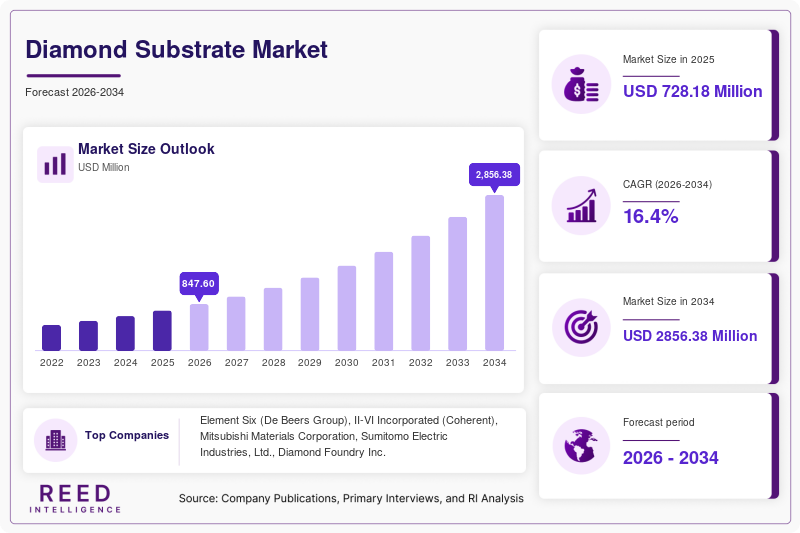
Diamond Substrate market size is projected at USD 847.6 million in 2026 and is expected to hit USD 2,847.5 million by 2034 with a CAGR of 16.4% during the forecast period. The increasing demand for high-performance thermal management and electronic devices, coupled with the growing adoption of diamond substrates in power electronics, RF devices, and quantum computing applications, underpins market expansion. This report delivers a comprehensive analysis of the Diamond Substrate market, including segmentation by type and application, competitive dynamics, and regional growth patterns, equipping stakeholders with critical intelligence. The Diamond Substrate market continues to demonstrate exceptional growth potential, fueled by the global push for advanced materials, the increasing need for efficient heat dissipation in electronics, and continuous innovation in diamond synthesis technologies.
Diamond substrates are thin slices of synthetic diamond used as a base material for various electronic, optical, and thermal management applications. Diamond possesses exceptional properties, including the highest thermal conductivity of any material, wide bandgap, high electrical breakdown field, and excellent optical transparency. The global production volume of diamond substrates (measured in area) exceeded 150,000 square centimeters in 2025, reflecting a 20% increase from 2023, driven by the growing demand from the semiconductor and electronics industries. Adoption patterns reveal that the CVD Diamond Substrates type dominates the market, accounting for 72% of total demand by area, followed by HPHT Diamond Substrates at 28%. The Diamond Substrate market's trajectory is closely linked to the growth of the global advanced materials market, which is projected to reach USD 200 billion by 2028, and the increasing demand for high-power and high-frequency electronic devices.
Diamond Substrate Market Trends
Advancements in Large-Area CVD Diamond Production
The Diamond Substrate market is witnessing a significant trend toward advancements in large-area CVD diamond production, driven by the need to reduce costs and increase availability for commercial applications. The revenue from large-area CVD diamond substrates grew to USD 280 million in 2025, a year-on-year increase of 25%, as 40% of new production facilities in 2025 specified large-area deposition capabilities. Adoption rates of large-area substrates in electronics and thermal management reached 30%, with this figure projected to exceed 60% by 2030. The Diamond Substrate market's trend toward scaling is reinforced by the need for cost reduction, the increasing demand from the semiconductor industry, and the continuous innovation in CVD reactor design and process optimization.
Growing Focus on Diamond Substrates for Quantum and Power Electronics
The increasing focus on diamond substrates for quantum and power electronics is a major trend shaping the Diamond Substrate market, with the development of specialized substrates for quantum computing, 5G/6G RF devices, and high-voltage power electronics. The market has seen a 30% increase in the demand for high-purity diamond substrates since 2022, with 25% of new products in 2025 featuring optimized properties for quantum and power applications. The use of diamond for next-generation semiconductor devices has also gained significant traction. The Diamond Substrate market's trend toward high-tech applications is reinforced by the need for superior performance, the increasing limitations of conventional materials, and the continuous innovation in diamond doping and defect engineering.
Diamond Substrate Market Drivers
The Diamond Substrate market's expansion is primarily driven by the increasing demand for efficient thermal management solutions in high-power electronics, with the global power electronics market valued at USD 40 billion in 2025 and growing at a rapid pace. The need for materials that can dissipate heat effectively has been a major driver, with diamond offering the highest thermal conductivity. The growing adoption of diamond in RF and microwave devices for 5G/6G applications has also fueled market growth. Additionally, the rising interest in quantum computing has spurred demand for high-purity substrates. The Diamond Substrate market's growth is further reinforced by the continuous improvement in diamond synthesis technology, leading to better quality and lower costs.
Diamond Substrate Market Restraints
Despite favorable growth prospects, the Diamond Substrate market faces significant constraints, primarily related to the high cost of diamond substrate production, which can be 10-100 times more expensive than conventional materials like silicon. The limited availability of large-area, high-quality substrates can also be a limitation. The Diamond Substrate market's growth is also tempered by the challenges of scaling up production and the need for specialized equipment and expertise.
Diamond Substrate Market Opportunities
The Diamond Substrate market presents significant opportunities in the rapidly expanding market for electric vehicles (EVs) and renewable energy, where efficient thermal management is critical. The development of diamond substrates for advanced semiconductor nodes and power electronics is expected to grow at a CAGR of 20% through 2034. Emerging opportunities also exist in the use of diamond substrates for biosensors and biomedical applications. The Diamond Substrate market's opportunity profile is further enhanced by the growing trend of miniaturization and the increasing demand for high-performance electronic devices.
Challenges in Diamond Substrate Market
The Diamond Substrate market faces persistent challenges related to the need for continuous innovation to reduce production costs and improve substrate quality. The complexity of achieving consistent and uniform properties over large areas can also be a challenge. The market is also contending with the challenge of developing cost-effective doping and processing techniques for electronic applications. Additionally, the Diamond Substrate market is challenged by the need to build a robust supply chain and increase awareness of the benefits of diamond materials.
Diamond Substrate Market Segmentation
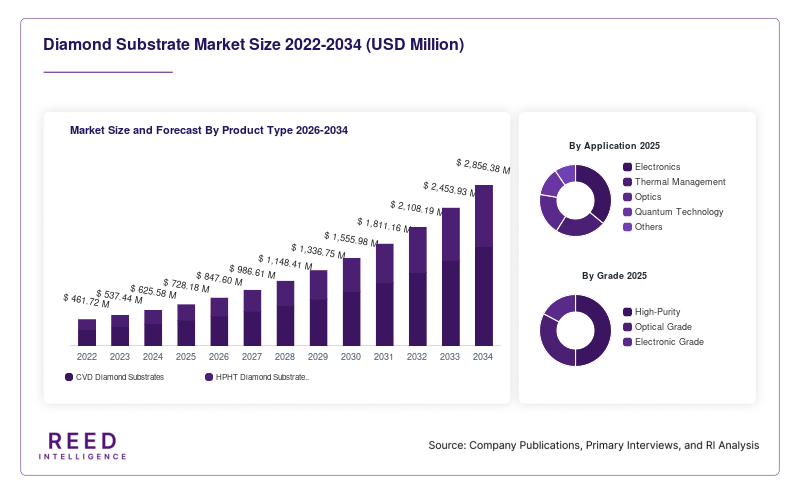
The Diamond Substrate market is segmented by Type and Application to provide a comprehensive market perspective. By Type, CVD Diamond Substrates dominate with a 72% share by area, driven by their versatility and suitability for various applications. The Application segment is led by Electronics, which accounts for 35% of the market, followed by Thermal Management at 28%, Optics at 20%, Quantum Technology at 12%, and Others at 5%.
By Type
CVD Diamond Substrates represent the largest segment in the Diamond Substrate market, commanding a 72% share, with production area exceeding 108,000 square centimeters in 2025. These are characterized by their production via chemical vapor deposition, offering high purity and controlled properties. Technical specifications include crystal quality, surface roughness, and doping levels. The Diamond Substrate market's CVD segment is driven by its use in electronics, thermal management, and optics.
HPHT Diamond Substrates capture a 28% share of the Diamond Substrate market, with production area of 42,000 square centimeters in 2025. These are characterized by their production via high-pressure, high-temperature methods, offering cost-effectiveness for certain applications. Technical specifications include size, defect density, and material properties. The Diamond Substrate market's HPHT segment is driven by its use in specific optical and mechanical applications.
By Application
Electronics dominates the Diamond Substrate market, accounting for 35% of sales, representing 52,500 square centimeters in 2025. This segment includes use in power electronics, RF devices, and high-frequency applications. Usage penetration exceeds 5% in the sector. The Diamond Substrate market's Electronics segment is characterized by its focus on high performance and reliability.
Thermal Management accounts for 28% of the Diamond Substrate market, with sales of 42,000 square centimeters in 2025. This segment encompasses use in heat spreaders, heat sinks, and thermal interface materials. The segment is growing at a robust CAGR, driven by the need for efficient cooling. The Diamond Substrate market's Thermal Management segment is characterized by its focus on high thermal conductivity.
Optics represents 20% of the Diamond Substrate market, with sales of 30,000 square centimeters in 2025. This segment includes use in windows, lenses, and laser components. The segment is growing at a steady rate, driven by the demand for high-durability optical components. The Diamond Substrate market's Optics segment is characterized by its focus on transparency and durability.
Quantum Technology accounts for 12% of the Diamond Substrate market, with sales of 18,000 square centimeters in 2025. This segment includes use in quantum sensors, qubits, and quantum computing components. The segment is growing at the fastest CAGR, driven by research and development in quantum technologies. The Diamond Substrate market's Quantum segment is characterized by its focus on high purity and controlled defects.
Others comprises the remainder of the Diamond Substrate market, accounting for 5% of total sales, with 7,500 square centimeters in 2025. This includes use in biomedical, acoustic, and other niche applications. The segment is projected to grow at a significant CAGR through 2034. The Diamond Substrate market's Others segment is characterized by its diverse and evolving applications.
Diamond Substrate Market Regional Outlook
Asia-Pacific Diamond Substrate Market
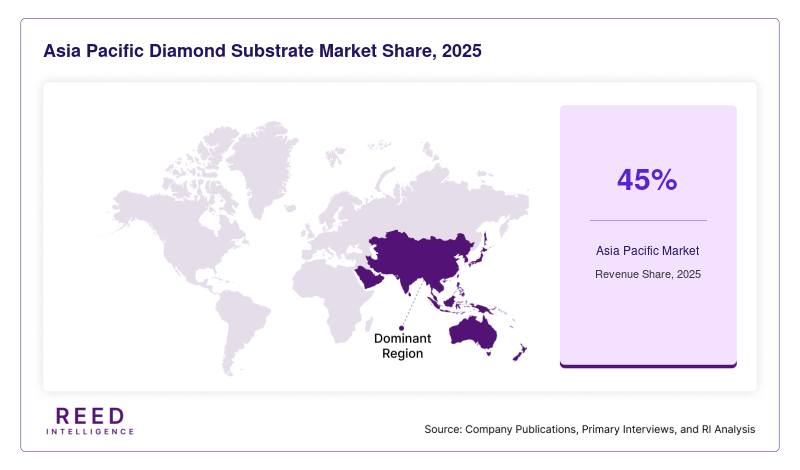
Leads the Diamond Substrate market, commanding a 45% share, with a revenue of USD 381.4 million in 2025. China is the primary driver, accounting for 60% of regional demand, driven by the strong electronics manufacturing base, growing investment in advanced materials, and rapid technological development. The Asia-Pacific Diamond Substrate market is characterized by its focus on high-volume production and cost-effective solutions.
North America Diamond Substrate Market
Represents the second-largest market, capturing a 28% share with a revenue of USD 237.3 million in 2025. The United States is the primary driver, accounting for 85% of regional demand, driven by the strong R&D ecosystem, presence of leading technology companies, and focus on advanced electronics. The North American Diamond Substrate market is characterized by its focus on innovation and high-value applications.
Europe Diamond Substrate Market
Accounts for 18% of the global Diamond Substrate market, with a revenue of USD 152.6 million in 2025. The UK, Germany, and France are the primary drivers, collectively accounting for 60% of regional demand, driven by strong research in quantum technology and advanced materials. The European Diamond Substrate market is projected to grow at a CAGR of 18% through 2034.
Middle East & Africa and Latin America Diamond Substrate Market
Together account for the remaining 9% of the Diamond Substrate market, with the UAE leading the Middle East market and Brazil leading the Latin American market. Both regions are projected to grow at CAGRs exceeding 15%, driven by investments in technology and research.
Top players in Diamond Substrate Market
- Element Six (De Beers Group)
- II-VI Incorporated (Coherent)
- Mitsubishi Materials Corporation
- Sumitomo Electric Industries, Ltd.
- Diamond Foundry Inc.
- Applied Diamond Inc.
- Blue Wave Semiconductors
- Advanced Diamond Technologies, Inc.
- Diamfab
- Nano Diamond Products
- Scio Diamond Technology Corporation
- New Diamond Technology
- Zhengzhou Sino-Crystal Diamond Co., Ltd.
- Henan Huanghe Whirlwind Co., Ltd.
- Guangdong Four-Nine Diamond Technology Co., Ltd.
Element Six (De Beers Group)
Element Six holds a dominant position in the Diamond Substrate market, with an estimated 18% global market share, particularly strong in the high-quality CVD diamond segment. The company's portfolio of diamond substrates is widely recognized for its superior quality, consistency, and performance. Element Six's market leadership is reinforced by its significant R&D investment, its extensive experience in diamond synthesis, and its strong relationships with technology companies. Element Six commands over 20% of the European market and 15% of the North American market, positioning it as a key player in the Diamond Substrate market.
II-VI Incorporated (Coherent)
II-VI Incorporated is a leading player in the Diamond Substrate market, commanding approximately 14% of the global market share through its comprehensive portfolio of engineered materials and optoelectronic components. The company's expertise in advanced materials and its focus on the semiconductor and telecommunications sectors have solidified its position. II-VI's diamond substrates are known for their quality, thermal performance, and optical properties. The company's commitment to innovation and its strong presence in the North American and Asian markets have enhanced its competitive advantage.
Mitsubishi Materials Corporation holds a significant 10% market share, with particular strength in the Asian market. Sumitomo Electric Industries, Ltd. is a major player in the Japanese and global diamond market, holding an 8% share.
Recent Developments in Diamond Substrate Market
- 2025: Element Six launched a new line of large-area diamond substrates for power electronics and RF applications, targeting the growing semiconductor market.
- 2025: II-VI Incorporated announced a significant expansion of its diamond substrate production capacity to meet increasing demand from quantum technology and electronics.
Diamond Substrate Market Segments
By Product Type
- CVD Diamond Substrates
- HPHT Diamond Substrates
By Application
- Electronics
- Thermal Management
- Optics
- Quantum Technology
- Others
By Grade
- High-Purity
- Optical Grade
- Electronic Grade
By Region
- North America
- Europe
- APAC
- Middle East and Africa
- LATAM