Diaphragm Metering Pump Market Size, Share Demand Report By Type (Mechanical Diaphragm Pumps, Hydraulic Diaphragm Pumps, Solenoid-Driven Diaphragm Pumps), By Application (Water & Wastewater Treatment, Chemical Processing, Pharmaceuticals, Food & Beverage, Oil & Gas), By End-Use Industry (Chemical Industry, Oil & Gas Industry, Water Treatment Industry, Pharmaceutical Industry, Others), By Region & Segment Forecasts, 2026–2034
USD 3950
Market Overview
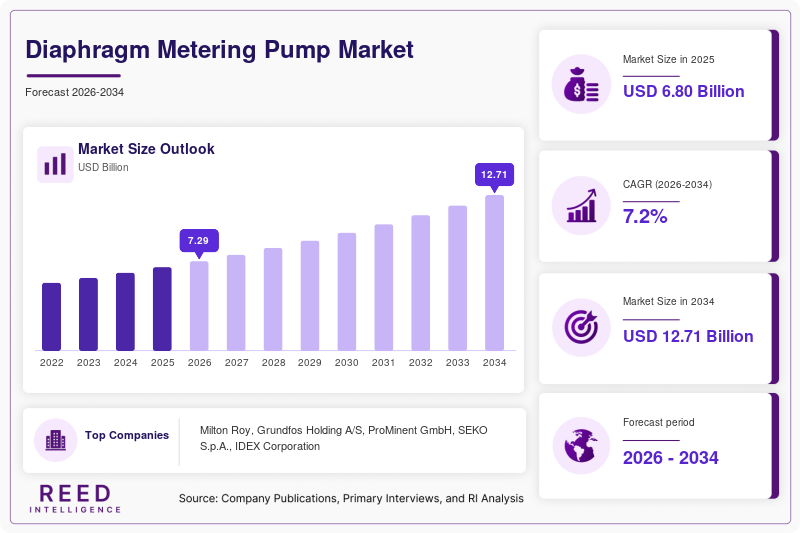
The global Diaphragm Metering Pump Market was valued at approximately USD 6.8 billion in 2026 and is projected to reach around USD 11.9 billion by 2034, expanding at a CAGR of 7.2% during the forecast period (2026–2034). Diaphragm metering pumps are widely used in industries requiring precise fluid dosing, such as water treatment, chemicals, pharmaceuticals, and oil & gas. These pumps offer high accuracy, leak-proof operation, and compatibility with corrosive fluids, which continues to drive their adoption across industrial applications.
A major global factor supporting market growth is the rising investment in water and wastewater treatment infrastructure. Governments and private stakeholders are increasingly prioritizing sustainable water management systems to address water scarcity and environmental concerns. Diaphragm metering pumps play a critical role in dosing chemicals for purification and treatment processes, thereby strengthening their demand globally.
Key Highlights
- North America dominated the market with a 33.8% share in 2025.
- Asia Pacific is expected to grow at the fastest CAGR of 8.9% during 2026–2034.
- By type, mechanical diaphragm pumps accounted for the largest share of 42.6%, while hydraulic diaphragm pumps are projected to grow at a CAGR of 8.4%.
- By application, water & wastewater treatment led with a 39.3% share, whereas pharmaceuticals are expected to expand at a CAGR of 8.7%.
- The United States remained the dominant country, with market values of USD 1.6 billion in 2024 and USD 1.7 billion in 2025.
Market Trends
Integration of Smart and IoT-Enabled Pump Systems
The integration of smart technologies and IoT-enabled monitoring systems is reshaping the diaphragm metering pump market. Manufacturers are embedding sensors and digital control units into pumps to provide real-time performance tracking, flow rate adjustments, and predictive maintenance alerts. These capabilities reduce downtime and operational risks while improving dosing accuracy. Industries such as chemical processing and water treatment increasingly demand such intelligent systems to optimize operations and comply with strict regulatory requirements. Additionally, cloud-based platforms allow remote monitoring and data analysis, which supports efficient decision-making and energy management. This trend is expected to gain momentum as industrial automation continues to expand globally.
Growing Preference for Energy-Efficient and Eco-Friendly Pumps
Energy efficiency and environmental sustainability are becoming central considerations in industrial equipment selection, including diaphragm metering pumps. Manufacturers are focusing on developing pumps that consume less energy while maintaining high precision and reliability. Advanced materials and improved diaphragm designs are contributing to reduced wear and extended service life. Furthermore, the shift toward eco-friendly operations is encouraging the adoption of pumps that minimize chemical leakage and emissions. Regulatory frameworks promoting sustainable practices are also influencing purchasing decisions. As industries aim to reduce their carbon footprint and operational costs, energy-efficient diaphragm metering pumps are expected to witness steady demand.
Market Drivers
Rising Demand in Water and Wastewater Treatment Applications
The increasing global emphasis on water conservation and wastewater treatment is a key driver for the diaphragm metering pump market. Governments and municipalities are investing heavily in infrastructure projects to improve water quality and address growing environmental concerns. Diaphragm metering pumps are essential in dosing chemicals such as chlorine, coagulants, and pH adjusters during treatment processes. Their precision and ability to handle corrosive fluids make them suitable for such applications. Rapid urbanization and industrialization are further intensifying the demand for efficient water management systems, thereby boosting the adoption of these pumps across both developed and emerging economies.
Expansion of Chemical and Pharmaceutical Industries
The growth of chemical manufacturing and pharmaceutical production is significantly contributing to the demand for diaphragm metering pumps. These industries require accurate and consistent dosing of fluids to ensure product quality and safety. In pharmaceuticals, stringent regulatory standards necessitate precise control over fluid handling processes, which diaphragm pumps effectively provide. Additionally, the increasing production of specialty chemicals and active pharmaceutical ingredients is driving the need for reliable dosing systems. As these industries continue to expand globally, the demand for advanced metering pumps is expected to rise steadily.
Market Restraint
High Initial Cost and Maintenance Complexity
One of the primary restraints affecting the diaphragm metering pump market is the relatively high initial investment and maintenance complexity associated with these systems. Compared to conventional pumps, diaphragm metering pumps require specialized components and precision engineering, which increases their upfront cost. For small and medium-sized enterprises, this can act as a barrier to adoption, particularly in price-sensitive markets.
In addition to initial costs, maintenance requirements can be complex due to the need for periodic diaphragm replacement and calibration to maintain accuracy. Improper maintenance may lead to reduced efficiency or operational failure, increasing overall lifecycle costs. For example, in chemical processing plants, failure to maintain pumps properly can result in inaccurate dosing, leading to product quality issues and potential financial losses. These factors may discourage some end-users from investing in diaphragm metering pumps, thereby limiting market growth to a certain extent.
Market Opportunities
Increasing Adoption in Emerging Economies
Emerging economies present significant growth opportunities for the diaphragm metering pump market due to rapid industrialization and infrastructure development. Countries in Asia Pacific, Latin America, and Africa are investing in water treatment facilities, chemical manufacturing plants, and energy projects. This creates a strong demand for reliable and efficient dosing equipment. Additionally, government initiatives aimed at improving industrial productivity and environmental standards are encouraging the adoption of advanced technologies, including diaphragm metering pumps. As these regions continue to develop, the market is expected to witness substantial growth opportunities.
Technological Advancements and Product Innovation
Continuous technological advancements are opening new avenues for market growth. Manufacturers are focusing on developing innovative products with enhanced features such as automated control systems, improved durability, and compatibility with a wide range of fluids. The introduction of compact and modular pump designs is also gaining traction, as it allows easy installation and integration into existing systems. Furthermore, advancements in materials and manufacturing techniques are improving pump efficiency and reducing maintenance requirements. These innovations are expected to attract new customers and expand the application scope of diaphragm metering pumps across various industries.
Segmental Analysis
By Type
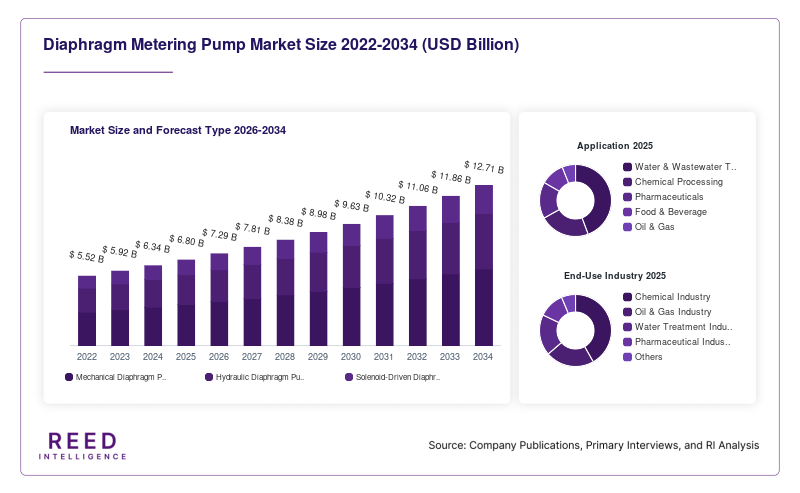
Mechanical diaphragm pumps dominated the market in 2024, accounting for a share of 42.6%. These pumps are widely used due to their simple design, cost-effectiveness, and reliability in handling various fluids. They are particularly suitable for applications requiring moderate pressure and flow rates, making them a preferred choice in water treatment and general industrial processes. Their ease of maintenance and availability further contribute to their widespread adoption across industries.
Hydraulic diaphragm pumps are expected to be the fastest-growing subsegment, with a CAGR of 8.4% during the forecast period. These pumps offer higher pressure capabilities and improved accuracy compared to mechanical variants. They are increasingly used in demanding applications such as oil & gas and chemical processing. The growing need for high-performance dosing systems and advancements in pump technology are driving the adoption of hydraulic diaphragm pumps.
By Application
Water & wastewater treatment was the dominant application segment in 2024, accounting for 39.3% of the market share. The increasing demand for clean water and effective wastewater management is driving the adoption of diaphragm metering pumps in this segment. These pumps are essential for precise chemical dosing, ensuring efficient treatment processes and compliance with environmental regulations.
The pharmaceutical segment is expected to grow at the fastest CAGR of 8.7% during the forecast period. The rising demand for pharmaceutical products and stringent regulatory requirements are driving the need for accurate fluid handling systems. Diaphragm metering pumps provide the precision and reliability required in pharmaceutical manufacturing, supporting their growing adoption in this sector.
By End-Use Industry
The chemical industry dominated the market in 2024, holding a significant share due to the extensive use of diaphragm metering pumps in chemical dosing applications. These pumps are used for handling aggressive and corrosive chemicals, ensuring safe and accurate dosing. The growth of specialty chemicals and industrial production further supports the demand in this segment.
The oil & gas industry is expected to be the fastest-growing subsegment, with a CAGR of 8.1%. The need for efficient chemical injection systems in upstream and downstream operations drives the demand for diaphragm metering pumps. Increasing exploration activities and investments in energy infrastructure further contribute to the growth of this segment.
Regional Analysis
North America
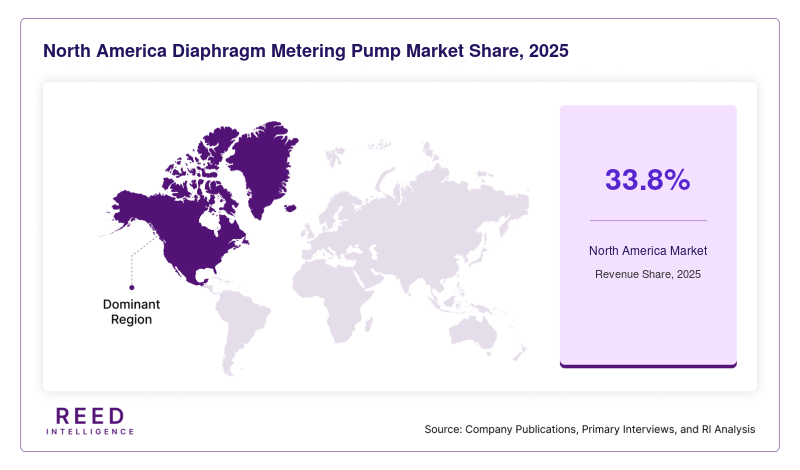
North America held a dominant share of 33.8% in 2025 and is expected to grow at a CAGR of 6.5% during the forecast period. The region benefits from advanced industrial infrastructure and high adoption of automation technologies. Strong demand from water treatment and chemical industries supports market growth. Regulatory standards related to environmental protection further drive the adoption of precise dosing equipment such as diaphragm metering pumps.
The United States dominates the North American market, supported by extensive investments in water infrastructure and industrial automation. A key growth factor is the increasing adoption of smart pump systems integrated with IoT technologies, enabling efficient monitoring and predictive maintenance. This enhances operational efficiency and reduces downtime.
Europe
Europe accounted for approximately 27.4% of the market share in 2025 and is projected to grow at a CAGR of 6.8%. The region’s focus on environmental sustainability and strict regulatory frameworks drives the demand for advanced dosing solutions. Industries are increasingly adopting diaphragm metering pumps to meet compliance requirements and improve operational efficiency.
Germany leads the European market due to its strong industrial base and technological expertise. A unique growth factor is the region’s emphasis on energy-efficient solutions, encouraging the adoption of advanced diaphragm pumps with reduced energy consumption. This aligns with Europe’s broader sustainability goals.
Asia Pacific
Asia Pacific is expected to grow at the fastest CAGR of 8.9% during the forecast period, with a market share of 24.6% in 2025. Rapid industrialization and urbanization are driving demand for water treatment and chemical processing solutions. Increasing investments in infrastructure development further support market growth.
China dominates the Asia Pacific market due to its large industrial base and ongoing infrastructure projects. A key growth factor is government initiatives to improve water quality and environmental conditions, which boost the demand for diaphragm metering pumps in water treatment applications.
Middle East & Africa
The Middle East & Africa region held a market share of 7.1% in 2025 and is projected to grow at a CAGR of 6.2%. The region’s oil & gas industry significantly contributes to the demand for diaphragm metering pumps, particularly for chemical injection processes.
Saudi Arabia leads the regional market, driven by investments in oil & gas and water desalination projects. A unique growth factor is the expansion of desalination plants, which require precise chemical dosing systems, thereby increasing the adoption of diaphragm metering pumps.
Latin America
Latin America accounted for 7.1% of the market share in 2025 and is expected to grow at a CAGR of 6.7%. The region’s growing industrial sector and increasing focus on water treatment infrastructure support market growth.
Brazil dominates the Latin American market due to its expanding industrial activities. A key growth factor is the increasing investment in municipal water treatment facilities, which drives the demand for efficient dosing equipment such as diaphragm metering pumps.
Competitive Landscape
The diaphragm metering pump market is moderately competitive, with several established players focusing on product innovation and strategic partnerships. Leading companies are investing in research and development to enhance pump efficiency, durability, and integration with digital technologies. The market also witnesses collaborations and acquisitions aimed at expanding product portfolios and geographical presence.
A leading player in the market is Milton Roy, known for its advanced metering pump solutions and strong global presence. The company has recently introduced new smart pump systems with enhanced monitoring capabilities, aligning with the growing demand for automation. Other key players are also focusing on expanding their product offerings and improving customer support services to strengthen their market position.
Key Players
- Milton Roy
- Grundfos Holding A/S
- ProMinent GmbH
- SEKO S.p.A.
- IDEX Corporation
- Dover Corporation
- SPX Flow Inc.
- Lewa GmbH
- Blue-White Industries
- Tacmina Corporation
- Nikkiso Co., Ltd.
- Verder Group
- Depamu Pump Technology
- PSG (Pump Solutions Group)
- Flowrox
Recent Developments
- In 2025, Grundfos launched a new range of energy-efficient diaphragm metering pumps with integrated digital monitoring systems.
- In 2024, ProMinent expanded its product portfolio by introducing advanced dosing pumps designed for high-pressure applications.
- In 2025, SEKO S.p.A. announced a strategic partnership with a technology firm to develop IoT-enabled smart pump solutions.
Diaphragm Metering Pump Market Segments
Type
- Mechanical Diaphragm Pumps
- Hydraulic Diaphragm Pumps
- Solenoid-Driven Diaphragm Pumps
Application
- Water & Wastewater Treatment
- Chemical Processing
- Pharmaceuticals
- Food & Beverage
- Oil & Gas
End-Use Industry
- Chemical Industry
- Oil & Gas Industry
- Water Treatment Industry
- Pharmaceutical Industry
- Others
By Region
- North America
- Europe
- APAC
- Middle East and Africa
- LATAM