Dibromomethane Market Size, Share & Demand Report By Type (Industrial Grade, Laboratory Grade / High Purity Grade), By Application (Chemical Intermediates, Pharmaceutical Synthesis, Research and Laboratory Use, Others), By End-Use Industry (Chemical Industry, Pharmaceutical & Biotechnology, Academic and Research Institutes, Others), By Region & Segment Forecasts, 2025–2034
USD 3950
Market Overview
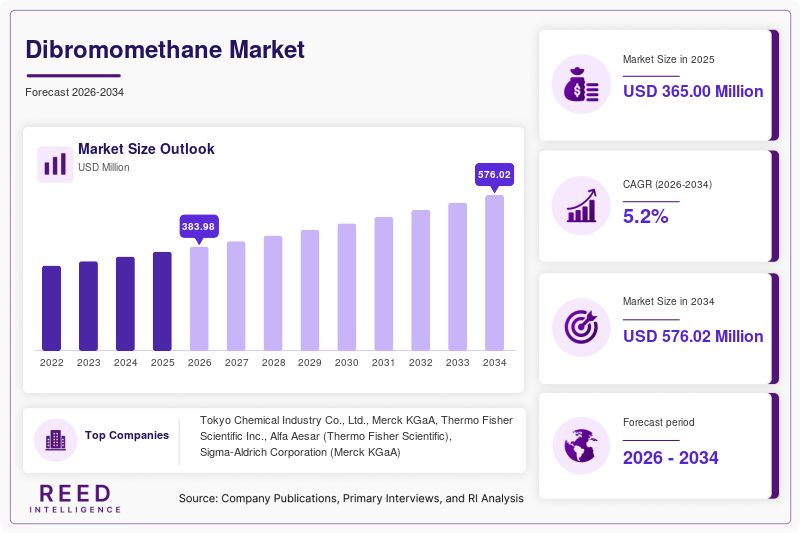
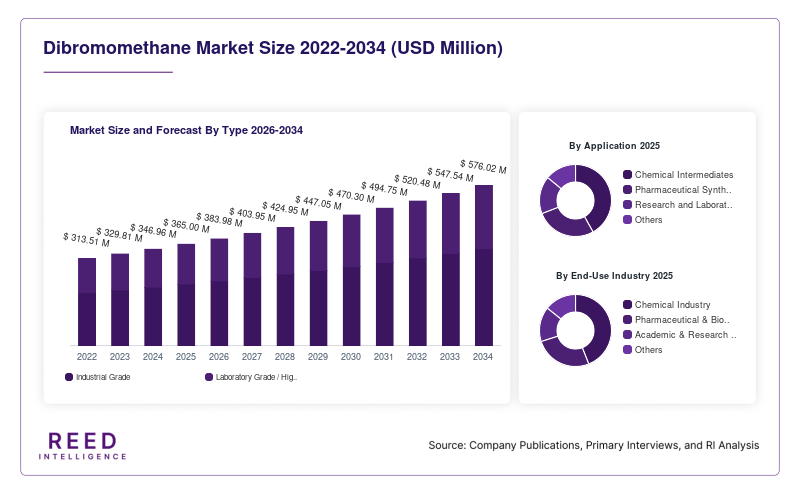
The global Dibromomethane Market size was valued at approximately USD 365 million in 2025 and is projected to reach USD 575 million by 2033, registering a compound annual growth rate (CAGR) of around 5.2% during the forecast period (2025–2034). Dibromomethane, a halogenated organic compound widely used as an intermediate in chemical synthesis, is gaining relevance in pharmaceutical research, specialty chemicals manufacturing, and laboratory applications. The increasing utilization of halogenated intermediates in fine chemical production has strengthened demand for dibromomethane across both industrial and research-oriented environments.
One global factor supporting market growth has been the expansion of specialty chemical manufacturing worldwide. Several chemical producers are investing in high-value intermediates to meet demand from pharmaceuticals, agrochemicals, and advanced materials industries. Dibromomethane plays a role in bromination reactions and laboratory synthesis processes, making it a valuable compound in research laboratories and industrial chemical production. In addition, increasing investment in research and development activities within biotechnology and life sciences sectors has further supported the adoption of dibromomethane in controlled chemical synthesis.
Key Highlights
- Asia Pacific held the dominant regional share of 39.6% in 2025, while Latin America is expected to register the fastest CAGR of 6.4% during the forecast period.
- By type, industrial grade accounted for the largest share at 58.1% in 2025, whereas high-purity laboratory grade is projected to grow fastest at a CAGR of 6.8%.
- By application, chemical intermediates dominated with 46.7% share in 2025, while pharmaceutical synthesis is expected to grow fastest at 6.6% CAGR.
- China remained the leading country market, valued at USD 92 million in 2025 and projected to reach USD 97 million in 2026.
Market Trends
Expansion of Specialty Chemical Production
A key trend shaping the Dibromomethane Market is the expansion of specialty chemical production worldwide. Chemical manufacturers are increasingly focusing on specialized intermediates that enable precise synthesis of high-value compounds. Dibromomethane functions as an effective brominating agent and intermediate in several organic reactions, making it useful in research laboratories and chemical manufacturing facilities. As industries such as pharmaceuticals and fine chemicals continue to require complex molecular structures, the demand for halogenated intermediates including dibromomethane is gradually increasing. Manufacturers are also improving production technologies to achieve higher purity levels, enabling the compound to be used in advanced research and industrial synthesis processes.
Rising Demand for High-Purity Laboratory Chemicals
Another notable trend in the Dibromomethane Market is the increasing demand for high-purity laboratory chemicals. Universities, pharmaceutical research institutions, and biotechnology laboratories require highly controlled reagents for experimental procedures and analytical testing. High-purity grades of dibromomethane are gaining adoption in laboratory environments where chemical accuracy and reproducibility are important. As research activities expand globally, especially in Asia Pacific and North America, suppliers are offering refined grades with improved packaging and handling standards. This trend has encouraged chemical producers to invest in purification technologies and specialized distribution channels to serve research-focused customers.
Market Drivers
Growing Pharmaceutical Research Activities
The expansion of pharmaceutical research has been a major driver supporting the Dibromomethane Market. Pharmaceutical companies and research institutions frequently utilize halogenated compounds in chemical synthesis processes during drug development and laboratory experimentation. Dibromomethane can be used in bromination reactions and intermediate formation within controlled chemical environments. With increasing investments in drug discovery and biotechnology research, laboratories require reliable reagents and intermediates that support complex organic synthesis. The growth of research facilities in developed and emerging economies has therefore contributed to consistent demand for dibromomethane.
Increasing Production of Fine Chemicals
Another key factor driving the Dibromomethane Market is the growth of the fine chemicals industry. Fine chemicals are specialized compounds used in pharmaceuticals, agrochemicals, and advanced materials production. These compounds often require halogenated intermediates for synthesis processes. Dibromomethane is used in certain bromination reactions and chemical transformations, supporting the production of specialized chemical compounds. As industries continue to develop new chemical formulations and research advanced materials, the demand for intermediates used in synthesis is expected to expand steadily, supporting the overall growth of the market.
Market Restraint
Environmental and Regulatory Concerns
One of the primary restraints affecting the Dibromomethane Market involves environmental and regulatory concerns associated with halogenated compounds. Several governments and regulatory authorities maintain strict regulations regarding the production, storage, transportation, and disposal of brominated chemicals. These regulations are intended to minimize environmental impact and ensure safe chemical handling within industrial and laboratory settings.
Halogenated organic compounds can require specialized safety protocols during manufacturing and usage due to their chemical properties. Compliance with environmental regulations may increase operational costs for manufacturers and distributors of dibromomethane. Companies must invest in proper storage infrastructure, transportation safety measures, and regulatory compliance documentation. These requirements can create barriers for smaller chemical suppliers attempting to enter the market.
In addition, environmental monitoring standards in certain regions require companies to carefully manage emissions and waste disposal during chemical production. Such regulatory frameworks may influence production capacity and operational flexibility for chemical manufacturers. As a result, regulatory oversight remains an important factor that could moderate the overall growth pace of the dibromomethane industry.
Market Opportunities
Expansion of Chemical Research Infrastructure
An emerging opportunity within the Dibromomethane Market lies in the expansion of global chemical research infrastructure. Governments and private organizations are increasingly investing in research laboratories, universities, and innovation centers focused on chemical sciences. These facilities require a wide range of laboratory reagents and chemical intermediates to conduct research and experimentation. As new research institutions are established across developing economies, the demand for high-purity laboratory chemicals such as dibromomethane is expected to increase steadily.
Growth of Emerging Chemical Manufacturing Markets
Another opportunity for the Dibromomethane Market is the growth of chemical manufacturing sectors in emerging economies. Countries in Asia Pacific, Latin America, and the Middle East are strengthening their chemical production capabilities to support domestic industries and exports. As new chemical plants and specialty chemical manufacturing clusters are developed, the demand for intermediates used in chemical synthesis processes is likely to expand. Dibromomethane suppliers can benefit from these developments by establishing distribution partnerships and regional production facilities to serve growing industrial demand.
Segmental Analysis
By Type
Industrial grade dibromomethane represented the largest share of the Dibromomethane Market at 58.1% in 2025. Industrial grade compounds are widely used in chemical manufacturing environments where they serve as intermediates or reagents during synthesis processes. Chemical production facilities typically require large quantities of reagents to support batch-based chemical synthesis operations. Industrial grade dibromomethane provides the necessary chemical properties required for bromination reactions and intermediate formation. Its usage within industrial laboratories and production facilities has contributed to its dominant share within the market.
High-purity laboratory grade dibromomethane is expected to grow at the fastest CAGR of approximately 6.8% during the forecast period. Research institutions and biotechnology laboratories increasingly require reagents with precise purity levels to ensure consistent experimental results. High-purity grades are manufactured using refined production and purification processes that eliminate impurities. As research activities continue to expand globally, demand for laboratory-grade dibromomethane is likely to grow steadily.
By Application
Chemical intermediates accounted for the largest share of the Dibromomethane Market at 46.7% in 2025. The compound is commonly used as an intermediate during the synthesis of more complex chemical compounds. Chemical manufacturers utilize dibromomethane in bromination reactions and controlled laboratory processes that enable the creation of specialized molecules. Its role in organic synthesis processes has supported widespread use within chemical production environments.
Pharmaceutical synthesis is projected to be the fastest-growing application segment with a CAGR of around 6.6% through 2034. Pharmaceutical research and drug development often involve complex organic reactions that require specialized reagents and intermediates. Dibromomethane may be used in certain laboratory synthesis processes associated with pharmaceutical compound development. As pharmaceutical research continues to expand globally, this application segment is expected to experience consistent growth.
By End-Use Industry
The chemical industry held the largest share of the Dibromomethane Market at 52.4% in 2025. Chemical manufacturers rely on halogenated intermediates during the production of specialized chemical compounds. Dibromomethane supports various organic synthesis reactions within chemical laboratories and industrial production environments. Its functionality within chemical synthesis has allowed the compound to maintain a strong presence within the chemical manufacturing sector.
The pharmaceutical and biotechnology industry is anticipated to grow at the fastest CAGR of 6.5% during the forecast period. Pharmaceutical companies and biotechnology firms frequently conduct research involving organic synthesis and compound modification. Dibromomethane may serve as a reagent or intermediate during certain laboratory experiments and synthesis procedures. The increasing number of biotechnology startups and pharmaceutical research projects is expected to contribute to the growth of this segment.
Regional Analysis
North America
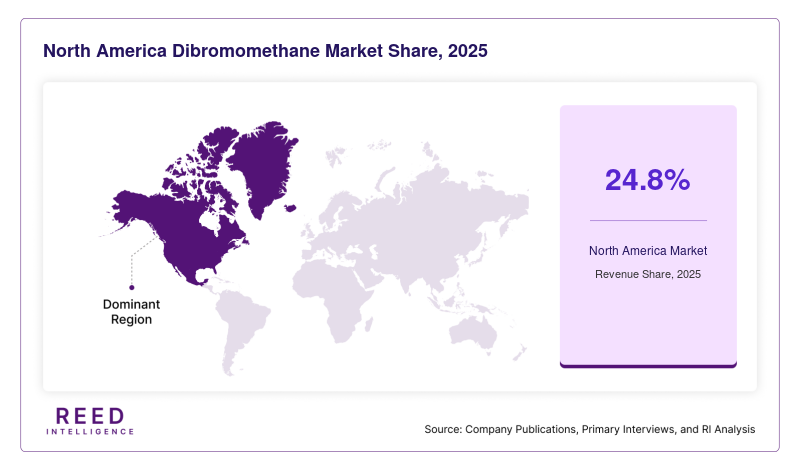
North America accounted for 24.8% of the global Dibromomethane Market share in 2025 and the region is projected to grow at a CAGR of approximately 4.7% during the forecast period. The region has maintained a stable demand environment supported by well-established chemical manufacturing industries and strong research infrastructure. Several chemical laboratories and specialty chemical manufacturers operate across the United States and Canada, utilizing halogenated intermediates in research and chemical synthesis processes. The presence of advanced research facilities and regulatory frameworks has shaped a structured market environment for dibromomethane suppliers.
The United States represented the dominant country market in North America. The country benefits from a strong network of pharmaceutical research institutions and chemical laboratories that require reliable laboratory reagents. Universities, biotechnology firms, and chemical research centers conduct various organic synthesis studies that involve halogenated compounds. The availability of specialized chemical distributors and advanced laboratory infrastructure has supported steady demand for dibromomethane across research and industrial settings.
Europe
Europe held 21.3% share of the global Dibromomethane Market in 2025, and the regional market will likely grow at a CAGR of around 4.5% through 2034. The European chemical industry includes several established specialty chemical producers that manufacture advanced chemical compounds for pharmaceuticals, agrochemicals, and industrial applications. Dibromomethane demand in the region is associated with chemical synthesis and laboratory research activities carried out by academic and industrial institutions.
Germany emerged as the leading country market within Europe. The country has a strong chemical manufacturing sector and a large number of research laboratories focused on advanced chemistry. Germany’s chemical clusters and industrial research centers conduct extensive studies related to organic synthesis and chemical intermediates. These activities support the steady utilization of laboratory reagents and halogenated compounds including dibromomethane.
Asia Pacific
Asia Pacific represented the largest share of the Dibromomethane Market at 39.6% in 2025, and the region is expected to grow at a CAGR of 5.8% during the forecast period. The region has become an important hub for chemical manufacturing and laboratory research activities. Expanding chemical production facilities and increasing investments in scientific research have contributed to the growing demand for chemical intermediates across several countries.
China dominated the Asia Pacific market due to its large-scale chemical manufacturing industry. The country hosts numerous chemical production facilities and research laboratories engaged in chemical synthesis and industrial chemical development. The presence of integrated chemical manufacturing clusters has strengthened the supply chain for halogenated compounds including dibromomethane. These factors have enabled China to maintain a strong position in the regional market.
Middle East & Africa
The Middle East & Africa accounted for 7.4% of the global Dibromomethane Market share in 2025, and the region is expected to expand at a CAGR of 4.9% during the forecast period. Chemical industries in the region have been gradually diversifying, with investments in specialty chemical production and research infrastructure supporting the market environment.
Saudi Arabia emerged as the leading country market in the region. The country has invested in chemical industrial zones and research centers focused on developing advanced chemical products. Industrial diversification strategies have encouraged the development of chemical production facilities that utilize various intermediates and laboratory chemicals. These developments have supported the gradual expansion of dibromomethane demand in the region.
Latin America
Latin America held 6.9% of the global Dibromomethane Market share in 2025, and the regional market is expected to grow at the fastest CAGR of approximately 6.4% through 2034. The region’s chemical industry has been expanding steadily with growing investments in industrial infrastructure and chemical research capabilities.
Brazil represented the dominant country market in Latin America. The country hosts several universities, research institutes, and chemical manufacturing facilities that conduct chemical synthesis and laboratory research. Expanding industrial research capabilities and increasing academic research initiatives have contributed to the demand for laboratory reagents and chemical intermediates including dibromomethane.
Competitive Landscape
The Dibromomethane Market includes a mix of specialty chemical manufacturers and laboratory chemical suppliers that produce halogenated compounds for industrial and research applications. Companies compete based on product purity, supply chain reliability, and distribution networks serving laboratories and chemical manufacturers.
Among the market participants, Tokyo Chemical Industry Co., Ltd. has maintained a strong presence due to its extensive catalog of laboratory reagents and global distribution network. The company supplies high-purity chemical compounds used in research laboratories and industrial chemical synthesis. A recent development includes the expansion of its specialty reagent portfolio aimed at supporting advanced chemical research activities.
Other companies operating in the market include producers specializing in brominated compounds, chemical intermediates, and laboratory-grade reagents. Market participants are focusing on improving production efficiency, maintaining consistent chemical purity standards, and expanding distribution channels to serve academic research institutions and specialty chemical manufacturers.
Key Players in the Dibromomethane Market
- Tokyo Chemical Industry Co., Ltd.
- Merck KGaA
- Thermo Fisher Scientific Inc.
- Alfa Aesar
- Santa Cruz Biotechnology Inc.
- TCI America
- Toronto Research Chemicals
- Oakwood Chemical
- Apollo Scientific Ltd.
- Sigma-Aldrich Corporation
- Central Drug House
- Loba Chemie Pvt. Ltd.
- Acros Organics
- Spectrum Chemical Manufacturing Corp.
- Combi-Blocks Inc.
Recent Developments
- Several specialty chemical suppliers have expanded high-purity halogenated compound production lines to meet increasing demand from research laboratories.
- Chemical distributors have introduced improved packaging solutions for laboratory reagents to enhance safe handling and storage of brominated compounds.
- Manufacturers have increased supply partnerships with research institutions and chemical laboratories to ensure stable reagent availability.
- Some companies have invested in advanced purification technologies to produce laboratory-grade dibromomethane with consistent chemical purity.
Dibromomethane Market Segments
By Type
- Industrial Grade
- Laboratory Grade / High Purity Grade
By Application
- Chemical Intermediates
- Pharmaceutical Synthesis
- Research and Laboratory Use
- Others
By End-Use Industry
- Chemical Industry
- Pharmaceutical & Biotechnology
- Academic & Research Institutes
- Others
By Region
- North America
- Europe
- APAC
- Middle East and Africa
- LATAM