Dicumyl Peroxide Market Size, Share & Demand Report By Application (Polymerization Initiator, Cross-Linking Agent, Curing Agent), By End-Use Industry (Plastics, Rubber, Electrical & Electronics, Automotive, Construction), By Form (Solid, Liquid), By Distribution Channel (Direct Sales, Distributors, Online Channels), By Region & Segment Forecasts, 2025–2034
USD 3950
Market Overview
The global Dicumyl Peroxide Market size was valued at approximately USD 310 million in 2025 and is projected to reach USD 520 million by 2034, expanding at a CAGR of 5.9% from 2025 to 2034. The market growth is being driven by increasing demand for crosslinking agents in polymer processing, particularly in polyethylene and rubber manufacturing. Dicumyl peroxide is widely used as an initiator in polymerization reactions and as a curing agent in elastomers, making it essential in industries such as automotive, construction, and electrical insulation.
A significant global factor supporting the growth of the Dicumyl Peroxide Market is the steady expansion of the polymer and plastics industry. Rising consumption of high-performance plastics, especially in emerging economies, has increased the need for efficient crosslinking chemicals. Additionally, advancements in material engineering have enhanced the performance characteristics of dicumyl peroxide, further strengthening its adoption.
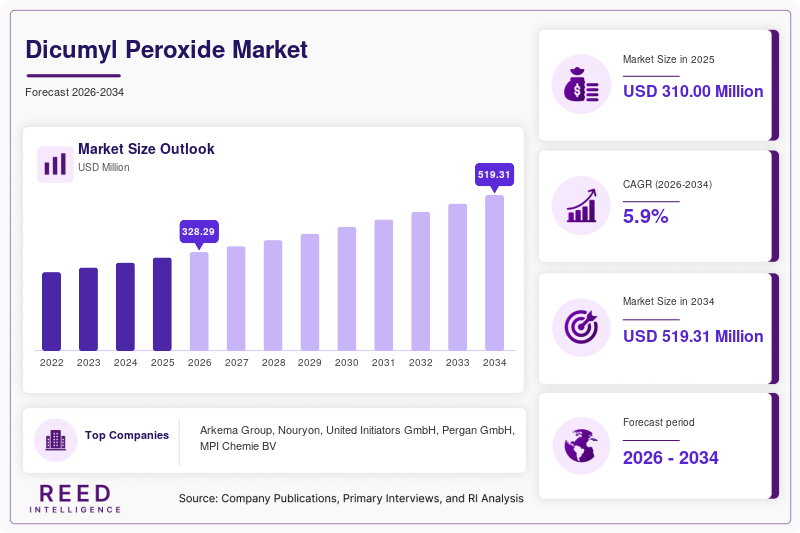
Key Highlights:
- Asia Pacific dominated the market with a 42% share, while it is also expected to be the fastest-growing region with a CAGR of 6.8%.
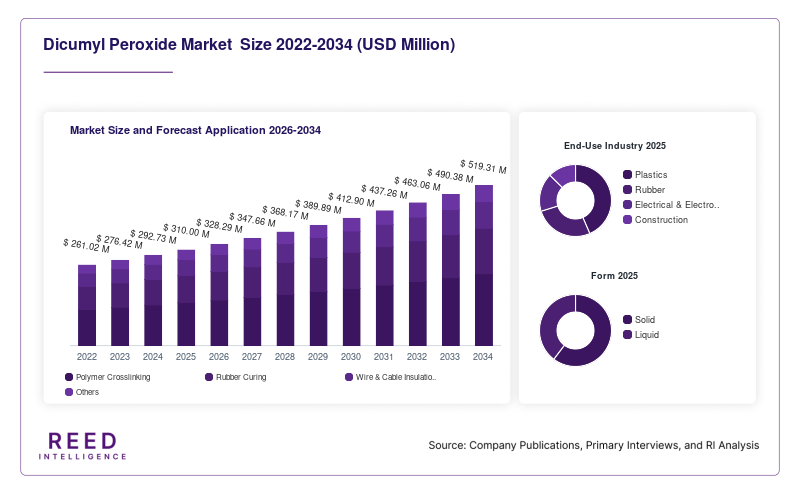
- By application, polymer crosslinking was the leading segment, while wire & cable insulation is projected to grow at the fastest CAGR of 7.2%.
- China remained the dominant country, with market values of USD 82 million in 2024 and USD 87 million in 2025.
Market Trends
Increasing Use in High-Performance Polymers
The Dicumyl Peroxide Market is witnessing growing adoption in high-performance polymer applications. Industries such as automotive and electronics are shifting toward materials with enhanced thermal stability and durability. Dicumyl peroxide plays a crucial role in crosslinking polyethylene and polypropylene, improving mechanical strength and resistance properties. This trend is particularly evident in the development of advanced insulation materials for electrical systems.
Shift Toward Eco-Friendly Processing Chemicals
Manufacturers are increasingly focusing on environmentally friendly production processes. As a result, there is a rising preference for peroxide-based initiators like dicumyl peroxide, which offer cleaner decomposition profiles compared to traditional chemicals. Regulatory pressure and sustainability goals are encouraging companies to optimize formulations and reduce hazardous by-products. This shift is expected to influence product innovation and market competitiveness over the forecast period.
Market Drivers
Rising Demand from Wire & Cable Industry
The expanding global demand for electricity transmission and communication infrastructure is fueling the need for high-quality insulation materials. Dicumyl peroxide is widely used in crosslinked polyethylene (XLPE), a key material in wire and cable insulation. Its ability to enhance thermal resistance and electrical properties makes it indispensable for modern cable systems. Growth in renewable energy projects and urban electrification is further accelerating demand.
Growth in Automotive and Rubber Industries
The automotive sector’s increasing reliance on durable rubber components is driving the consumption of dicumyl peroxide. It is extensively used as a curing agent in rubber manufacturing, improving elasticity and resistance to wear. The shift toward electric vehicles has also increased demand for high-performance materials, indirectly supporting the Dicumyl Peroxide Market.
Market Restraint
Handling and Storage Challenges
Dicumyl peroxide is a reactive chemical that requires careful handling and controlled storage conditions. It is sensitive to heat and contamination, which can lead to safety concerns during transportation and usage. These challenges increase operational costs for manufacturers and limit adoption among small-scale industries. Additionally, stringent safety regulations related to organic peroxides further restrict market growth, particularly in regions with strict compliance standards. Companies must invest in specialized infrastructure and training to ensure safe usage, which may hinder the expansion of the Dicumyl Peroxide Market.
Market Opportunities
Expansion in Renewable Energy Infrastructure
The global transition toward renewable energy presents significant opportunities for the Dicumyl Peroxide Market. Wind and solar energy systems require advanced cable insulation materials capable of withstanding harsh environmental conditions. Dicumyl peroxide-based crosslinking agents are well-suited for such applications, creating a strong growth avenue.
Technological Advancements in Polymer Processing
Ongoing innovations in polymer chemistry are opening new application areas for dicumyl peroxide. Improved formulations with enhanced stability and efficiency are being developed to meet specific industrial requirements. These advancements are expected to expand its use in niche applications, such as specialty elastomers and advanced composites, thereby boosting market growth.
Segmental Analysis
By Application
Polymer crosslinking was the dominant subsegment, accounting for approximately 48% of the market share in 2024. Its widespread use in enhancing the properties of polyethylene and polypropylene has made it the primary application area.
Wire & cable insulation is expected to be the fastest-growing subsegment, with a projected CAGR of 7.2%. The increasing need for efficient power transmission systems will drive growth in this segment.
By End-Use Industry
The plastics industry held the largest share of around 45% in 2024, driven by extensive use of dicumyl peroxide in polymer processing. The demand for high-performance plastics has supported this dominance.
The electrical & electronics segment is projected to grow at a CAGR of 6.9%, fueled by rising investments in power infrastructure and communication networks.
By Form
Solid form dominated the market with a 62% share in 2024, owing to its ease of handling and stability in industrial applications. It is widely preferred in large-scale manufacturing processes.
Liquid form is expected to grow at a CAGR of 6.3%, driven by its increasing use in specialized applications requiring precise dosing and uniform mixing.
By Distribution Channel
Direct sales accounted for the largest share of 58% in 2024, as manufacturers prefer direct procurement for bulk quantities. This channel ensures cost efficiency and consistent supply.
Online distribution is anticipated to grow at a CAGR of 7.0%, supported by digital transformation and increased accessibility of chemical products through e-commerce platforms.
Regional Analysis
North America
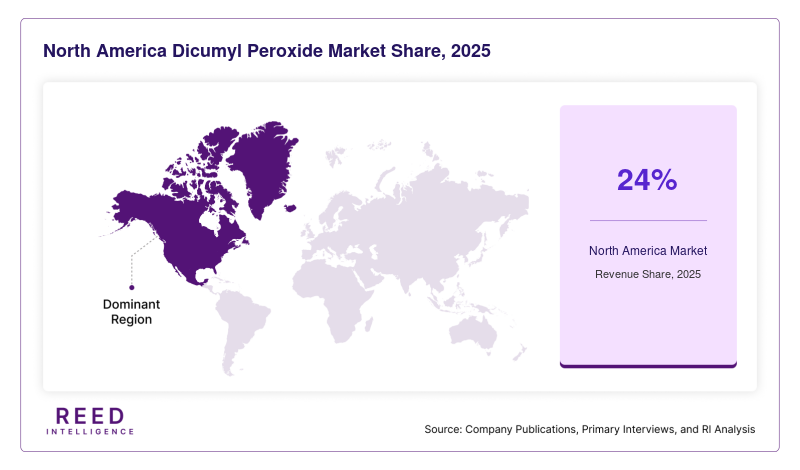
North America accounted for approximately 24% of the Dicumyl Peroxide Market share in 2025 and is projected to grow at a CAGR of 5.2% during the forecast period. The region’s growth will be supported by steady demand from the electrical and automotive industries.
The United States dominated the regional market due to its strong manufacturing base and advanced polymer industry. The presence of established chemical companies and ongoing investments in infrastructure modernization have contributed to sustained demand for dicumyl peroxide.
Europe
Europe held around 20% market share in 2025 and is expected to expand at a CAGR of 5.0% through 2034. The region’s focus on sustainable materials and strict environmental regulations will influence market dynamics.
Germany emerged as the dominant country, driven by its robust automotive and industrial sectors. The demand for high-performance materials in manufacturing processes has supported the use of dicumyl peroxide in polymer applications.
Asia Pacific
Asia Pacific captured the largest share of 42% in 2025 and is anticipated to grow at the fastest CAGR of 6.8%. Rapid industrialization and expanding manufacturing activities are key factors driving the market.
China led the region due to its extensive polymer production capacity and strong demand from construction and electronics industries. Government initiatives to boost infrastructure development have further enhanced market growth.
Middle East & Africa
The Middle East & Africa accounted for approximately 7% of the market share in 2025 and is projected to grow at a CAGR of 5.6%. The region’s growth will be supported by increasing investments in construction and energy sectors.
Saudi Arabia dominated the market, benefiting from its expanding petrochemical industry. The availability of raw materials and growing industrial activities have contributed to the adoption of dicumyl peroxide.
Latin America
Latin America held about 7% share in 2025 and is expected to grow at a CAGR of 5.4%. The region’s development in infrastructure and manufacturing sectors will drive demand.
Brazil led the regional market due to its growing automotive and construction industries. Increasing industrial output and rising demand for durable materials have supported market expansion.
Competitive Landscape
The Dicumyl Peroxide Market is moderately consolidated, with key players focusing on product innovation and capacity expansion. Leading companies are investing in research and development to enhance product performance and safety. Strategic collaborations and regional expansions are also common to strengthen market presence.
Arkema Group is recognized as a market leader, known for its extensive portfolio of organic peroxides. The company recently introduced improved formulations aimed at enhancing efficiency in polymer crosslinking applications. Other prominent players are also focusing on sustainability and regulatory compliance to maintain competitiveness.
Key Players
- Arkema Group
- Nouryon
- United Initiators GmbH
- Pergan GmbH
- MPI Chemie BV
- Akzo Nobel N.V.
- Chinasun Specialty Products Co., Ltd.
- Taicang Plastic Additives Factory
- Shanghai Oil Chemical Co., Ltd.
- Novichem
Recent Developments
- Arkema expanded its production capacity for organic peroxides to meet rising global demand.
- Nouryon introduced a new grade of dicumyl peroxide with enhanced safety features.
- United Initiators announced a strategic partnership to strengthen its distribution network in Asia Pacific.
- Pergan GmbH launched a product line focused on high-performance polymer applications.
- ADEKA Corporation invested in R&D to develop advanced peroxide formulations for specialty uses.
Dicumyl Peroxide Market Segments
Application
- Polymer Crosslinking
- Rubber Curing
- Wire & Cable Insulation
- Others
End-Use Industry
- Plastics
- Rubber
- Electrical & Electronics
- Construction
Form
- Solid
- Liquid
Distribution Channel
- Direct Sales
- Distributors
- Online
By Region
- North America
- Europe
- APAC
- Middle East and Africa
- LATAM