Dielectric Coolant Market Size, Share Demand Report By Product Type (Bio-Based Dielectric Coolants), By Application (Data Center Immersion Cooling, Battery Energy Storage Systems, Power Electronics, Electric Vehicles, Industrial Equipment), By End-Use Industry (IT & Telecommunications, Energy & Utilities, Automotive, Manufacturing), By Region & Segment Forecasts, 2026–2034
USD 3950
Market Overview
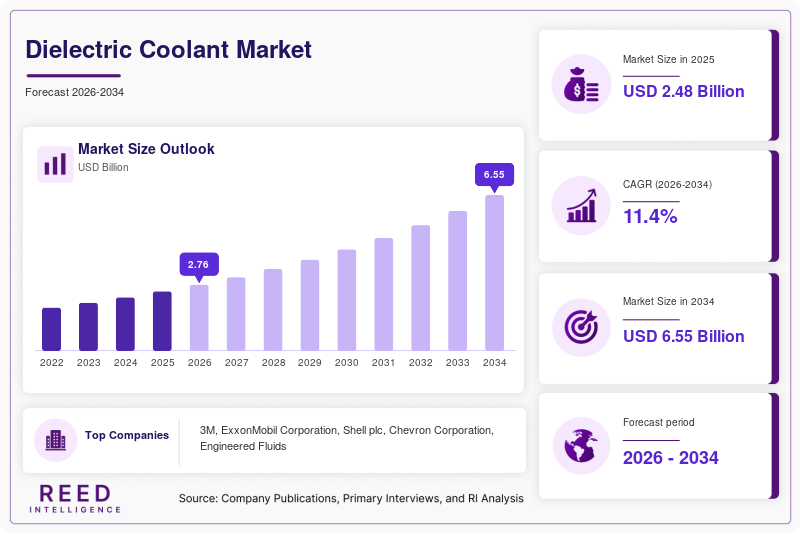
The global Dielectric Coolant Market size was valued at approximately USD 2.48 billion in 2026 and is projected to reach USD 5.87 billion by 2034, expanding at a CAGR of 11.4% during 2026–2034. The market is witnessing steady expansion due to increasing demand for advanced thermal management solutions across data centers, electric vehicles, battery energy storage systems, power electronics, and high-performance computing environments. Dielectric coolants are non-conductive fluids specifically designed to dissipate heat while preventing electrical interference, making them suitable for immersion cooling and other critical applications.
A major global factor supporting market growth is the rapid expansion of digital infrastructure. The increasing deployment of artificial intelligence workloads, cloud computing platforms, edge computing facilities, and hyperscale data centers has intensified the need for efficient cooling technologies. Traditional air-cooling systems are facing limitations in managing higher heat densities, prompting operators to adopt immersion cooling technologies that rely on dielectric coolants. Furthermore, rising investments in renewable energy storage systems and electric mobility are creating additional demand for advanced cooling fluids capable of improving equipment efficiency and operational reliability.
Key Highlights
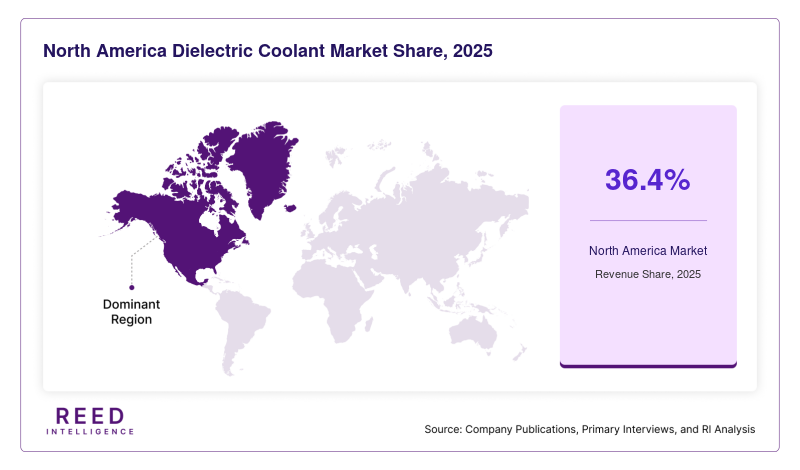
- North America dominated the market with a 36.4% share in 2025.
- Asia Pacific is expected to grow at the fastest CAGR of 13.2% during 2026–2034.
- By product type, synthetic dielectric coolants accounted for the largest share of 44.8%.
- while bio-based dielectric coolants are projected to grow at a CAGR of 14.5%.
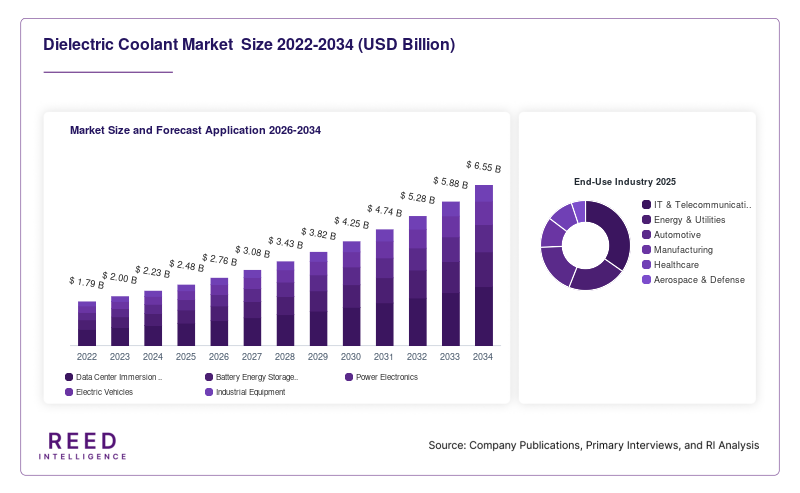
- By application, data center immersion cooling led with a 39.6% share.
- whereas battery energy storage systems are expected to expand at a CAGR of 15.1%.
- By end-use industry, IT and telecommunications held the largest share of 35.9%.
- while electric vehicle manufacturing is forecast to grow at a CAGR of 14.8%.
- The United States remained the dominant country, with market values of USD 690 million in 2024 and USD 760 million in 2025.
Market Trends
Growing Adoption of Immersion Cooling Technologies
The increasing deployment of immersion cooling systems across hyperscale and enterprise data centers is becoming a significant trend in the Dielectric Coolant Market. Data center operators are under pressure to manage rising power densities generated by artificial intelligence processors, graphics processing units, and advanced computing systems. Immersion cooling offers improved heat dissipation compared to conventional air-cooling methods while reducing energy consumption and infrastructure requirements. As organizations seek to optimize operational efficiency and lower carbon emissions, dielectric coolants are becoming essential components of next-generation cooling architectures. The trend is particularly evident among cloud service providers and high-performance computing facilities that require reliable thermal management under demanding operating conditions.
Expansion of Sustainable and Bio-Based Coolant Solutions
Environmental sustainability is increasingly influencing product development strategies within the Dielectric Coolant Market. Manufacturers are investing in bio-based and low-global-warming-potential fluid technologies to address environmental concerns and evolving regulatory requirements. These advanced formulations offer favorable thermal performance while reducing ecological impact compared with traditional synthetic alternatives. Growing corporate commitments toward sustainability targets are encouraging adoption across data centers, industrial facilities, and energy storage projects. In addition, end users are seeking cooling fluids that provide longer operational lifecycles and easier disposal processes. As environmental considerations become more important in purchasing decisions, sustainable dielectric coolant solutions are expected to gain substantial market traction over the forecast period.
Market Drivers
Rising Demand for High-Density Data Centers
The increasing construction of hyperscale and edge data centers is a major growth driver for the Dielectric Coolant Market. Artificial intelligence applications, machine learning workloads, cloud storage requirements, and digital transformation initiatives continue to generate unprecedented demand for computing power. As server racks become denser, conventional cooling methods struggle to maintain optimal operating temperatures. Dielectric coolants provide superior thermal management capabilities, enabling operators to improve equipment performance and reduce energy consumption. Their ability to support immersion cooling systems while enhancing server reliability makes them an attractive solution for modern data center infrastructure. Continued investments in digital ecosystems are expected to sustain strong demand for dielectric cooling technologies.
Growth of Electric Vehicles and Energy Storage Systems
The global transition toward electrification is creating substantial opportunities for dielectric coolant manufacturers. Electric vehicle batteries and stationary energy storage systems generate significant heat during charging and discharging cycles, requiring efficient thermal management solutions to ensure safety and performance. Dielectric coolants help maintain stable operating temperatures while protecting sensitive electronic components. As governments and private organizations continue investing in renewable energy integration and transportation electrification, demand for advanced cooling fluids is expected to increase. Expanding battery production facilities and growing deployment of large-scale energy storage projects are contributing to higher consumption of dielectric coolant products across multiple industrial sectors.
Market Restraint
High Initial Implementation Costs and Technical Integration Challenges
Despite favorable long-term efficiency benefits, the relatively high initial investment associated with dielectric cooling systems remains a key challenge for market growth. Many organizations continue to rely on established air-cooling infrastructure because transitioning to immersion cooling technologies often requires significant modifications to facility design, equipment configurations, and operational procedures. Small and medium-sized enterprises may find capital expenditures difficult to justify, particularly when existing cooling systems remain functional. Additionally, concerns regarding fluid compatibility, maintenance requirements, and employee training can delay adoption decisions. In certain industries, regulatory compliance and certification processes further increase implementation complexity. For example, operators upgrading traditional server environments to immersion cooling systems must often redesign rack configurations, monitoring systems, and maintenance practices. These factors can slow adoption rates, particularly in cost-sensitive markets, despite the long-term operational advantages offered by dielectric coolants.
Market Opportunities
Expansion of Artificial Intelligence Infrastructure
The rapid growth of artificial intelligence infrastructure presents a significant opportunity for the Dielectric Coolant Market. AI applications require powerful processors capable of handling complex computational workloads, resulting in substantial heat generation. Conventional cooling technologies often struggle to maintain efficient performance in these environments. Dielectric coolants enable immersion cooling systems that support higher processing densities while reducing energy consumption and cooling-related costs. As enterprises, governments, and technology providers continue investing in AI-focused facilities, demand for advanced thermal management solutions is expected to rise. This trend is likely to create new revenue opportunities for coolant manufacturers developing specialized formulations designed for high-performance computing applications.
Emerging Demand from Renewable Energy Storage Facilities
The growing deployment of renewable energy storage infrastructure is opening new growth avenues for dielectric coolant suppliers. Grid-scale battery storage projects require effective thermal management to maximize performance, safety, and operational lifespan. Dielectric coolants help maintain stable temperatures across battery systems while minimizing electrical risks. Increasing investments in solar and wind energy projects are driving demand for large-scale storage facilities capable of balancing power supply fluctuations. As governments implement policies supporting clean energy transitions, energy storage deployments are expected to accelerate significantly. This evolving landscape creates opportunities for manufacturers to introduce specialized dielectric coolant solutions tailored to the requirements of advanced battery technologies and energy management systems.
Segmental Analysis
By Product Type
Synthetic dielectric coolants represented the dominant product category, accounting for approximately 44.8% of market share in 2024. These fluids are widely utilized because of their favorable thermal conductivity, chemical stability, and compatibility with advanced electronic systems. Data centers, industrial automation facilities, and power electronics manufacturers increasingly prefer synthetic formulations due to their proven performance under demanding operating conditions. The ability to maintain consistent cooling efficiency while minimizing equipment degradation contributes significantly to their market leadership. Continuous research and development efforts aimed at enhancing fluid lifespan and environmental performance further reinforce the position of synthetic dielectric coolants across multiple end-use industries.
Bio-based dielectric coolants are expected to register the fastest growth, expanding at a CAGR of 14.5% through 2034. Growing environmental awareness and sustainability commitments are encouraging organizations to adopt cooling solutions with lower ecological impact. Bio-based formulations offer attractive performance characteristics while supporting corporate sustainability objectives. Regulatory pressure related to environmental protection is also motivating end users to explore alternatives to conventional fluid technologies. As manufacturers continue improving thermal properties and operational durability, bio-based products are gaining acceptance across data centers, energy storage facilities, and industrial applications. Increasing investments in green technologies are expected to accelerate adoption throughout the forecast period.
By Application
Data center immersion cooling accounted for the largest share of approximately 39.6% in 2024, reflecting the increasing need for advanced thermal management within digital infrastructure environments. Growing deployment of artificial intelligence servers, cloud computing systems, and high-performance computing equipment has intensified cooling requirements across modern data centers. Immersion cooling solutions utilizing dielectric fluids provide superior heat transfer efficiency while reducing energy consumption and facility space requirements. Operators benefit from improved equipment reliability and lower operating costs, making immersion cooling an attractive option for expanding digital ecosystems. Continuous growth in global data traffic further strengthens demand within this application segment.
Battery energy storage systems are projected to be the fastest-growing application segment, recording a CAGR of 15.1% during the forecast period. Renewable energy integration and electrification initiatives are driving widespread deployment of advanced battery technologies. Effective thermal management is essential for maintaining battery performance, safety, and operational longevity. Dielectric coolants provide reliable temperature control while minimizing electrical risks associated with high-energy storage systems. Increasing investments in utility-scale storage projects, electric vehicle charging infrastructure, and distributed energy resources are creating strong demand for specialized cooling solutions. These factors are expected to support substantial segment expansion through 2034.
By End-Use Industry
The IT and telecommunications sector held the leading position with approximately 35.9% market share in 2024. Rapid digitalization, cloud adoption, and growing internet traffic are increasing the need for efficient thermal management across computing environments. Data centers represent a major source of demand as operators seek solutions capable of handling rising power densities while controlling energy costs. Dielectric coolants help optimize cooling efficiency and support sustainability goals by reducing dependence on conventional air-cooling systems. Ongoing investments in artificial intelligence infrastructure, edge computing networks, and telecommunications modernization continue to strengthen the sector's contribution to overall market revenue.
Electric vehicle manufacturing is anticipated to emerge as the fastest-growing end-use industry, expanding at a CAGR of 14.8% through 2034. Vehicle electrification trends are accelerating demand for advanced battery technologies and power electronics systems that require effective thermal management. Dielectric coolants help improve battery safety, charging efficiency, and operational reliability under diverse operating conditions. Growing government incentives for electric mobility and increasing consumer adoption of electric vehicles are encouraging manufacturers to expand production capacity. As battery technologies become more sophisticated, the importance of high-performance cooling solutions is expected to increase significantly, supporting rapid market growth.
Regional Analysis
North America
North America accounted for approximately 36.4% of the global Dielectric Coolant Market in 2025 and continues to maintain a leading position within the industry. The region benefits from strong investments in hyperscale data centers, artificial intelligence infrastructure, and advanced computing facilities. Major technology companies are actively deploying immersion cooling systems to improve energy efficiency and support increasing computational workloads. The market is projected to expand at a CAGR of 10.8% through 2034, supported by continuous technological innovation and sustainability initiatives across the information technology sector.
The United States remains the dominant contributor to regional revenue generation. One unique growth factor is the country's concentration of AI-focused data center projects requiring advanced thermal management solutions. Increasing demand for high-performance processors and cloud infrastructure is encouraging operators to adopt dielectric cooling technologies. The presence of major technology firms, established research capabilities, and favorable investment conditions further strengthens the market outlook across the nation.
Europe
Europe represented nearly 27.1% of global market revenue in 2025 and is expected to maintain steady growth during the forecast period. The region is projected to record a CAGR of 10.4% as organizations focus on reducing energy consumption and achieving sustainability targets. Stringent environmental regulations are encouraging the adoption of efficient cooling technologies within data centers and industrial facilities. Growing investments in renewable energy infrastructure and advanced manufacturing activities are also contributing to increased demand for dielectric coolant solutions.
Germany serves as the leading market within Europe due to its strong industrial base and advanced engineering capabilities. A unique growth factor supporting regional expansion is the increasing integration of energy-efficient cooling technologies within manufacturing operations. German industries are emphasizing operational efficiency and carbon reduction strategies, creating favorable conditions for dielectric coolant adoption. Continuous investments in digital infrastructure further support long-term market development.
Asia Pacific
Asia Pacific held approximately 22.5% of the global Dielectric Coolant Market in 2025 and is anticipated to record the fastest growth rate during the forecast period. The market is expected to expand at a CAGR of 13.2% through 2034. Rapid industrialization, increasing digital transformation initiatives, and expanding cloud computing infrastructure are generating significant demand for advanced cooling technologies. The region is also witnessing substantial investments in electric vehicle manufacturing and battery production facilities, further supporting market growth.
China dominates the Asia Pacific market due to its extensive electronics manufacturing ecosystem and large-scale data center construction activities. A unique growth factor is the country's aggressive expansion of domestic artificial intelligence infrastructure. Rising demand for high-performance computing environments is accelerating adoption of immersion cooling technologies and dielectric coolants. Government support for digitalization and advanced manufacturing projects continues to create favorable opportunities for market participants.
Middle East & Africa
The Middle East & Africa accounted for approximately 7.1% of global market revenue in 2025 and is projected to grow at a CAGR of 9.8% through 2034. Increasing investments in digital infrastructure, smart city projects, and data center developments are supporting regional demand. Organizations are exploring advanced cooling solutions to manage high ambient temperatures while improving operational efficiency. Growth in renewable energy projects and industrial automation initiatives is also contributing to the adoption of dielectric cooling technologies.
The United Arab Emirates is the dominant market within the region. A unique growth factor is the rapid expansion of smart city developments requiring advanced data processing and digital infrastructure capabilities. These projects are generating demand for energy-efficient cooling technologies capable of operating effectively in challenging climatic conditions. Continued government investments in innovation and technology-driven economic diversification further support regional market growth.
Latin America
Latin America captured approximately 6.9% of the global Dielectric Coolant Market in 2025 and is expected to expand at a CAGR of 9.5% during the forecast period. Growing digitalization initiatives and increasing adoption of cloud computing services are supporting market development. Regional organizations are investing in modern data center facilities to accommodate rising internet usage and digital service demand. Additionally, industrial modernization programs are creating opportunities for advanced thermal management technologies across various sectors.
Brazil remains the leading country within Latin America. A unique growth factor is the increasing deployment of regional cloud infrastructure designed to support expanding digital economies. As organizations invest in local data processing capabilities, demand for efficient cooling systems continues to rise. Government initiatives supporting digital transformation and growing awareness of energy-efficient technologies are expected to strengthen market prospects throughout the forecast period.
Competitive Landscape
The Dielectric Coolant Market is characterized by the presence of global chemical manufacturers, specialty fluid developers, and thermal management solution providers competing through product innovation and strategic partnerships. Companies are focusing on improving thermal conductivity, environmental performance, and fluid longevity to address evolving customer requirements. Research and development investments remain a key competitive strategy, particularly in bio-based and low-emission coolant technologies.
Among leading participants, 3M continues to maintain a strong market position due to its extensive portfolio of dielectric fluid solutions and established relationships across electronics and data center industries. A recent development involved the expansion of advanced immersion cooling fluid offerings targeted at high-density computing applications. Other prominent companies are pursuing collaborations with data center operators and electric vehicle manufacturers to strengthen market presence and accelerate commercialization of next-generation cooling technologies.Competitive dynamics are expected to intensify as demand increases across artificial intelligence infrastructure, renewable energy storage systems, and electric mobility applications. Companies capable of delivering efficient, sustainable, and cost-effective dielectric coolant solutions are likely to secure stronger market positions during the forecast period.
Key Players
- 3M
- ExxonMobil
- Shell plc
- Chevron Corporation
- Engineered Fluids
- Solvay
- Dow Inc.
- Lubrizol Corporation
- BASF SE
- TotalEnergies
- Castrol
- Petro-Canada Lubricants
- Valvoline Inc.
- M&I Materials
- FUCHS Group
Recent Developments
- A leading dielectric fluid manufacturer introduced a new bio-based immersion cooling fluid designed for hyperscale data center deployments, focusing on sustainability and energy efficiency.
- Several global data center operators announced pilot projects utilizing advanced dielectric immersion cooling systems to support artificial intelligence and high-performance computing workloads.
- A major thermal management solutions provider expanded production capacity for synthetic dielectric coolants to address increasing demand from battery energy storage and electric vehicle applications.
- Multiple chemical companies formed strategic partnerships with renewable energy developers to create specialized cooling solutions for grid-scale battery storage facilities.
- Industry participants accelerated research programs focused on low-emission dielectric coolant formulations with enhanced thermal conductivity and longer operational lifecycles.
Dielectric Coolant Market Segments
Product Type
A PHP Error was encountered
Severity: Notice
Message: Undefined offset: 0
Filename: reportpages/rd.php
Line Number: 400
Backtrace:
File: /var/www/html/application/views/frontend/reportpages/rd.php
Line: 400
Function: _error_handler
File: /var/www/html/application/controllers/FrontendReportController.php
Line: 420
Function: view
File: /var/www/html/index.php
Line: 315
Function: require_once
- Synthetic Dielectric Coolants
- Mineral Oil-Based Dielectric Coolants
- Bio-Based Dielectric Coolants
Application
- Data Center Immersion Cooling
- Battery Energy Storage Systems
- Power Electronics
- Electric Vehicles
- Industrial Equipment
End-Use Industry
- IT & Telecommunications
- Energy & Utilities
- Automotive
- Manufacturing
- Healthcare
- Aerospace & Defense
By Region
- North America
- Europe
- APAC
- Middle East and Africa
- LATAM