Diethanolamide Market Size, Share & Demand Report By Type (Coconut Diethanolamide, Lauramide Diethanolamide, Oleamide Diethanolamide, Other Types), By Application (Personal Care Products, Industrial Cleaning, Textile Chemicals, Lubricants and Metalworking Fluids, Agricultural Chemicals, Other Applications), By End-Use Industry (Consumer Goods, Industrial Manufacturing, Automotive, Textile Industry, Agriculture, Other End-Use Industries) By Region & Segment Forecasts, 2026–2034
USD 3950
Market Overview
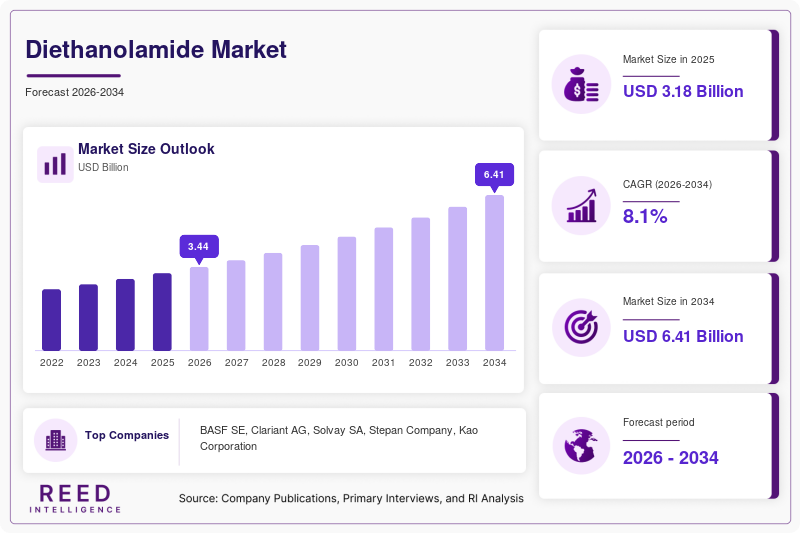
The global Diethanolamide Market size was valued at USD 3.18 billion in 2026 and is projected to reach USD 5.94 billion by 2034, expanding at a CAGR of 8.1% during the forecast period. The market continues to gain momentum due to the expanding use of diethanolamide compounds in personal care formulations, industrial cleaners, textile chemicals, lubricants, and agricultural emulsifiers. Manufacturers are increasingly using coconut and fatty acid-based diethanolamide ingredients because of their foaming, thickening, and emulsifying properties. Growing consumer demand for multifunctional surfactants in shampoos, liquid detergents, and cosmetic products is also supporting market growth across developed and emerging economies.
One of the major global factors driving the Diethanolamide Market is the rapid expansion of the household and personal care industry. Rising urbanization, changing hygiene awareness, and increasing spending on premium cleaning products have encouraged manufacturers to increase production capacities for surfactants and foam stabilizers. Diethanolamide derivatives are widely used in liquid soaps, hand washes, and industrial cleaning products because they improve viscosity and product performance. In addition, several chemical manufacturers are investing in bio-based feedstock integration to meet environmental standards while maintaining cost efficiency. The market is also benefiting from growing industrial demand in textile processing and metalworking fluids, particularly across Asia Pacific and Latin America.
Key Highlights
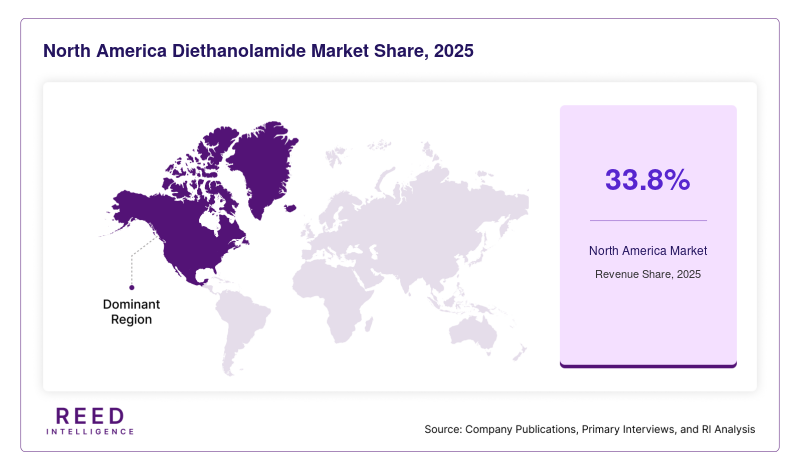
- North America dominated the market with a 33.8% share in 2025.
- Asia Pacific is expected to grow at the fastest CAGR of 9.8% during 2026–2034.
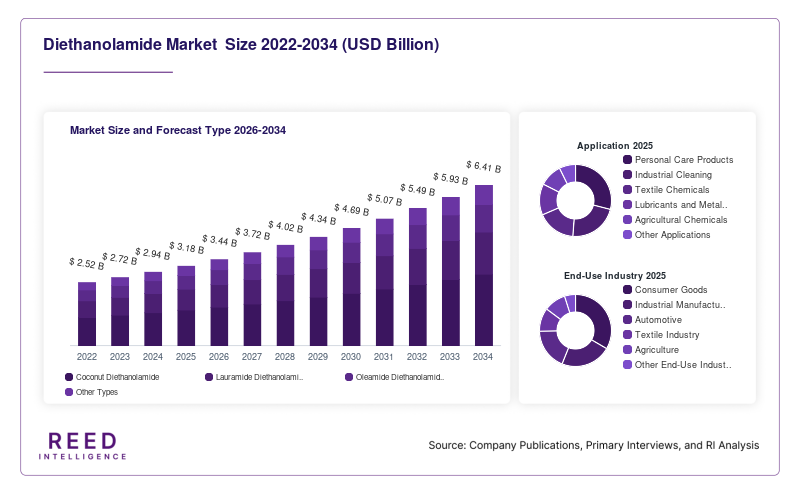
- By type, coconut diethanolamide accounted for the largest share of 42.6%, while lauramide diethanolamide is projected to grow at a CAGR of 9.5%.
- By application, personal care products led with a 39.4% share, whereas industrial cleaning applications are expected to expand at a CAGR of 9.2%.
- By end-use industry, consumer goods accounted for the highest share of 36.1%, while industrial manufacturing is anticipated to grow at a CAGR of 8.9%.
- The United States remained the dominant country, with market values of USD 620 million in 2024 and USD 675 million in 2025.
Market Trends
Rising Preference for Bio-Based Surfactant Ingredients
The Diethanolamide Market is witnessing strong demand for bio-based and naturally derived surfactant ingredients across cosmetic, detergent, and industrial applications. Manufacturers are increasingly shifting toward coconut oil and vegetable oil-based diethanolamide production to align with sustainability goals and regulatory compliance standards. Consumers are showing greater interest in environmentally compatible cleaning and personal care products, which is encouraging producers to reformulate products with renewable feedstock materials. This trend is especially visible in Europe and North America, where large consumer brands are introducing sulfate-free shampoos and biodegradable liquid soaps containing mild surfactant systems. Chemical companies are also investing in green chemistry technologies to reduce emissions during production while maintaining product performance. Growing awareness regarding safer formulations and eco-label certifications is expected to strengthen the adoption of bio-based diethanolamide compounds throughout the forecast period.
Expansion of High-Performance Cleaning Formulations
The increasing use of high-performance cleaning solutions in institutional, industrial, and residential sectors is shaping product innovation in the Diethanolamide Market. Manufacturers are developing advanced cleaning formulations that offer enhanced foam stability, grease removal, and viscosity control for liquid detergents and multipurpose cleaners. Diethanolamide compounds are gaining wider acceptance in concentrated cleaning products because they improve texture and maintain product consistency under varying storage conditions. The trend is becoming more prominent in hospitality, healthcare, and food processing sectors where sanitation standards continue to rise. Demand for efficient cleaning products during commercial expansion in emerging economies is also contributing to higher consumption of specialty surfactants. Several companies are introducing low-irritation and high-solubility diethanolamide variants to meet industrial cleaning requirements while reducing chemical usage. This transition toward multifunctional cleaning formulations is expected to create long-term opportunities for market participants.
Market Drivers
Growing Demand from the Personal Care and Cosmetics Industry
The expanding personal care and cosmetics sector is a major growth driver for the Diethanolamide Market. Diethanolamide compounds are widely used in shampoos, body washes, facial cleansers, and liquid soaps because of their ability to stabilize foam and improve viscosity. Rising consumer expenditure on premium grooming and hygiene products has increased the demand for effective surfactants that provide better texture and cleansing performance. The growth of e-commerce beauty brands and specialized skincare products has further accelerated the use of multifunctional ingredients in cosmetic formulations. In emerging economies, rapid urbanization and increasing awareness regarding personal hygiene are encouraging higher consumption of personal care products. Several manufacturers are also focusing on mild and skin-compatible formulations, which has increased the adoption of coconut-based diethanolamide ingredients. Continuous product innovation and expanding retail distribution networks are expected to support market growth over the coming years.
Increasing Industrial Usage in Cleaning and Lubrication Applications
Industrial demand for efficient cleaning agents and lubrication additives is contributing significantly to the growth of the Diethanolamide Market. These compounds are used in industrial degreasers, textile processing chemicals, metalworking fluids, and oilfield formulations because they improve emulsification and product stability. Manufacturing industries are increasingly adopting specialized cleaning solutions that enhance operational efficiency and equipment maintenance. The growth of automotive manufacturing, heavy machinery production, and industrial processing facilities is generating consistent demand for chemical additives with strong surfactant properties. In addition, the expansion of commercial cleaning services and institutional sanitation programs is increasing the need for concentrated liquid cleaning formulations. Several industrial operators are seeking cost-effective additives that provide improved compatibility with water-based systems, which is supporting the demand for diethanolamide compounds. Rising investments in industrial infrastructure across Asia Pacific and the Middle East are expected to sustain long-term market expansion.
Market Restraint
Regulatory Concerns Related to Chemical Safety and Environmental Impact
Regulatory scrutiny regarding the safety profile and environmental impact of certain diethanolamide compounds remains a key restraint for the Diethanolamide Market. Several regulatory agencies have introduced guidelines related to ingredient concentration limits, labeling standards, and potential impurities associated with surfactant production. Manufacturers operating in Europe and North America are facing stricter compliance requirements concerning chemical handling, wastewater discharge, and occupational safety standards. These regulations increase production costs and require additional investments in quality testing and process optimization. Some consumer brands are also limiting the use of synthetic surfactants in response to growing public concerns regarding chemical exposure and skin sensitivity. Smaller manufacturers often face challenges in adapting to evolving regulatory frameworks because of limited financial resources and technological capabilities. For example, personal care product companies reformulating sulfate-free and naturally derived product lines may reduce the use of conventional diethanolamide ingredients in favor of alternative surfactants. Such shifts could moderately limit market penetration in highly regulated regions during the forecast period.
Market Opportunities
Growing Potential in Emerging Economies
Emerging economies across Asia Pacific, Latin America, and Africa are creating substantial opportunities for the Diethanolamide Market due to rising industrialization and increasing consumer spending on hygiene products. Expanding middle-class populations and improving retail distribution channels are driving demand for liquid detergents, personal care items, and industrial cleaners. Local manufacturers are increasing production capacities to meet domestic consumption needs while reducing dependence on imports. The growth of urban infrastructure projects and commercial establishments is also supporting demand for institutional cleaning products containing surfactant additives. In countries such as India, Brazil, Indonesia, and Vietnam, manufacturers are introducing affordable and concentrated formulations that rely on cost-effective foam stabilizers like diethanolamide compounds. Additionally, government initiatives supporting domestic chemical manufacturing and foreign direct investment are encouraging international companies to establish regional production facilities. These developments are expected to create long-term growth prospects for market participants.
Technological Advancements in Specialty Chemical Production
Technological advancements in specialty chemical manufacturing are opening new growth opportunities for the Diethanolamide Market. Producers are increasingly adopting advanced process technologies to improve product purity, reduce waste generation, and enhance energy efficiency during production. Automated blending systems and digital quality monitoring solutions are helping manufacturers maintain consistent product performance for industrial and personal care applications. Innovations in bio-based feedstock integration are also enabling companies to develop sustainable product lines that comply with evolving environmental standards. Several manufacturers are exploring customized diethanolamide formulations for high-performance lubricants, agricultural emulsifiers, and textile processing chemicals. These specialty applications require improved thermal stability and compatibility with complex chemical systems. Research and development activities focused on multifunctional surfactants are expected to support product diversification and higher-value applications. As industries continue to demand efficient and environmentally compatible additives, technological innovation is likely to strengthen future market expansion.
Segmental Analysis
By Type
Coconut diethanolamide accounted for the largest share of the Diethanolamide Market in 2024, representing 42.6% of total revenue. The segment maintains strong demand due to its extensive use in shampoos, liquid soaps, detergents, and industrial cleaners. Coconut-based formulations are widely preferred because they provide effective foam stabilization, emulsification, and viscosity enhancement properties while offering better compatibility with personal care formulations. Manufacturers are increasingly utilizing coconut-derived feedstocks to improve sustainability profiles and align with consumer preference for naturally sourced ingredients. The segment is also benefiting from growing demand for sulfate-free and mild cleansing products across developed economies. In addition, expanding production of household cleaning solutions in emerging economies continues to support steady consumption of coconut diethanolamide compounds across multiple industrial applications.
By Application
Personal care products represented the dominant application segment in the Diethanolamide Market in 2024, accounting for 39.4% of total market share. The segment benefits from rising demand for shampoos, facial cleansers, hand washes, and body care products across global consumer markets. Diethanolamide compounds are widely used in these formulations because they improve foam texture, viscosity, and cleansing efficiency while supporting stable product consistency. Increasing consumer awareness regarding hygiene and grooming routines is encouraging cosmetic manufacturers to launch new product variants with enhanced sensory performance. The expansion of online retail channels and premium beauty brands has also contributed to higher demand for specialty surfactant ingredients. Additionally, growing consumption of personal care products in Asia Pacific and Latin America continues to create sustained growth opportunities for manufacturers operating within this application segment.
By End-Use Industry
The consumer goods segment held the largest share of the Diethanolamide Market in 2024, contributing 36.1% of overall revenue. The segment includes household cleaning products, toiletries, cosmetics, and personal hygiene items that rely heavily on surfactant-based ingredients for performance enhancement. Increasing consumer preference for liquid soaps, hand sanitizers, dishwashing liquids, and haircare products is supporting strong product demand across developed and emerging markets. Manufacturers within the consumer goods industry are focusing on product innovation, fragrance enhancement, and improved texture formulations to strengthen brand differentiation. Diethanolamide compounds are frequently used because they improve foam quality and product stability while supporting cost-effective production processes. Rising disposable income levels and changing consumer lifestyles are expected to sustain long-term demand growth within this segment.
Regional Analysis
North America
North America accounted for 33.8% of the global Diethanolamide Market in 2025 and continues to maintain a strong position due to high demand from personal care, industrial cleaning, and chemical processing industries. The region is projected to expand at a CAGR of 7.4% during the forecast period as manufacturers continue investing in premium surfactant formulations and sustainable chemical technologies. The presence of established cosmetic and household cleaning product manufacturers supports steady product consumption. Growing awareness regarding hygiene and sanitation standards in commercial sectors is also increasing the adoption of advanced cleaning chemicals across the region.
The United States remains the dominant country in North America due to its strong industrial base and high consumer spending on personal care products. One unique growth factor supporting the market is the rapid adoption of bio-based chemical ingredients by major consumer goods companies seeking sustainable product positioning. Several domestic manufacturers are expanding production facilities for coconut-based diethanolamide compounds to meet growing demand from eco-friendly cosmetic and cleaning product lines. Increasing investment in research and development activities related to mild surfactant formulations is further supporting regional market growth.
Europe
Europe represented 25.1% of the global Diethanolamide Market in 2025 and is expected to grow at a CAGR of 7.1% from 2026 to 2034. The region benefits from strong demand for environmentally compatible personal care and household cleaning products. European chemical manufacturers are increasingly focusing on sustainable production processes and biodegradable surfactant ingredients to comply with strict environmental regulations. Demand for specialty industrial cleaning chemicals in automotive manufacturing and food processing sectors is also contributing to market expansion. The growing trend toward premium organic cosmetic products continues to support product innovation throughout the region.
Germany remains the leading country in the European market because of its advanced chemical manufacturing industry and strong industrial cleaning sector. A unique growth factor in the country is the integration of green chemistry technologies within large-scale surfactant production facilities. German manufacturers are actively investing in low-emission production systems and renewable raw materials to improve environmental performance. The presence of well-established automotive and industrial equipment industries also creates sustained demand for metalworking fluids and specialty cleaning agents containing diethanolamide compounds.
Asia Pacific
Asia Pacific held 28.4% of the global Diethanolamide Market in 2025 and is anticipated to register the fastest CAGR of 9.8% during the forecast period. Rapid industrialization, expanding urban populations, and rising consumer awareness regarding hygiene products are driving significant market growth across the region. The increasing production of shampoos, detergents, and liquid cleaning products in countries such as China and India is creating consistent demand for foam stabilizers and surfactant additives. Growing investments in domestic chemical manufacturing capacities and lower production costs are also supporting regional market expansion.
China continues to dominate the Asia Pacific market due to its extensive chemical production infrastructure and large consumer goods manufacturing sector. One unique growth factor supporting the country’s market expansion is the rapid development of export-oriented household cleaning and cosmetic product industries. Chinese manufacturers are increasingly supplying low-cost surfactant ingredients to global markets while improving production efficiency through automation and large-scale operations. Rising domestic demand for premium personal care products among middle-income consumers is also strengthening long-term growth opportunities.
Middle East & Africa
The Middle East & Africa accounted for 6.4% of the global Diethanolamide Market in 2025 and is projected to grow at a CAGR of 7.9% through 2034. Increasing industrialization and the expansion of commercial cleaning activities are supporting market growth in the region. Demand for industrial detergents, oilfield chemicals, and institutional cleaning solutions continues to rise due to ongoing infrastructure development projects. The hospitality and healthcare sectors are also increasing consumption of specialized cleaning formulations. Several regional governments are promoting local chemical production to reduce import dependence and strengthen industrial diversification initiatives.
Saudi Arabia is the dominant country within the regional market because of its strong petrochemical industry and expanding industrial infrastructure projects. A unique growth factor supporting market growth is the increasing use of specialty surfactants in oilfield and refinery cleaning applications. Industrial operators are adopting advanced cleaning formulations to improve operational efficiency and equipment maintenance within large-scale energy facilities. Government investments in industrial zones and manufacturing diversification programs are further encouraging chemical companies to establish regional production operations.
Latin America
Latin America captured 6.3% of the global Diethanolamide Market in 2025 and is expected to grow at a CAGR of 8.2% during the forecast period. The region is benefiting from rising consumption of personal care products, liquid detergents, and industrial cleaning agents. Urbanization and improving economic conditions are increasing demand for affordable hygiene and household cleaning solutions across major economies. Manufacturers are also focusing on expanding local production capabilities to meet regional demand and reduce logistics costs. Growth in food processing and textile industries is creating additional opportunities for surfactant-based chemical formulations.
Brazil remains the leading country in the Latin American market due to its large consumer goods sector and expanding domestic chemical industry. One unique growth factor supporting the market is the increasing production of plant-based surfactant ingredients derived from locally available agricultural feedstocks. Brazilian manufacturers are investing in sustainable chemical processing to support demand for environmentally compatible cosmetic and cleaning products. The strong presence of regional detergent and personal care brands is also contributing to higher consumption of diethanolamide compounds.
Competitive Landscape
The Diethanolamide Market is moderately fragmented, with global and regional manufacturers competing through product innovation, pricing strategies, and production capacity expansion. Leading companies are focusing on sustainable surfactant production, bio-based raw material integration, and strategic partnerships to strengthen market positioning. Product quality, formulation compatibility, and regulatory compliance remain critical competitive factors within the industry. Several manufacturers are also expanding their distribution networks in emerging economies to capture growing demand from personal care and industrial cleaning sectors.
BASF SE remains one of the leading participants in the global market due to its broad specialty chemical portfolio and extensive global manufacturing presence. The company continues investing in sustainable surfactant technologies and advanced formulation development to support demand from personal care and industrial customers. In 2025, BASF SE announced the expansion of its surfactant production capacity in Asia Pacific to improve supply chain efficiency and meet growing regional demand.
Key Players
- BASF SE
- Clariant AG
- Solvay SA
- Stepan Company
- Kao Corporation
- Croda International Plc
- Huntsman Corporation
- Evonik Industries AG
- Galaxy Surfactants Ltd.
- Lubrizol Corporation
- Pilot Chemical Company
- Colonial Chemical Inc.
- Innospec Inc.
- Taiwan NJC Corporation
- Oxiteno SA
Recent Developments
- In 2025, Clariant AG introduced a new bio-based diethanolamide surfactant series designed for sulfate-free personal care formulations and eco-friendly household cleaners.
- In 2024, Stepan Company expanded its specialty surfactant manufacturing facility in North America to support increasing demand from industrial cleaning and consumer product manufacturers.
- In 2025, Galaxy Surfactants Ltd. announced a strategic partnership with regional cosmetic manufacturers in Southeast Asia to strengthen the supply of coconut-based surfactant ingredients.
- In 2024, Kao Corporation launched an advanced low-irritation surfactant formulation for premium skincare and haircare products targeting sensitive skin applications.
- In 2025, Solvay SA invested in process optimization technologies to improve energy efficiency and reduce emissions within its specialty chemical production operations.
Diethanolamide Market Segments
Type
- Coconut Diethanolamide
- Lauramide Diethanolamide
- Oleamide Diethanolamide
- Other Types
Application
- Personal Care Products
- Industrial Cleaning
- Textile Chemicals
- Lubricants and Metalworking Fluids
- Agricultural Chemicals
- Other Applications
End-Use Industry
- Consumer Goods
- Industrial Manufacturing
- Automotive
- Textile Industry
- Agriculture
- Other End-Use Industries
By Region
- North America
- Europe
- APAC
- Middle East and Africa
- LATAM