Diethylene Glycol Monoethyl Ether Market Size, Share, Demand Report by Purity Type (High Purity Grade, Industrial Grade), By Application (Coatings & Solvents, Electronic Cleaning, Chemical Intermediates, Industrial Cleaning), By End-Use Industry (Paints & Coatings, Electronics & Semiconductors, Pharmaceuticals, Industrial Manufacturing, Household Cleaning) & Regional Forecasts, 2026–2034
USD 3950
Market Overview
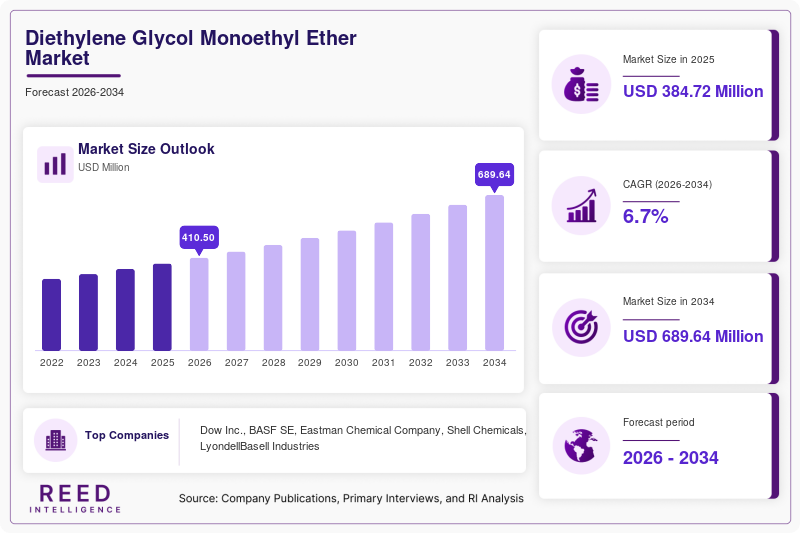
The Diethylene Glycol Monoethyl Ether Market size is estimated at USD 410.5 million, and it is expected to reach USD 690.2 million by 2034, registering a CAGR of 6.7% during the forecast period.
A key global factor supporting the growth of the Diethylene Glycol Monoethyl Ether Market is the rapid expansion of industrial coatings and specialty chemical manufacturing, particularly in emerging economies. Rising construction activity and automotive production have significantly increased demand for efficient, slow-evaporating solvents, strengthening market penetration.
The Diethylene Glycol Monoethyl Ether Market is also benefiting from its strong solvency properties, low volatility, and compatibility with water-based and solvent-based systems, making it widely preferred in formulation chemistry across multiple industries.
Key Highlights
- Dominant region share (2025): Asia Pacific held 34.2% share of the global market
- Fastest-growing region CAGR (2026–2034): Middle East & Africa at 7.4% CAGR
- Leading subsegment (Purity Type): High-purity grade held 52.3% share in 2025
- Fastest-growing subsegment (Purity Type): Industrial grade at 7.2% CAGR
- Dominant country: China market size was USD 88.2 million in 2024 and USD 94.6 million in 2025
Market Trends
Shift Toward Low-VOC and Environment-Friendly Solvents
The Diethylene Glycol Monoethyl Ether Market is witnessing a gradual transition toward low-VOC (volatile organic compound) and environmentally compliant solvent systems. Regulatory pressure on industrial emissions has led manufacturers to adopt glycol ethers that provide high solvency with reduced environmental impact, boosting demand in coatings and cleaning formulations.
Rising Demand from Electronics and Precision Cleaning Applications
Another major trend shaping the Diethylene Glycol Monoethyl Ether Market is its increasing use in electronics manufacturing. The compound is widely used in precision cleaning, semiconductor processing, and circuit board formulations due to its excellent solvency and controlled evaporation rate, supporting high-precision industrial applications.
Market Drivers
Expanding Paints and Coatings Industry
One of the primary drivers of the Diethylene Glycol Monoethyl Ether Market is the rapid expansion of the global paints and coatings industry. Infrastructure development, automotive production, and industrial maintenance activities are increasing demand for high-performance solvent systems that improve flow, leveling, and film formation.
Growth in Industrial and Household Cleaning Applications
The Diethylene Glycol Monoethyl Ether Market is also driven by rising demand for industrial and household cleaning products. Its excellent solubility in both organic and aqueous systems makes it a preferred ingredient in degreasers, surface cleaners, and specialty cleaning formulations used across manufacturing and institutional sectors.
Market Restraint
Health and Environmental Regulatory Restrictions
A key restraint impacting the Diethylene Glycol Monoethyl Ether Market is the increasing regulatory scrutiny related to glycol ether exposure. Concerns regarding long-term occupational exposure and environmental persistence have led to tighter handling regulations, which may limit adoption in certain regions and applications.
Market Opportunities
Expansion of Green Chemistry-Based Solvent Formulations
The shift toward sustainable chemical production presents a major opportunity for the Diethylene Glycol Monoethyl Ether Market. Manufacturers are increasingly investing in bio-based and low-toxicity solvent alternatives that maintain performance while complying with environmental standards.
Growth in Semiconductor and Electronics Manufacturing
Rising global semiconductor production, particularly in Asia Pacific and North America, is creating new demand opportunities. The compound’s role in precision cleaning and microelectronics processing positions it as a critical material in high-growth electronics supply chains.
Segmental Analysis
The Diethylene Glycol Monoethyl Ether Market is segmented based on purity type, application, and end-use industry. Each segment reflects unique demand dynamics influenced by industrial growth, regulatory trends, and formulation requirements.
By Purity Type Analysis
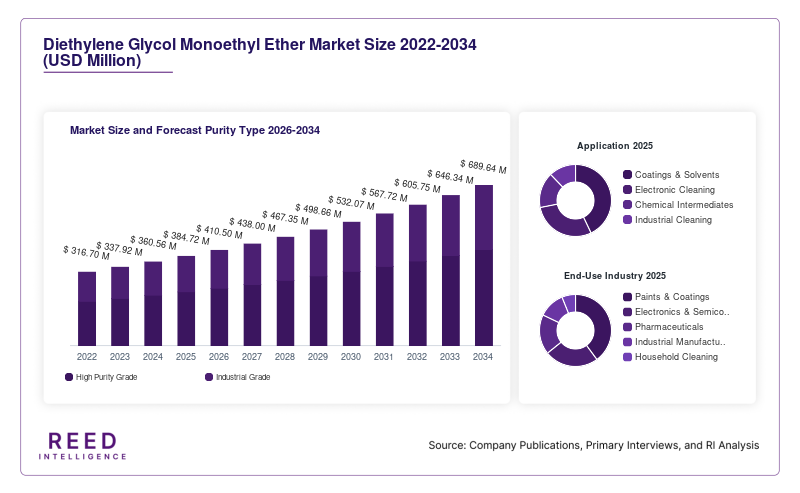
High-purity grade dominated the Diethylene Glycol Monoethyl Ether Market in 2025, accounting for 52.3% share. This dominance is attributed to its extensive use in electronics, pharmaceuticals, and high-performance coatings where formulation stability and low impurity levels are critical. High-purity variants ensure consistent chemical performance, making them highly preferred in advanced industrial applications.
Industrial-grade Diethylene Glycol Monoethyl Ether is the fastest-growing subsegment, expected to register a 7.2% CAGR during 2026–2034. Its growth is supported by increasing demand in large-scale cleaning agents, metal degreasers, and general-purpose solvent applications. Cost efficiency and broad usability are key factors driving its adoption across developing economies within the Diethylene Glycol Monoethyl Ether Market.
By Application Analysis
Coatings and solvent applications represented the dominant segment with 39.5% share in 2025. The compound’s strong solvency, slow evaporation rate, and compatibility with resin systems make it ideal for paints, varnishes, and protective coatings used in automotive and construction industries.
Electronic cleaning and semiconductor applications are the fastest-growing subsegment, projected at a 7.5% CAGR. This growth is driven by rising semiconductor fabrication activities and increasing demand for ultra-clean surfaces in microelectronics manufacturing. The Diethylene Glycol Monoethyl Ether Market benefits significantly from precision cleaning requirements in this segment.
By End-Use Industry Analysis
The paints and coatings industry remained the largest end-use segment in the Diethylene Glycol Monoethyl Ether Market, holding 41.8% share in 2025. Growth in infrastructure development, automotive refinishing, and industrial coatings supports sustained demand for glycol ether-based solvent systems.
The pharmaceutical industry is the fastest-growing end-use segment, expected to expand at a 7.1% CAGR. The compound is increasingly used in drug formulation processes and cleaning applications in pharmaceutical manufacturing environments due to its controlled evaporation and solvent compatibility.
Industrial cleaning applications also contribute significantly, driven by rising demand for degreasing agents and surface preparation chemicals across manufacturing facilities.
Regional Analysis
North America
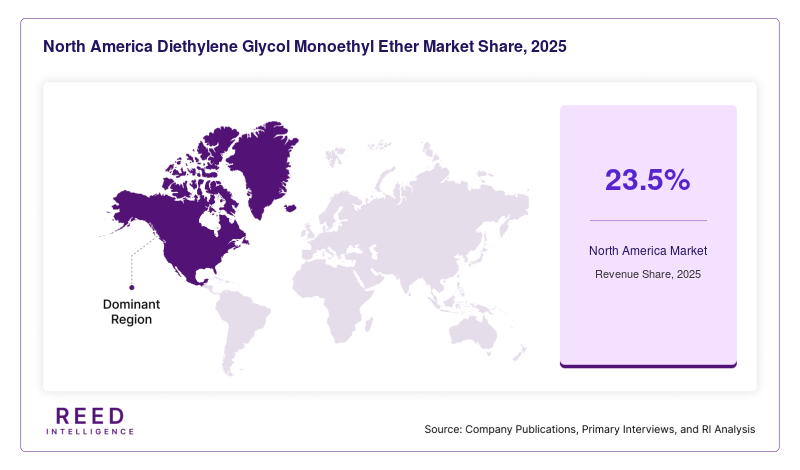
North America accounted for 23.5% share of the global market in 2025. The region is expected to expand at a 6.3% CAGR (2026–2034) due to strong demand from paints, coatings, and industrial cleaning industries. The United States dominates regional consumption, driven by advanced manufacturing and stringent environmental compliance standards.
Europe
Europe held 26.1% share in 2025, supported by strong chemical manufacturing infrastructure and regulatory emphasis on sustainable solvents. The region is projected to grow at a 6.1% CAGR, with Germany leading due to its automotive coatings and specialty chemical industries.
Asia Pacific
Asia Pacific dominated the Diethylene Glycol Monoethyl Ether Market with 34.2% share in 2025 and is expected to register a 7.0% CAGR (2026–2034). China, India, and Japan drive demand due to large-scale industrialization, electronics production, and construction growth.
Middle East & Africa
Middle East & Africa held 9.8% share in 2025 and is expected to grow at the fastest regional 7.4% CAGR. Growth is driven by expanding construction activities, oil & gas industrial cleaning applications, and increasing chemical imports in GCC countries.
Latin America
Latin America accounted for 6.4% share in 2025 and is projected to grow at a 6.5% CAGR. Brazil leads the region due to its expanding paints and coatings industry and rising industrial manufacturing activities.
Competitive Landscape
The Diethylene Glycol Monoethyl Ether Market is moderately consolidated with the presence of global chemical manufacturers focusing on capacity expansion, formulation innovation, and regional distribution strengthening. Companies are investing in sustainable solvent technologies and high-purity product lines to meet evolving regulatory requirements.
Key players include Dow Inc., BASF SE, Eastman Chemical Company, Shell Chemicals, and LyondellBasell Industries. Dow Inc. maintains a strong leadership position in glycol ether production and recently expanded its production facility to support increasing demand from coatings and electronics sectors. BASF SE continues to focus on environmentally compliant solvent solutions, while Eastman Chemical Company emphasizes specialty glycol ether formulations for industrial and electronic applications. Shell Chemicals and LyondellBasell are strengthening their downstream chemical integration to improve supply efficiency in global markets.
Key Players List
- Dow Inc.
- BASF SE
- Eastman Chemical Company
- Shell Chemicals
- LyondellBasell Industries
- INEOS Group
- SABIC
- ExxonMobil Chemical
- LG Chem Ltd.
- Mitsubishi Chemical Corporation
- Sinopec Group
- Reliance Industries Limited
- Jiangsu Hualun Chemical Co., Ltd.
- Jiangshan Chemical Co., Ltd.
- Zibo Qixiang Tengda Chemical Co., Ltd.
Recent Developments
- Expansion of glycol ether production capacity in Asia Pacific to support rising coatings demand.
- Increasing R&D investments in low-VOC solvent formulations across Europe.
- Strategic partnerships between chemical manufacturers and electronics firms for precision cleaning applications.
- Capacity optimization initiatives in North America targeting sustainable solvent production.
- Growing adoption of high-purity glycol ethers in semiconductor manufacturing processes.
Diethylene Glycol Monoethyl Ether Market Segments
Purity Type
- High Purity Grade
- Industrial Grade
Application
- Coatings & Solvents
- Electronic Cleaning
- Chemical Intermediates
- Industrial Cleaning
End-Use Industry
- Paints & Coatings
- Electronics & Semiconductors
- Pharmaceuticals
- Industrial Manufacturing
- Household Cleaning
By Region
- North America
- Europe
- APAC
- Middle East and Africa
- LATAM