Digital Calipers With LCD Display Market Size, Share & Demand Report By Material (Stainless Steel, Carbon Fiber, Plastic), By Type (Standard Digital Calipers, Depth Calipers, Height Calipers, Specialty Calipers), By Application (Industrial Manufacturing, Automotive, Aerospace, Electronics, Research & Education), By Distribution Channel (Online Retail, Industrial Suppliers & Distributors, Specialty Tool Stores, Direct Sales), By Region & Segment Forecasts, 2026–2034
USD 3950
Market Overview
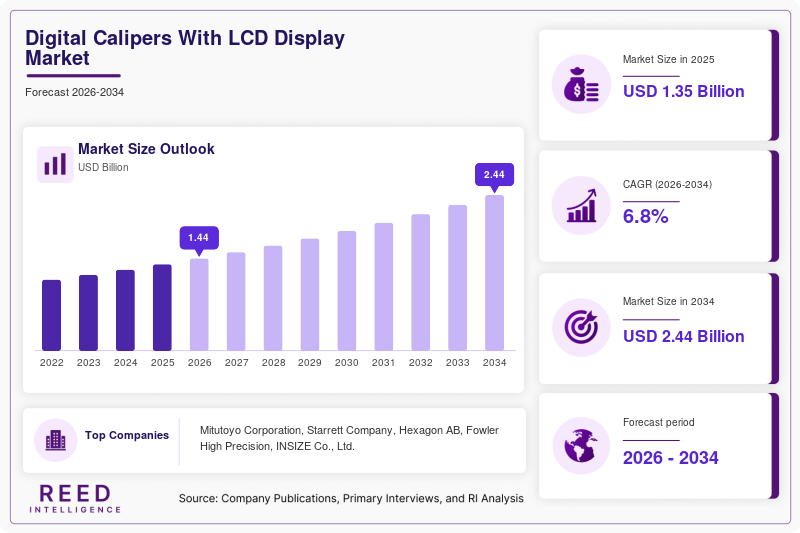
The Digital Calipers With LCD Display Market size was valued at approximately USD 1.35 billion in 2026 and is projected to reach USD 2.28 billion by 2034, expanding at a CAGR of 6.8% during 2026–2034. The market continues to grow steadily due to increasing precision requirements across manufacturing, automotive, aerospace, and electronics industries. These tools are essential for accurate dimensional measurement, offering enhanced readability, ease of use, and improved efficiency compared to traditional calipers.
A key global factor supporting market growth is the expansion of precision engineering and automated manufacturing processes. Industries worldwide are prioritizing accuracy and quality control, which has led to widespread adoption of digital measuring tools. The integration of LCD displays allows users to obtain real-time readings, reducing human error and improving productivity in both industrial and laboratory environments.
Key Highlights:
- North America dominated the market with 34.5% share in 2025, while Asia Pacific is expected to grow at the fastest CAGR of 7.9%.
- The stainless steel calipers segment led with a 61% share, while carbon fiber calipers are projected to grow at a CAGR of 8.3%.
- The industrial manufacturing application segment held the largest share at 48%, whereas the electronics segment is expected to grow fastest at 8.6% CAGR.
- The United States remained the dominant country, with market values of USD 395 million in 2024 and USD 418 million in 2025.
Market Trends
Integration of Smart Features and Connectivity
One of the prominent trends shaping the Digital Calipers With LCD Display Market is the integration of smart technologies such as Bluetooth connectivity and data transfer capabilities. Modern digital calipers are increasingly being equipped with wireless communication features, enabling seamless integration with computers and industrial software systems. This allows real-time data logging, improves traceability, and supports quality assurance processes. The trend is particularly significant in advanced manufacturing setups where Industry 4.0 practices are being adopted.
Shift Toward Lightweight and Durable Materials
Another key trend is the growing use of lightweight materials such as carbon fiber composites. While stainless steel remains dominant due to its durability and precision, industries are gradually adopting lighter alternatives that offer ease of handling without compromising measurement accuracy. This shift is especially visible in sectors requiring frequent manual measurements, such as field engineering and maintenance operations. Additionally, manufacturers are focusing on ergonomic designs and improved LCD readability to enhance user experience and operational efficiency.
Market Drivers
Rising Demand for Precision Measurement Tools
The increasing emphasis on quality control and precision in manufacturing processes is a major driver of the Digital Calipers With LCD Display Market. Industries such as automotive, aerospace, and electronics require highly accurate measurement tools to maintain product standards and reduce defects. Digital calipers provide quick and reliable readings, making them essential for ensuring dimensional accuracy in production lines.
Growth of Industrial Automation and Advanced Manufacturing
The expansion of automated manufacturing systems is another key factor driving market growth. As industries adopt advanced machinery and robotics, the need for precise measurement tools that can integrate with digital systems becomes critical. Digital calipers with LCD displays offer compatibility with automated workflows and data systems, enabling efficient monitoring and quality checks. This alignment with automation trends significantly boosts their adoption across global industries.
Market Restraint
High Cost Compared to Traditional Measuring Tools
One of the primary restraints in the Digital Calipers With LCD Display Market is the relatively higher cost compared to conventional vernier calipers. Although digital calipers offer superior accuracy and ease of use, their higher price point can limit adoption, particularly among small-scale manufacturers and workshops in developing regions. Cost sensitivity often leads users to prefer traditional tools, especially when high precision is not critical.
Additionally, digital calipers require periodic maintenance, battery replacement, and calibration, which adds to the overall cost of ownership. These factors can discourage budget-conscious buyers from transitioning to digital solutions. Furthermore, concerns related to durability in harsh industrial environments may also impact purchasing decisions, especially in sectors where tools are exposed to dust, moisture, or extreme temperatures.
Market Opportunities
Expansion in Emerging Economies
Emerging economies present significant growth opportunities for the Digital Calipers With LCD Display Market. Rapid industrialization, infrastructure development, and the expansion of manufacturing sectors in countries across Asia, Latin America, and Africa are driving demand for precision measurement tools. As these regions continue to modernize their industrial capabilities, the adoption of digital calipers is expected to increase substantially.
Adoption in Educational and Research Institutions
Another promising opportunity lies in the increasing use of digital calipers in educational and research institutions. Engineering colleges, technical institutes, and laboratories are incorporating advanced measurement tools into their curricula and research activities. This trend not only drives demand but also familiarizes future professionals with digital tools, fostering long-term market growth. Manufacturers are also introducing cost-effective models tailored for academic use, further supporting this segment.
Segmental Analysis
By Material
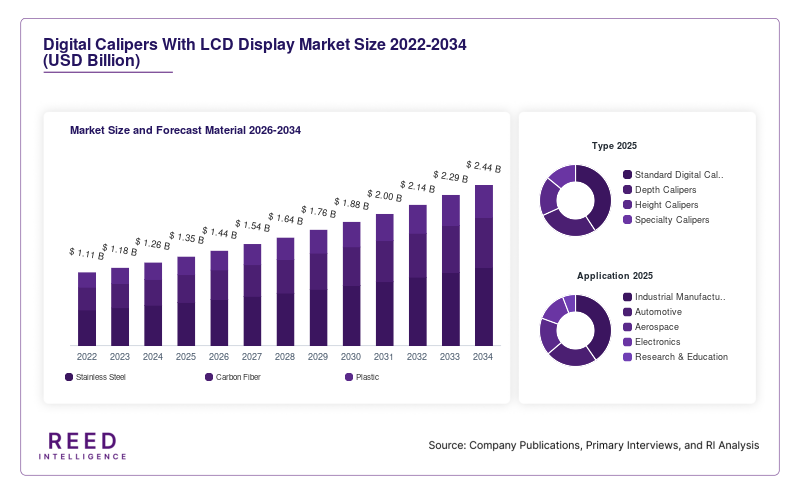
The stainless steel segment dominated the Digital Calipers With LCD Display Market, accounting for approximately 61% of the market share in 2025. Its dominance was attributed to durability, corrosion resistance, and high measurement accuracy, making it suitable for industrial applications.
The carbon fiber segment is expected to grow at the fastest CAGR of 8.3% during the forecast period. Its lightweight nature and ease of handling will drive adoption, particularly in applications requiring portability and frequent measurements.
By Type
Standard digital calipers held the largest share, contributing around 54% in 2025. These calipers are widely used due to their versatility and affordability across multiple industries.
Specialized digital calipers, including depth and height measuring variants, are projected to grow at a CAGR of 7.8%. Their increasing use in niche applications such as precision machining and inspection processes will support growth.
By Application
Industrial manufacturing dominated the segment with a 48% share in 2025, driven by the need for accurate measurements in production processes.
The electronics segment is expected to witness the fastest growth at a CAGR of 8.6%, fueled by the miniaturization of components and the need for precise measurements in circuit manufacturing.
By End-Use Industry
The automotive sector led the market with a 29% share in 2025, supported by stringent quality standards and high production volumes.
The aerospace sector is anticipated to grow at a CAGR of 7.5%, driven by the demand for high-precision tools in component manufacturing and maintenance.
By Distribution Channel
Offline channels dominated with a 63% share in 2025, as customers preferred physical inspection and verification before purchase.
Online channels are expected to grow at a CAGR of 8.1%, driven by the increasing adoption of e-commerce platforms and digital purchasing trends.
Regional Analysis
North America
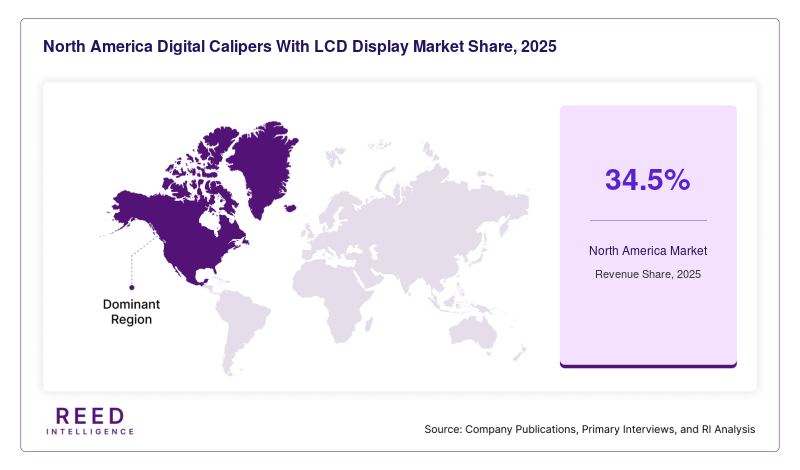
In 2025, North America accounted for approximately 34.5% of the Digital Calipers With LCD Display Market share, driven by strong industrial infrastructure and technological adoption. The region is expected to grow at a CAGR of 6.2% during 2026–2034. Growth will be supported by continued investment in advanced manufacturing technologies and quality control systems.
The United States dominated the regional market due to its well-established aerospace and automotive industries. A key growth factor is the increasing adoption of digital measurement tools in precision engineering applications, where accuracy and efficiency are critical for maintaining competitive advantage.
Europe
Europe held around 26.8% market share in 2025 and is projected to grow at a CAGR of 6.5% over the forecast period. The region benefits from strong regulatory standards related to manufacturing quality and product precision.
Germany emerged as the leading country, driven by its advanced manufacturing sector and focus on engineering excellence. The presence of high-precision industries and a strong emphasis on innovation have significantly contributed to the adoption of digital calipers across various applications.
Asia Pacific
Asia Pacific represented approximately 24.7% of the market share in 2025 and is anticipated to register the fastest CAGR of 7.9% during the forecast period. Rapid industrialization and expanding manufacturing activities are key factors driving growth in the region.
China dominated the market due to its large-scale manufacturing base. The country’s growth is fueled by increasing investments in industrial automation and the rising demand for cost-effective yet accurate measurement tools in production processes.
Middle East & Africa
The Middle East & Africa region held about 7.1% market share in 2025 and is expected to grow at a CAGR of 6.7%. Growth in this region is supported by infrastructure development and diversification of industrial sectors.
The United Arab Emirates led the regional market, driven by investments in construction and industrial projects. The increasing focus on quality standards in manufacturing and engineering activities is contributing to market expansion.
Latin America
Latin America accounted for approximately 6.9% of the market share in 2025 and is projected to grow at a CAGR of 6.4% during the forecast period. Economic development and industrial growth are key factors supporting market demand.
Brazil dominated the region due to its expanding manufacturing sector. The growing need for precision tools in automotive and industrial applications is driving the adoption of digital calipers across the country.
Competitive Landscape
The Digital Calipers With LCD Display Market is moderately fragmented, with several global and regional players competing based on product quality, innovation, and pricing. Key companies focus on enhancing product features, such as improved display readability, battery life, and connectivity options.
A leading player in the market is Mitutoyo Corporation, known for its high-precision measurement tools and strong global presence. The company recently introduced advanced digital calipers with enhanced data connectivity features, strengthening its market position.
Other major players are also investing in research and development to introduce lightweight materials and ergonomic designs. Strategic partnerships, product launches, and expansion into emerging markets remain common growth strategies among competitors.
Key Players List
- Mitutoyo Corporation
- Starrett Company
- Hexagon AB
- Fowler High Precision
- INSIZE Co., Ltd.
- TESA Technology
- Mahr GmbH
- Sylvac SA
- Baker Gauges India Pvt. Ltd.
- Moore & Wright
- Accusize Industrial Tools
- Anytime Tools
- iGaging LLC
- Groz Tools
- Central Tools Inc.
Recent Developments
- In 2025, Mitutoyo Corporation launched a new series of digital calipers with wireless data transfer capabilities.
- Starrett Company introduced enhanced LCD display models with improved battery efficiency.
- Hexagon AB expanded its precision tools portfolio with advanced measurement solutions.
- INSIZE Co., Ltd. focused on expanding its distribution network in emerging markets.
- Mahr GmbH invested in R&D to develop lightweight and ergonomic digital calipers.
Digital Calipers With LCD Display Market Segments
Material
- Stainless Steel
- Carbon Fiber
- Plastic
Type
- Standard Digital Calipers
- Depth Calipers
- Height Calipers
- Specialty Calipers
Application
- Industrial Manufacturing
- Automotive
- Aerospace
- Electronics
- Research & Education
Distribution Channel
- Online Retail
- Industrial Suppliers & Distributors
- Specialty Tool Stores
- Direct Sales
By Region
- North America
- Europe
- APAC
- Middle East and Africa
- LATAM