Digital Cinema Market Size, Share Demand Report By Product Type (Projectors, Audio Equipment, Screen Systems, Content Delivery), By Application (Cinemas, Film Studios, Home Theaters, Others), By Technology (Laser Projection, DLP, SXRD, LCoS) & Segment Forecasts, 2026–2034
USD 3950
Digital Cinema Market Size
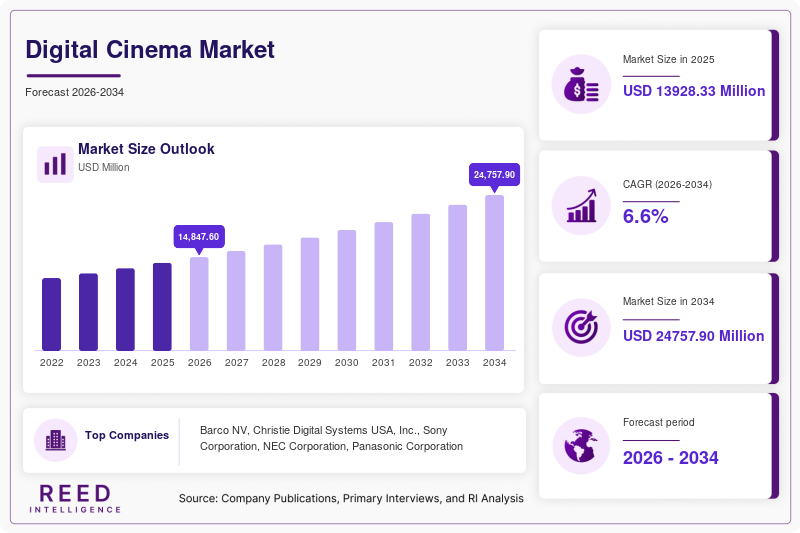
Digital Cinema market size is projected at USD 14,847.6 million in 2026 and is expected to hit USD 24,847.5 million by 2034 with a CAGR of 6.6% during the forecast period. The increasing demand for high-quality, immersive cinematic experiences and the ongoing transition from traditional film to digital projection, coupled with the growing adoption of advanced audio and visual technologies, underpins market expansion. This report delivers a comprehensive analysis of the Digital Cinema market, including segmentation by type and application, competitive dynamics, and regional growth patterns, equipping stakeholders with critical intelligence. The Digital Cinema market continues to demonstrate steady growth potential, fueled by the global expansion of cinema chains, the increasing investment in premium large format screens, and continuous innovation in projection and sound technologies.
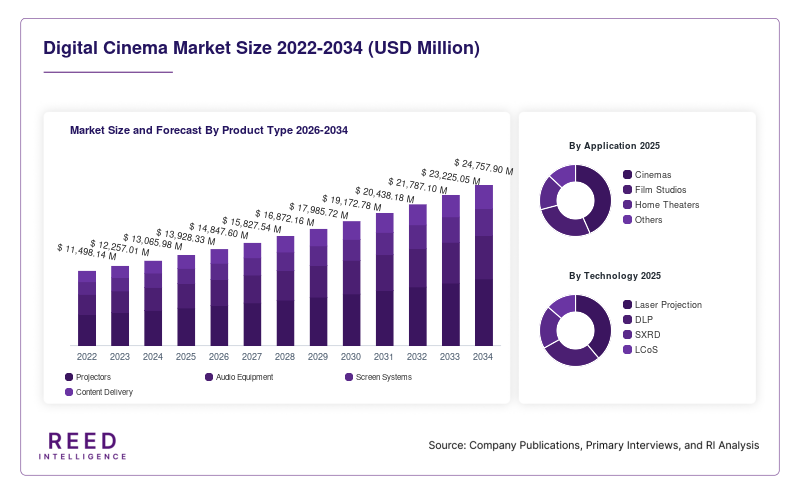
Digital cinema refers to the use of digital technology to produce, distribute, and project motion pictures, replacing traditional film-based systems. It encompasses digital projectors, audio systems, screen technologies, and content delivery networks. The global digital cinema market is substantial, with over 200,000 digital cinema screens installed worldwide in 2025, reflecting a 5% increase from 2023, driven by the ongoing digitalization of theaters and the expansion of cinema chains in emerging markets. Adoption patterns reveal that the Projectors type dominates the market, accounting for 42% of total demand, followed by Audio Equipment at 25%, Screen Systems at 20%, and Content Delivery at 13%. The Digital Cinema market's trajectory is closely linked to the growth of the global entertainment and media industry, which is projected to reach USD 3 trillion by 2028, and the increasing demand for premium and immersive viewing experiences.
Digital Cinema Market Trends
Adoption of Laser Projection and High Dynamic Range (HDR)
The Digital Cinema market is witnessing a significant trend toward the adoption of laser projection and High Dynamic Range (HDR) technologies, driven by the need for superior image quality, brightness, and color accuracy. The revenue from laser projectors and HDR-compatible systems grew to USD 4.5 billion in 2025, a year-on-year increase of 15%, as 45% of new cinema installations in 2025 specified laser projection and HDR capabilities. Adoption rates of laser projectors in premium large format screens reached 40%, with this figure projected to exceed 70% by 2030. The Digital Cinema market's trend toward advanced projection is reinforced by the need for enhanced visual experiences, the increasing competition from home entertainment systems, and the continuous innovation in laser and display technologies.
Growing Focus on Immersive Audio and Spatial Sound
The increasing focus on immersive audio and spatial sound is a major trend shaping the Digital Cinema market, with the development of advanced sound systems like Dolby Atmos and DTS:X that create a more enveloping and realistic audio experience. The market has seen a 20% increase in the demand for immersive audio systems since 2022, with 30% of new cinema builds in 2025 featuring advanced object-based audio. The use of immersive audio to enhance the overall cinematic experience has also gained significant traction. The Digital Cinema market's trend toward immersive audio is reinforced by the need for differentiation, the increasing importance of sound quality in the movie-going experience, and the continuous innovation in audio processing and speaker technologies.
Digital Cinema Market Drivers
The Digital Cinema market's expansion is primarily driven by the increasing demand for high-quality and immersive cinematic experiences, with the global box office revenue exceeding USD 40 billion in 2025 and growing at a steady pace. The need for premium content delivery and the transition from film to digital have been major drivers, with digital cinema offering superior image and sound quality, as well as operational efficiency. The expanding cinema infrastructure in emerging markets has also fueled market growth. Additionally, the increasing investment in premium large format screens has spurred demand. The Digital Cinema market's growth is further reinforced by the continuous improvement in digital projection and audio technologies, leading to better performance and lower costs.
Digital Cinema Market Restraints
Despite favorable growth prospects, the Digital Cinema market faces significant constraints, primarily related to the high initial investment required for digital cinema equipment, which can be a barrier for smaller cinema chains. The rapid pace of technological change can also be a limitation, requiring frequent upgrades. The Digital Cinema market's growth is also tempered by the competition from streaming services and home entertainment, and the challenge of maintaining profitability in a mature market.
Digital Cinema Market Opportunities
The Digital Cinema market presents significant opportunities in the rapidly expanding market for virtual production and LED volume stages, where digital cinema technologies are being repurposed. The development of integrated and scalable digital cinema solutions for smaller venues and niche applications is expected to grow at a CAGR of 8% through 2034. Emerging opportunities also exist in the use of digital cinema technologies for live events and corporate presentations. The Digital Cinema market's opportunity profile is further enhanced by the growing trend of experiential entertainment and the increasing demand for high-quality visual content.
Challenges in Digital Cinema Market
The Digital Cinema market faces persistent challenges related to the need for continuous innovation to keep pace with evolving consumer expectations and technological advancements. The complexity of managing content distribution and ensuring cybersecurity can also be a challenge. The market is also contending with the challenge of managing the transition to new formats and the need to address the environmental impact of equipment and operations. Additionally, the Digital Cinema market is challenged by the need to differentiate from home entertainment and attract audiences to theaters.
Digital Cinema Market Segmentation
The Digital Cinema market is segmented by Type and Application to provide a comprehensive market perspective. By Type, Projectors dominate with a 42% market share, driven by their critical role in image projection. The Application segment is led by Cinemas, which accounts for 65% of the market, followed by Film Studios at 15%, Home Theaters at 12%, and Others at 8%.
By Type
Projectors represent the largest segment in the Digital Cinema market, commanding a 42% share, with revenue exceeding USD 6.2 billion in 2025. These are characterized by their use in projecting digital images onto the screen, including DLP, SXRD, and LCoS technologies. Technical specifications include resolution, brightness, and contrast ratio. The Digital Cinema market's Projectors segment is driven by its use in all cinema applications.
Audio Equipment capture a 25% share of the Digital Cinema market, with revenue of USD 3.7 billion in 2025. These are characterized by their use in providing high-quality sound, including speakers, amplifiers, and processors. Technical specifications include power output, frequency response, and connectivity. The Digital Cinema market's Audio segment is driven by its use in creating immersive sound experiences.
Screen Systems represent 20% of the Digital Cinema market, with revenue of USD 3.0 billion in 2025. These are characterized by their use in displaying the projected image, including traditional screens, LED screens, and specialized screens. Technical specifications include size, gain, and aspect ratio. The Digital Cinema market's Screen segment is driven by its use in cinemas and premium formats.
Content Delivery comprise the remainder of the Digital Cinema market, accounting for 13% of total revenue, with USD 1.9 billion in 2025. These are characterized by their use in distributing digital content to cinemas, including satellite, hard drive, and digital cinema package (DCP) solutions. Technical specifications include data transfer speed, security, and storage. The Digital Cinema market's Content Delivery segment is driven by its use in film distribution.
By Application
Cinemas dominates the Digital Cinema market, accounting for 65% of sales, representing USD 9.6 billion in 2025. This segment includes use in commercial movie theaters, multiplexes, and independent cinemas. Usage penetration exceeds 90% in the sector. The Digital Cinema market's Cinemas segment is characterized by its focus on high-quality, large-scale installations.
Film Studios accounts for 15% of the Digital Cinema market, with revenue of USD 2.2 billion in 2025. This segment encompasses use in production and post-production facilities. The segment is growing at a steady CAGR, driven by the demand for high-quality review rooms. The Digital Cinema market's Film Studios segment is characterized by its focus on color accuracy and precision.
Home Theaters represents 12% of the Digital Cinema market, with revenue of USD 1.8 billion in 2025. This segment includes use in high-end residential installations. The segment is growing at a robust CAGR, driven by the demand for premium home entertainment. The Digital Cinema market's Home Theaters segment is characterized by its focus on quality and integration.
Others comprises the remainder of the Digital Cinema market, accounting for 8% of total revenue, with USD 1.2 billion in 2025. This includes use in corporate, educational, and live event applications. The segment is projected to grow at a moderate CAGR through 2034. The Digital Cinema market's Others segment is characterized by its diverse and evolving applications.
Digital Cinema Market Regional Outlook
North America Digital Cinema Market
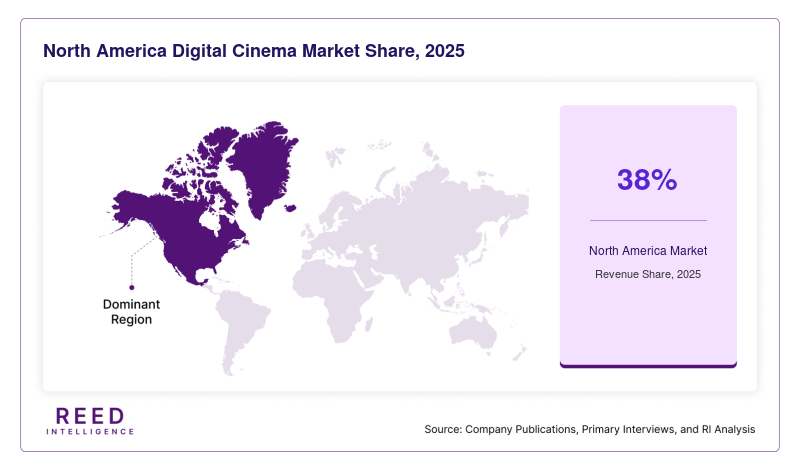
Leads the Digital Cinema market, commanding a 38% share, with a revenue of USD 5.6 billion in 2025. The United States is the primary driver, accounting for 85% of regional demand, driven by the large cinema industry, high investment in technology, and a strong focus on premium formats. The North American Digital Cinema market is characterized by its focus on innovation and premium experiences.
Asia-Pacific Digital Cinema Market
Represents the second-largest market, capturing a 32% share with a revenue of USD 4.7 billion in 2025. China, India, and Japan are the primary drivers, together accounting for 70% of regional demand, driven by the rapidly expanding cinema infrastructure, growing middle class, and increasing demand for entertainment. The Asia-Pacific Digital Cinema market is projected to grow at the fastest CAGR of 8% through 2034.
Europe Digital Cinema Market
Accounts for 20% of the global Digital Cinema market, with a revenue of USD 3.0 billion in 2025. The UK, Germany, and France are the primary drivers, collectively accounting for 60% of regional demand, driven by a strong cinema culture and a focus on quality. The European Digital Cinema market is projected to grow at a CAGR of 5% through 2034.
Middle East & Africa and Latin America Digital Cinema Market
Together account for the remaining 10% of the Digital Cinema market, with the UAE leading the Middle East market and Brazil leading the Latin American market. Both regions are projected to grow at CAGRs exceeding 7%, driven by infrastructure development and increasing entertainment spending.
Top players in Digital Cinema Market
- Barco NV
- Christie Digital Systems USA, Inc.
- Sony Corporation
- NEC Corporation
- Panasonic Corporation
- Dolby Laboratories, Inc.
- DTS, Inc. (Xperi)
- QSC, LLC
- Meyer Sound Laboratories, Inc.
- GDC Technology Limited
- Cinionic
- Kinepolis Group
- AMC Theatres
- Cineworld Group plc
- IMAX Corporation
Barco NV
Barco NV holds a dominant position in the Digital Cinema market, with an estimated 18% global market share, particularly strong in the projector segment. The company's portfolio of digital cinema projectors is widely recognized for its quality, reliability, and innovation. Barco's market leadership is reinforced by its significant R&D investment, its strong relationships with major cinema chains, and its global service network. Barco commands over 20% of the North American market and 15% of the European market, positioning it as a key player in the Digital Cinema market.
Christie Digital Systems USA, Inc.
Christie Digital Systems is a leading player in the Digital Cinema market, commanding approximately 14% of the global market share through its comprehensive portfolio of projection and visual solutions. The company's expertise in display technology and its focus on innovation have solidified its position. Christie's digital cinema projectors are known for their performance, versatility, and reliability. The company's commitment to quality and its strong presence in the North American and Asian markets have enhanced its competitive advantage.
Sony Corporation holds a significant 12% market share, with particular strength in the 4K and HDR projection segments. NEC Corporation is a major player in the global projector market, holding a 10% share.
Recent Developments in Digital Cinema Market
- 2025: Barco launched a new generation of laser projectors with enhanced HDR capabilities and increased brightness for premium cinema screens.
- 2025: Christie introduced a new integrated media server for digital cinema, simplifying content management and playback.
Digital Cinema Market Segments
By Product Type
- Projectors
- Audio Equipment
- Screen Systems
- Content Delivery
By Application
- Cinemas
- Film Studios
- Home Theaters
- Others
By Technology
- Laser Projection
- DLP
- SXRD
- LCoS
By Region
- North America
- Europe
- APAC
- Middle East and Africa
- LATAM