Digital Commodity Trading Platform Market Size, Share & Growth Report By Deployment Mode (Cloud-Based Platforms, On-Premise Platforms, Hybrid Platforms), By Commodity Type (Energy Commodities, Metals Commodities, Agricultural Commodities, Financial Commodities), By End User (Trading Firms, Commodity Exchanges, Institutional Investors, Retail Investors, Brokerage Companies), By Regional Outlook and Segment Forecasts, 2026–2034
USD 3950
Market Overview
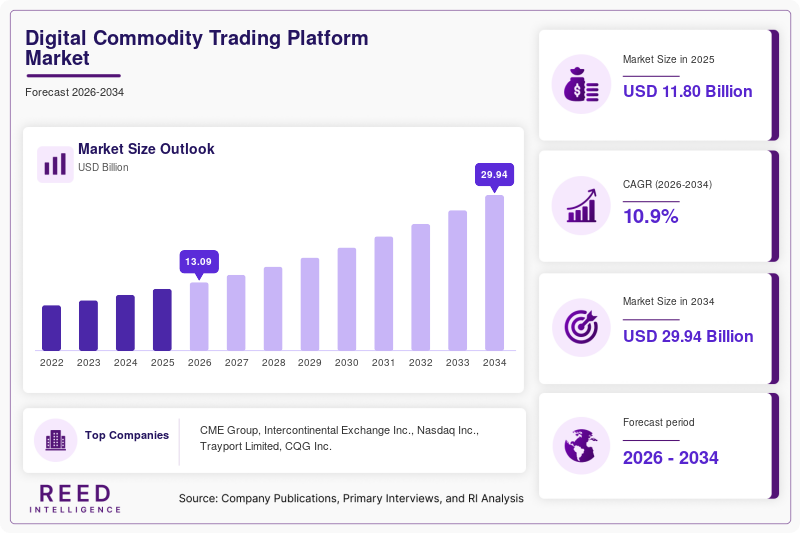
The global Digital Commodity Trading Platform Market size was valued at USD 11.8 billion in 2026 and is projected to reach USD 26.9 billion by 2034, expanding at a CAGR of 10.9% during the forecast period from 2026 to 2034. The market is experiencing consistent expansion due to the growing digitalization of commodity trading operations across energy, metals, agriculture, and financial commodities. Enterprises are increasingly replacing conventional trading systems with cloud-based and AI-enabled platforms to improve transaction visibility, pricing accuracy, and operational efficiency. Rising cross-border trade activities and the increasing demand for real-time analytics have also strengthened the adoption of integrated trading platforms among commodity exchanges, brokers, institutional investors, and trading firms.
The expansion of algorithmic trading and automated risk management systems has further supported market development. Companies are deploying advanced platforms to manage fluctuating commodity prices, regulatory compliance requirements, and supply chain disruptions. Blockchain-enabled trade settlement solutions and smart contracts are also gaining traction, particularly in oil, natural gas, and precious metals trading environments. In addition, increasing investments in digital infrastructure across emerging economies have accelerated the transition toward centralized electronic commodity marketplaces.
Key Highlights
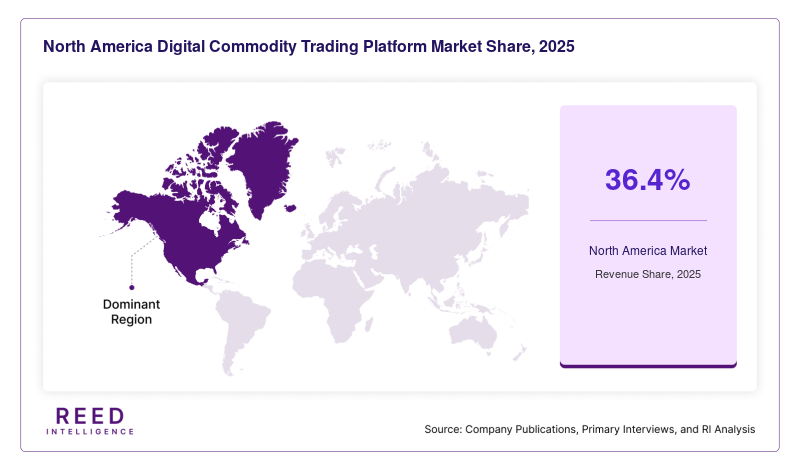
- North America dominated the market with a 36.4% share in 2025, while Asia Pacific is expected to grow at the fastest CAGR of 12.3% during 2026–2034.
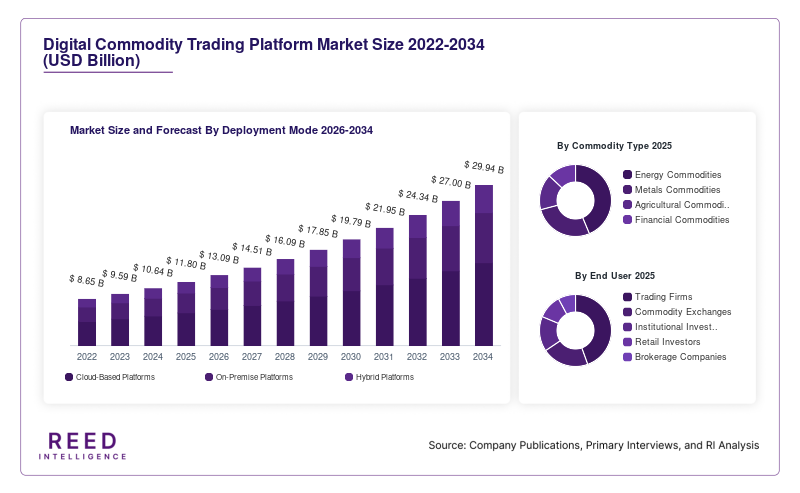
- By deployment mode, cloud-based platforms accounted for the largest share of 44.7%, while hybrid platforms are projected to grow at a CAGR of 13.1%.
- By commodity type, energy commodities led with a 39.6% share, whereas agricultural commodities are expected to expand at a CAGR of 12.7%.
- By end user, trading firms dominated with a 42.5% share, while retail investors are projected to grow at a CAGR of 13.5%.
- The United States remained the dominant country, with market values of USD 3.6 billion in 2024 and USD 4.1 billion in 2025.
Market Trends
Artificial Intelligence Integration Reshaping Commodity Trading Operations
Artificial intelligence and machine learning technologies are increasingly transforming the Digital Commodity Trading Platform Market by enabling predictive analytics, automated trade execution, and advanced market forecasting. Trading firms are deploying AI-powered systems to identify price fluctuations, optimize trade timing, and reduce operational risks associated with volatile commodity markets. The integration of natural language processing tools for market sentiment analysis is also improving decision-making capabilities among institutional investors and commodity brokers. AI-driven dashboards are helping companies analyze weather patterns, geopolitical developments, and supply chain disruptions that influence commodity pricing dynamics. These capabilities are particularly valuable in energy and agricultural commodity trading where external variables significantly impact pricing. In addition, AI-supported compliance monitoring systems are reducing manual oversight and improving regulatory adherence. As commodity trading becomes increasingly data-intensive, demand for intelligent trading platforms with automation capabilities is expected to remain strong throughout the forecast period.
Expansion of Blockchain-Based Settlement and Smart Contract Systems
Blockchain adoption is emerging as a significant trend across the Digital Commodity Trading Platform Market due to the increasing requirement for secure and transparent trade settlement mechanisms. Commodity traders are integrating decentralized ledger technologies to improve transaction authentication, reduce settlement delays, and enhance traceability across global supply chains. Smart contracts are simplifying trade execution by automatically validating predefined contractual conditions, reducing dependency on intermediaries and minimizing transaction disputes. Energy and metals trading companies are increasingly investing in blockchain-enabled platforms to improve cross-border trade efficiency and reduce operational costs associated with documentation and verification. The technology also enhances cybersecurity and minimizes the risk of data manipulation in high-value commodity transactions. Several commodity exchanges are collaborating with fintech firms to develop secure digital ecosystems capable of supporting real-time settlement operations. As global commodity trade volumes continue to increase, blockchain-enabled infrastructure is expected to become a standard feature within advanced trading platforms.
Market Drivers
Increasing Digitalization Across Commodity Exchanges and Trading Firms
The rapid digital transformation of commodity exchanges and brokerage firms is one of the major growth drivers for the Digital Commodity Trading Platform Market. Traditional commodity trading systems often involve fragmented communication channels, lengthy settlement procedures, and limited real-time visibility. Digital platforms are addressing these operational challenges by offering integrated trading environments with automated workflows, live market analytics, and centralized risk management tools. Commodity exchanges are investing heavily in cloud infrastructure and digital transaction systems to improve trade execution speed and operational transparency. The adoption of electronic trading systems has also expanded due to growing demand for remote trading capabilities and multi-device accessibility. Large commodity trading organizations are increasingly prioritizing scalable digital ecosystems capable of handling high transaction volumes and global market participation. The transition toward digital commodity ecosystems is expected to accelerate further as enterprises focus on improving operational agility and reducing infrastructure costs.
Rising Demand for Real-Time Risk Management and Market Analytics
Commodity markets are highly sensitive to geopolitical tensions, weather changes, transportation disruptions, and fluctuating currency values, creating strong demand for advanced risk management solutions. Digital commodity trading platforms are becoming essential tools for traders seeking real-time analytics, portfolio monitoring, and predictive market intelligence. Integrated dashboards equipped with data visualization and algorithmic modeling capabilities are enabling organizations to respond quickly to changing market conditions. Financial institutions and hedge funds are increasingly relying on digital platforms to monitor commodity exposure and improve investment decision-making processes. Advanced analytics tools also support better inventory planning and procurement strategies for commodity-dependent industries such as manufacturing, agriculture, and energy production. The growing complexity of global commodity supply chains has increased the need for centralized platforms capable of consolidating market intelligence and trade data. This rising dependence on data-driven trading operations is expected to support long-term market expansion.
Market Restraint
Cybersecurity Risks and Regulatory Compliance Challenges Limiting Adoption
Cybersecurity concerns and evolving regulatory requirements remain significant restraints for the Digital Commodity Trading Platform Market. Commodity trading platforms process large volumes of sensitive financial and transactional data, making them attractive targets for cyberattacks, phishing activities, and ransomware incidents. Data breaches can result in financial losses, operational disruptions, and reputational damage for trading firms and exchanges. As a result, companies are required to invest heavily in cybersecurity infrastructure, encryption technologies, and compliance management systems, increasing operational expenses. Regulatory frameworks governing commodity trading also vary significantly across countries, creating additional complexities for multinational platform providers. Compliance with anti-money laundering regulations, cross-border trade laws, and financial reporting standards requires continuous software upgrades and monitoring processes. Smaller trading firms often face challenges in implementing advanced cybersecurity systems due to budget limitations. In addition, concerns related to data privacy and unauthorized access continue to influence platform adoption decisions among institutional investors. These factors may slow implementation rates in highly regulated markets despite growing digitalization trends.
Market Opportunities
Growing Adoption of Mobile Commodity Trading Applications
The increasing use of smartphones and mobile financial applications is creating strong growth opportunities for the Digital Commodity Trading Platform Market. Commodity trading companies and brokerage firms are developing mobile-friendly platforms that allow users to access real-time market updates, execute trades, and monitor portfolios from remote locations. Retail participation in commodity trading is rising steadily due to improved accessibility and user-friendly mobile interfaces. Mobile platforms equipped with AI-driven alerts, price forecasting tools, and multilingual support are attracting new investor groups across emerging economies. Younger investors are increasingly preferring mobile trading ecosystems due to their convenience and low operational barriers. Financial technology companies are also introducing subscription-based commodity analytics services integrated with mobile trading applications. This trend is expected to expand further as internet penetration and digital payment infrastructure continue to improve across developing markets.
Expansion of Commodity Trading Activities in Emerging Economies
Emerging economies across Asia Pacific, Latin America, and the Middle East are creating favorable growth opportunities for digital commodity trading platform providers. Rapid industrialization, expanding energy demand, and increasing agricultural exports are contributing to higher commodity trading volumes in these regions. Governments are supporting the modernization of commodity exchanges and digital trade infrastructure to improve market transparency and attract foreign investment. Local commodity producers are increasingly adopting digital platforms to connect directly with international buyers and reduce transaction inefficiencies. The rise of cross-border commodity partnerships and regional trade agreements is also encouraging investment in cloud-based trading technologies. Financial institutions in emerging markets are introducing commodity derivatives and digital trading services to diversify investment offerings. As digital infrastructure and fintech ecosystems continue to develop, demand for scalable and secure commodity trading platforms is expected to rise significantly.
Segmental Analysis
By Deployment Mode
Cloud-based platforms dominated the Digital Commodity Trading Platform Market in 2024, accounting for 44.7% of the global market share. The segment continues to lead due to increasing demand for scalable, cost-efficient, and remotely accessible trading infrastructure. Commodity exchanges and trading firms are adopting cloud deployment models to improve operational flexibility and reduce hardware maintenance costs. Cloud-based systems also support real-time analytics, automated updates, and seamless integration with external data sources, making them highly suitable for dynamic trading environments. Large organizations are increasingly deploying cloud trading ecosystems to manage high transaction volumes and enable multi-location operations. In addition, cloud infrastructure enhances disaster recovery capabilities and business continuity planning, which are essential for financial trading environments. The rising adoption of subscription-based software models and managed trading services is further supporting segment growth across both developed and emerging economies.
Hybrid platforms are projected to register the fastest CAGR of 13.1% during the forecast period due to increasing demand for customized trading environments that combine on-premise security with cloud scalability. Commodity trading firms handling highly sensitive transactional data are increasingly preferring hybrid deployment models to maintain greater control over critical operations while benefiting from cloud-enabled analytics capabilities. Hybrid systems are particularly gaining traction among energy and metals trading companies that require secure data storage alongside advanced computational tools. The flexibility to integrate legacy infrastructure with modern cloud applications is another major factor supporting segment growth. Financial institutions are also investing in hybrid ecosystems to improve compliance management and strengthen cybersecurity frameworks. As organizations seek balanced deployment strategies that support both performance optimization and regulatory compliance, demand for hybrid commodity trading platforms is expected to increase steadily.
By Commodity Type
Energy commodities represented the largest share of the Digital Commodity Trading Platform Market in 2024, accounting for 39.6% of total revenue. The dominance of this segment is primarily attributed to the large trading volumes associated with crude oil, natural gas, electricity, and renewable energy products. Energy companies and commodity exchanges are increasingly deploying digital trading systems to improve transaction speed, optimize pricing strategies, and manage market volatility. Real-time analytics and predictive forecasting tools are especially important in energy trading due to frequent geopolitical disruptions and fluctuating supply-demand dynamics. Digital platforms are also helping energy traders improve regulatory compliance and enhance operational transparency across global supply chains. The transition toward renewable energy markets and carbon trading initiatives is further increasing the need for advanced digital trading infrastructure. These factors continue to support strong adoption of commodity trading platforms within the energy sector.
Agricultural commodities are expected to witness the fastest CAGR of 12.7% during the forecast period due to increasing digitization across agricultural trade networks and rising global food demand. Commodity traders and agricultural cooperatives are increasingly adopting digital platforms to improve supply chain visibility, inventory planning, and price forecasting capabilities. Mobile-based commodity trading applications are gaining popularity among farmers and exporters seeking direct access to international buyers and commodity exchanges. Weather analytics, crop forecasting tools, and blockchain-enabled traceability systems are becoming integral features within agricultural trading platforms. Governments in developing economies are also supporting digital agriculture initiatives aimed at improving market transparency and reducing transaction inefficiencies. The expansion of cross-border agricultural trade and increasing investments in agritech infrastructure are expected to accelerate demand for digital commodity trading solutions within this segment.
By End User
Trading firms held the dominant share of the Digital Commodity Trading Platform Market in 2024, accounting for 42.5% of global revenue. These organizations rely heavily on digital platforms to manage large transaction volumes, monitor price fluctuations, and optimize portfolio performance across multiple commodity classes. Advanced trading platforms equipped with algorithmic trading tools, real-time risk management systems, and AI-enabled analytics are becoming essential for commodity brokerage operations. Trading firms are also adopting digital ecosystems to improve compliance management and streamline cross-border transaction processes. The growing complexity of commodity markets has increased the importance of centralized platforms capable of integrating data from multiple exchanges and supply chain sources. Additionally, demand for high-frequency trading capabilities and predictive market intelligence is encouraging continuous investment in advanced commodity trading technologies. These factors continue to support the strong position of trading firms within the market.
Retail investors are projected to register the fastest CAGR of 13.5% during the forecast period due to increasing accessibility of online commodity trading platforms and mobile investment applications. Digital brokerage firms are offering simplified interfaces, educational tools, and low-cost trading options that are attracting individual investors into commodity markets. Precious metals, agricultural products, and energy commodities are becoming increasingly popular investment categories among retail users seeking portfolio diversification. Mobile applications equipped with AI-powered market alerts and automated portfolio management tools are improving user engagement and investment decision-making. Social trading features and real-time educational content are also encouraging participation among younger investors. Expanding internet connectivity and digital payment infrastructure across emerging economies are expected to create additional opportunities for retail-focused commodity trading platforms during the forecast period.
Regional Analysis
North America
North America accounted for the largest share of the Digital Commodity Trading Platform Market in 2025, representing 36.4% of global revenue. The region is projected to expand at a CAGR of 10.2% during the forecast period due to the strong presence of commodity exchanges, financial institutions, and advanced digital infrastructure. Market growth is supported by widespread adoption of cloud-based trading systems and algorithmic trading technologies across the United States and Canada. Increasing investments in AI-enabled analytics and automated compliance management systems are also contributing to regional expansion.
The United States remained the dominant country within North America due to its highly developed financial ecosystem and strong commodity trading environment. Major trading firms are increasingly investing in blockchain-based settlement technologies and predictive analytics platforms to improve transaction efficiency. The growing use of digital energy trading systems across crude oil and natural gas markets is another important growth factor supporting regional demand. In addition, increasing participation of retail investors through online commodity brokerage platforms continues to strengthen market expansion.
Europe
Europe held a substantial share of the Digital Commodity Trading Platform Market in 2025 and is expected to grow at a CAGR of 9.8% through 2034. The region benefits from established commodity exchanges, advanced fintech infrastructure, and rising demand for transparent trading systems. European commodity traders are increasingly adopting integrated digital platforms to improve operational efficiency and comply with stringent regulatory standards. The market is also supported by rising investments in renewable energy trading and carbon credit exchange systems across major European economies.
Germany emerged as the dominant country in the European market due to its strong industrial base and increasing digitalization initiatives across financial services. The country is witnessing growing adoption of AI-driven commodity analytics platforms among energy and manufacturing companies. Expansion of sustainable commodity trading initiatives and environmental compliance frameworks is also encouraging investment in advanced digital trading ecosystems. Furthermore, increasing collaboration between fintech companies and commodity exchanges is accelerating technology adoption across the regional market.
Asia Pacific
Asia Pacific is anticipated to register the fastest CAGR of 12.3% during the forecast period due to rapid industrialization, expanding commodity imports, and rising digital transformation initiatives. Governments across the region are modernizing commodity exchanges and encouraging electronic trading practices to improve market transparency. Increasing investments in cloud computing infrastructure and mobile trading applications are also driving regional growth. The region is witnessing higher participation from retail investors and commodity exporters seeking access to efficient digital marketplaces.
China remained the dominant country within Asia Pacific owing to its large commodity consumption base and extensive manufacturing sector. The country is investing significantly in blockchain-enabled trade settlement systems and AI-powered commodity analytics solutions. Rising demand for digital trading platforms in agricultural and metals commodities is supporting market expansion. In addition, growing cross-border commodity trade partnerships and government-backed digital finance initiatives are creating favorable conditions for platform providers operating within the regional market.
Middle East & Africa
The Middle East & Africa region is experiencing steady growth in the Digital Commodity Trading Platform Market and is projected to expand at a CAGR of 9.4% through 2034. Market growth is primarily supported by increasing digitalization across oil and gas trading operations and rising investments in financial technology infrastructure. Commodity trading firms are adopting advanced digital platforms to improve trade execution speed and strengthen supply chain transparency. The growing importance of energy exports and cross-border commodity transactions is also contributing to regional market development.
Saudi Arabia emerged as the leading country in the regional market due to large-scale investments in digital economic transformation and energy trading modernization. The country is increasingly adopting cloud-based commodity trading solutions to improve operational efficiency in petroleum and petrochemical sectors. Government initiatives focused on fintech expansion and economic diversification are encouraging investment in secure digital trading ecosystems. Additionally, rising demand for real-time commodity pricing tools among institutional investors is strengthening the regional market outlook.
Latin America
Latin America accounted for a moderate share of the Digital Commodity Trading Platform Market in 2025 and is expected to grow at a CAGR of 9.7% during the forecast period. The region is benefiting from increasing exports of agricultural commodities, metals, and energy resources. Commodity producers and exporters are increasingly using digital trading platforms to improve transaction visibility and reduce dependency on manual documentation systems. Rising internet penetration and fintech adoption are also supporting the transition toward electronic commodity trading ecosystems across the region.
Brazil remained the dominant country in Latin America due to its large agricultural export industry and expanding commodity trading activities. The country is witnessing increasing deployment of digital trading systems within soybean, coffee, and sugar commodity markets. Financial institutions and commodity exchanges are investing in AI-enabled analytics tools to improve trade forecasting and market monitoring capabilities. Furthermore, growing government support for digital financial infrastructure and cross-border trade modernization is expected to contribute to sustained market growth.
Competitive Landscape
The Digital Commodity Trading Platform Market is characterized by increasing competition among fintech companies, commodity exchanges, cloud technology providers, and enterprise software vendors. Leading market participants are focusing on artificial intelligence integration, blockchain-enabled settlement systems, and advanced analytics capabilities to strengthen their competitive position. Strategic partnerships, acquisitions, and product innovation remain key approaches adopted by companies seeking to expand their global presence. Market participants are also investing in cybersecurity infrastructure and compliance management solutions to address evolving regulatory requirements and customer concerns related to data security.
CME Group maintained a leading market position due to its extensive commodity trading infrastructure, global exchange network, and advanced electronic trading systems. The company continues to invest in cloud-based analytics and automated risk management technologies to improve operational efficiency and user experience. In 2025, the company introduced enhanced AI-powered commodity forecasting tools designed to improve predictive trading capabilities for institutional investors. Other major companies are focusing on expanding mobile trading functionalities and developing blockchain-supported trade settlement platforms to attract new customer segments and improve transaction transparency across global commodity markets.
Key Players
- CME Group
- Intercontinental Exchange Inc.
- Nasdaq Inc.
- Trayport Limited
- CQG Inc.
- FIS Global
- SAP SE
- Oracle Corporation
- SS&C Technologies Holdings Inc.
- Openlink Financial LLC
- ION Group
- Trading Technologies International Inc.
- Symphony Communication Services
- Eka Software Solutions
- Enuit LLC
Recent Developments
- In February 2026, CME Group expanded its AI-powered commodity analytics capabilities to improve predictive market forecasting and automated trade execution services.
- In September 2025, Intercontinental Exchange Inc. introduced blockchain-enabled settlement tools designed to improve transparency and reduce transaction processing times in energy commodity trading.
- In November 2025, Nasdaq Inc. launched an upgraded cloud-based commodity trading infrastructure platform focused on improving cybersecurity and compliance management capabilities.
- In January 2026, Trayport Limited partnered with multiple European energy exchanges to strengthen digital trading connectivity and real-time pricing integration services.
- In August 2025, Eka Software Solutions introduced advanced mobile trading applications with integrated risk management dashboards for agricultural commodity traders.
Digital Commodity Trading Platform Market Segments
By Deployment Mode
- Cloud-Based Platforms
- On-Premise Platforms
- Hybrid Platforms
By Commodity Type
- Energy Commodities
- Metals Commodities
- Agricultural Commodities
- Financial Commodities
By End User
- Trading Firms
- Commodity Exchanges
- Institutional Investors
- Retail Investors
- Brokerage Companies
By Region
- North America
- Europe
- APAC
- Middle East and Africa
- LATAM