Digital Holographic Microscopy Market Size, Share Demand Report By Product Type (Transmission Digital Holographic Microscopy Systems, Reflection Digital Holographic Microscopy Systems), By Application (Cell Biology Research, Semiconductor Inspection, Material Science Research, Biomedical Diagnostics), By End-Use (Academic and Research Institutes, Pharmaceutical and Biotechnology Companies, Semiconductor Manufacturing Industry), By Distribution Channel (Direct Sales, Scientific Equipment Distribu
USD 3950
Market Overview
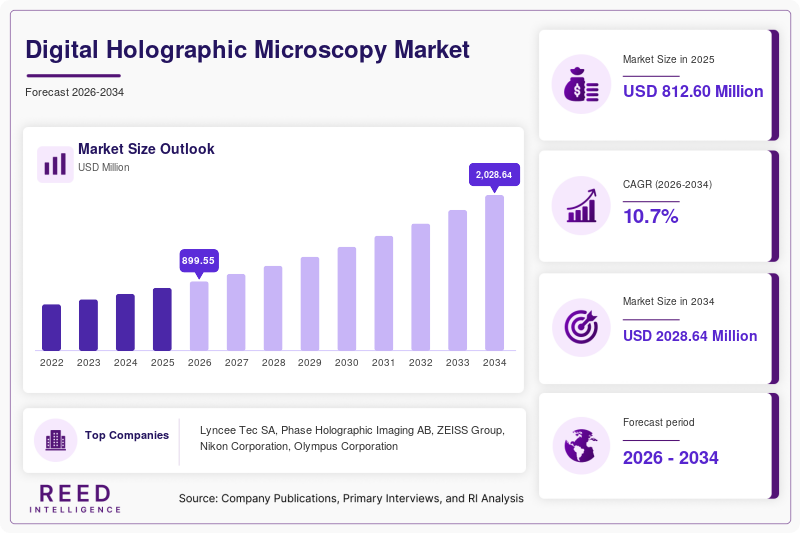
The Digital Holographic Microscopy Market size was valued at USD 812.6 million in 2025 and is projected to reach USD 2.03 billion by 2034, expanding at a CAGR of 10.7% during the forecast period 2025–2034. Digital holographic microscopy (DHM) is an advanced imaging technique that records and reconstructs holographic information digitally, enabling high-resolution three-dimensional imaging of microscopic samples. The technology is widely used in life sciences research, semiconductor inspection, material science, and biomedical diagnostics due to its ability to provide quantitative phase imaging without physical sample preparation.
A major global factor supporting the growth of the Digital Holographic Microscopy Marketis the increasing demand for non-invasive imaging technologies in biomedical research. Researchers require advanced imaging systems capable of analyzing living cells without staining or labeling. Digital holographic microscopy enables real-time observation of cell behavior, morphology, and growth patterns while maintaining sample integrity. This capability has made DHM a valuable tool for studying cellular processes, disease mechanisms, and drug interactions.
Key Highlights
- North America held the dominant share of 37.6% in 2025, while Asia Pacific is expected to grow at a CAGR of 12.1% during 2025–2034.
- Transmission Digital Holographic Microscopy Systems accounted for the largest share by type, while Reflection Systems are projected to grow at a CAGR of 11.4%.
- Cell Biology Applications represented the leading application segment, while Semiconductor Inspection is expected to grow at 11.6% CAGR.
- The United States remained the dominant country, with the market valued at USD 248 million in 2025 and USD 268 million in 2026.
Market Trends
Integration of Artificial Intelligence in Microscopy Analysis
Artificial intelligence technologies are increasingly being integrated into digital microscopy platforms to enhance imaging analysis. AI algorithms can process complex holographic data and identify cellular structures or material defects with high accuracy. Researchers are adopting AI-assisted imaging tools to accelerate data interpretation and reduce manual analysis time. These systems also allow automated tracking of cell behavior and morphological changes during long-term experiments. As laboratories adopt digital research workflows, the combination of artificial intelligence and holographic imaging is becoming an important trend in the Digital Holographic Microscopy Market.
Increasing Adoption of Label-Free Imaging Techniques
Label-free imaging methods are gaining importance in life sciences research. Conventional microscopy often requires fluorescent dyes or chemical labeling to visualize cellular components. Digital holographic microscopy allows scientists to observe biological samples without introducing external agents. This capability reduces sample preparation time and preserves natural cellular behavior. Researchers studying cell growth, migration, and disease progression are increasingly using label-free imaging systems. The growing preference for non-invasive observation methods continues to support the adoption of digital holographic microscopy technologies.
Market Drivers
Rising Demand for Advanced Imaging Technologies in Biomedical Research
Biomedical research laboratories require high-resolution imaging systems to analyze complex cellular structures. Digital holographic microscopy enables researchers to capture three-dimensional images of living cells and biological samples. The technology allows real-time monitoring of cellular dynamics, which is useful for studying biological processes such as cell division, apoptosis, and migration. As biomedical research expands across academic institutions and pharmaceutical laboratories, the demand for advanced microscopy technologies continues to increase.
Growing Applications in Semiconductor Inspection and Industrial Metrology
Digital holographic microscopy is also used in semiconductor manufacturing and industrial quality inspection. The technology enables precise measurement of micro-scale structures and surface defects on semiconductor wafers and microelectronic components. Manufacturers rely on these systems to detect manufacturing irregularities and ensure product quality. As semiconductor production expands globally, industrial laboratories are adopting advanced optical inspection tools. This trend contributes to the growth of the Digital Holographic Microscopy Market.
Market Restraint
High Cost of Advanced Microscopy Systems
One of the primary challenges facing the Digital Holographic Microscopy Marketis the high cost associated with advanced microscopy systems. DHM equipment includes specialized optical components, high-resolution detectors, and sophisticated computational software. These technologies increase the overall cost of system acquisition and maintenance.
Research laboratories with limited budgets may find it difficult to invest in advanced digital holographic microscopy systems. Smaller academic institutions and research facilities may prioritize conventional microscopy solutions that are more affordable and widely available. This cost barrier can limit the widespread adoption of DHM technology in certain research environments.
Another factor contributing to high costs is the complexity of the technology. Digital holographic microscopy systems require precise optical alignment and advanced software processing to reconstruct holographic images. Maintenance and calibration may require technical expertise, which can increase operational costs for laboratories.
Although technological advancements may gradually reduce equipment costs, the initial investment required for DHM systems remains a restraint for some potential users.
Market Opportunities
Expansion of Digital Imaging in Pharmaceutical Drug Discovery
Pharmaceutical companies increasingly rely on advanced imaging technologies during drug discovery and development processes. Digital holographic microscopy allows researchers to monitor cellular responses to experimental drug compounds in real time. This capability enables scientists to evaluate drug efficacy and toxicity by observing changes in cell morphology and behavior. As pharmaceutical research continues to adopt advanced analytical tools, digital holographic microscopy systems may find expanding applications in drug discovery laboratories.
Growing Adoption in Nanotechnology and Materials Science Research
Nanotechnology and materials science research require imaging tools capable of analyzing structures at micro- and nano-scale levels. Digital holographic microscopy provides precise measurements of surface structures and thin films without physical contact with the sample. Researchers studying nanomaterials, polymers, and advanced materials can use DHM systems to measure surface topography and structural changes. As research in nanotechnology expands globally, the demand for high-precision optical imaging systems is expected to create opportunities for the Digital Holographic Microscopy Market.
Segmental Analysis
By Type
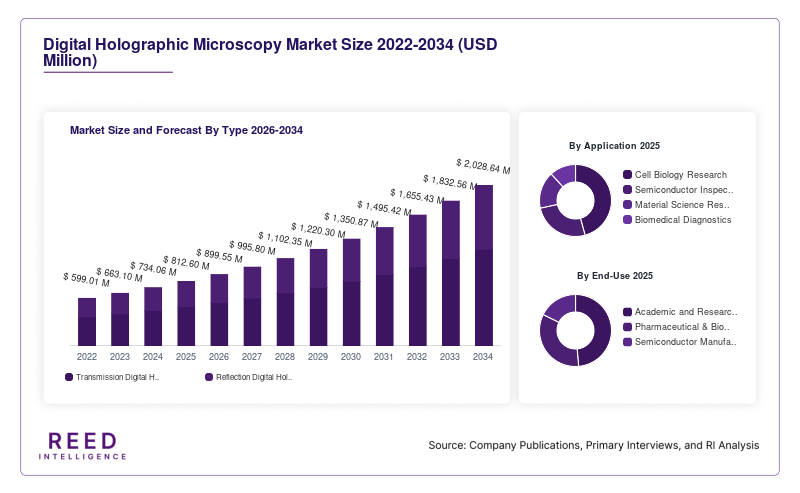
Transmission digital holographic microscopy systems accounted for 54.8% of the Digital Holographic Microscopy Market share in 2025. These systems are commonly used for biological sample analysis because they allow light to pass through transparent specimens. Researchers studying cell morphology and behavior frequently use transmission systems to obtain high-resolution images of living cells.
Reflection digital holographic microscopy systems are expected to grow at a CAGR of 11.4% during the forecast period. These systems are widely used in industrial applications such as semiconductor inspection and surface analysis. Reflection DHM enables precise measurement of surface structures without requiring transparent samples.
By Application
Cell biology applications accounted for 42.7% of the Digital Holographic Microscopy Market share in 2025. Researchers use DHM technology to study cellular growth, morphology, and behavior in real time. The technology allows scientists to observe living cells without labeling or staining.
Semiconductor inspection is expected to grow at a CAGR of 11.6% during the forecast period. Semiconductor manufacturers require precise imaging systems capable of identifying micro-scale defects in electronic components. Digital holographic microscopy provides accurate surface measurements and defect detection.
By End-Use
Academic and research institutes represented 45.2% of the Digital Holographic Microscopy Market share in 2025. Universities and scientific laboratories conduct extensive research in cell biology, nanotechnology, and materials science. These institutions rely on advanced microscopy tools for experimental analysis.
Pharmaceutical and biotechnology companies are expected to grow at a CAGR of 11.2% during the forecast period. These companies use advanced imaging technologies to study drug interactions with biological cells and tissues.
By Distribution Channel
Direct sales accounted for 56.1% of the Digital Holographic Microscopy Market share in 2025. Manufacturers typically sell high-value microscopy systems directly to research institutions and industrial laboratories.
Scientific equipment distributors are expected to grow at a CAGR of 10.8% during the forecast period. These distributors supply specialized laboratory equipment to smaller research facilities and academic institutions.
North America
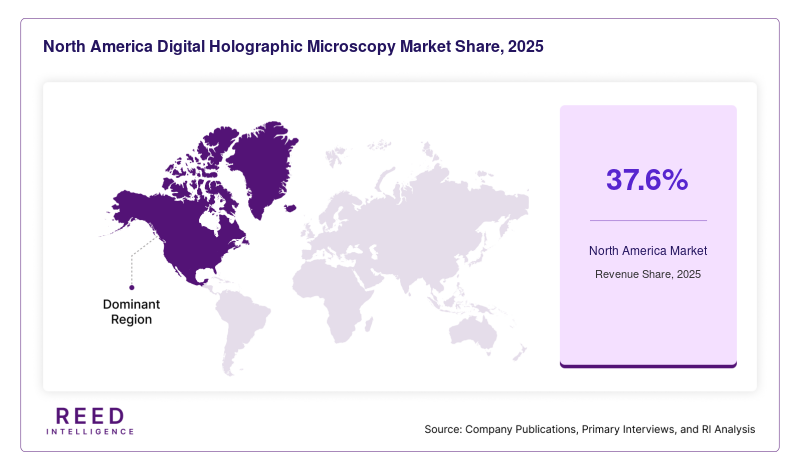
North America accounted for 37.6% of the Digital Holographic Microscopy Market share in 2025. The region’s market is expected to grow at a CAGR of 10.3% during 2025–2034. Growth has been supported by strong research infrastructure and significant investment in life sciences and biomedical technologies.
The United Statesremained the dominant country in the region. Numerous research institutions and biotechnology companies operate advanced imaging laboratories focused on cell biology and biomedical research. Universities and pharmaceutical companies invest heavily in high-resolution imaging systems to support scientific innovation.
Europe
Europe held 27.1% of the Digital Holographic Microscopy Market share in 2025and is projected to grow at a CAGR of 10.1% during the forecast period. The region has a well-established scientific research ecosystem that supports advanced microscopy technologies.
Germany represented the leading country in the regional market. The country hosts several research institutes specializing in optical imaging and materials science. These institutions use digital holographic microscopy systems for experimental studies involving microstructures and biological samples.
Asia Pacific
Asia Pacific represented 23.4% of the Digital Holographic Microscopy Market share in 2025and is expected to grow at the fastest CAGR of 12.1% during the forecast period. Expansion of scientific research infrastructure and increasing investment in biotechnology laboratories are supporting regional market growth.
Chinaremained the dominant country in the region. Government-supported research programs and academic institutions are investing in advanced microscopy equipment for biomedical and materials science research. These initiatives continue to drive adoption of digital holographic microscopy technologies.
Middle East & Africa
The Middle East & Africa accounted for 6.4% of the Digital Holographic Microscopy Market share in 2025and is projected to grow at a CAGR of 9.6% during the forecast period. Growth in the region is supported by expanding research infrastructure and increasing government funding for scientific innovation.
United Arab Emiratesremained the dominant country within the region. The country has invested in research centers focused on biotechnology and advanced imaging technologies, which supports the adoption of digital microscopy systems.
Latin America
Latin America accounted for 5.5% of the Digital Holographic Microscopy Market share in 2025and is projected to grow at a CAGR of 9.4% during the forecast period. The regional market is supported by expanding university research programs and biotechnology initiatives.
Brazilremained the leading country in the regional market. Academic institutions and research laboratories are adopting advanced imaging technologies for life sciences and materials science research.
Competitive Landscape
The Digital Holographic Microscopy Marketincludes optical technology companies, scientific instrument manufacturers, and specialized imaging system developers. Market participants focus on improving imaging resolution, integrating advanced software analytics, and expanding product portfolios.
Lyncee Tec SAis recognized as a leading participant in the market due to its focus on digital holographic microscopy systems designed for biological and industrial research applications. The company has introduced advanced DHM platforms capable of high-speed imaging and automated analysis.
Other companies active in the market include Phase Holographic Imaging AB, ZEISS Group, Nikon Corporation, and Olympus Corporation. These companies develop high-precision optical instruments used in scientific research and industrial inspection. Continuous technological innovation and investment in imaging software development remain key competitive strategies within the Digital Holographic Microscopy Market.
Key Players List
- Lyncee Tec SA
- Phase Holographic Imaging AB
- ZEISS Group
- Nikon Corporation
- Olympus Corporation
- Leica Microsystems
- Hitachi High-Tech Corporation
- Bruker Corporation
- HORIBA Ltd.
- Keyence Corporation
- Hamamatsu Photonics
- Oxford Instruments
- Nanolive SA
- Carl Zeiss Microscopy GmbH
- Andor Technology (Oxford Instruments)
Recent Developments
- 2024: Phase Holographic Imaging AB launched an upgraded digital holographic microscopy platform designed for live cell imaging.
- 2023: Lyncee Tec SA introduced high-speed holographic imaging software for automated cell analysis.
- 2024: ZEISS Group expanded its optical microscopy product portfolio for industrial inspection applications.
- 2023: Nikon Corporation introduced new digital imaging modules for advanced microscopy platforms.
- 2024: Olympus Corporation enhanced its research microscopy systems with advanced digital imaging capabilities.
Digital Holographic Microscopy Market Segments
By Type
- Transmission Digital Holographic Microscopy
- Reflection Digital Holographic Microscopy
By Application
- Cell Biology Research
- Semiconductor Inspection
- Material Science Research
- Biomedical Diagnostics
By End-Use
- Academic and Research Institutes
- Pharmaceutical & Biotechnology Companies
- Semiconductor Manufacturing Industry
By Distribution Channel
- Direct Sales
- Scientific Equipment Distributors
By Region
- North America
- Europe
- APAC
- Middle East and Africa
- LATAM