Digital Market Size, Share & Demand Report By Type (Digital Advertising, E-Commerce, Digital Content & Streaming, Digital Software & Services), By Application (Retail & E-Commerce, Media & Entertainment, BFSI, Healthcare) By Region & Segment Forecasts, 2026–2034
USD 3950
Digital Market Size
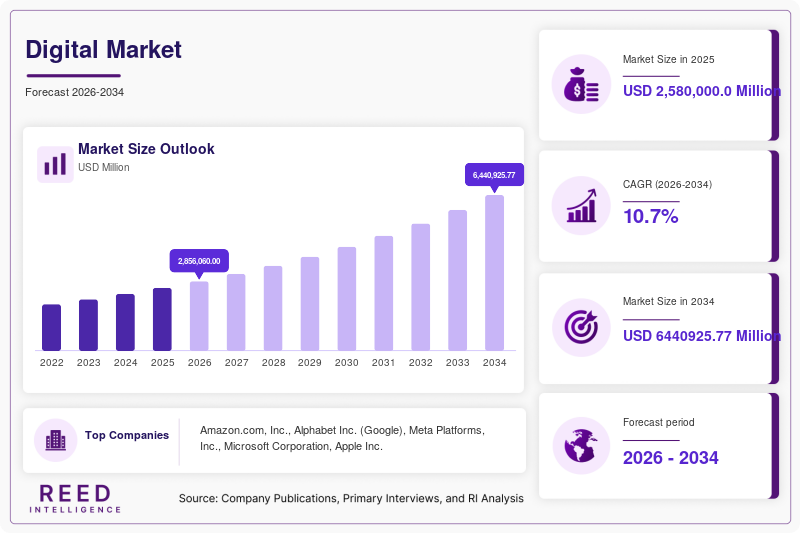
The digital market size is projected at USD 2,850,000.0 million in 2026 and is expected to hit USD 6,420,000.0 million by 2034 with a CAGR of 10.7% during the forecast period. The increasing internet penetration, the growing adoption of smartphones and connected devices, and the rising consumer preference for digital transactions and online content consumption underpin market expansion. This report delivers a comprehensive analysis of the digital market, including segmentation by type and application, competitive dynamics, and regional growth patterns, equipping stakeholders with critical intelligence to navigate this expansive and rapidly evolving digital economy landscape.
Digital Market Key Takeaways
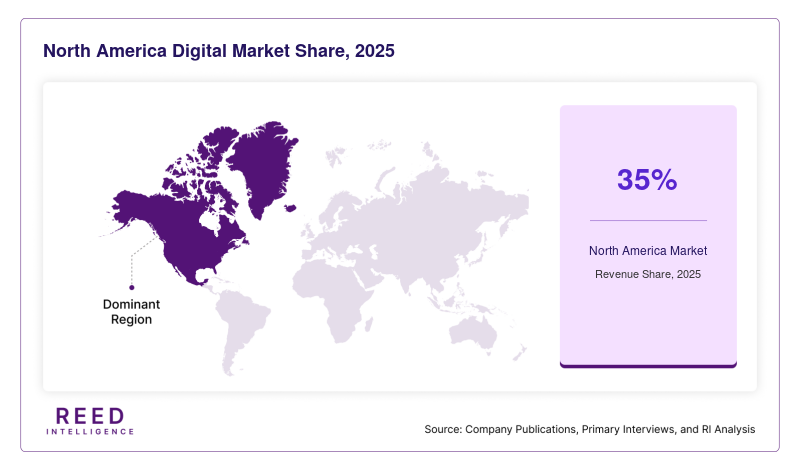
- Dominant Region: North America leads the digital market with a 35% share, while Asia-Pacific is the fastest-growing region with a projected CAGR of 13.5% through 2034.
- Dominant Segment: The E-Commerce type dominates the market with a 42% share, while the Retail & E-Commerce application is the leading segment with a 38% share.
- Emerging Country: India is projected to reach USD 285,000.0 million by 2034, expanding at a CAGR of 16.2%.
- Key Drivers: The increasing internet penetration, the growing smartphone adoption, and the rising consumer preference for digital convenience are driving market growth.
The digital market encompasses a broad spectrum of digital products, services, and platforms that facilitate online transactions, content consumption, communication, and business operations. This includes digital advertising, e-commerce, digital content and streaming, and digital software and services. Globally, the digital economy has grown exponentially, with an estimated 5.5 billion internet users and 4.8 billion smartphone users in 2025. In terms of revenue, E-Commerce accounted for roughly 42% of the total market share, driven by the increasing adoption of online shopping and digital payments, while Digital Advertising followed with 28% share, particularly driven by the shift of advertising budgets from traditional to digital channels. The market is further characterized by a penetration rate exceeding 85% in developed economies for internet access, whereas emerging markets represent a growing adoption frontier due to increasing smartphone penetration and improving digital infrastructure. The Digital Content & Streaming segment, representing 18% of the market, is driven by the growing demand for on-demand entertainment, and Digital Software & Services, representing 12% of the market, is fueled by the increasing adoption of cloud-based solutions and SaaS models.
Digital Market Trends
Integration of AI and Machine Learning Across Digital Platforms
The digital market is witnessing a significant trend toward the integration of Artificial Intelligence (AI) and Machine Learning (ML) across all digital platforms and services. This shift is driven by the need for personalization, automation, and enhanced user experiences. AI-powered recommendation engines, chatbots, and predictive analytics are becoming standard features in e-commerce, content streaming, and digital advertising. The adoption of AI in digital platforms has increased by 45% year-over-year, with over 65% of new digital product launches incorporating AI capabilities. This digital market trend is supported by the growing availability of data, advances in computing power, and the increasing comfort of consumers with AI-driven interactions. The integration of generative AI for content creation and customer service is also gaining momentum.
Growth of Mobile-First and Omnichannel Digital Experiences
The increasing focus on mobile-first and omnichannel digital experiences is a major trend shaping the digital market. The development of mobile-optimized websites, progressive web apps, and native mobile applications is gaining traction, driven by the dominance of smartphones as the primary device for internet access. The emergence of seamless omnichannel experiences that integrate online and offline touchpoints is particularly prominent in retail and BFSI. This digital market growth is supported by the growing consumer expectation for convenience and consistency across channels. The integration of digital wallets, buy-now-pay-later options, and contactless payments is enhancing the digital commerce experience. The use of social media platforms as shopping and entertainment channels is also expanding.
Digital Market Drivers
The digital market's expansion is primarily driven by the increasing global internet penetration, with over 5.5 billion users connected to the internet in 2025, representing approximately 68% of the world's population. The growing adoption of smartphones and connected devices has been a major driver, with over 4.8 billion smartphone users globally, enabling ubiquitous access to digital services. The rising consumer preference for digital convenience, including online shopping, streaming, and digital payments, has further fueled market demand. The increasing investment in digital infrastructure, including 5G networks and cloud computing, has expanded the capabilities and reach of digital services. Additionally, the growing adoption of digital technologies by businesses for operations, marketing, and customer engagement has supported market growth.
Digital Market Restraints
Despite favorable growth prospects, the digital market faces significant constraints, primarily related to the growing concerns about data privacy and security, which can undermine consumer trust and lead to regulatory scrutiny. The market's growth is further tempered by the digital divide, with significant portions of the population in developing regions lacking access to reliable internet and digital devices. Additionally, the increasing competition and saturation in some digital segments can lead to customer acquisition challenges and pricing pressure. The complexity of navigating varying regulatory frameworks across different jurisdictions can also create compliance burdens for digital businesses.
Digital Market Opportunities
The digital market presents significant opportunities in the rapidly expanding segment of emerging markets, where increasing smartphone penetration and improving digital infrastructure are creating new digital consumers. The development of innovative digital services in areas such as fintech, healthtech, and edtech represents another promising avenue. Emerging opportunities also exist in the application of AI and data analytics for personalized digital experiences and operational efficiency. Furthermore, the growing adoption of digital technologies by small and medium-sized enterprises offers a fertile ground for market expansion.
Challenges in Digital Market
The digital market grapples with persistent challenges related to the need for continuous innovation to keep pace with rapidly evolving consumer expectations and technological advancements. The complexity of managing cybersecurity risks and protecting user data presents ongoing operational challenges. The market is also contending with the challenge of addressing the digital divide and ensuring inclusive access to digital services. Moreover, the need for effective talent acquisition and retention in a competitive digital skills market poses challenges for digital businesses.
Digital Market Segmentation Analysis
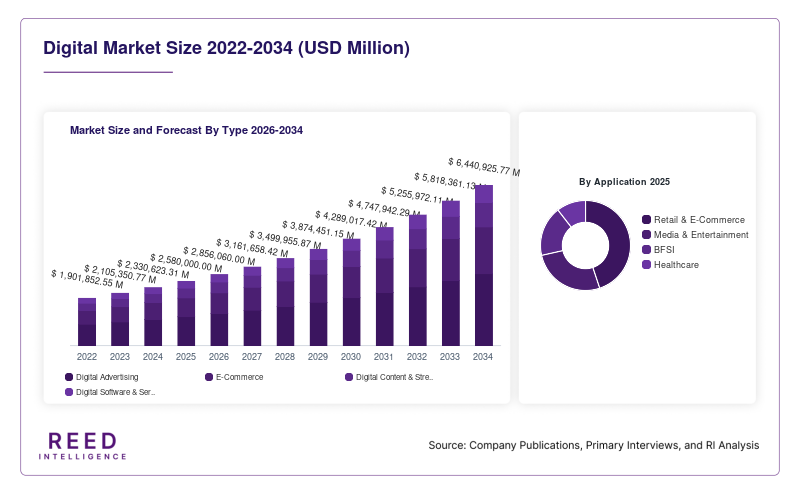
The digital market is segmented by Type and Application to provide a comprehensive market perspective. By Type, E-Commerce dominates with a 42% market share, driven by the increasing adoption of online shopping. The Application segment is led by Retail & E-Commerce, which accounts for 38% of the market, followed by Media & Entertainment at 25%, BFSI at 22%, and Healthcare at 15%.
By Type
E-Commerce represents the largest segment in the digital market, commanding a 42% share, with revenue exceeding USD 1,197,000 million in 2025. This includes online retail, digital marketplaces, and direct-to-consumer platforms. Technical specifications include platform scalability, payment integration, and logistics capabilities. The market's E-Commerce segment is driven by the increasing consumer preference for online shopping and the growing availability of digital payment options.
Digital Advertising captures a 28% share of the digital market, with revenue of USD 798,000 million in 2025. This includes search advertising, display advertising, social media advertising, and programmatic advertising. Technical specifications include targeting capabilities, analytics, and real-time bidding. The market's Digital Advertising segment is driven by the shift of advertising budgets from traditional to digital channels and the growing effectiveness of targeted digital campaigns.
Digital Content & Streaming represents 18% of the market, with revenue of USD 513,000 million in 2025, characterized by video streaming, music streaming, gaming, and digital publishing. Technical specifications include content delivery networks, streaming quality, and subscription management. The market's Digital Content & Streaming segment is driven by the growing demand for on-demand entertainment and the increasing adoption of subscription-based models.
Digital Software & Services account for 12% of the market, with revenue of USD 342,000 million in 2025, involving cloud-based software, SaaS, and digital services. Technical specifications include cloud infrastructure, API integration, and security features. The market's Digital Software & Services segment is driven by the increasing adoption of cloud-based solutions and the growing demand for digital transformation services.
By Application
Retail & E-Commerce dominates the digital market, accounting for 38% of sales, representing USD 1,083,000 million in 2025. This segment includes digital solutions for retail operations, online marketplaces, and e-commerce platforms. Usage penetration exceeds 75% in developed markets for online shopping. The market's Retail & E-Commerce segment is characterized by its focus on convenience, personalization, and seamless customer experiences.
Media & Entertainment accounts for 25% of the digital market, with revenue of USD 712,500 million in 2025. This segment encompasses digital content creation, streaming services, gaming, and digital publishing. The segment is growing at a significant rate, driven by the increasing demand for on-demand content. The market's Media & Entertainment segment is characterized by its focus on content quality, user engagement, and subscription models.
BFSI represents 22% of the market, with revenue of USD 627,000 million in 2025, involving digital banking, online payments, insurtech, and digital financial services. The segment's growth is fueled by the increasing adoption of digital financial services and the growing demand for convenience. The market's BFSI segment is characterized by its focus on security, compliance, and user trust.
Healthcare accounts for 15% of the market, with revenue of USD 427,500 million in 2025, encompassing telemedicine, digital health records, healthtech apps, and online pharmacy services. The market's Healthcare segment is driven by the increasing adoption of digital health solutions and the growing demand for accessible healthcare services.
Digital Market Regional Analysis
North America Digital Market
Leads the digital market, commanding a 35% share, with revenue of USD 997,500 million in 2025. The United States is the primary driver, accounting for 88% of regional demand, driven by high internet penetration, advanced digital infrastructure, and the presence of leading digital companies. The North American market is characterized by its focus on innovation, digital transformation, and consumer adoption.
Asia-Pacific Digital Market
Represents the second-largest and fastest-growing market, capturing a 32% share with revenue of USD 912,000 million in 2025. China, India, and Japan are the primary drivers, accounting for 70% of regional demand, fueled by massive internet user bases, increasing smartphone penetration, and rapid digital transformation. The Asia-Pacific market is projected to grow at the fastest CAGR of 13.5% through 2034, driven by digital inclusion and economic growth.
Europe Digital Market
Accounts for 25% of the global digital market, with revenue of USD 712,500 million in 2025. Germany, the United Kingdom, and France are the primary drivers, accounting for 58% of regional demand, driven by advanced digital infrastructure, high consumer adoption, and supportive regulatory frameworks. The European market is projected to grow at a steady CAGR, supported by continuous innovation and digital initiatives.
Latin America and Middle East & Africa Digital Market
Together account for the remaining 8% of the digital market, with Brazil and the UAE leading their respective regions. Both regions are projected to grow at CAGRs exceeding 12%, driven by improving internet penetration, increasing smartphone adoption, and growing digital transformation initiatives.
Top players in Digital Market
- Amazon.com, Inc.
- Alphabet Inc. (Google)
- Meta Platforms, Inc.
- Microsoft Corporation
- Apple Inc.
- Alibaba Group Holding Limited
- Tencent Holdings Limited
- Netflix, Inc.
- Salesforce.com, Inc.
- Adobe Inc.
- PayPal Holdings, Inc.
- Shopify Inc.
- Booking Holdings Inc.
- Uber Technologies, Inc.
- ByteDance Ltd.
Recent Developments in Digital Market
- April 2026 – Amazon.com, Inc. launched a new AI-powered shopping assistant across its e-commerce platforms, enhancing personalization and customer experience.
- June 2025 – Alphabet Inc. (Google) introduced a new generative AI tool for digital advertising, enabling automated creative generation and optimization.
- August 2025 – Meta Platforms, Inc. announced a new suite of AI-powered tools for businesses on its platforms, enhancing customer engagement and commerce.
- February 2026 – Microsoft Corporation launched a new cloud-based digital transformation platform for SMEs, offering integrated software and services.
- October 2025 – Netflix, Inc. introduced a new ad-supported subscription tier in multiple markets, expanding its digital content offerings.
Digital Market Segments
By Type
- Digital Advertising
- E-Commerce
- Digital Content & Streaming
- Digital Software & Services
By Application
- Retail & E-Commerce
- Media & Entertainment
- BFSI
- Healthcare
By Region
- North America
- Europe
- APAC
- Middle East and Africa
- LATAM