Digital Marketing Agency Market Size, Share & Trends Analysis Report By Service Type (Search Engine Optimization, Paid Advertising & PPC, Social Media Marketing, Content Marketing, Email & CRM Marketing), By Client Size (Large Enterprises, Small & Medium Enterprises), By Industry Vertical (Retail & E-commerce, BFSI, Healthcare, IT & Telecommunications, Travel & Hospitality) Forecasts, 2026–2034
USD 3950
Digital Marketing Agency Market Size
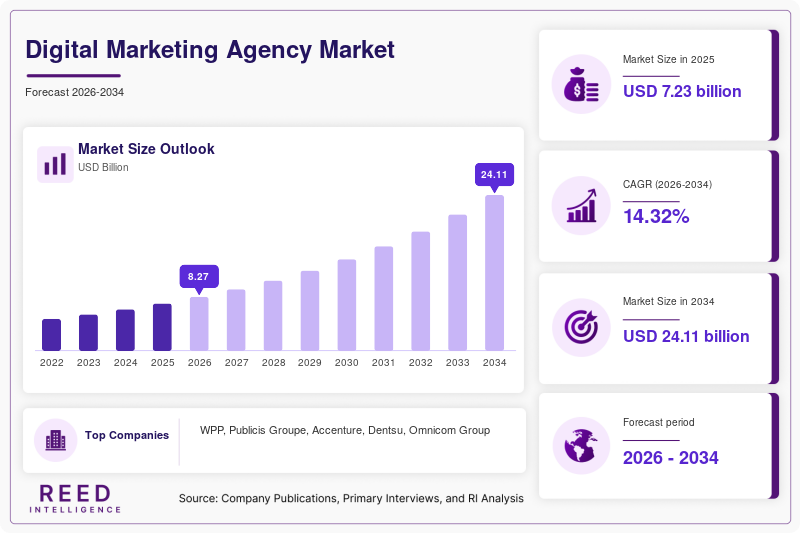
The global digital marketing agency market size was valued at USD 7.23 billion in 2025 and is projected to grow from USD 8.27 billion in 2026 to USD 24.11 billion by 2034, registering a CAGR of 14.32% during the forecast period from 2026 to 2034.
The market trajectory is supported by the expansion of measurable digital advertising, increasing use of AI in campaign execution, growth of social and creator-led advertising, retail media, and rising demand for agencies that can connect media spending with sales, customer acquisition, and first-party data. U.S. internet advertising revenue reached USD 294.6 billion in 2025, up 13.9% year over year, while IAB's September 2026 outlook raised its 2026 U.S. advertising-growth forecast to 12.3%.
Digital marketing agencies are shifting from campaign execution providers toward integrated partners covering media buying, search, social platforms, content, customer relationship management, analytics, commerce, and marketing technology. This change is visible in the agency strategies of major groups. WPP, for example, has reorganized around WPP Media, WPP Creative, WPP Production, and WPP Enterprise Solutions, with the latter combining commerce, CRM, loyalty, first-party data, customer experience, engineering, and platforms.
The demand environment is also becoming more performance-oriented. IAB reported that 2025 U.S. digital advertising growth was supported by video, social and commerce media, while rising expectations for measurable business outcomes are concentrating spending in channels that can connect investment with results. Creator advertising reached USD 37 billion in the U.S. in 2025 and is projected by IAB to reach USD 44 billion in 2026.
AI is changing the agency delivery model at the same time. Google has expanded AI Max for Search and Performance Max, automating elements of targeting, bidding, creative development and optimization, while Dentsu and Publicis are building proprietary AI and agentic marketing systems.
Digital Marketing Agency Market Drivers
Expansion of measurable digital advertising
The core demand signal is continued movement of advertising budgets toward channels where advertisers can measure impressions, clicks, conversions, customer acquisition and sales. U.S. internet advertising revenue reached USD 294.6 billion in 2025, representing 13.9% year-over-year growth. IAB also reported that search, social, video and commerce media remained major components of the digital advertising ecosystem.
For agencies, this changes the purchasing requirement. Clients increasingly need specialists to manage multiple advertising platforms, attribution, creative testing, audience targeting and performance reporting rather than simply buying media. Google Performance Max, for example, now uses AI across bidding, budget optimization, audience selection, creatives and attribution. This creates recurring agency work around campaign architecture, data quality, conversion tracking and optimization. The counterbalance is that platform automation reduces some routine media-buying tasks, forcing agencies to justify fees through higher-value strategy, analytics and creative capabilities.
AI is increasing demand for integrated marketing capabilities
AI is moving from an experimental tool to infrastructure within marketing operations. Google's 2026 advertising products include AI Max for Search, generative creative tools and Ads in AI Mode, while Dentsu's April 2026 evolution of dentsu.Connect brings agentic AI into creative, production, media and experience workflows.
For agencies, the mechanism is broader than content generation. AI requires clean customer data, connected technology stacks, brand controls, workflow integration and measurement. Publicis' 2026 partnership with Microsoft combines Publicis Sapient's transformation capabilities with Epsilon identity data and AI agents, while WPP Enterprise Solutions combines CRM, commerce, first-party data and engineering capabilities. The commercial implication is a shift toward higher-value consulting, data, technology and marketing-operations engagements alongside traditional campaign services.
Social, creator and commerce media are widening agency workloads
Digital marketing is expanding beyond conventional search and display advertising. IAB reported that U.S. creator advertising reached USD 37 billion in 2025 and identified creators as an increasingly established media channel. In Europe, digital advertising grew 10.5% in 2025 to EUR 131 billion, with video, social advertising and retail media among the strongest growth areas.
These channels require new operating capabilities: creator selection, content production, influencer compliance, retail-media planning, audience measurement and commerce optimization. Agencies therefore have more opportunities to combine creative and media services into recurring programs. The constraint is fragmentation. IAB identifies creator selection, measurement and operational standards as major challenges, increasing the cost of managing these channels at scale.
Digital Marketing Agency Market Restraints
Platform automation is reducing some traditional agency tasks
Advertising platforms increasingly automate campaign setup, targeting, bidding and creative production. Google's AI Max, for example, expands search-term matching and creative optimization, while Performance Max automates bidding and inventory allocation across multiple Google properties.
This creates a direct margin and pricing challenge for agencies whose revenue depends heavily on manual campaign management. Smaller agencies can also face technology-investment pressure because clients increasingly expect sophisticated dashboards, AI tools, attribution systems and first-party data activation. The market therefore rewards agencies that combine automation with proprietary expertise, strategic planning, creative development and measurable business outcomes.
Privacy, advertising and platform-compliance requirements raise delivery complexity
Digital agencies increasingly operate within privacy, advertising-disclosure and platform-governance requirements. The FTC states that advertising claims must be truthful, non-deceptive and evidence-based, while its endorsement guidance applies to influencer and social-media marketing.
European regulation adds further complexity around the use of personal data for advertising. The European Commission's 2026 Digital Markets Act reporting also highlighted regulatory scrutiny of personalized-advertising models. Agencies therefore need compliance processes covering consent, data use, influencer disclosures, advertising claims and platform policies. These requirements increase operating costs and can limit targeting capabilities where customers do not consent to data use.
Digital Marketing Agency Market Opportunities
AI-enabled marketing operations
The strongest service opportunity is moving beyond AI-generated content toward AI-enabled marketing operations. Dentsu's agentic platform is designed to connect creative, media, production and experience workflows, while Publicis is combining AI agents, identity data and enterprise transformation capabilities.
This creates opportunities for agencies to sell AI implementation, workflow redesign, marketing automation, data integration, AI governance and continuous optimization. Instead of charging only for campaign hours, agencies can increasingly package technology-enabled marketing systems with recurring management and optimization services.
Creator, retail media and commerce services
Creator advertising and retail media are becoming more established budget categories. IAB projects U.S. creator advertising to reach USD 44 billion in 2026, while IAB Europe reported that European retail media reached EUR 13.3 billion in 2025 after growing 16.7%.
Agencies can capture this demand through creator management, social commerce, retail-media planning, content production, measurement and commerce optimization. The commercial advantage is that these services connect brand visibility with customer acquisition and transactions, supporting recurring client relationships.
Segmental Analysis
By Service Type
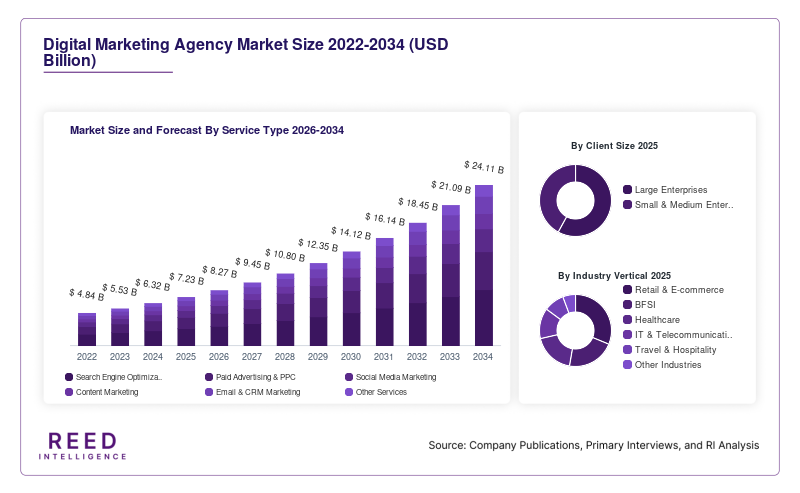
SEO represents approximately 24% of the global market in 2025, supported by continuing demand for organic visibility, technical optimization, content strategy and search-intent analysis. However, the function is changing as AI search and AI-assisted advertising alter how users discover information. Google's 2026 AI Max developments show that search marketing increasingly combines automated query matching, creative generation and landing-page relevance.
Paid advertising accounts for approximately 22% of the market, supported by measurable acquisition objectives and spending across search, social, video and commerce platforms. Its recurring nature makes campaign management, creative testing, audience segmentation and conversion measurement important agency services.
Social Media Marketing: Social media marketing represents approximately 20% and is the fastest-growing service segment at approximately 16.1% CAGR. IAB Europe reported 19.2% growth in European social advertising during 2025, while creator advertising has become a distinct channel in U.S. media planning.
Content marketing represents approximately 16%, supported by demand for websites, video, social content, thought leadership, product content and personalized communications. Generative AI is reducing production time for some content formats while increasing the importance of editorial control, brand governance and differentiation.
Email and CRM marketing represents approximately 10%. Demand is linked to first-party data strategies, customer retention and lifecycle marketing, particularly as advertisers seek alternatives to increasingly constrained third-party targeting.
Other services represent approximately 8%, including conversion-rate optimization, influencer management, analytics, marketing automation and specialized digital consulting.
By Client Size
Large enterprises account for approximately 56% of market demand because they operate across multiple markets, brands, channels and customer databases. Their agency requirements increasingly include integrated media, creative, CRM, data and technology. WPP and Publicis are both expanding enterprise-level marketing transformation capabilities rather than limiting their propositions to campaign execution.
SMEs represent approximately 44% and are the fastest-growing client-size segment at approximately 15.9% CAGR. Digital channels allow smaller businesses to access search, social, content and performance marketing without building large internal teams. The main constraint is budget sensitivity, which increases demand for packaged services and measurable acquisition outcomes.
By Industry Vertical
Retail and e-commerce represents approximately 26%, making it the largest industry vertical. The segment benefits from the direct relationship between digital campaigns, product discovery, online conversion and retail media. European retail media exceeded EUR 13 billion in 2025, demonstrating how advertising is increasingly integrated with commerce infrastructure.
BFSI represents approximately 15%, with agencies supporting customer acquisition, digital product launches, financial education, CRM and personalization. Compliance requirements make brand governance, disclosure and data management important parts of delivery.
IT and telecommunications represents approximately 14%, supported by complex B2B acquisition funnels, product launches, content marketing and account-based digital programs.
Healthcare represents approximately 13% and is the fastest-growing industry vertical at approximately 16.4% CAGR. Providers, health platforms and healthcare brands increasingly use digital channels for patient acquisition, education, engagement and service discovery, although privacy and advertising restrictions increase campaign complexity.
Travel and hospitality represents approximately 10%, supported by search, social, performance advertising, destination content and direct-booking strategies.
Other industries account for approximately 22%, spanning professional services, education, manufacturing, automotive, consumer goods and public-facing organizations.
Regional Analysis
North America Digital Marketing Agency Market
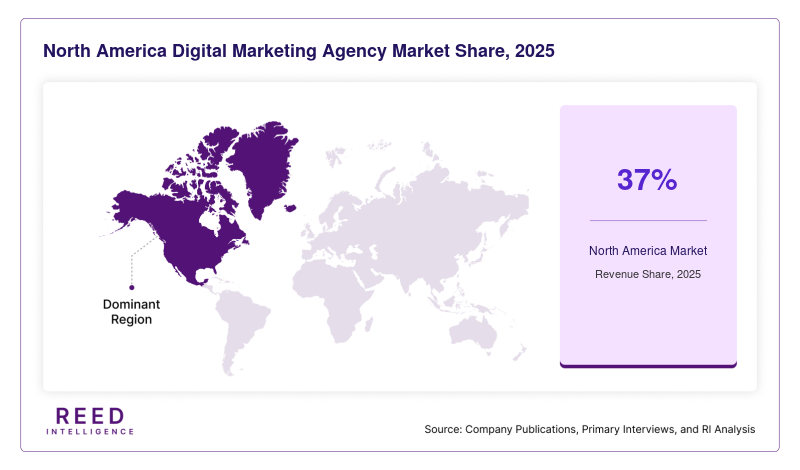
North America represents approximately 37% of the global digital marketing agency market in 2025, making it the largest regional market, with growth of approximately 12.9% CAGR. The region benefits from a mature advertising ecosystem, large technology platforms, high agency penetration and extensive use of performance marketing. U.S. internet advertising revenue reached USD 294.6 billion in 2025, up 13.9%, providing a large addressable spending base for agencies.
The U.S. market is also becoming more performance-oriented. IAB's September 2026 outlook raised its 2026 U.S. advertising-growth forecast to 12.3%, while identifying customer acquisition, brand equity and AI-driven discovery as important priorities for advertisers.
Agency competition is increasingly based on technology and data capabilities. Publicis is combining Epsilon identity data with Publicis Sapient transformation capabilities and AI agents, while WPP is integrating media, creative, production and enterprise solutions.
The region's main constraint is market maturity. Clients have more internal marketing teams, sophisticated procurement and established technology stacks, making it harder for agencies to compete on basic campaign execution. Demand is consequently shifting toward specialized strategy, data, AI implementation, creative systems and measurable growth services.
Europe Digital Marketing Agency Market
Europe accounts for approximately 27% of the global market in 2025, with an estimated 12.2% CAGR. The region has a large and increasingly sophisticated digital advertising ecosystem. IAB Europe reported that digital advertising investment across 30 national markets reached EUR 131 billion in 2025, representing 10.5% growth. Video, social advertising and retail media were major contributors.
The structure of European advertising is important for agencies because growth is occurring across several specialized channels. Video advertising grew 19.6%, social advertising 19.2%, and retail media 16.7% in 2025. Agencies can therefore expand from conventional media management into social video, creator campaigns, commerce media and performance measurement.
Privacy and consumer-protection rules create a more complex operating environment than in less regulated markets. Agencies must account for consent, data governance, advertising disclosures and platform restrictions. This increases compliance costs but also creates demand for privacy-safe first-party data, measurement and governance services.
Western European markets remain important revenue centers, while some Nordic, Baltic and other markets show different maturity levels. This variation creates room for localized agency models rather than a single standardized European service proposition.
APAC Digital Marketing Agency Market
APAC represents approximately 23% of the global market in 2025 and is the fastest-growing region, registering approximately 17.2% CAGR. The region combines large populations of digitally connected consumers with rapidly expanding mobile usage, social commerce, e-commerce and digital advertising ecosystems.
India is an important growth market. Dentsu's 2026 digital advertising research highlights the convergence of commerce, content and culture and identifies AI-powered creativity and digital public infrastructure as important forces shaping the country's marketing ecosystem.
The broader connectivity base also supports long-term demand. ITU estimates that about 6 billion people were online globally in 2025, while mobile broadband coverage has become nearly universal. APAC's large consumer markets provide agencies with expanding audiences across search, video, social platforms and mobile commerce.
The agency model in APAC is becoming more technology-oriented. Dentsu operates across approximately 120 countries and regions and in April 2026 introduced an agentic AI-powered version of dentsu.Connect covering creative, media, production and experience workflows.
Market fragmentation remains a constraint because languages, platforms, regulations, purchasing behavior and digital maturity vary substantially across countries. Agencies with localized creative and data capabilities can therefore address a broader portion of regional demand.
Middle East and Africa Digital Marketing Agency Market
Middle East and Africa accounts for approximately 6% of the global market in 2025, with approximately 15.0% CAGR. The region's agency market is supported by increasing internet penetration, mobile-first consumer behavior, e-commerce development and investment in digital customer experiences.
The underlying connectivity opportunity remains substantial. ITU reports that although nearly three-quarters of the global population is online, 2.2 billion people remained offline in 2025, with most of the offline population located in low- and middle-income countries. This creates a differentiated regional market: advanced urban centers have sophisticated performance marketing demand, while other markets remain focused on digital adoption and customer acquisition.
Agency demand is particularly relevant for tourism, hospitality, financial services, telecommunications, retail and government-linked digital initiatives. These industries require localized content, multilingual communication, social campaigns and mobile-focused customer journeys.
The principal constraints include differences in infrastructure, purchasing power, data regulation and digital maturity across countries. As a result, agencies need local partnerships and market-specific delivery models rather than relying entirely on standardized global campaigns.
LATAM Digital Marketing Agency Market
LATAM represents approximately 7% of the global market in 2025, with an estimated 14.3% CAGR. Digital marketing demand is supported by growing online populations, social-media engagement, e-commerce adoption and the increasing importance of mobile-first customer acquisition.
The region provides agencies with opportunities in performance advertising, social commerce, creator marketing, content localization and customer relationship management. The commercial mechanism is especially relevant for brands that need localized campaigns across several Spanish- and Portuguese-speaking markets.
LATAM also provides an attractive operating environment for agencies that can combine centralized technology with local creative and cultural knowledge. WPP's June 2026 decision to unify Natura and Avon communications in Latin America under a dedicated operation illustrates the continuing importance of regional specialization within global agency structures.
The principal limitations are macroeconomic volatility, currency movements, uneven digital maturity and differences in advertising markets between countries. These conditions can make client budgets more variable than in mature North American and Western European markets.
Competitive Landscape
The digital marketing agency market is highly fragmented beneath a relatively small group of multinational agency networks and technology-enabled marketing companies. Competition increasingly centers on the ability to integrate media, creative, data, commerce, customer experience and technology rather than simply offering SEO or paid advertising as separate services.
Large agency groups are investing heavily in proprietary AI platforms. WPP has built WPP Open and reorganized around integrated media, creative, production and enterprise solutions. Publicis combines Publicis Sapient, Epsilon and its Marcel AI platform, while its 2026 agreement to acquire LiveRamp expands its data-collaboration capabilities.
Dentsu is pursuing a similar technology-led model through dentsu.Connect, which integrates agentic AI into the marketing lifecycle. These investments change competitive positioning because agencies can offer clients connected workflows and proprietary data capabilities that are harder for smaller firms to reproduce.
Key Market Players
- WPP
- Publicis Groupe
- Accenture
- Dentsu
- Omnicom Group
- Havas
- Monks
- DEPT®
- Jellyfish
- NP Digital
Recent Market Developments
September 2026 – Google expands AI Max for Search
Google's AI Max technology moved beyond beta during 2026, with broader targeting and creative capabilities. Google stated that its full AI Max feature set generated an average 7% increase in conversions or conversion value at a similar CPA/ROAS in its internal global data for non-retail advertisers. Agencies must increasingly sell strategic direction, measurement and AI governance rather than relying only on manual search-campaign management.
August 2026 – WPP reports continued agency transformation
WPP's 2026 interim-results cycle followed its restructuring around WPP Media, WPP Creative, WPP Production and WPP Enterprise Solutions. The restructuring demonstrates how major agency groups are consolidating media, creative, production, data and technology capabilities to compete for larger integrated client mandates.
Digital Marketing Agency Market Segments
By Service Type
- Search Engine Optimization
- Paid Advertising & PPC
- Social Media Marketing
- Content Marketing
- Email & CRM Marketing
- Other Services
By Client Size
- Large Enterprises
- Small & Medium Enterprises
By Industry Vertical
- Retail & E-commerce
- BFSI
- Healthcare
- IT & Telecommunications
- Travel & Hospitality
- Other Industries
By Region
- North America
- Europe
- APAC
- Middle East and Africa
- LATAM